

AI for mortgage brokers automates the paperwork and policy research that slow deal flow, freeing brokers to spend more time advising clients and closing loans. Instead of manually reading pay stubs, T4s, and bank statements, brokers now feed documents into systems that extract the data, check it against lender rules, and flag what's missing.
- Document intake and extraction: OCR and NLP pull income, asset, and identity data from PDFs and scans in minutes, not hours.
- Lender criteria matching: specialist engines search guideline databases and return citation-backed answers instead of a manual policy hunt, a shift the Canadian Mortgage Trends guide to AI describes as splitting tool use between general chat assistants and dedicated criteria engines.
- Pipeline automation: cases move through stages automatically, with reminders replacing manual follow-up.
- Client engagement: chat tools handle routine lead questions and queue follow-ups for broker review.
Industry reporting already links AI adoption to faster mortgage approvals and less manual paperwork, largely through predictive risk models and document automation.
Key Takeaways
AI for mortgage brokers works best when document intake, extraction, and compliance packaging are automated while underwriting judgment and client advice stay human.
| Point | Details |
|---|---|
| Automate intake first | Document classification and data extraction deliver the fastest, lowest-risk time savings. |
| Keep humans on judgment calls | Underwriting decisions and client advice should stay reviewed by a person, not fully automated. |
| Verify data residency and audit logs | Confirm Canadian data residency and full audit trails before signing with any AI vendor. |
| Pilot narrow, measure weekly | Test one document type or workflow stage for four to six weeks and track hours saved. |
| Autowrite implements this pipeline | Autowrite automates classification, extraction, auto-fill, and e-sign packaging with Canadian data residency. |
Table of Contents
- What Does AI Actually Do for Mortgage Brokers Day to Day?
- How Does AI Fit Into the Mortgage Broker Workflow?
- What Are the Benefits and Risks of AI for Brokers?
- How Do You Start Adopting AI in Your Brokerage?
- How Does Autowrite Put This Pipeline Into Practice?
- How Do You Manage Data Quality and Governance With AI Tools?
- What Ethical Questions Go Beyond Compliance?
- Where Is AI in Mortgage Brokering Headed Next?
- What Changed for Me After Adopting AI Tools
- Ready to Cut the Paperwork Out of Your Pipeline?
- Frequently Asked Questions
- Sources
What Does AI Actually Do for Mortgage Brokers Day to Day?
The daily value of AI shows up in the boring parts of a broker's job: reading, sorting, checking, and chasing. Here's where it earns its place in a typical file.
- Document intake and OCR: scanned pay stubs and bank statements get digitized and sorted by document type automatically, cutting the manual filing that used to eat up the first hour of every new file.
- Automated data extraction: income figures, employer names, and account balances get pulled into structured fields, which means fewer missing-document callbacks to clients.
- Lender criteria matching: instead of flipping through lender guideline PDFs, a broker can query a rules engine and get a scenario check across multiple programs in seconds.
- Underwriting support and risk scoring: the system flags debt service ratios or credit issues before submission, catching problems that used to surface only after a lender declined the deal.
- Pipeline automation: files auto-advance through stages like conditions, approval, and funding, with status updates going out without a broker typing them.
- Client chat and lead follow-up: routine questions get answered instantly, and drip follow-ups keep cold leads warm without manual effort.
- Protection and ancillary product prompts: the system suggests mortgage protection insurance or related products at the right point in the file, rather than relying on a broker to remember.
Vendor case summaries suggest document intake and automated chase workflows alone can return multiple hours per broker per week in reclaimed time.
Pro Tip: Automate the intake and matching steps first. Keep underwriting judgment and client advice fully human. That split builds trust with lenders and clients while you learn what the tools can actually handle.
How Does AI Fit Into the Mortgage Broker Workflow?
The pipeline behind most broker-focused AI tools follows a consistent sequence, and understanding it helps you ask sharper vendor questions.
- Intake: documents arrive via upload, email, or portal and get sorted by type.
- OCR: optical character recognition converts scanned images and PDFs into machine-readable text.
- NLP entity extraction: natural language processing pulls names, dates, income figures, and account numbers into structured fields.
- Validation: extracted data gets checked against lender rules and internal checklists, flagging gaps or inconsistencies.
- Auto-fill: validated data populates underwriting forms and lender submission packages.
- Audit trail: every step gets logged, creating a record for compliance review and dispute resolution.
Picture that as a straight line from a scanned pay stub to a filled-out lender form, with a checkpoint at validation where a human reviews anything the system flags as uncertain.
The best results come from clean source documents and a defined checklist upfront. Blurry scans or inconsistent naming conventions degrade extraction accuracy no matter how good the underlying model is. Integration with your CRM, loan origination system (LOS), and lender portals determines whether this pipeline saves time or just creates another disconnected tool.
Pro Tip: Ask any vendor to show you their confidence threshold: the point where the system stops auto-filling and routes a field to a human for review. If they can't answer that clearly, keep looking.
What Are the Benefits and Risks of AI for Brokers?
The benefits are real, but so are the risks, and a broker who ignores either side is setting up a bad pilot.
Benefits worth pursuing:
- Time savings on document handling and lender research, which vendors report can free up multiple hours weekly per broker.
- More consistent file packs, since automated validation catches missing documents before submission rather than after a lender kicks the file back.
- Faster enquiry-to-application conversion when chat tools respond to leads instantly instead of overnight.
Risks that deserve equal attention:
- Bias and explainability: risk-scoring models can encode patterns that disadvantage certain applicants, and if you can't explain why a model flagged a file, you have a compliance problem.
- Data residency: client financial data needs to stay within the jurisdiction your regulator expects, which for Canadian brokers generally means Canadian servers.
- Model errors and vendor risk: an OSFI–FCAC joint risk report on AI adoption in financial institutions names model risk, explainability, data governance, and third-party oversight as the top concerns regulators watch.
Compliance checklist: confirm audit trails exist for every automated decision, verify data residency claims in writing, and review the AIDA companion document for expectations around transparency and governance before signing with any vendor.
Pro Tip: Keep a human in the loop on any outbound client communication the AI drafts. Queue it for review rather than letting it send automatically.
How Do You Start Adopting AI in Your Brokerage?
Running a pilot properly beats rolling out a tool brokerage-wide and hoping for the best.
- Scope a narrow pilot: pick one document type or one stage of the pipeline, such as income verification, and limit it to five to ten files.
- Set KPIs before you start: hours saved per file, enquiry-to-application rate, and error rate on flagged fields.
- Choose a timeline: four to six weeks is usually enough to see whether the tool holds up under real file volume.
- Name stakeholders: someone on your team owns quality checks, and someone owns the vendor relationship.
Quick wins to target first:
- Lead capture automation for after-hours inquiries.
- Document triage so new files get sorted the moment they arrive.
- Template drafting for routine client follow-ups.
Vendor evaluation checklist: confirm CRM and LOS integration points, Canadian data residency, audit logging depth, service-level agreements, onboarding time, and whether pricing is per-seat or per-transaction.
Pro Tip: Track hours saved weekly during the pilot, not just at the end. A tool that saves time in week one but creates rework by week four isn't actually saving anything.
How Does Autowrite Put This Pipeline Into Practice?
Autowrite builds the intake-to-audit pipeline described above specifically for Canadian mortgage brokers, rather than adapting a generic document tool to the mortgage niche.
- Document classification: incoming files get sorted by type automatically, whether they arrive as scans, PDFs, or photos from a client's phone.
- Data extraction and auto-fill: income, asset, and identity data get pulled and mapped directly into underwriting forms.
- E-sign and compliance packaging: completed files get assembled into submission-ready packages with signature workflows built in.
- Audit trail and Canadian data residency: every automated step gets logged, and client data stays on servers within Canada, addressing the residency question every broker should be asking vendors.
For a broker running a busy pipeline, that combination typically means less time spent chasing missing documents and a cleaner file arriving at the lender's desk the first time. Autowrite positions itself around this exact workflow, automating classification, extraction, and compliance packaging while keeping the audit log a broker or auditor can review after the fact.
| Pipeline Stage | How Autowrite Handles It |
|---|---|
| Intake | Automatic document classification |
| Extraction | Data pulled into underwriting forms |
| Compliance | E-sign and audit-ready packaging |
| Residency | Data stored on Canadian servers |
How Do You Manage Data Quality and Governance With AI Tools?
Bad data in means bad data out, and no amount of machine learning fixes a sloppy intake process. Governance starts with defining what "clean" looks like before you automate anything: consistent file naming, a standard document checklist per loan type, and clear rules for what counts as a complete application.
Set a validation threshold and stick to it. If extracted income data doesn't match the source document with high confidence, that field should route to a human, not get auto-approved because the pipeline is running smoothly that week. Regular spot-checks matter too: pull a sample of automated files each month and manually verify the extraction against the original documents.
Version control on your checklists and lender rule sets is easy to overlook but critical. Lender guidelines change, and if your validation engine is checking against outdated criteria, you'll approve files that get bounced back weeks later. Assign someone on your team to own guideline updates, even if the vendor handles the technical sync.
Retention policy needs a decision too. How long do extracted data and original documents stay in the system after a file closes or falls through? That answer should align with your provincial recordkeeping obligations, not default to whatever the vendor sets out of the box. Document your governance decisions in writing. When a regulator or lender asks how you're managing AI-assisted files, "we have a process" beats "the software handles it" every time.
What Ethical Questions Go Beyond Compliance?
Meeting regulatory requirements is the floor, not the ceiling. Clients deserve to know when a chatbot, not a person, is answering their questions, and when a risk score, not a human judgment call, influenced how their file got prioritized.
Transparency here is simple to implement and easy to skip: label AI-assisted communication clearly, and be ready to explain, in plain language, why a system flagged something in a client's file. If you can't explain it to the client, you probably can't defend it to a lender or regulator either.
There's also a fairness question that sits alongside bias and explainability. Risk-scoring models trained on historical lending data can replicate old patterns of who got approved and who didn't, even when nobody intended that outcome. Brokers who rely heavily on automated scoring should periodically review outcomes across different client groups, not just trust that the model is neutral because it's mathness rather than human judgment.
Client consent matters too. Clients should know their documents are being processed by an AI system, understand where that data is stored, and know they can ask for human review at any point in the process. None of this replaces the compliance checklist from earlier. It sits on top of it, and it's the part that determines whether clients trust the tool enough to keep working with you after the novelty wears off.
Where Is AI in Mortgage Brokering Headed Next?
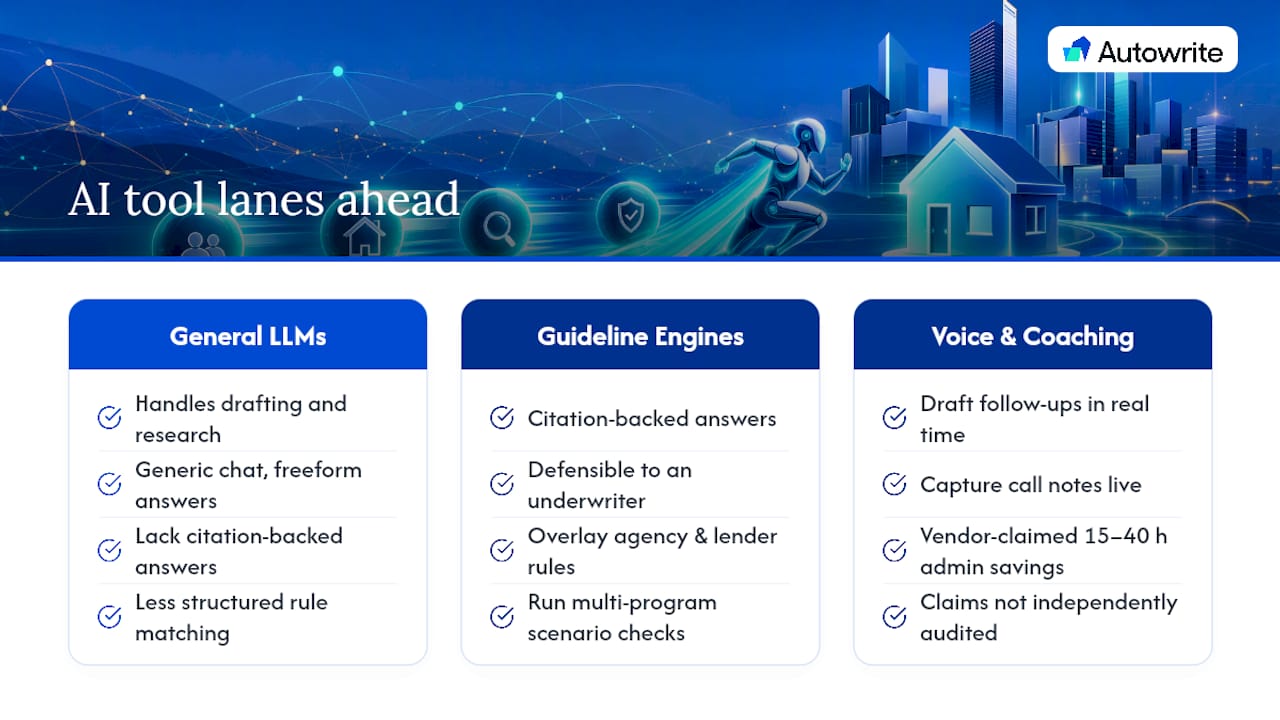
The tool landscape is already splitting into two lanes, and that split will likely sharpen over the next few years. General-purpose language models handle drafting and research well, while specialist engines built specifically for lender guidelines return citation-backed answers that a broker can actually defend to an underwriter, a distinction the Canadian Mortgage Trends guide draws out clearly.
Guideline engines that overlay agency and lender-specific rules already let brokers run scenario checks across multiple programs at once, an approach some enterprise mortgage AI platforms are building around directly. Expect more of that: less generic chat, more structured rule matching with a paper trail.
Voice and call-coaching tools are another area to watch. Some vendors already draft follow-ups and capture call notes in real time, with claimed admin savings that vendors put in the range of 15 to 40 hours per user, though those figures come from vendor materials rather than independent audits and should be treated as directional, not guaranteed.
The regulatory side will keep tightening too. As AIDA-style frameworks mature, expect vendors to compete on auditability and governance features as much as raw automation speed. Enterprise-focused platforms already market secure, auditable agents as a selling point precisely because buyers are starting to ask how a loan file review decision gets explained after the fact. Brokers who pick vendors built for that scrutiny now will have an easier time than those who bolt compliance on later.
What Changed for Me After Adopting AI Tools
The biggest surprise wasn't the time saved on document sorting, though that was real. It was how much faster client conversations moved once I wasn't apologizing for missing paperwork. Files that used to take three days of back-and-forth now clear intake in an afternoon. The lesson I didn't expect: the tool doesn't replace judgment, it just gets you to the judgment call faster.
Ready to Cut the Paperwork Out of Your Pipeline?
Autowrite gives Canadian mortgage brokers the fastest path from document intake to a compliance-ready submission, without the vendor sprawl of stitching together separate OCR, extraction, and e-sign tools. It's built specifically for licensed brokers and brokerages, so you're not adapting a generic document platform to fit lending workflows. It's the other way around.
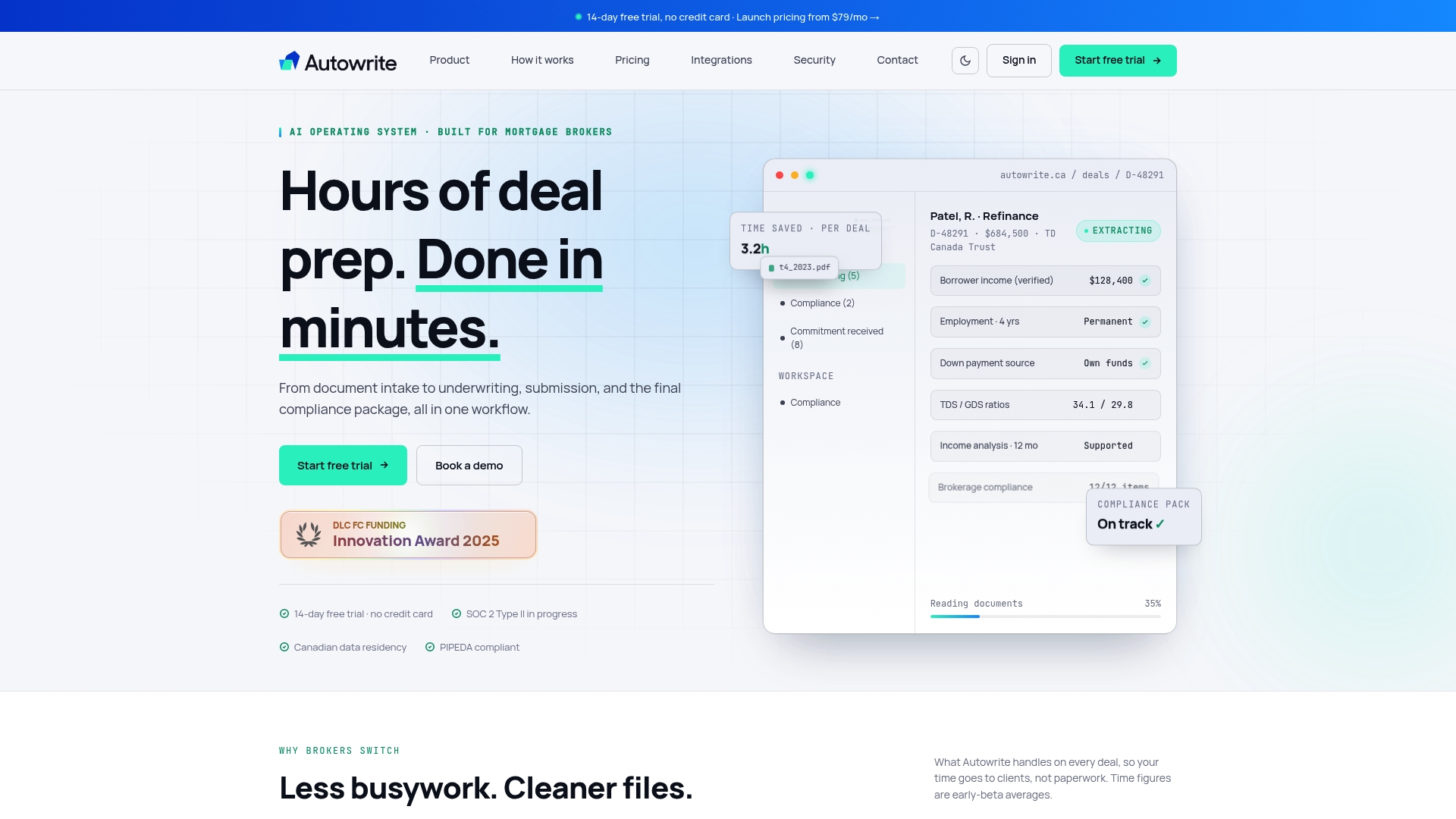
The platform classifies incoming documents, extracts and validates the data, auto-fills your underwriting forms, and assembles e-sign packages with a full audit trail, all on servers that keep client data within Canada. If your team is still manually chasing pay stubs and cross-checking lender guidelines by hand, that's exactly the gap this closes. Start a 14-day free trial and run it against your next five files to see where the hours actually go.
Frequently Asked Questions
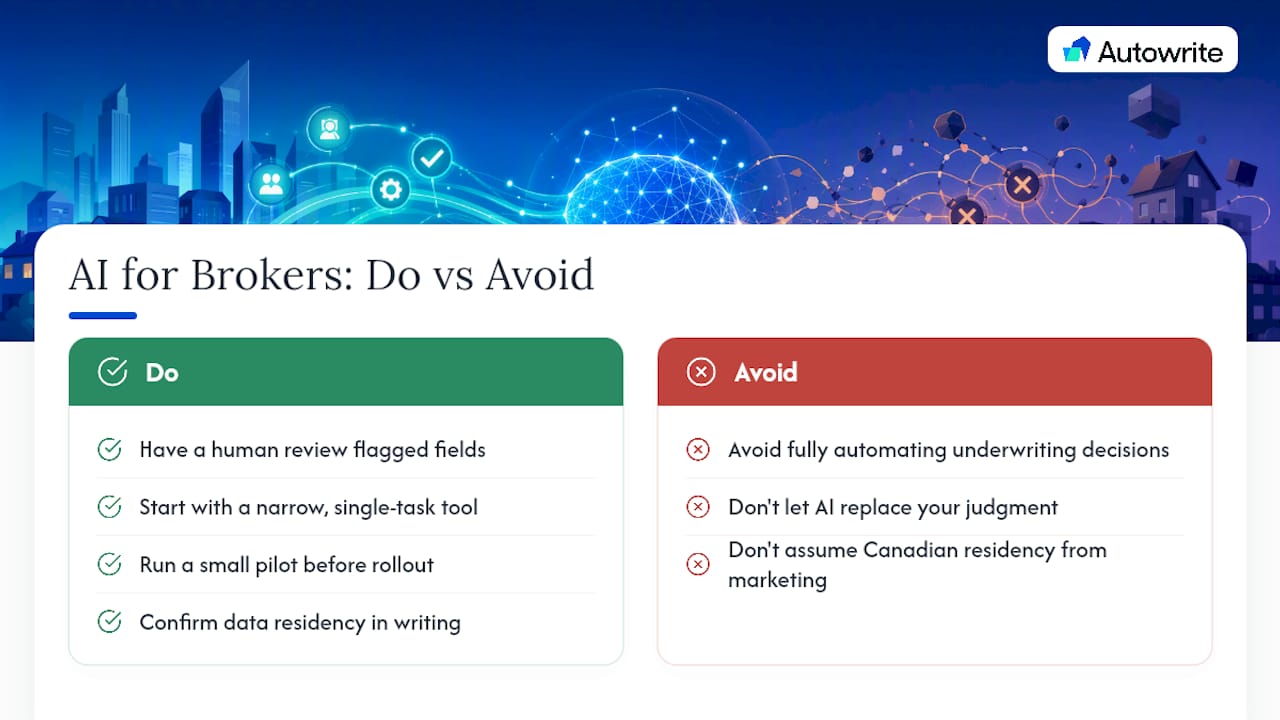
Is AI for mortgage brokers reliable enough to trust with client files? It's reliable for structured tasks like data extraction and document sorting, provided a human reviews flagged fields. Full automation of underwriting decisions still carries explainability and bias risks the OSFI–FCAC risk report flags directly.
What's the best AI for loan officers and mortgage brokers just starting out? Start with a narrow tool that handles one task well, typically document intake and extraction, rather than an all-in-one platform you haven't tested. Run a small pilot before committing to a brokerage-wide rollout.
Does AI-assisted loan processing require special compliance disclosures to clients? Best practice is to disclose when a chatbot or automated system is handling part of a client's file and to be able to explain any AI-influenced decision in plain terms. The AIDA companion document frames transparency as a core expectation, not an optional extra.
How does mortgage automation software handle data residency for Canadian brokers? Platforms built specifically for the Canadian market, including Autowrite, store client data on Canadian servers to align with provincial privacy expectations. Always confirm this in writing rather than assuming it from marketing copy.
Can AI tools replace a broker's lender-criteria knowledge? Specialist guideline engines can surface citation-backed answers faster than a manual policy search, but they work best as a research aid, not a replacement for a broker's judgment on which lender fits a client's full situation.
This article is general information, not a substitute for advice from a qualified financial advisor. Consult a qualified financial professional about your own circumstances before acting on anything here.
Sources
- Artificial Intelligence and Data Act (AIDA) companion document — Innovation, Science and Economic Development Canada
- OSFI–FCAC risk report on AI uses and risks for federally regulated financial institutions — OSFI
- How AI Will Influence the Mortgage Industry — Nesto
- The mortgage pro's guide to AI: What to use, when, and why it matters — Canadian Mortgage Trends