
No federal law forces Canadian businesses to store customer data inside Canada. That surprises a lot of people, given how often "data residency" gets treated as a legal requirement rather than a business choice. What the Office of the Privacy Commissioner of Canada actually enforces under PIPEDA is accountability: if you send personal information to a processor in another country, you remain responsible for making sure that information gets comparable protection. Geography isn't the test. Contractual and technical safeguards are.
The federal government's own white paper on data sovereignty reinforces this by treating residency and sovereignty as separate problems, and it recommends a risk-based approach rather than a blanket storage mandate. Before you assume you're in the clear, though, know the exceptions:
- Some provinces and sectors impose real, statutory residency requirements (British Columbia's public bodies, Nova Scotia, Quebec's Law 25, Alberta health data).
- Enterprise clients, insurers, or government procurement contracts can impose residency terms that go well beyond what the law requires.
- Even data stored in Canada can be reachable by a foreign government if the vendor is incorporated abroad. This is the CLOUD Act problem, and it trips up more IT teams than any provincial statute does.
Table of Contents
- What Federal Law Says About Cross-Border Data Transfers
- When Provincial and Sector Rules Override the Federal Default
- Residency vs. Sovereignty: Why Location Isn't the Whole Answer
- What to Require From Vendors Before You Sign
- How This Plays Out for Mortgage Brokers Specifically
- Keeping Records That Prove You Did the Work
- Bringing This Into Your Compliance Program Today
- Where to Go for Official Guidance
- The Real Lesson Buried in This Legal Gray Zone
- Sources
What Federal Law Says About Cross-Border Data Transfers
PIPEDA doesn't say "keep it in Canada." It says "stay accountable for it wherever it goes." That's a meaningfully different standard, and it's the one most businesses misread when they first look into data privacy in Canada.
The law rests on a handful of principles that matter directly for anyone processing personal information through a third-party vendor, whether that's a payroll provider in Chicago or a document-processing tool hosted on AWS in Oregon:
- Accountability: your organization is on the hook for information you transfer, even after it leaves your servers.
- Safeguards: you need to confirm the receiving party applies protection comparable to what PIPEDA requires here.
- Openness: your privacy policy has to disclose that data may be processed outside Canada, not bury it in a footnote.
- Individual access: people still have a right to know how their information was handled and where it went.
In practice, this means a written contract alone isn't enough. The Office of the Privacy Commissioner expects organizations to actually verify vendor practices, not just take a sales rep's word for it. A proper transfer-impact assessment looks past the primary vendor and traces the full subprocessor chain, because a Canadian company can sign a clean data processing agreement with its main cloud provider while that provider quietly routes backups through a subcontractor in a jurisdiction with far weaker privacy law.
One concrete mitigation works better than almost anything else: a written data processing addendum (DPA) that specifies where data lives, who can access it, and grants your organization audit rights. Pair that with a documented risk assessment before you sign, not after a breach forces you to scramble for one. The OPC's own guidance on cross-border transfers lays out exactly what a defensible assessment needs to consider, including the practical odds that data could be compelled by a foreign court and how much damage that would actually cause if it happened.
None of this requires a residency mandate. It requires a paper trail showing you thought about the risk before you took it.
When Provincial and Sector Rules Override the Federal Default
The federal picture is permissive. Several provinces and sectors are not, and this is where "is data residency necessary in Canada" stops being a general question and becomes a "it depends on who you are" question.
British Columbia has historically been the strictest example. Its public-sector privacy legislation once mandated that public body data physically stay in Canada, and while amendments have loosened that into a more flexible, privacy-impact-assessment driven model, public bodies still need to document why cross-border processing is safe before doing it. Nova Scotia has run a comparable public-body residency rule and is working through changes to modernize it. Quebec's Law 25 goes further than most: before personal information can be sent outside the province, the organization must complete a formal transfer-impact assessment confirming the destination offers adequate protection. Alberta's health information rules push custodians toward similar privacy-impact-assessment expectations for anything touching patient records.
| Jurisdiction / Sector | Residency Posture | Trigger |
|---|---|---|
| Federal (PIPEDA) | No storage mandate; accountability-based | Any cross-border transfer of personal information |
| British Columbia (public bodies) | PIA-driven, historically stricter | Public sector data processing |
| Nova Scotia (public bodies) | Residency rules under review | Public body contracts |
| Quebec (Law 25) | Mandatory pre-transfer assessment | Any transfer outside Quebec |
| Alberta (health data) | PIA expected before third-party processing | Health information custodians |
Beyond statute, contracts create their own residency requirements constantly. A government procurement RFP might require Canadian hosting as a bid condition regardless of what PIPEDA says. A large enterprise customer negotiating a master services agreement might insist on a residency clause simply because their own board policy demands it. If you sell into insurance, banking, or government-adjacent markets, check your contracts before you check the statute; the contract is usually the stricter document.
The practical check for your organization: ask whether you're a public body, whether you handle health information, whether you operate in or serve Quebec residents, and whether any current or prospective customer contract references data location. If any answer is yes, treat residency as a real requirement, not a preference.
Residency vs. Sovereignty: Why Location Isn't the Whole Answer
Residency means where the data physically sits. Sovereignty means which country's laws can actually compel access to it. Those are two different questions, and conflating them is the single most common mistake in this space.
Canada's own Digital Sovereignty Framework makes this distinction explicit: storing data in a Canadian data center owned or operated by a US-headquartered company doesn't insulate that data from US legal process. The CLOUD Act allows US authorities to compel a US-based company to produce data it controls, regardless of where that data physically sits. A server farm in Ontario doesn't change who the parent company answers to in a US courtroom.

This is why a documented transfer-impact assessment needs to look at corporate structure, not just server location. True operational sovereignty combines Canadian infrastructure with Canadian corporate control and, ideally, customer key custody. If the vendor holds the encryption keys and the vendor's parent company is subject to foreign court orders, geography is mostly theater.
Mitigations that actually move the needle:
- Choose vendors incorporated and headquartered in Canada, not just vendors with a Canadian data center.
- Demand customer-managed encryption keys so the vendor physically cannot produce readable data even if compelled.
- Keep subprocessor lists short and disclosed, since every additional link in the chain is another jurisdiction to evaluate.
Pro Tip: Ask any vendor one direct question: "If a foreign court ordered you to produce our data tomorrow, could you comply without our knowledge?" A vendor with true customer-key custody has to say no. If they hedge, you've found your risk.
What to Require From Vendors Before You Sign
Vendor evaluation is where most of this theory turns into actual practice. If you're negotiating a contract for cloud storage, document processing, or any SaaS platform touching client personal information, work through these in order:
- Confirm corporate jurisdiction. Where is the company incorporated, and where is its head office? A Canadian data center operated by a foreign-owned entity still leaves you exposed to foreign legal process.
- Get per-service residency commitments in writing. Many providers host primary data in Canada but route backups, analytics, or support tools through servers elsewhere. Ask for a service-by-service breakdown, not a general statement.
- Request the subprocessor list. Every vendor a vendor uses is a link in the chain you're accountable for under PIPEDA. Insist on advance notice before any subprocessor changes.
- Ask for a SOC 2 report or equivalent audit evidence. This tells you whether the vendor's security controls have actually been independently verified, not just claimed in a sales deck.
- Review incident history. A vendor's past breach disclosures (or lack of them) tell you more about operational maturity than any marketing page.
On the contract side, make sure the agreement includes a proper data processing addendum, explicit language on data localization where your sector requires it, restrictions on subprocessor access to raw personal information, breach-notification timing (72 hours is a common benchmark), and clear terms for data return or deletion when the relationship ends. Legal reviews of Canadian data localization rules consistently flag one gap: businesses sign DPAs that promise safeguards but never specify what happens to the data when the contract terminates.
On the technical side, push for customer-managed encryption keys (sometimes called CMEK), documented encryption standards for data at rest and in transit, detailed access logging, and role-based access controls that limit who inside the vendor's organization can even see your data.
Pro Tip: Build your vendor checklist into the RFP stage, not the contract-signing stage. Once you're locked into a vendor, your leverage to demand key custody or subprocessor transparency drops fast.
How This Plays Out for Mortgage Brokers Specifically
Mortgage files are dense with exactly the personal information PIPEDA cares about most: income statements, credit reports, bank statements, identification documents, and property details, which is why many rely on AI lead response and consultation booking for mortgage brokers to better manage client interactions. Add OSFI's reporting requirements for federally regulated mortgage insurers, and you have a sector where data handling mistakes carry both privacy and regulatory consequences at once.
The checklist for a broker or brokerage owner evaluating a new tech platform looks like this:
- Classify what data types flow through the platform (identity documents, income verification, credit data) and flag which are highest risk.
- Run a privacy impact assessment or transfer-impact assessment before onboarding any new vendor, not after.
- Require the vendor to show, in writing, where data is hosted, who legally controls it, and whether encryption keys are customer-managed.
- Document every decision. If a regulator or client ever asks why you chose a vendor, you need a paper trail, not a memory.
This is precisely where platform architecture starts to matter as much as legal policy. Autowrite is built as an AI-powered operating system for Canadian mortgage brokers, and its Canadian data residency posture is designed around this exact checklist rather than bolted on afterward. Document intake, classification, and underwriting data extraction all run through infrastructure built with Canadian hosting and compliance documentation in mind, which means a broker doing vendor due diligence isn't starting from zero on every PIA.
When a brokerage's compliance officer has to answer "where does our client data actually live, and who can access it," the honest answer determines how fast a deal, an audit, or a procurement review moves. A platform that documents its answer clearly turns that question from a research project into a five-minute confirmation.
That difference shows up directly in procurement timelines. A broker evaluating platforms with vague or offshore data practices ends up doing the vendor's compliance homework manually. One with documented Canadian hosting and clear jurisdiction answers upfront speeds that same review considerably.
Keeping Records That Prove You Did the Work
Accountability under PIPEDA isn't just a mindset. It has to leave a paper trail regulators, auditors, and enterprise clients can actually inspect.
- Maintain PIAs and TIAs for every vendor or data flow that crosses a provincial or national border.
- Keep vendor risk assessments current, updated whenever a subprocessor or hosting arrangement changes.
- File signed DPAs alongside the underlying commercial contract, not in a separate, forgotten folder.
- Log consent records showing what customers were told about cross-border processing and when.
- Build a data map that tracks where personal information originates, where it's stored, and where it travels.
- Record incidents, even minor ones, since a documented near-miss strengthens your case that your privacy program actually functions.
Build these checks into procurement and change-management processes directly, so a new vendor or a platform update automatically triggers a fresh review instead of relying on someone remembering to ask.
Bringing This Into Your Compliance Program Today
Canadian businesses face accountability obligations under PIPEDA rather than a blanket storage mandate, but provincial, sector, and contractual rules can make residency mandatory in specific cases.
| Point | Details |
|---|---|
| No federal storage mandate | PIPEDA requires accountability and safeguards for transferred data, not physical residency in Canada. |
| Watch provincial exceptions | Quebec, BC public bodies, Nova Scotia, and Alberta health data carry stricter residency or assessment rules. |
| Residency isn't sovereignty | A Canadian data center under foreign corporate control can still be reached through the CLOUD Act. |
| Vendor contracts need teeth | Require a DPA, subprocessor disclosure, SOC 2 evidence, and customer-managed encryption keys. |
| Documentation proves accountability | Keep PIAs, TIAs, vendor assessments, and data maps to demonstrate compliance under audit. |
Where to Go for Official Guidance
Start with the Office of the Privacy Commissioner's cross-border guidance and the Government of Canada's sovereignty framework for the primary legal positions.
- Quebec businesses should review Law 25's transfer assessment requirements directly.
- Mortgage brokers should check OSFI reporting expectations for regulated entities.
- For platform-level compliance features built for Canadian brokers, see Autowrite's compliance overview.
- For borderline cases involving foreign subprocessors, consult privacy counsel before signing.
The Real Lesson Buried in This Legal Gray Zone
The conventional advice treats data residency like a checkbox: pick a Canadian data center, move on. That advice is incomplete, and it lets a lot of vendors sell geography as a substitute for actual accountability.
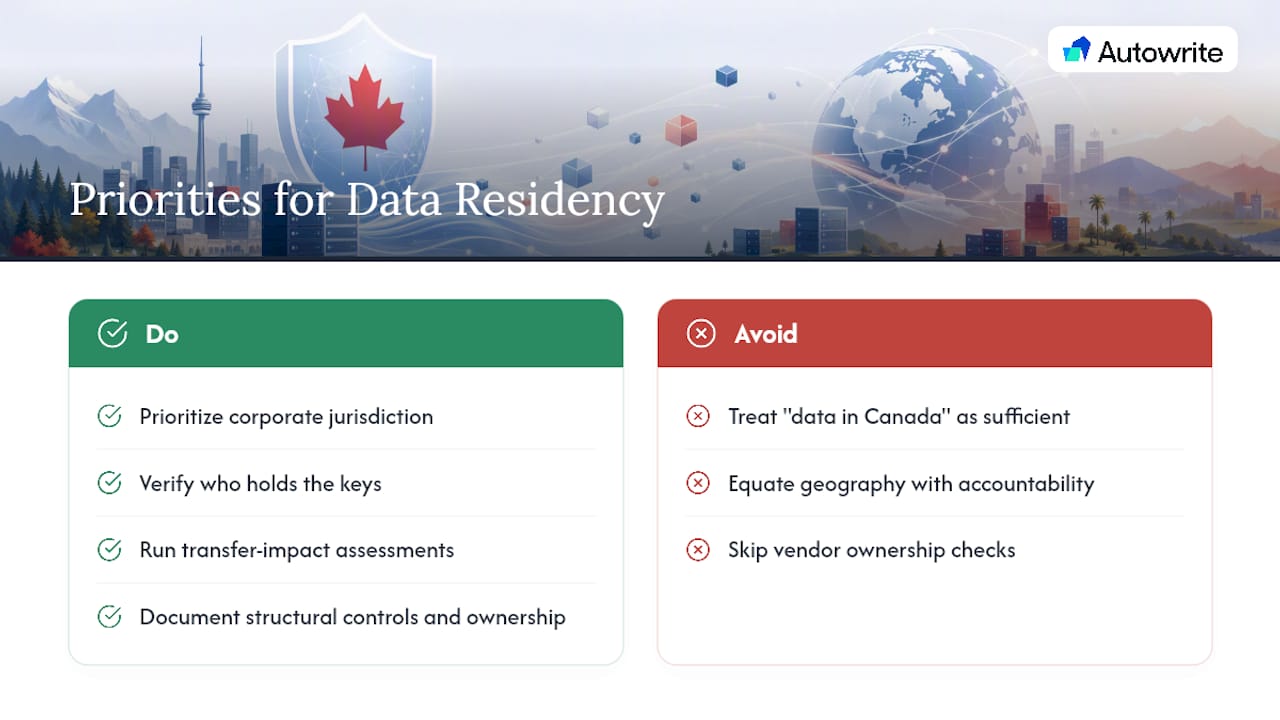
What the law actually rewards is documentation and structural control, not zip codes. A business that runs a real transfer-impact assessment on a US-hosted vendor is in better shape than one that stores data in Toronto but never checked who owns the company or holds the keys. Brokers especially should stop asking vendors "is my data in Canada?" and start asking "who can be legally compelled to hand it over, and under what circumstances?"
Prioritize corporate jurisdiction and key custody first. Residency is the easy, visible layer. Sovereignty is the layer that actually determines whether your client's mortgage file stays private when it matters.
— Anant Bawa