
Every gift-funds file lenders approve without a follow-up call has three things in it: a signed, lender-compliant gift letter with a clear non-repayable statement, a traceable proof-of-funds trail from donor account to borrower account, and a one-page funds summary that lets an underwriter verify the math in under a minute. Skip any one of those, and you're looking at a stipulation request, a delayed close, or worse, a declined file.
Lender templates aren't interchangeable. The wording your last deal used for one lender can trigger a rewrite request at another, so confirm the exact form before you collect a single signature.
- Signed gift letter naming the donor, relationship, dollar amount, subject property, and an explicit statement the money never gets repaid.
- Bank statements and transfer receipts showing the funds moving from the donor's account into the borrower's, with dates that line up.
- A one-page summary and numbered file so the underwriter can cross-reference every document without hunting.
Pro Tip: Build a lender-template library in your file system now. When a deal comes in, you should be able to pull the correct gift-letter form in under 60 seconds instead of digging through old emails.
Key Takeaways
A lender-compliant gift file requires a signed non-repayable gift letter, a fully traceable proof-of-funds trail, and a one-page summary that lets underwriters verify everything without a follow-up call.
| Point | Details |
|---|---|
| Confirm the lender's template first | Wording varies by lender, and using the wrong form is a leading cause of gift-letter rework. |
| Hit the 15-day seasoning window | Aim to have gift funds deposited into the borrower's account at least 15 days before closing. |
| Never submit redacted statements | Full, unredacted bank pages with account numbers are expected; redactions trigger extra scrutiny. |
| Document your verification steps | Log who reviewed donor ID and funds documents, and when, directly in the loan file. |
| Automate the assembly work | Autowrite classifies donor documents, extracts key fields, and flags gaps before submission to underwriting. |
Table of Contents
- Gift Letter Requirements Canada: The Fields Underwriters Actually Check
- Why Do Lenders Reject Gift Letters So Often?
- How Early Should Gift Funds Be in the Borrower's Account?
- What Verification and AML Documentation Should Brokers Keep on File?
- Submission-Ready Gift File Checklist
- Handling Gifts From Outside Canada
- Protecting Donor Privacy While Meeting Lender Documentation Rules
- Multiple Donors and Partial Gift Contributions
- Where Gift Files Actually Fall Apart
- How Autowrite Simplifies Gift-Letter Compliance for Brokers
- Sources
Gift Letter Requirements Canada: The Fields Underwriters Actually Check
Underwriters aren't reading gift letters for tone. They're scanning for six specific data points, and missing even one usually means the file bounces back with a stipulation. CMHC's guidance for mortgage professionals points to a signed donor letter plus proof the funds actually landed in the borrower's account as baseline expectations, not nice-to-haves.
Here's the checklist worth pinning above your desk:
- Donor's full legal name matching their government ID exactly, no nicknames or shortened versions.
- Relationship to the borrower, stated plainly (parent, grandparent, sibling) since some lenders restrict eligible donors to immediate family.
- Exact dollar amount of the gift, matching the deposit down to the cent.
- Subject property address, tying the gift to this specific transaction rather than a generic down payment.
- A non-repayable statement, the single most scrutinized line in the entire document. Vague language here is the fastest way to get a file kicked back.
- Donor signature, date, and contact information so the lender can verify directly if something looks off.
Beyond the letter itself, plan on collecting donor bank statements covering roughly 90 days, wire transfer or e-transfer confirmations, deposit evidence into the borrower's account, and government ID verification for the donor. If the donor lives outside Canada or the documents aren't in English or French, budget time for notarization and translation before your file goes to underwriting.
Never submit a redacted page. CMLS's broker resource includes sample wording that specifies bank name, transit number, and account number as expected fields, and a blacked-out account number reads as a red flag even when the redaction was well intentioned. If a client insists on privacy, explain that a partially hidden statement almost always triggers more scrutiny, not less.
Pro Tip: Ask for the donor's bank statement PDF directly from their online banking portal rather than a photo or screenshot. Underwriters trust a clean export far more than a phone picture with glare across the numbers.
Why Do Lenders Reject Gift Letters So Often?
Lender rules on gift-fund donors are not standardized across the industry. Some lenders accept gifts only from immediate family (parents, grandparents, siblings), while others extend eligibility to a broader circle, including in-laws or godparents. Practitioner commentary on lender templates and timing makes the point bluntly: confirm donor eligibility with the specific lender before you rely on those funds in your ratios, not afterwards.
The template question causes more rework than almost anything else in a gift file. A signed letter using generic wording, or another lender's form, often gets rejected outright even when every fact on the page is accurate. Confirm the lender's exact template at application, not at conditional approval.
Common triggers that pull a file into extra verification:
- Deposits landing in the borrower's account inside the final one to two weeks before closing.
- Funds originating from a country flagged for anti-money-laundering concerns or sanctions.
- Any indication the "gift" is actually a loan, including side agreements or repayment schedules.
- Redacted statements or missing pages in the donor's bank records.
- A third party with financial interest in the property (a co-signer, business partner, or prior owner) appearing in the funds trail.
None of these are automatic declines. They're all reasons an underwriter stops and asks questions, which is exactly what a well-built file avoids.
How Early Should Gift Funds Be in the Borrower's Account?
Aim to have gift funds deposited into the borrower's account well before closing to allow adequate seasoning time. CMLS's broker guidance treats that window as the practical threshold: funds seasoned in the borrower's account for at least 15 days generally clear without extra scrutiny, while anything deposited later commonly draws a request for additional verification.
Confirm each lender's specific seasoning expectation early, since the 15-day figure is a reliable rule of thumb rather than a universal rule every lender applies identically.
- At application intake, request donor bank statements and ask the client when the gift transfer is planned.
- Before conditional approval, confirm the lender's exact seasoning window and gift-letter template.
- As soon as the transfer happens, log the deposit date in your funds summary so it's visible at a glance.
- If the deposit lands late, prepare a notarized donor letter or direct bank confirmation as a backup before underwriting asks for it.
Pro Tip: Set a calendar reminder 20 days before every closing date on a file with gift funds. That five-day buffer gives you room to chase a slow-moving wire transfer without scrambling at the last minute.
What Verification and AML Documentation Should Brokers Keep on File?
Verification isn't a formality you complete and forget. It's a defensibility exercise, and OSFI's underwriting guideline is explicit that brokers are expected to confirm down payment sources, ensure funds aren't borrowed, and retain records detailed enough to survive an audit. Incomplete documentation isn't just a lender headache; it's a compliance failure.
Practically, that means four things go in every gift file:
- Identity verification for the donor, following your brokerage's policy (commonly two pieces of ID, at least one photo).
- A reconciled transfer trail: bank statements, wire or e-transfer confirmations, and deposit records that show origin, any currency conversion, and final receipt.
- A verification log: who checked the documents, when, and what exactly was reviewed, kept in the file alongside your summary page.
- Source-of-wealth documentation for overseas gifts, translated and notarized where the lender requires it.
Origination standards note that large or unexplained deposits draw additional scrutiny under anti-money-laundering policy, regardless of how legitimate the funds actually are. The burden is on the file to prove it, not on the underwriter to assume it.
A front-loaded funds summary that reconciles every deposit to a specific account and cites exact page numbers is a small piece of extra work that saves hours of underwriting back-and-forth, and it meaningfully lowers the odds of an AML flag getting raised over something that was never actually a problem.
Skipping the verification log is the most common shortcut brokers take, and it's the one that causes the most pain later. If a file gets audited eighteen months after closing, "I remember checking that" doesn't hold up. A dated note does.
Submission-Ready Gift File Checklist
Assemble the package in this order every time, and underwriters will move through it faster because they know exactly where to look.
- One-page funds summary up front: total gift amount, donor and borrower account details, deposit date, and what portion of the down payment the gift covers.
- Signed lender gift-letter template, using the exact form that lender requires.
- Donor identity verification documentation per your brokerage's policy.
- Donor bank statements, full pages, no redactions, covering the recommended window.
- Transfer or wire receipt showing the money leaving the donor's account.
- Deposit confirmation showing the money landing in the borrower's account.
- Notarized or translated documents, if the lender requires them for an out-of-country donor.
- Page numbers throughout, cross-referenced in the summary sheet so nothing requires a manual search.
Include the donor's phone number or email in the summary too. Some lenders call to verify the gift directly, and a missing contact detail is an easy way to stall a file that's otherwise complete.
Handling Gifts From Outside Canada
International gift funds aren't rare, and they're not fundamentally different from domestic ones. They just require more paperwork, and the paperwork takes longer to collect.
Start with the transfer trail. Lenders want to see the full path: source account, the conversion from foreign currency into Canadian dollars, and the final deposit into the borrower's account, matching dollar for dollar once the exchange rate is applied. Origination standards for international gifts commonly call for source-of-wealth documentation alongside the standard gift letter, meaning the donor may need to show where the money came from originally, not just that it exists.

Currency conversion introduces a wrinkle worth flagging with your client early: the exchange rate at the time of transfer won't necessarily match the rate on the day of deposit, and lenders want the summary page to account for that gap rather than leave it unexplained. A borrower who "gifted $50,000 CAD" but whose bank statement shows a foreign-currency withdrawal needs the math shown, not implied.
Notarization and translation add real time to a file. If the donor's documents are in a language other than English or French, budget at least a week for certified translation before the file can move to underwriting, and confirm with the lender whether notarization is mandatory or simply preferred. Building this timeline into the file at application, rather than discovering it two weeks before closing, is the difference between a smooth international gift and a scramble.
Protecting Donor Privacy While Meeting Lender Documentation Rules
Donors are handing over bank statements with their full account numbers, balances, and transaction history visible, often for a transaction they're not even party to. That deserves careful handling on your end, separate from the underwriting requirements themselves.
Store donor documents the same way you store borrower documents: encrypted storage, access limited to staff actually working the file, and no forwarding by unsecured email when a secure portal is available. Redacting a document to protect the donor's privacy feels responsible, but as covered earlier, lenders generally reject redacted statements outright, so the better answer is restricting who inside your brokerage can see the file rather than hiding information from the lender.
Get explicit consent from the donor before collecting their documents, and explain plainly what will happen to them, that they'll be reviewed by the lender's underwriting team, retained per your brokerage's record policy, and not used for any purpose beyond this transaction. A donor who understands the process upfront is far less likely to push back on providing a full, unredacted 90-day statement later.
Retention timelines should mirror your brokerage's standard file-retention policy, and donor documents should be purged on the same schedule as the rest of the loan file rather than kept indefinitely just because they arrived separately.
Multiple Donors and Partial Gift Contributions
Not every gift comes from one person in one lump sum. Two parents contributing jointly, a parent and a sibling both chipping in, or a gift covering only part of the down payment with the rest coming from the borrower's own savings, all of these need their own paper trail rather than getting lumped into a single approximate figure.
Each donor needs a separate gift letter, even when they're related to each other and contributing to the same transaction. A joint letter signed by both parents is often accepted, but confirm with the specific lender rather than assuming, since some templates are built for a single donor and require duplication instead of a shared signature block.
Your funds summary needs a line for every source: donor A's contribution, donor B's contribution, and the borrower's own funds, each reconciled to its own bank statement and deposit record. An underwriter should be able to look at that one page and see exactly how the down payment adds up without cross-referencing five separate documents to do the math themselves.
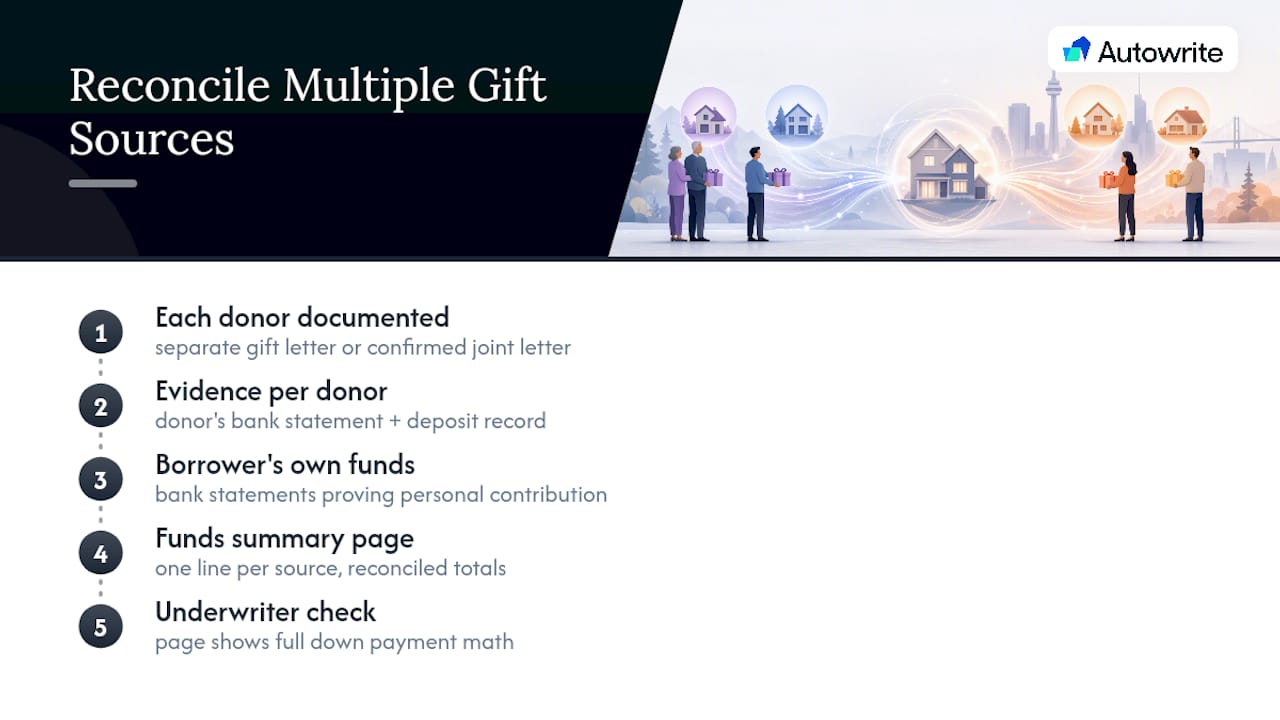
Partial gifts, where the gift covers, say, $30,000 of a $60,000 down payment, get flagged more often simply because the file looks more complicated. The fix isn't complicated, though: show the borrower's own contribution with the same rigor you'd apply to the gift, meaning bank statements demonstrating the funds were genuinely theirs and not from an undisclosed third source.
Where Gift Files Actually Fall Apart
The same three problems show up on file after file: wording that doesn't match the lender's required template, a deposit that landed nine days before closing instead of fifteen, and a bank statement with the account number blacked out because someone thought they were being helpful. None of these are complicated fixes. They're just easy to miss when you're juggling six files at once and the gift letter feels like a formality until it isn't.
What actually changes the outcome is treating document assembly as a checklist exercise instead of a memory exercise. Tools that classify incoming documents and flag missing fields before submission, like Autowrite, cut down the hours brokers spend manually checking whether every page is unredacted and every date lines up. Standardizing lender-confirmation and packaging steps across a brokerage, rather than leaving it to each broker's own habits, is where the real time savings show up.
— Anant Bawa
How Autowrite Simplifies Gift-Letter Compliance for Brokers
You already know the drill: chase the donor for a clean statement, cross-check the lender's exact template, count pages by hand, and hope nothing's redacted before you hit submit. Autowrite cuts that manual checking down to minutes instead of hours by automatically classifying incoming donor documents, extracting the key fields, and flagging gaps, like a missing signature or a statement that's short a page, before the file ever reaches underwriting.
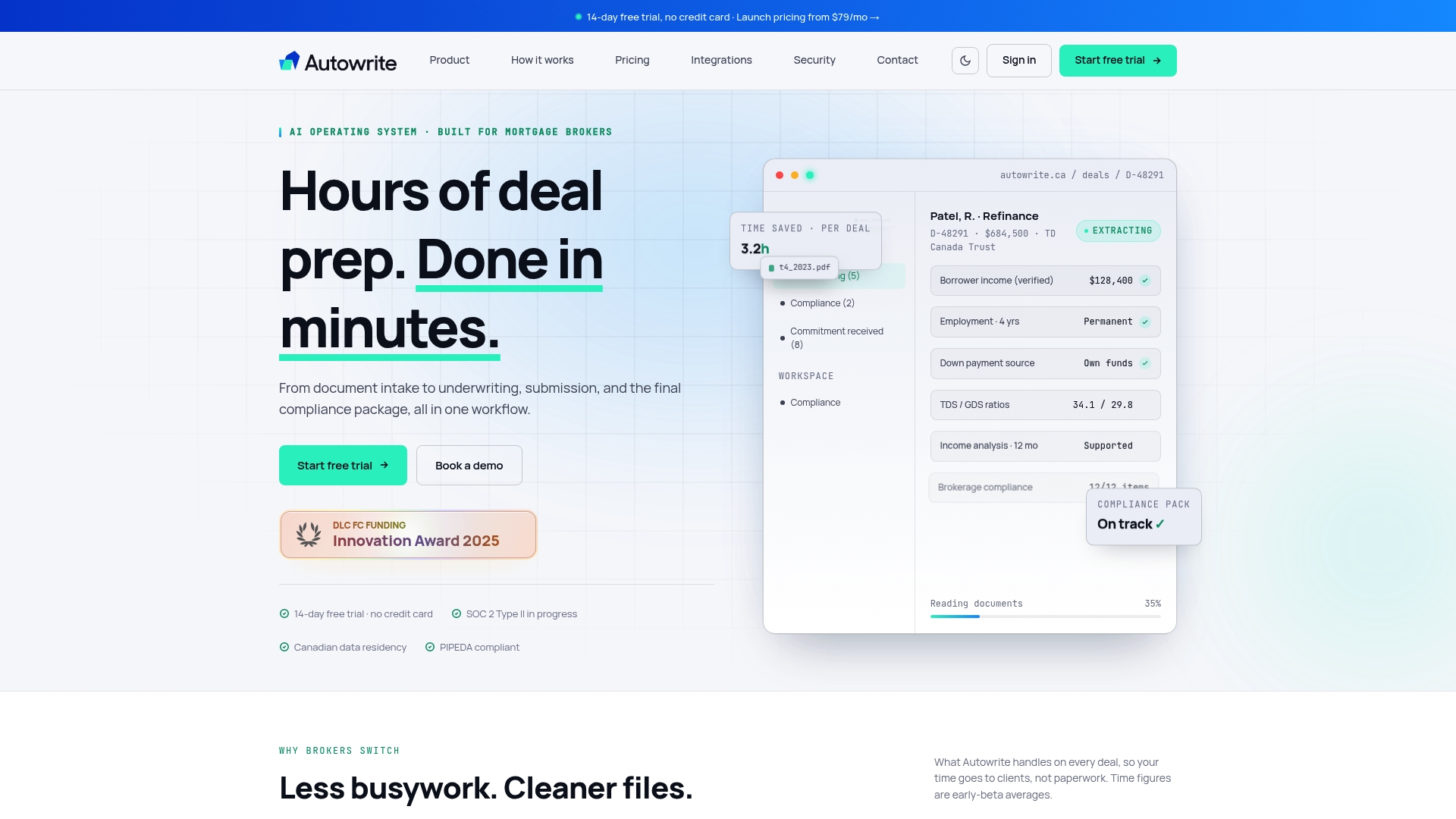
Built specifically for Canadian mortgage brokers, Autowrite auto-fills underwriting forms, assembles e-sign and compliance packages, and keeps everything on Canadian data residency, which matters when you're handling sensitive donor financial records. It syncs with the mortgage software your brokerage already runs, so gift-fund files move from intake to a submission-ready package without the manual reassembly.
If missing gift-letter wording or a late-arriving bank statement has ever cost you a closing date, start a free trial with Autowrite and see how much faster a gift-funds file moves when the document work runs itself.
Sources
- Residential mortgage underwriting practices and procedures guideline — OSFI
- Mortgage application tips — CMHC
- CMLS broker resource (gift letter guidance)
- Mortgage origination standards — MortgageProScan