
GDS equals principal, interest, property tax, heat, and half of any condo fees, divided by gross monthly income, and lenders cap it at 39% for CMHC-insured mortgages. TDS adds every other monthly debt payment to that housing figure, divided by the same income, capped at 44%. Two catches trip up most borrowers: lenders calculate the mortgage payment using the qualifying (stress-test) rate, not your contract rate, and revolving credit gets counted at 3% of the balance regardless of what you actually pay each month.
TL;DR:
- Using the stress-test rate instead of your contract rate can increase your mortgage payment assumptions by 10 to 12 percentage points per one percent rise, reducing borrowing capacity.
- Adding non-mortgage debts like credit cards at 3% of their balance, or using actual payments for loans, can significantly raise your TDS ratio, potentially causing a rejection.
- Both GDS and TDS calculations depend heavily on the accuracy of your input costs, including taxes, heat, condo fees, and debt amounts, which must be documented precisely.
- Using official calculators like CMHC's or FCAC's helps verify your ratios and prevents surprises, especially when close to lending limits, and should be re-run after debt payments or income changes.
- Prioritizing paying down revolving credit balances before applying for a mortgage can lower your ratios and improve pre-approval chances, especially if your numbers are near the limits.
Table of Contents
- How to Calculate GDS TDS: The Formulas Behind PITH
- Worked Example: Calculating GDS and TDS Step by Step
- Which Debts Count Toward Your TDS Ratio?
- Why the Qualifying Rate Changes Your Numbers
- Confirm Your Numbers With Official Calculators
- What Mortgage Professionals Wish Applicants Knew Sooner
- A Faster Way for Brokers to Verify GDS and TDS Inputs
- Where to Verify Official GDS and TDS Rules
- Sources
How to Calculate GDS TDS: The Formulas Behind PITH
GDS and TDS both start with the same housing number, often called PITH: principal, interest, property tax, and heat. If you're buying a condo, add half of your monthly condo fees to that total. Divide the sum by your gross monthly household income and you have your GDS ratio.

TDS takes that same PITH figure and adds every other recurring debt payment: credit cards, car loans, student loans, personal lines of credit. Same income denominator, different debts included.
Lenders use gross monthly income, not net, and for most salaried applicants that means annual salary divided by twelve. For self-employed borrowers or anyone with variable income, lenders typically anchor to the Notice of Assessment and its Line 23600 net income figure, since that's the number the Canada Revenue Agency has already verified.
Before you calculate anything, gather these inputs:
- Your mortgage payment estimated at the qualifying rate, not your quoted contract rate
- Monthly property tax (check your last tax bill or municipal assessment)
- Monthly heat cost (actual bills or a reasonable estimate if you're buying new)
- Condo fees, if applicable, with the exact monthly amount from the strata disclosure
- A complete list of other monthly debts: minimum credit card payments, car loans, lines of credit, student loans
Get any one of these wrong and the whole ratio shifts, sometimes enough to change whether you qualify.
Worked Example: Calculating GDS and TDS Step by Step
Numbers make this concrete.
1. Calculate the mortgage payment at the qualifying rate. The qualifying rate is whichever is higher: your contract rate plus 2%, or the posted floor rate set by federal guidelines. Here, the qualifying rate is calculated as the contract rate plus 2% or a floor rate, whichever is higher. The payment at the qualifying rate is higher than the payment at the actual contract rate.
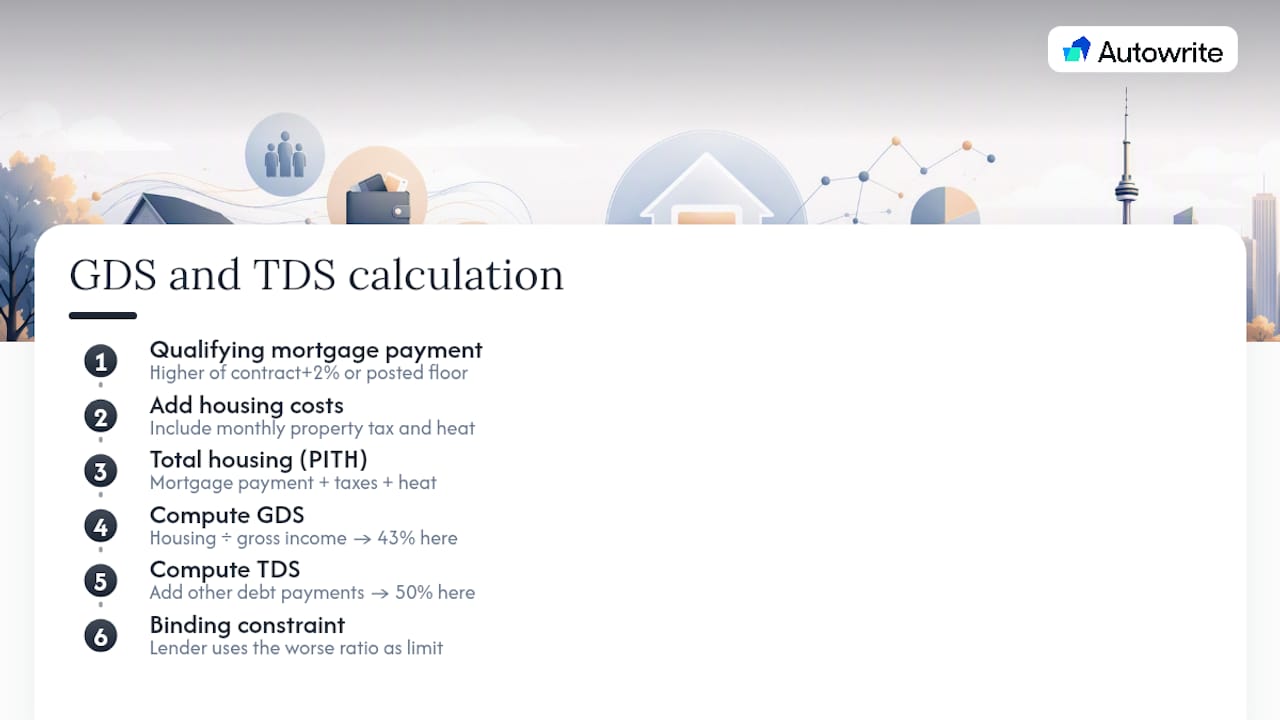
2. Add the rest of the housing costs. Property tax and heat are estimated based on typical monthly amounts, and there is no condo fee since this is a detached house. Total housing costs equal mortgage payment plus taxes and heat.
**3.
**4.
**5.
GDS of 43% and TDS of 50% both blow past the standard limits of 39% and 44%, which means this household needs a smaller mortgage, a longer amortization, or less revolving debt before applying. Lenders will use whichever ratio is worse as the binding constraint, so fixing GDS alone wouldn't have saved this application.
Which Debts Count Toward Your TDS Ratio?
TDS pulls in every recurring credit obligation, and how lenders convert a balance into a monthly figure matters as much as the balance itself.
- Credit cards and unsecured lines of credit: 3% of the outstanding balance each month, regardless of your minimum payment
- Car loans and other installment debt: the actual monthly payment shown on your loan statement
- Student loans: actual monthly payment, or a calculated minimum if you're on an income-based plan
- Secured lines of credit: often treated with amortization assumptions similar to installment loans, so a large secured LOC can hit your TDS harder than expected
- Support payments: court-ordered child or spousal support counts as a monthly obligation
- Outstanding CRA debt: unpaid taxes can factor into a lender's overall risk assessment even outside the strict TDS math
Rental income from an existing property can offset these numbers. CMHC guidance allows lenders to count up to 50% of gross rental income toward your income in certain cases, which helps landlords qualifying for a second property.
Pro Tip: *Pay down credit card balances before applying, not car loans.
Why the Qualifying Rate Changes Your Numbers
Every mortgage ratio test uses the qualifying rate, sometimes called the stress-test rate, not the rate your lender actually quotes you.
That gap between contract rate and qualifying rate is where a lot of pre-approval surprises come from.
- A mortgage that looks affordable at 5% suddenly gets tested at 7%
- Higher test rate means a higher assumed payment, which pushes both GDS and TDS up
- As a rough rule of thumb, every percentage point added to your qualifying rate adds roughly 10 to 12% to your calculated mortgage payment on a typical 25-year amortization
This is exactly why two buyers with identical incomes and identical purchase prices can qualify for very different amounts, depending on the rate their lender locked in when quoting them.
Confirm Your Numbers With Official Calculators
Manual math is worth doing once, but cross-check it before you submit anything. The CMHC debt service calculator walks through the same inputs, mortgage payment, taxes, heat, condo fees, and other debts, and returns your GDS and TDS instantly. The Financial Consumer Agency of Canada runs a similar mortgage qualifier tool that applies the same 39%/44% guidelines.
- Re-run the calculation any time a debt balance changes, since paying down a card mid-application can meaningfully shift your TDS
- Save a screenshot or PDF of your results and keep it with your application documents
- Use both tools if your numbers land close to the limit, since small rounding differences can matter
What Mortgage Professionals Wish Applicants Knew Sooner
The single biggest lever most applicants ignore is revolving debt. Timing matters too: if you earn bonuses or commission, apply after your latest NOA reflects that income, not before. And pull your documentation together early. A broker who reviews your NOAs and statements ahead of submission catches ratio problems before a lender does, which saves you from a hard decline showing up on file.
— Anant Bawa
A Faster Way for Brokers to Verify GDS and TDS Inputs
Every calculation in this guide depends on getting the raw numbers right, pay stubs, NOAs, condo fee disclosures, and debt statements, before the math even starts. For brokers handling a full pipeline of files, that data entry is where hours disappear every week.
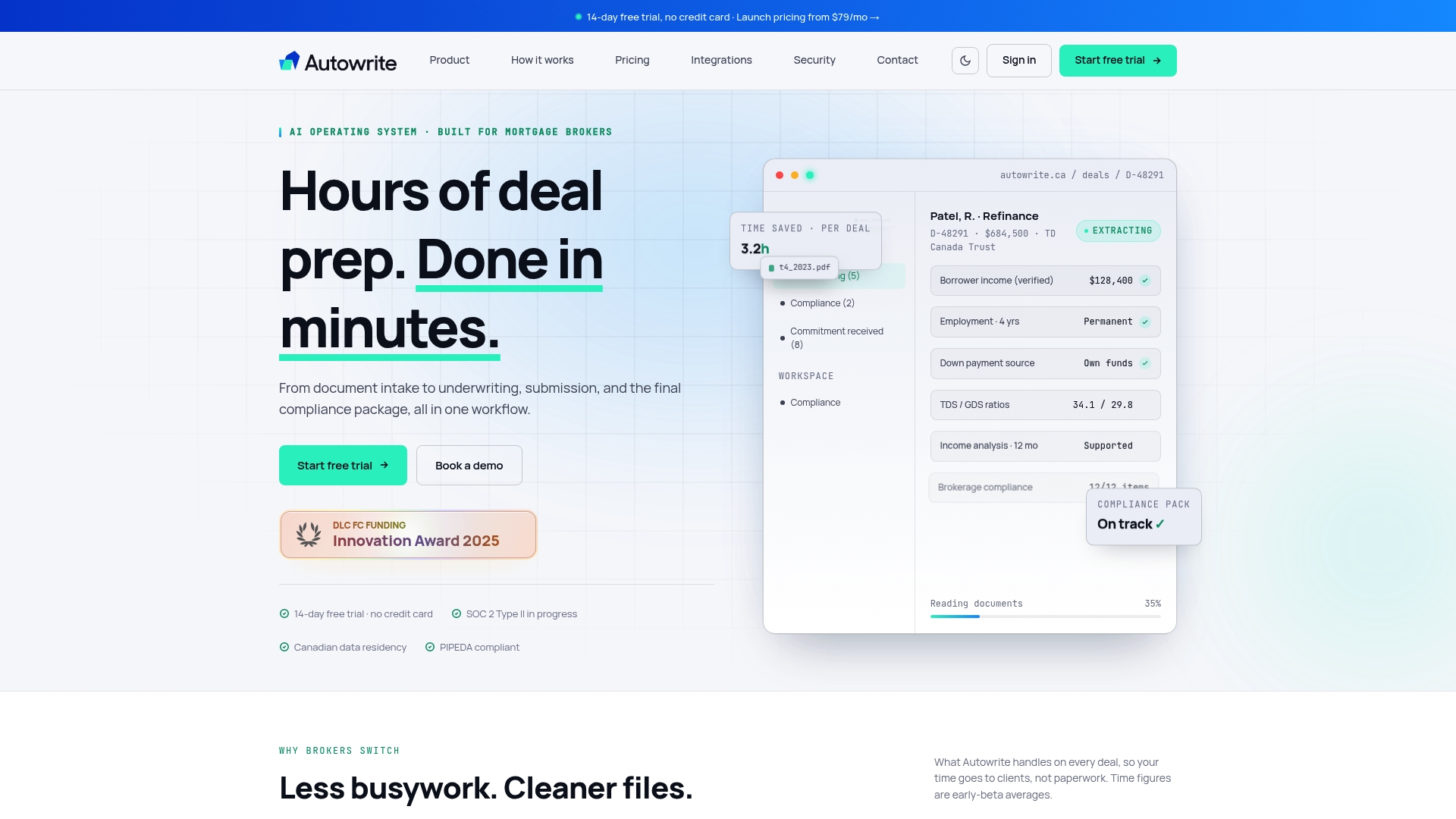
Autowrite reads pay stubs, T4s, and Notice of Assessment documents directly, pulling income figures into underwriting forms without manual retyping. It classifies incoming documents automatically, extracts the debt and income data GDS and TDS calculations depend on, and pre-fills the fields your lender submission needs, cutting a task that used to take an afternoon down to minutes. For a broker juggling multiple files with tight closing timelines, that accuracy on the front end means fewer ratio surprises later. If you're spending hours reconciling client paperwork by hand, see how Autowrite works and start a trial to see what it pulls from your next file.
Where to Verify Official GDS and TDS Rules
- CMHC's guidance on calculating GDS/TDS and its consumer debt service calculator
- The FCAC mortgage qualifier tool for a second-opinion calculation
- CRA income verification guidance for how NOAs factor into your income figure
- For commercial applicants curious how debt-service coverage works outside residential lending, this DSCR guide for commercial real estate covers the parallel concept
This article is general information, not a substitute for advice from a qualified financial advisor. Consult a qualified financial professional about your own circumstances before acting on anything here.
Sources
- Calculating GDS / TDS | CMHC
- Debt service calculator | CMHC
- Mortgage Qualifier Tool - Canada.ca (FCAC)
- Canada Revenue Agency — Income verification guidance