
BLUF: A lender-ready broker submission contains nine items — a signed application, credit report, income verification, down payment verification, property documentation, a broker submission note, required disclosures, e-sign consent packages, and confirmed portal validation. Miss any one, and the file lands in an underwriter's queue with a status of "incomplete" instead of "in progress."
The highest-leverage item on that list isn't a document at all. It's the submission note. A well-written note tells the underwriter the borrower's story before they have to dig for it, and files with clear, context-rich notes move faster and draw fewer clarifying questions.
Use this as your immediate pre-submit pass:
- Signed application and credit consent form
- Current credit bureau report
- Income verification matched to employment type
- Down payment or source-of-funds evidence
- Purchase contract, MLS listing, or appraisal
- Condo docs (status certificate, insurance) if applicable
- Submission note under 200 words
- Broker contact info and confirmed portal ID
TL;DR:
- An underwriter prefers a complete file with all nine core documents plus a concise, under 200-word submission note that clearly explains the borrower's story.
- Including a detailed, well-structured submission note significantly accelerates review time and reduces clarifying questions from underwriters.
- Use consistent file naming, attach all required disclosures early, and verify signatures, names, and documents in a five-minute quality check before submitting.
- Sending disclosures at least two business days before deadlines complies with provincial rules and minimizes resubmission delays.
- Automating document classification and form-filling with tools like Autowrite can reduce manual errors, speed up workflow, and improve submission accuracy.
Table of Contents
- Lender Submission Checklist: Documents Every File Needs
- How Do You Write a Submission Note That Gets Read?
- Organizing Files So Underwriters Can Review Them Fast
- What Does a Reliable Pre-Submission Workflow Look Like?
- Regulatory Timing: What Disclosure Rules Actually Require
- The Five-Minute QC Check Before You Hit Submit
- Why the Submission Note Matters More Than Brokers Think
- Autowrite Handles the Checklist So You Handle the Client
- Key Takeaways
- Sources
Lender Submission Checklist: Documents Every File Needs
Lenders sort files into two piles fast: complete and everything else. The core document package required for a lender submission breaks into six groups, and skipping any one of them is the single most common reason a file bounces back before an underwriter even opens it.
1. Application and consents. The signed mortgage application and a signed credit bureau consent form comes first. No consent, no pull, no file review. If the application has any handwritten corrections, initial them. Underwriters flag uninitialed changes as a red flag almost automatically.
2. Credit report. Pull the bureau yourself through your brokerage's access, and attach it rather than making the lender pull a duplicate. Duplicate pulls within a short window can ding the borrower's score and slow things down.
3. Income verification, matched to employment type. This is where files fall apart most often:
- Salaried employees: recent pay stubs plus a letter of employment
- Hourly or variable income: pay stubs covering a longer stretch, plus prior year's T4
- Self-employed borrowers: Notice of Assessment (NOA), T1 generals for two years, and either a business bank statement package or an accountant's letter confirming income stability
- Commission-based earners: T4s plus a two-year average calculation, shown explicitly rather than left for the underwriter to compute
Bank-statement scenarios deserve extra care. If you're using bank statements in place of tax documents, highlight the deposits you're relying on and note which ones are recurring versus one-off. An underwriter shouldn't have to guess which line items count toward qualifying income.
4. Down payment and source of funds. Three months of statements showing the funds seasoned in the account, or a gift letter with the donor's ID and relationship to the borrower if the funds are gifted. RRSP withdrawals under the Home Buyers' Plan need the withdrawal confirmation attached, not just mentioned in your note.

5. Property documentation. Purchase contract with all schedules, MLS listing sheet, and appraisal if one's been ordered. For condos, add the status certificate, insurance certificate, and any special assessment notices. Missing condo docs are a frequent cause of delay on attached-dwelling deals specifically.
6. Broker disclosures and cover materials. Your submission note, any required provincial disclosure forms, and your direct contact information. Lender submission guidance often asks explicitly for broker contact details inside the notes field, not buried in an attached PDF where it's easy to miss.
An example broker submission form is worth keeping on hand as a structural reference, even if your own brokerage uses a different template. The categories rarely change.
How Do You Write a Submission Note That Gets Read?
Keep it under 200 words. Underwriters read dozens of these a day, and a note that runs long gets skimmed, which defeats the purpose.
Structure it in five moves:
- Purpose in one line. Product requested, loan amount, purpose (purchase, refinance, renewal with equity take-out).
- Borrower profile in two sentences. Employment type, income verification method, credit tier.
- Exit strategy, if it's a bridge loan, private deal, or anything short-term. State the repayment source plainly.
- Credit anomalies, explained in one sentence each. A late payment from a documented job loss two years ago reads very differently from an unexplained collection account.
- Self-employed borrowers get a slightly longer treatment: a two-paragraph note on the business, its income stability, and the verification method prevents the underwriter from making assumptions and often heads off a follow-up request entirely.
Pro Tip: Call the underwriter directly when a credit anomaly needs more context than two sentences can carry, or when you're testing an unusual scenario before committing paperwork to it. A five-minute call up front beats three days of email back-and-forth after submission.
Organizing Files So Underwriters Can Review Them Fast
File chaos costs you time you don't get back. Standardize your naming convention across every submission: LastName_DocType_Date (example: Nguyen_PayStub_Jan2026.pdf). Consistency lets a processor scan a folder in seconds instead of opening five files to find the right one.
- Use PDF for everything except where a lender's portal requests a specific format.
- Single combined PDF works for smaller files (under 15 pages); split into logical groups (income, property, credit) once you're past that.
- Paste the submission note directly into the portal's notes field, not just as an attached file. Some underwriters never open attachments before reading the notes field first.
- Fill every required portal field completely. Blank fields trigger auto-flags on several platforms.
- Capture your confirmation or application ID the moment the portal accepts the file, and reference it in any follow-up email.
What Does a Reliable Pre-Submission Workflow Look Like?
Build the same five steps into every file, regardless of lender:
- Validate the package against your checklist before touching the portal.
- Pull broker credit if your brokerage has bureau access, rather than waiting on the lender.
- Run a QC pass for signatures, dates, and matching names across documents.
- Consider a scenario call for anything outside standard guidelines. Private lenders in particular invite brokers to review scenarios by phone or email before formal submission, which catches missing documents before they cost you a resubmission.
- Submit and log the confirmation ID immediately.
Portal choice varies by lender relationship. Filogix, Velocity, Lendesk, and Finmo each handle validation and document upload slightly differently, and some lenders still prefer direct email for complex or private deals. Turnaround expectations differ too, so log submission date, channel, and expected response window in your pipeline tracker the moment you hit send.
Regulatory Timing: What Disclosure Rules Actually Require
Ontario's O. Reg. 188/08 standards of practice require brokerages to disclose required information to lenders at the earliest opportunity, typically no later than a short period before specified events. That timing isn't a suggestion. Build it into your workflow as a hard deadline, not a best-effort target.
- Attach disclosure forms directly to the submission package, not as a separate follow-up email.
- Timestamp every disclosure you send and keep it in the client file.
- Set an internal policy that disclosures go out the same day the file is deemed complete, not the day before a deadline.
Consistent internal submission policies paired with a final QC gate correlate with fewer resubmissions and smoother lender relationships over time, particularly in competitive markets where underwriter attention is scarce.
The Five-Minute QC Check Before You Hit Submit
Most bounced files fail for the same handful of reasons, and nearly all of them are catchable in five minutes.
- Confirm every signature page is signed and dated. Missing initials on amended pages are the single most common bounce.
- Check that the borrower's name matches exactly across the application, credit report, and property documents. Middle names and hyphenation mismatches trip up automated portal checks.
- Confirm all required disclosure forms are attached, not just referenced in the note.
- Verify income documents match the employment type claimed. A T4 for a borrower described as self-employed is an instant red flag.
- Add a one-page index at the front of the PDF listing every included document. A short cover index reduces underwriter time-to-first-decision because it tells them exactly what to expect before they start scrolling.
Pro Tip: Have a second person in your brokerage sign off on the file before submission, even informally. A fresh set of eyes catches naming mismatches and missing signatures that the person who assembled the file has stopped seeing.
Why the Submission Note Matters More Than Brokers Think
Most broker training treats the submission note as an afterthought, something you dash off after the real work of assembling documents is done. That's backward. The note is the first thing an underwriter reads, and it's the only part of the file where you control the framing entirely.
The conventional advice tells brokers to attach more documents when a file looks weak. Often the better fix is a sharper note. Two extra paragraphs explaining a self-employed borrower's income stability do more for approval speed than three extra bank statements the underwriter has to interpret themselves.
Where most brokers fall short is consistency. They write a great note when a deal is tricky and skip it entirely when a deal looks clean. Every file benefits from a note, because "clean" is a judgment underwriters make, not one brokers get to assume.
If there's one thing worth fixing this month, it's building the note into your process as a mandatory step, not a discretionary one. The paperwork problem is real, but the process problem, treating documentation as separate from communication, is usually the bigger one.
— Anant Bawa
Autowrite Handles the Checklist So You Handle the Client
Autowrite automates document intake, classification, and data extraction, turning a lender submission package that used to take hours into one you can assemble in minutes. It reads incoming pay stubs, NOAs, and bank statements, sorts them automatically, and flags what's missing before you find out from a lender rejection.
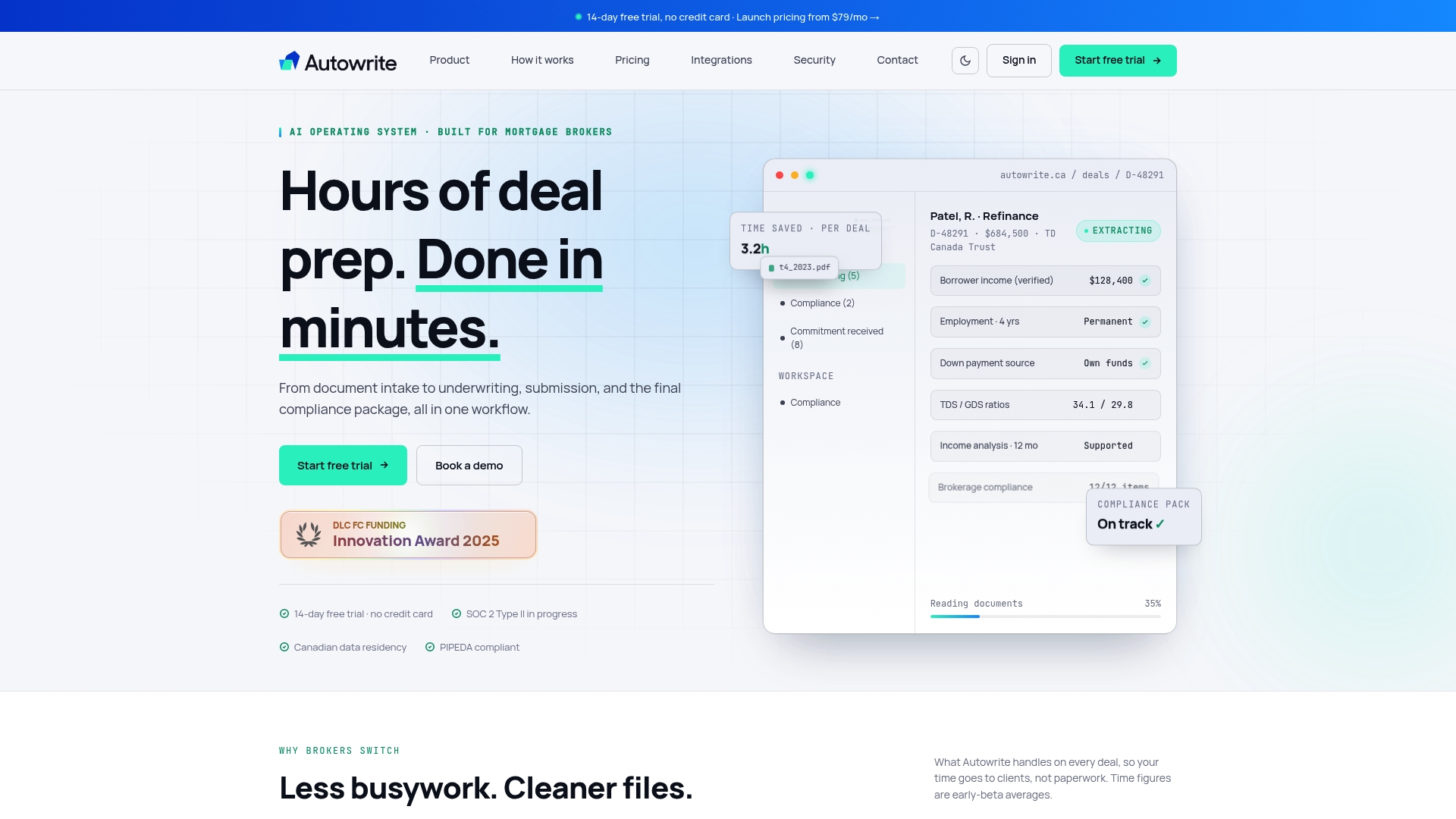
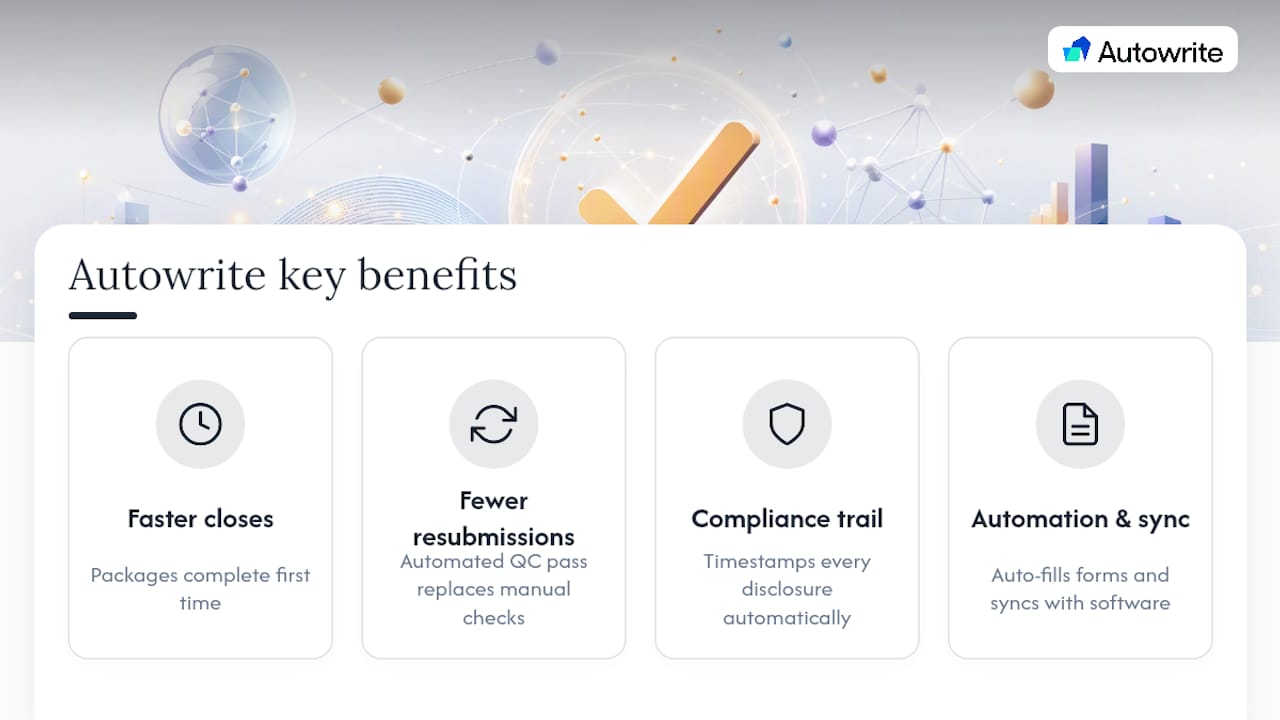
Three things brokers notice within the first few files: faster closes because packages go out complete the first time, fewer resubmissions because the QC pass happens automatically instead of manually, and a built in compliance audit trail that timestamps every disclosure without you tracking it in a spreadsheet. Autowrite also auto-fills underwriting forms and syncs with the mortgage software you already run, so the submission note and document package move together instead of living in separate systems.
If missing signatures and mismatched names are costing you resubmissions, try Autowrite or request a demo to see how the automation handles your next file from intake to submission.
Key Takeaways
A lender-ready submission depends less on document volume than on a complete package paired with a submission note that gives underwriters the borrower's story up front.
| Point | Details |
|---|---|
| Nine core items | Application, consent, credit report, income and down payment verification, property docs, note, disclosures, e-sign, portal ID. |
| Submission note first | Write a note under 200 words covering purpose, profile, exit strategy, and credit context before assembling documents. |
| Disclosure timing | Send required disclosures no later than two business days before specified events under provincial standards. |
| Naming consistency | Use a fixed file naming convention and a one-page index to cut underwriter review time. |
| Automate the routine | Autowrite classifies documents and auto-fills forms, reducing manual QC time and resubmission risk. |
Sources
- O. Reg. 188/08: Mortgage Brokerages: Standards of Practice
- WealthONE bank submission tips and FAQs
- The submission note that moves your deal forward — AMBA
- Private Lending for Mortgage Brokers | AP Capital