
Mortgage workflow automation is the orchestration layer that moves a loan file through intake, verification, conditions tracking, underwriting submission, and clear-to-close with far fewer manual handoffs. The highest ROI shows up in three places: document intake, data verification, and conditions tracking. Those three stages generate the most re-keying, the most missed paperwork, and the most stalled files.
The right approach isn't ripping out your loan origination system (LOS). Map your current file flow, pick one bottleneck to pilot, orchestrate an automation layer around the LOS using webhooks or APIs where possible, and keep a human in the loop for every judgment call.
- Definition: workflow orchestration, not a single point tool
- Best first targets: intake, verification, conditions tracking
- Technology stack: OCR/IDP for extraction, AI orchestration for routing, your existing LOS as system of record
- Guardrail: adverse-action decisions and eligibility calls stay with a licensed human
Pro Tip: Before you touch any software, time how long your processors currently spend chasing a single missing document. That number becomes your baseline, and without it you can't prove anything worked.
Key Takeaways
Mortgage workflow automation delivers the fastest, most measurable returns when it targets intake, verification, and conditions tracking while orchestrating around the existing LOS rather than replacing it.
| Point | Details |
|---|---|
| Start with intake | Standardize document structure before automating anything downstream. |
| Prioritize three stages | Intake, verification, and conditions tracking drive the largest ROI. |
| Orchestrate, don't replace | Build automation around your existing LOS instead of migrating platforms. |
| Measure before you pilot | Capture cycle time, processor-hours per file, and conditions per file as a baseline. |
| Keep humans on decisions | Adverse-action and eligibility calls stay human; automation prepares the data. |
| Autowrite fits this model | It automates intake, extraction, and underwriting prep while syncing with existing mortgage software and keeping decisions with the broker. |
Table of Contents
- What Is Mortgage Workflow Automation, Exactly?
- Where Do Mortgage Files Actually Get Stuck?
- What Results Can Lenders and Brokers Expect?
- What Technology Actually Powers This?
- Which Stages Should You Automate First?
- How Do You Roll Out Automation Without Breaking Things?
- How Should Automation Connect to Your LOS?
- How Do You Prove the ROI Actually Happened?
- What Guardrails Keep Automation Compliant?
- How Autowrite Applies This Approach for Brokers
- What Should Mortgage Operations Leaders Prioritize First?
- Ready to Automate Your Own Mortgage Workflow?
- Sources
What Is Mortgage Workflow Automation, Exactly?
The term gets used loosely, so it's worth separating three distinct things people mean when they say "automate the mortgage process."
Digitization just means converting paper to PDFs. It doesn't touch how data moves or who has to read it. Point automation solves one narrow task, like an e-signature tool or a single document scanner, without connecting to anything else. Orchestration, the thing this article is actually about, links multiple tasks into a flow: a document arrives, gets classified, gets its fields extracted, gets checked against what the file already has, and the result lands in front of a processor as decision-ready data instead of a stack of unsorted PDFs.
Intelligent document processing (IDP) and optical character recognition (OCR) sit underneath most of this. OCR reads the text; IDP adds classification and field extraction with confidence scores attached.
Where teams get confused is conflating robotic process automation (RPA) with AI orchestration. RPA follows rigid, rule-based scripts. It breaks the moment a form changes format. AI orchestration handles unstructured inputs, messy scans, inconsistent naming conventions, and still produces usable output. The goal isn't automation for its own sake. It's decision-ready data landing in front of the right person at the right moment.
Where Do Mortgage Files Actually Get Stuck?
Every loan file moves through roughly the same five stages, and each one has its own predictable failure point.
- Intake. Documents arrive scattered across email, fax, portals, and text messages, in no consistent order or naming convention.
- Verification. Processors re-key data from pay stubs and bank statements because the numbers weren't captured the first time.
- Conditions tracking. Missing conditions get discovered late, often right before the file is due to underwriting.
- Underwriting submission. Incomplete files bounce back, restarting the clock on borrower follow-up.
- Clear-to-close. Servicing handoff repeats data entry that already happened twice upstream.
The damage compounds. A missing pay stub caught at intake costs five minutes. The same missing pay stub caught at underwriting costs a resubmission cycle, a frustrated borrower, and possibly a blown rate lock. Automating downstream stages while leaving intake chaotic just moves the bottleneck. It doesn't remove it.
What Results Can Lenders and Brokers Expect?
The measurable wins cluster around four areas, and they compound on each other rather than acting independently.
Processor time is the most visible gain. When document classification and field extraction happen automatically instead of manually, processors spend their hours on judgment calls instead of data entry, which shortens cycle time per file. That shift also changes the borrower experience: clearer, more specific document requests mean fewer confused phone calls and fewer repeat asks for the same paperwork.
Loan quality improves too, mostly because automated extraction creates a consistent audit trail that a rushed manual process rarely produces. And once the bottleneck stages are automated, a brokerage can absorb more volume without proportionally growing headcount.
- Fewer processor-hours spent per file on data entry and re-keying
- Fewer borrower touches needed to complete a file
- Stronger, more consistent audit trails for compliance review
- Higher file volume handled per processor without added headcount
None of this happens by installing software and walking away. The gains show up specifically in the stages where manual work was heaviest, which is exactly why intake, verification, and conditions tracking are the priority targets rather than an afterthought.
What Technology Actually Powers This?
A modern automation stack has four working parts, and skipping any one of them tends to create a weak link that shows up later.
IDP and OCR extract structured fields, income figures, employer names, account numbers, from pay stubs, bank statements, and ID documents. This is the extraction layer, and it needs confidence scoring so low-certainty extractions get flagged rather than silently accepted.
AI orchestration replaces rigid RPA scripts with conditional logic that adapts to unstructured inputs. A sample multi-agent architecture from AWS shows how document extraction, validation, and underwriting-prep tasks can run through coordinated agents while final decisions stay with a person.
Verification connectors check extracted data against source systems and route anything below a confidence threshold to a human reviewer instead of pushing it through blind.
No-code and low-code orchestration layers let operations teams adjust workflow logic without waiting on a development sprint.
- IDP/OCR for structured extraction
- AI orchestration for conditional, adaptive routing
- Verification connectors with human-in-loop thresholds
- Low-code middleware for fast workflow adjustments
Which Stages Should You Automate First?
Not every stage deserves equal attention out of the gate. Three areas consistently deliver the fastest, most visible payoff, and they're the same three the broader ROI data points to: intake, document classification, and conditions tracking.
- Missing-document detection. An automated check flags gaps the moment a file is opened instead of days later when underwriting kicks it back.
- Auto-field population in the LOS. Extracted data from pay stubs and bank statements populates loan fields directly, cutting re-keying almost entirely.
- Triggered follow-ups. Borrowers get automatic, specific reminders about exactly what's missing, instead of a generic "we need more documents" email.
- Post-close QC automation. Once the front end is stable, add automated quality control checks after closing. Doing this too early just audits a broken process more efficiently.
Pro Tip: Resist the urge to automate everything simultaneously. Pick the single stage causing the most processor complaints, fix that first, and let the win build internal support for the next phase.
How Do You Roll Out Automation Without Breaking Things?
A rushed rollout is how automation projects fail quietly, six months in, with nobody quite sure why cycle times didn't improve. A sequenced approach avoids that.

Step 1: Map and baseline. Document your current file flow stage by stage and capture pre-baseline numbers, cycle time per stage, processor-hours per file, conditions per file, before changing anything. Skipping this step means you'll have no way to prove the pilot worked.
Step 2: Diagnose the real bottleneck. Standardizing intake and file structure matters more than any software choice you'll make next. Automating a disorganized intake process just scales the disorganization.
Step 3: Pilot narrow. Scope a 60 to 90 day pilot on one loan type or one branch. Define success metrics up front, not after you see the results.
Step 4: Choose your integration pattern. Favor webhook or API connections into your existing LOS over rebuilding it. An orchestration layer added on top of the LOS is almost always faster and lower risk than migrating to a new platform.
Step 5: Roll out with change management. Train processors on what changed and why, not just how to click through the new screens.
Step 6: Measure and scale. Compare post-pilot metrics against baseline, then expand to the next bottleneck.
- Map the file flow before touching software
- Fix intake structure before automating around it
- Pilot one bottleneck, not the whole process
- Prefer webhook/API integration over LOS migration
- Train staff on the "why," not just the click path
How Should Automation Connect to Your LOS?
Three integration patterns exist, and picking the right one depends heavily on your LOS contract and your IT team's bandwidth.
Webhook-driven integration pushes events from the LOS to the automation layer the moment something changes. It's low latency and low maintenance, but only works if your LOS vendor actually supports event pushes.
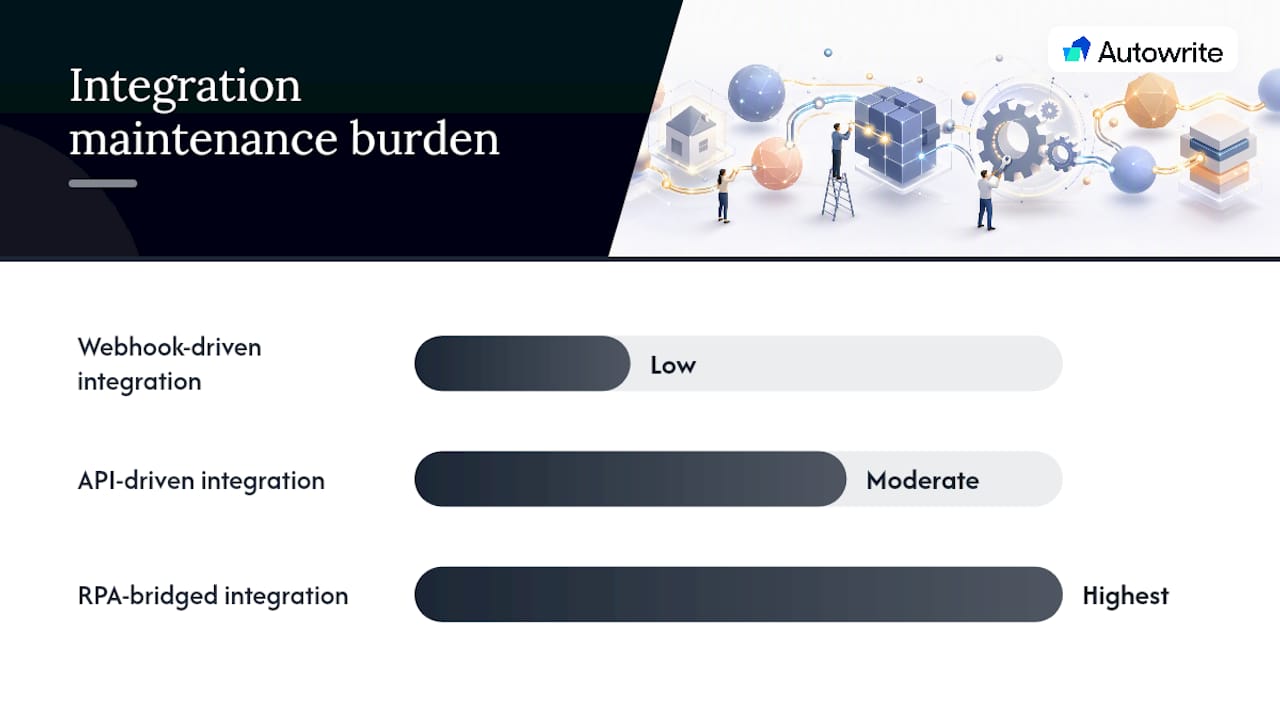
API-driven integration allows fuller two-way read and write access. It handles more complex workflows than webhooks alone, though it carries a moderate ongoing maintenance burden as both systems evolve.
RPA-bridged integration simulates clicks and keystrokes when neither webhook nor API access is available. Treat this as a last resort. It's the highest-maintenance option and breaks whenever the underlying screen layout changes.
- Webhook: fastest, lowest maintenance, requires vendor support
- API: fuller functionality, moderate ongoing maintenance
- RPA bridge: fallback only, highest maintenance and fragility
- Review vendor contracts for data residency and security terms before committing to any pattern
Loan origination remains the system of record throughout. Automation should orchestrate around it, not attempt to replace it.
How Do You Prove the ROI Actually Happened?
Vanity metrics, like "documents processed" or "automations triggered," don't tell you whether files close faster. The numbers that matter are closed-loop outcomes tied directly to your pre-pilot baseline.
| Metric | What It Tells You |
|---|---|
| Cycle time per stage | Whether files move faster through intake, verification, or underwriting specifically |
| Processor-hours per file | The direct labor savings automation is generating |
| Conditions per file | Whether conditions get caught earlier instead of late |
| Files per processor | Capacity gained without adding headcount |
| Close-date predictability | Whether borrowers and referral partners can trust your timelines |
For targeted SMB pilots, ROI often becomes visible within roughly three months when the pilot scope is narrow and the baseline was captured properly. Skip the pre-baseline step and that timeline becomes unprovable, even if the improvement is real.
What Guardrails Keep Automation Compliant?
Automation should prepare decision-ready data. It should never make the decision. Adverse-action determinations and eligibility judgments stay with a licensed human, full stop. What automation can and should do is surface confidence scores from extraction, flag anomalies, and route uncertain data to a reviewer instead of quietly accepting it.
Auditable logs matter just as much. Every automated step needs a data lineage trail showing what changed, when, and on what basis, because a regulator or auditor will eventually ask.
- Keep adverse-action and eligibility calls with a human reviewer
- Log every automated step with a clear data lineage trail
- Surface IDP confidence scores rather than hiding uncertain extractions
- Avoid automating before intake and file structure are standardized
- Treat heavy RPA dependency as a maintenance liability, not a stable foundation
Pro Tip: If you can't explain to an auditor exactly why a file moved from step three to step four, your automation isn't ready for production. Fix the logging before you scale the volume.
How Autowrite Applies This Approach for Brokers
Autowrite builds its document intelligence around the same "orchestrate, don't replace" principle this guide lays out. It automates intake, classification, and data extraction, then auto-fills underwriting forms and syncs with existing mortgage software rather than asking brokers to switch platforms.
That matters most in the stages this article flags as highest-ROI: intake and conditions tracking. Autowrite's platform assembles e-sign and compliance packages and runs income and down payment analysis, while final decisions stay with the broker, consistent with the human-in-loop principle covered above.
- Document intelligence for classification and extraction, not just storage
- Auto-fill into underwriting forms, syncing with existing mortgage software
- Canadian data residency built into the platform's design
- Team pipeline management alongside compliance package assembly
What Should Mortgage Operations Leaders Prioritize First?
If you take one thing from this guide, make it intake standardization. Every automation project I've seen underperform started by automating a downstream stage while intake stayed chaotic, which just moves the bottleneck instead of removing it.
Pick your first pilot based on where processors complain the loudest, not where the software demo looked most impressive. And whatever you automate, keep the actual lending decisions with a licensed person. Automation's job is to hand that person a clean file faster, not to make the call for them.
Ready to Automate Your Own Mortgage Workflow?
Everything covered above, intake standardization, LOS-preserving integration, human-in-loop decisioning, is exactly what Autowrite was built to run for licensed mortgage brokers. Instead of hiring a developer to bridge your LOS or hoping a generic RPA script survives the next form update, Autowrite's document intelligence classifies intake, extracts fields, and auto-fills underwriting forms while keeping your existing mortgage software in place.
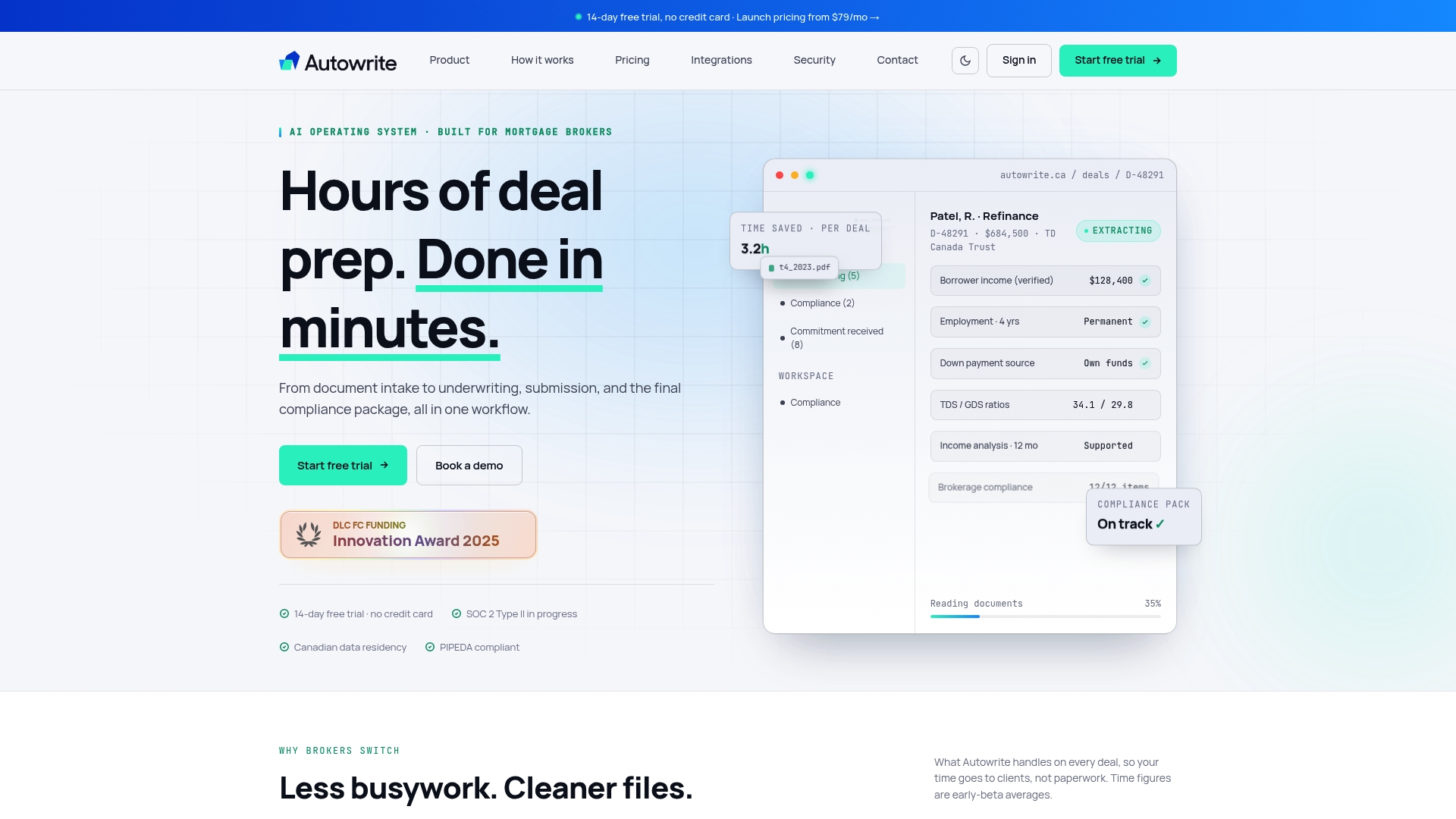
Brokers using it spend less time re-keying pay stub numbers and more time on the parts of the job that actually require judgment: talking to clients, structuring deals, and closing faster. Compliance packages assemble automatically, and Canadian data residency is built into the platform rather than bolted on. If the bottlenecks described in this guide sound familiar, start a trial with Autowrite and see how your own intake pile looks after the first week.
Sources
- Mortgage Workflow Automation (2026) | WisdomStream
- Autonomous mortgage processing using Amazon Bedrock Data Automation and Amazon Bedrock Agents
- Workflow optimization in mortgage operations: What actually changes outcomes - Affinity Home Lending
- Loan origination — Wikipedia