

Rental income can boost how much mortgage you qualify for, but the amount that counts depends entirely on whether the property is owner-occupied and which method the lender uses to calculate it. Most lenders add back roughly 50% of gross rent for a non-owner-occupied rental unit, though CMHC's Income Property program and certain credit unions will go higher for legal suites in your primary residence. The Canada Revenue Agency, CMHC, and OSFI each play a role in what gets recognized and how.
Before you apply, do three things:
- Confirm whether the unit is owner-occupied or a standalone investment property.
- Gather lease agreements, tax records, and bank deposit history now, not later.
- Run a rough ratio check using 50% of expected rent to see if it moves the needle.
Key Takeaways
Rental income can meaningfully raise your mortgage qualifying power, but the exact benefit hinges on property type, lender method, and documentation quality.
| Point | Details |
|---|---|
| Property type drives the rate | Owner-occupied legal suites often qualify for 80% to 100% add-back versus roughly 50% for standalone rentals. |
| Documentation must match | Leases, bank deposits, and T776 filings all need to tell the same consistent story. |
| CMHC sets the floor | CMHC Income Property allows up to 50% gross or net rental income for 2 to 4 unit non-owner-occupied properties. |
| Stress test still applies | Qualifying happens at contract rate plus 2% or the floor rate, whichever is higher, regardless of rental add-back. |
| Lender variation is real | Policies differ across A-lenders, credit unions, and B-lenders, so confirm specifics with a broker. |
Table of Contents
- How Lenders Actually Count Rental Income
- Documents You Need To Prove Rental Income
- How Rental Income Changes Your GDS and TDS
- Down Payment and Insurance Rules for Investment Properties
- Self-Employed Landlords, New Rentals, and Short-Term Stays
- What Brokers Check Before Submitting Your File
- The Real Gap in Most Rental Income Advice
- Frequently Asked Questions
- Sources
How Lenders Actually Count Rental Income
Lenders use one of two approaches. The add-back method takes a portion of gross rent and adds it directly to your qualifying income. The offset (net) method instead subtracts the rental unit's carrying costs (mortgage payment, taxes, heat) from the rent, then applies only the net figure to your ratios.
CMHC's Income Property guidelines let lenders use up to 50% of gross rental income or a net rental income approach for 2 to 4 unit non-owner-occupied properties, and taxes and heat can sometimes be excluded from the GDS and TDS calculations. Treatment shifts again when you're buying a home with a legal secondary suite you'll live in. CMHC's rental income guidance allows more generous recognition in owner-occupied scenarios, and some credit unions and B-lenders will credit 80% to 100% of suite rent when the unit is legal and self-contained.
Typical patterns:
- A-lenders: around 50% of gross rent for non-owner-occupied properties.
- Credit unions and B-lenders: often 80% to 100% for owner-occupied legal suites.
- Conservative underwriting kicks in when there's no tax history, high vacancy risk, or unclear operating expenses.
Pro Tip: Ask your lender up front whether they use add-back or offset. The same rental figure can produce a noticeably different qualifying income depending on which method they apply.
Documents You Need To Prove Rental Income
Lenders won't take your word for it. Bring:
- A signed, executed lease agreement.
- Bank statements showing consistent rent deposits.
- T1 general returns with the T776 rental income schedule attached.
- A recent Notice of Assessment (NOA) from the Canada Revenue Agency.
- A market rent letter or appraisal if the unit is currently vacant or newly built.
Most lenders want at least one full tax year of reported rental income before they'll count it at face value. If the suite is brand new, a professional appraisal substituting for tax history is often accepted, but only if the unit meets local zoning and legal-suite requirements. A basement apartment without a permit can get excluded from your application entirely, regardless of how much rent it actually generates.
How Rental Income Changes Your GDS and TDS
GDS (Gross Debt Service) and TDS (Total Debt Service) are the ratios lenders use to decide how much mortgage you can carry. CMHC references GDS at roughly 39% and TDS at roughly 44%, and how those ratios get calculated determines exactly where rental income gets plugged in.
Say you earn $75,000 a year and expect $2,000 a month in rent from a legal suite. At a 50% add-back, that's $1,000 a month, or $12,000 a year, added to your qualifying income. At 80%, it's $19,200. That gap alone can shift your maximum approved mortgage by tens of thousands of dollars.
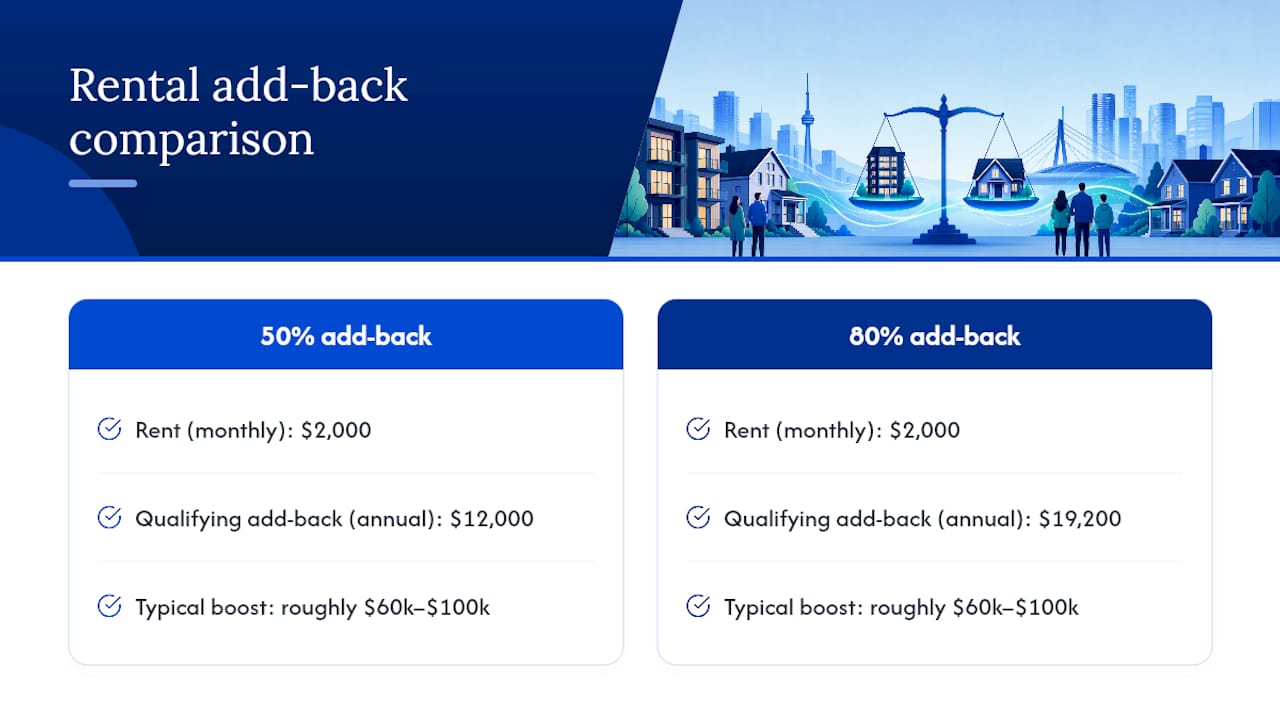
Mortgage guides that walk through similar math show rental income adding roughly $60,000 to $100,000 to borrowing capacity in common scenarios.
Pro Tip: Always stress-test the number. If you're qualifying at the contract rate plus 2% or the posted floor rate, whichever is higher, a strong rental add-back can offset the stress-test hit. A weak one won't.
Down Payment and Insurance Rules for Investment Properties
Buying a straight rental property, one you won't live in, comes with tighter rules than buying a home with a rental suite attached.
- Many non-owner-occupied rental properties require a substantial minimum down payment.
- CMHC mortgage insurance generally isn't available for pure investment properties bought without owner occupancy; it applies more readily to owner-occupied properties with rental suites through the Income Property program.
- Rental-heavy mortgages can carry a rate premium compared to insured, owner-occupied loans.
Practical guides estimate that rate premiums on rental property mortgages commonly run somewhere in the range of a few tenths to around half a percentage point higher than a comparable owner-occupied insured mortgage, though the exact spread varies by lender and file strength. OSFI's clarification on rental income and mortgage classification adds another layer: capital rule changes affecting how banks classify rental-heavy loans (IPRRE) can influence pricing, even when your file technically qualifies fine under standard underwriting.
Self-Employed Landlords, New Rentals, and Short-Term Stays
Self-employed borrowers reporting rental income through a corporation face extra scrutiny. Lenders typically want two years of T776 schedules and clear evidence you're actively involved in managing the property, not just a passive shareholder.
- New suites with no tax history: a market rent letter or formal appraisal often substitutes.
- Short-term rentals (Airbnb-style): most lenders treat this income cautiously and want a longer track record plus platform statements, since occupancy swings more than a standard lease.
- Watch for double-counting: OSFI's guidance flags that the same rental income shouldn't be leveraged to qualify for multiple mortgage applications simultaneously.
Two years of consistent T776 filings and a clean paper trail beat any verbal explanation of what a unit "should" rent for. Lenders underwrite paper, not promises.
What Brokers Check Before Submitting Your File
Brokers who work rental-income files regularly run a consistent checklist:
- Confirm the lease matches the bank deposits, dollar for dollar.
- Cross-check T1/T776 filings against the claimed rent.
- Verify the suite is legal through municipal zoning records.
- Match your file to the lender program most likely to accept your specific rental scenario, whether that's an A-lender, credit union, or CMHC Income Property.
Manual document review is where files get slowed down or rejected on technicalities. Automated document intelligence, the kind Autowrite builds for Canadian brokers, extracts lease terms, matches deposits, and flags missing rental documentation before underwriting even starts.
Pro Tip: A broker who specializes in rental income files usually knows which lenders will stretch further on suite income and which ones won't touch a short-term rental at all.

The Real Gap in Most Rental Income Advice
Most explainers treat rental income as a flat percentage you can plug into a spreadsheet. That's not how underwriting actually works. The number that matters isn't "what percentage of rent counts," it's whether your paperwork tells a story a human underwriter can verify in five minutes instead of fighting through for two weeks.
The 2026 OSFI clarification exposed something the industry had been fuzzy about for years: rental income rules for qualifying a borrower and capital classification rules for the bank are separate systems. Conflating them led plenty of applicants to assume rental income had gotten harder to use, when what changed was internal bank pricing, not your ability to qualify.
If you take one thing from this, prioritize documentation over percentage-chasing. A borrower with a clean two-year T776 history and matching bank deposits will out-qualify someone with a technically higher rent roll and messy paperwork almost every time.
Frequently Asked Questions
Does rental income help me qualify for a mortgage in Canada? Yes. Lenders generally count 50% of gross rent for non-owner-occupied properties, with higher rates possible for legal suites in owner-occupied homes.
What percentage of rental income counts toward a mortgage? It ranges from roughly 50% for standalone investment properties to 80% or 100% for owner-occupied legal suites, depending on the lender and CMHC program used.
Can I use rental income from a new suite with no tax history? Often, yes, using a market rent letter or professional appraisal instead of tax records, though lenders vary on how much weight they'll give it.
Does Airbnb income count toward mortgage qualification? Some lenders count it cautiously and typically want a longer income history plus platform statements before including it.
Sources
- CMHC Income Property
- Rental Income (Canada Revenue Agency, T4036)
- Clarifying OSFI's guidance: rental income and mortgage classification (OSFI)
- Rental Property Mortgage in Canada: Down Payment, Qualification & Tax Rules (2026) | WealthNorth