
Yes, your gig income can qualify you for a mortgage if you can document it properly. Lenders rely on your Notice of Assessment, T1 General and Form T2125, and they typically want about 24 months of stable, verifiable earnings. The federal stress test still applies and will shape how much you can actually borrow.
TL;DR:
- Lenders typically require two years of stable, verifiable tax documentation, including NOAs, T1 General, and T2125, to consider gig income for a mortgage.
- Self-employment income from gig work is assessed the same way as small business income, emphasizing consistency and independent verification over short-term peaks.
- Combining multiple income streams, maintaining proper records, and demonstrating business stability can improve approval chances even with less than two years of history.
- A larger down payment can help gig workers avoid insurer restrictions and increase flexibility in qualifying for a mortgage.
- Proper organization of documents, including separate business accounts and detailed profit and loss statements, accelerates underwriting and reduces conditions.
Table of Contents
- How lenders view gig and platform income
- What counts as gig income and the tax paperwork lenders expect
- How lenders calculate your qualifying income
- Step-by-step: build your mortgage-ready file
- Combining multiple income streams and what GST/HST registration signals
- If you have under 24 months of history or low declared income
- Five mistakes gig workers commonly make
- What better documentation means for the brokers handling these files
- A faster way to handle gig income files
- FAQ
- Sources
How lenders view gig and platform income
Lenders and regulators treat gig and platform income as self-employed income, full stop. It doesn't matter whether you drive for a rideshare app, deliver groceries, freelance as a designer, or rent out a spare room on Airbnb: once that money isn't coming from a T4 employer, it falls into the self-employed bucket for underwriting purposes.
That classification changes everything about how an application gets evaluated. A salaried applicant can often lean on a letter of employment and two pay stubs. A gig worker has to prove a pattern of earnings over time, because a single good month or even a single good year doesn't tell a lender much about what happens next year.
The underwriting objective is always the same: can you actually afford the payments, based on income a lender can verify independently? OSFI's guideline B-20 directs federally regulated lenders to verify income using sources that are hard to falsify and to account for how stable that income really is. A gig worker's bank deposits alone don't satisfy that bar. Tax filings do, because they're filed with the government and carry consequences for inaccuracy.
This is also where mortgage insurers come into the picture. If your down payment is under 20%, your lender needs to insure the mortgage, and insurer rules add another layer of scrutiny on top of the lender's own policies. That's one reason gig workers sometimes find more flexibility with a larger down payment: it removes the insurer from the equation and leaves the lending decision entirely with the bank or alternative lender.
A few things follow from this framing:
- Your gig income is assessed the same way a small business owner's income would be, not like a part-time side gig.
- Lenders want to see a trend, not a snapshot, so consistency across tax years matters more than a single strong month.
- Independent verification, meaning tax documents issued by the government, carries far more weight than app dashboards or personal bank statements alone.
What counts as gig income and the tax paperwork lenders expect
Almost any income you report on your tax return as self-employment counts: rideshare and delivery driving, freelance writing or design, consulting, content creation, tutoring, and short-term rental income all qualify as gig income in a lender's eyes. What matters is not the platform you use but how cleanly that income shows up on your tax filings.
Three documents form the backbone of a gig income mortgage application:
- Notice of Assessment (NOA) from the Canada Revenue Agency for each of the last two tax years, confirming what you reported and that CRA accepted it.
- T1 General returns for the same period, showing your total income picture alongside your self-employment earnings.
- Form T2125, the Statement of Business or Professional Activities, which breaks down your gross revenue, expenses, and net income from self-employment.
Beyond those three, lenders generally want supporting evidence that paints a fuller picture: 12 to 24 months of business bank statements, payout reports from the platforms you work with, copies of invoices or client contracts if you freelance, and proof of GST/HST registration and remittance history if your revenue crosses the threshold that requires it.
The practical work here happens long before you apply. Keep a dedicated business bank account separate from your personal spending, because mixed accounts make it nearly impossible for an underwriter to isolate your real business income from personal transfers. Build a simple profit and loss statement that matches what you filed on your T2125, and if your finances are at all complicated, have an accountant review it so there's no daylight between your records and your tax return.

Pro Tip: Ask your accountant for a letter confirming your net self-employment income for the past two years. A one-page accountant letter can resolve underwriter questions faster than a stack of bank statements.
If you're a mixed-income borrower, perhaps combining gig work with rental income from a property, our rental income mortgage guide walks through the documentation lenders expect for that income type specifically.
How lenders calculate your qualifying income
Most lenders average your declared net self-employment income over the past two tax years. If your T2125 showed $55,000 in net income one year and $65,000 the next, a lender will typically use $60,000 as your qualifying figure, not the higher recent number.

Because self-employed borrowers often claim legitimate business deductions that reduce taxable income, some lenders allow gross-ups or add-backs for specific non-cash expenses, like depreciation or home office write-offs, if you can document them clearly. This is one area where a detailed P&L and accountant support genuinely change your qualifying number for the better.
A smaller set of lenders, mostly alternative or monoline lenders, offer bank-statement or deposit-averaging programs that estimate income based on cash flow rather than net declared income. These programs can help borrowers whose tax filings understate true cash flow due to aggressive deductions, but they often come with a rate premium.
Whatever income figure a lender lands on, it then gets run through the stress test required under OSFI's B-20 guideline. You must qualify at the greater of your contract rate plus 2 percentage points or the minimum qualifying rate the regulator publishes, which shrinks your effective borrowing power compared to what the quoted rate alone would suggest.
The stress test requires you to qualify as if your rate were 7%, which lowers the maximum mortgage amount a lender will approve even though your actual payments will be based on the lower rate.
OSFI's guidance requires lenders to verify income using independent, hard-to-falsify sources and to normalize irregular earnings before applying this stress test, which is exactly why two years of consistent tax filings carry so much weight in a gig income file, as described in OSFI's B-20 guideline.
- Qualifying income is usually a two-year average of net self-employment income, not your most recent or highest year.
- Add-backs for non-cash deductions can raise your qualifying income if you can document them.
- The stress test applies regardless of which lender or income calculation method you use.
Step-by-step: build your mortgage-ready file
Preparing a strong file is mostly about sequencing. Gather the right documents in the right order, and the rest of the application moves faster.
- Pull your NOAs for the past two tax years directly from your CRA My Account, since lenders want the official document, not a summary.
- Collect your T1 General returns for the same two years alongside the NOAs.
- Prepare your Form T2125 for each year, or ask your accountant for copies if they filed on your behalf.
- Assemble 12 to 24 months of business bank statements, ideally from an account used only for business transactions.
- Download payout and earnings reports from every platform you work with, since app dashboards sometimes only show recent history.
- Organize invoices or signed contracts for any freelance or consulting work, especially recurring or retainer arrangements that signal income stability.
- Confirm your GST/HST registration status and gather remittance records if your revenue requires registration.
- Have an accountant review your P&L and reconcile it against your T2125, catching discrepancies before a lender does.
Pro Tip: Save every document as a labeled PDF in one folder by year and type. A broker can move your file through underwriting much faster when nothing needs to be chased down or re-requested.
Recurring contracts or retainer income deserve special attention here. If you can show a client relationship that's lasted a year or more with consistent monthly billing, that's evidence of stability that a lender will weigh more heavily than a pile of one-off gig payments. Brokers often use exactly this kind of documentation to justify income add-backs, since it shows the underwriter that your income isn't just variable, it's recurring and reasonably predictable. Our self-employed income mortgage guide covers the CMHC-specific documentation expectations in more depth if you're applying for an insured mortgage.
Combining multiple income streams and what GST/HST registration signals
Most gig workers don't rely on a single platform. If you drive for a rideshare app and also freelance on the side, all of that taxable income needs to show up on your T1 and T2125, ideally with a consistent pattern across both streams rather than one dominant source that fluctuates wildly.
Gross-ups and add-backs become relevant again here: if your combined net income looks thin because of legitimate deductions, documentation showing the deducted items were non-cash or one-time can support a higher qualifying figure. Lenders want paperwork, not just an explanation.
CRA guidance also notes that earning more than $30,000 over four calendar quarters triggers mandatory GST/HST registration, and a clean remittance history can actually work in your favor during underwriting, since it signals a real, ongoing business rather than occasional side income.
- Report every taxable income source on your T1 and T2125, even small or occasional gig work.
- Keep documentation ready to support any gross-up or add-back you want a lender to consider.
- Maintain GST/HST remittance records once you cross the $30,000 threshold, since this history can reinforce the legitimacy of your business.
If you have under 24 months of history or low declared income
Not everyone has two full years of gig income to show, and not every file will look strong on paper even with two years filed. A few realistic paths exist for thinner files.
A co-signer with stable, verifiable income can offset weaker self-employment history, particularly for a first purchase. Asset-based approaches, where a lender considers savings or investments alongside income, can help if you have substantial reserves but a short self-employment track record. Bank-statement loan programs, offered by some alternative lenders, estimate income from cash flow rather than net declared income, though they usually carry a rate premium.
An accountant-reviewed P&L carries real weight if your declared net income understates your actual cash flow due to deductions. Long-term contracts or retainer relationships help demonstrate stability even without two full tax years. Prior salaried employment in a related field can also support your case, since it shows a track record even if your current income source is newer.
- A larger down payment reduces lender risk and can open up more options when your history is thin.
- Working with a broker experienced in self-employed files often surfaces lenders willing to look past a standard two-year requirement.
- Sometimes the better move is simply to wait and accumulate a second year of filings rather than force an application through a lender with stricter requirements.
If you're weighing financing alternatives while you build up that history, WeFinanceU offers advisory services aimed specifically at applicants who don't yet have the standard two years on file.
Five mistakes gig workers commonly make
- Mixing personal and business finances, which makes it hard for any lender to isolate real business income.
- Failing to file or keep NOAs and T1s current, leaving no official paper trail to verify income.
- Not retaining platform payout records, since some apps don't preserve historical earnings data indefinitely.
- Letting credit slip before applying, when a few months of on-time payments could have strengthened the file.
- Applying with only one lender instead of working with a broker who knows which lenders handle gig income well.
For a deeper look at how recordkeeping habits now affect approval chances, it's worth checking tax filing and recordkeeping guidance built specifically for self-employed Canadians.
What better documentation means for the brokers handling these files
Gig income files live or die on paperwork quality. When documents come in organized, classified, and verified against the right figures, underwriting moves faster and fewer conditions come back from the lender. Reviewing NOAs, T1s, and T2125 forms by hand for every self-employed applicant is exactly the kind of repetitive work that invites errors under deadline pressure. Our mortgage document checklist for brokers outlines a workflow built around exactly this problem.
— Anant Bawa
A faster way to handle gig income files
We built Autowrite to take the paperwork grind out of exactly the kind of file described above. For Canadian mortgage brokers, we automatically classify incoming documents, extract line-level income data from NOAs, T1s, and T2125 forms, and assemble the underwriting and compliance package that would otherwise take hours to put together by hand.
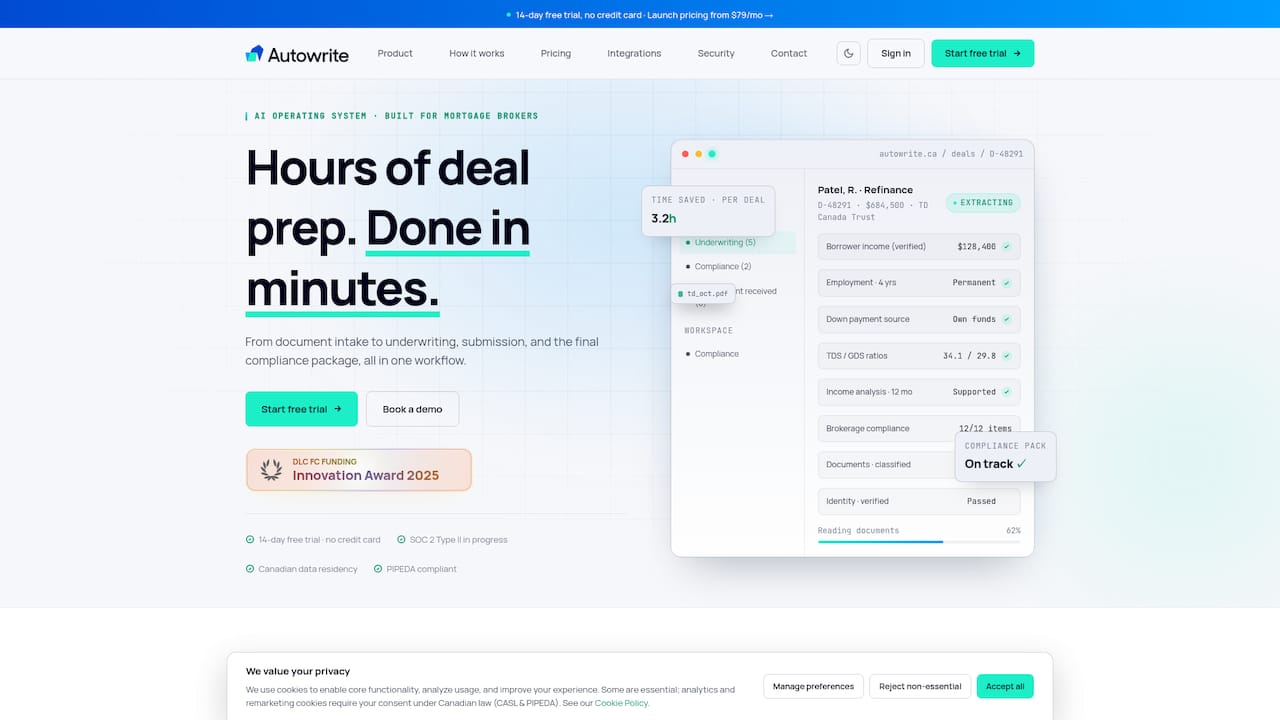
- We extract and verify self-employment income data directly from tax documents, cutting manual review time.
- We assemble compliance-ready packages so brokers spend less time chasing missing paperwork and more time with clients.
- Our plans start at $149 per month, with Starter, Pro, Legend and Enterprise options depending on deal volume.
If you're a broker juggling multiple self-employed and gig income files at once, visit our pricing page to see which plan fits your deal flow.
This article is general information, not a substitute for advice from a qualified financial advisor. Consult a qualified financial professional about your own circumstances before acting on anything here.
FAQ
What income do you need for a $1,000,000 mortgage?
The income required depends on your interest rate, amortization, debt load, and the stress test rate applied under OSFI's B-20 guideline, so there's no single fixed figure. A mortgage broker can run your specific numbers through current stress-test requirements to give you an accurate qualifying income range for your situation.
How do I get a loan as a gig worker?
You qualify by presenting your gig income as documented self-employment income, backed by two years of Notice of Assessment filings, T1 General returns, and Form T2125. Lenders also want supporting records like bank statements and platform payout reports to verify that income pattern independently.
How much does a mortgage broker make on a $500,000 mortgage?
Broker compensation varies by lender, deal structure, and province, and isn't published as a standard rate, so it's not publicly listed in a way that applies universally. Brokers are typically paid by the lender rather than the borrower, so the exact commission on any given deal depends on the specific agreement between broker and lender.
Can I use my Airbnb income to qualify for a mortgage?
Airbnb and other short-term rental income is treated as self-employment income and needs to appear on your T1 and Form T2125 to count toward qualifying income. Lenders will want to see a consistent history of that income reported on your tax filings, following the same documentation standards as other gig income.
Sources
- CMHC Self-Employed mortgage loan insurance
- OSFI: Residential mortgage underwriting practices and procedures (B-20)
- Canada