
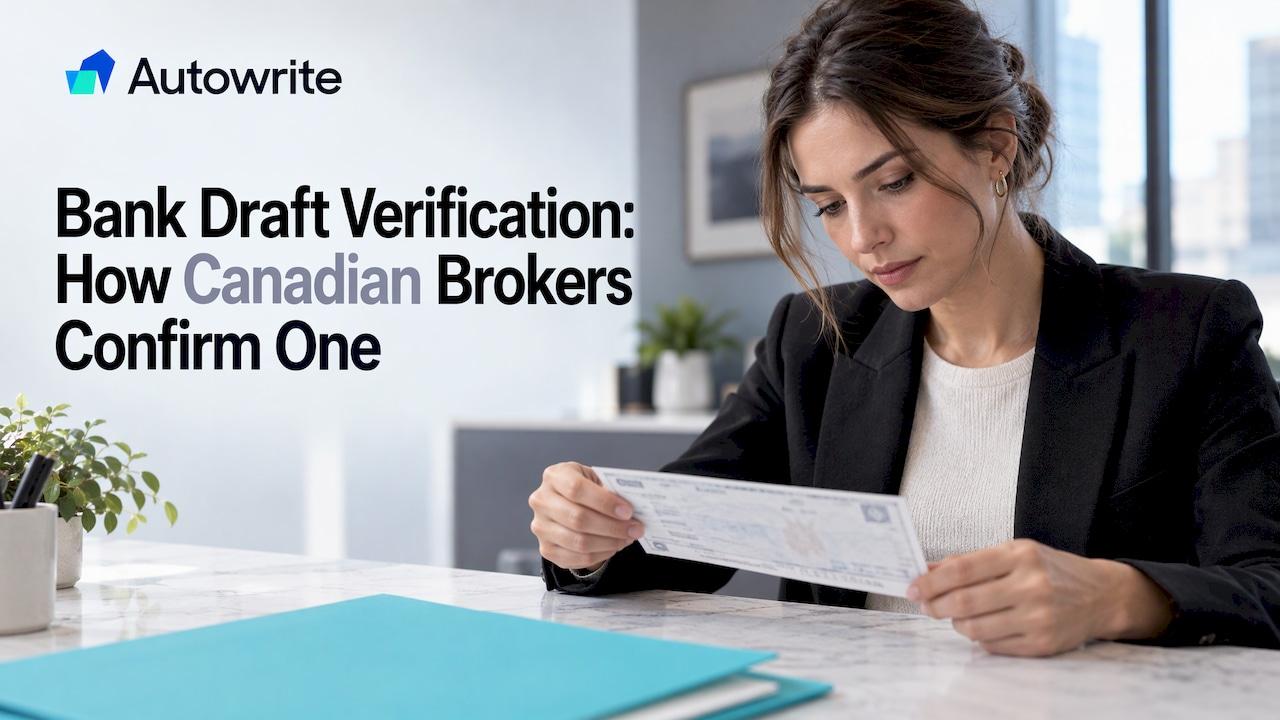
A bank draft can be verified only by the institution that issued it. The paper itself proves very little, and a draft that has been deposited is not proof of final funds. For a mortgage file, the safe routine is to read the draft, call the issuing branch on a number you looked up yourself, hold any release of funds until clearing is confirmed, and keep a clean record of each step. Autowrite is built for the paperwork around that routine: document intake, classification, data extraction and down payment analysis for Canadian mortgage brokers.
This guide is written for brokers, agents and brokerage owners who handle down payment evidence. It covers what a draft contains, how to confirm it, the warning signs, and what to do when something is wrong.
TL;DR
- A bank draft is guaranteed by the issuing bank, but it can still be counterfeited. Confirm it with the issuing institution, using a phone number you found independently.
- A deposit that shows as credited is provisional. The CBA says the credit can be removed if the item is found fraudulent when it is processed.
- Clearing a Canadian cheque drawn on a Canadian bank can take at least six business days, so do not release funds or finalize a file on the strength of a deposit slip.
- Overpayments, pressure to act quickly and drafts signed over from a third party are the classic tells.
- If a draft looks wrong, stop, keep records and report to the Canadian Anti-Fraud Centre and your bank.
Table of Contents
- What a bank draft is and why it shows up in mortgage files
- What is on a genuine draft
- How to verify a bank draft, step by step
- Deposited does not mean final
- Warning signs of a counterfeit or fraudulent draft
- Where this meets your compliance obligations
- If a draft looks wrong
- Where the paperwork time goes
- Put the routine into your workflow
- FAQ
- Sources
What a bank draft is and why it shows up in mortgage files
A bank draft is a document issued by a financial institution that certifies the funds are available. National Bank explains that the bank withdraws the amount from the customer's account and places it in a reserve account, so the money is guaranteed when the draft is cashed. It lists paying the down payment on a property as a typical use, and it notes that a draft is generally recommended for amounts of several thousand dollars or more.
That guarantee is why drafts are common in real estate: lawyers, sellers and lenders trust them more than a personal cheque. It is also why fraudsters copy them. For a broker, a draft usually appears in one of three ways:
- A client brings a copy of a draft, or a photo of one, as evidence of the down payment they will deliver at closing.
- A client or a third party sends a draft to a deposit account, such as a lawyer's trust account.
- A client shows a draft as proof of funds that were moved from another account.
In each case the question is the same: is this instrument real, and where did the money come from?
What is on a genuine draft
Know what you are looking at before you call anyone. According to National Bank, the negotiable portion of a draft contains the date of issue, the amount, the payee name, the issuing bank name, the signatures of bank staff, the draft number, and the institution's transit, institution and account numbers. A copy that is missing any of these deserves a closer look.
Paper security features help in person. The Canadian Bankers Association (CBA) notes that cheque security features can include watermarks and intricate designs that disappear if the item is scanned or photocopied. A related point from a Strait Area Chamber of Commerce alert, citing the CBA and a BMO relationship expert, is that most money orders and drafts should carry a protecto-graph mark for the dollar amount impressed into the paper.
This matters for brokers because most of what reaches you is a scan or a phone photo. Those features are exactly what a scan removes. A scanned draft can tell you what the document claims, such as the payee, amount and transit number. It cannot tell you whether the document is real.
How to verify a bank draft, step by step

1. Read the draft against the file
Compare the payee, amount and date with the purchase agreement, the deposit instructions and the client's application. Note the issuing institution, the draft number and the branch transit number. Mismatches in names or amounts are the first thing to resolve, before any call.
This is where document handling does the heavy lifting. Autowrite automates document intake, classification and data extraction, and it provides down payment analysis, so the draft details and the supporting statements land in one place instead of being retyped from an email attachment. Our extraction shows line-level confidence, which helps you see which values to double-check before you pick up the phone.
2. Find the issuing branch's number yourself
Never use a phone number printed on the draft, in an email, or given to you by the person delivering it. The Bank of Canada's fraud guidance cautions that you should never assume the number on call display is accurate, and the same logic applies to any number supplied by the other party. Look up the institution's number from its official website or from a statement you already trust.
3. Ask the issuing institution to confirm
National Bank says that to avoid a forged document you should contact the issuing financial institution to verify authenticity. The CBA says that if you are suspicious of a money order or bank draft, you can have your bank call the cheque writer's bank to ensure it is legitimate. The LAWPRO and Toronto Lawyers Association fraud-prevention materials for law firms add a practical list: ask your bank or the issuing bank to confirm the branch transit number and that the cheque is legitimate, and call the entity making the payment to confirm it is aware of the transaction (LAWPRO and TLA, April 2023).
Write down who you spoke to, the time, the draft number and what they confirmed. That note belongs in the file.
4. Confirm the source of the money
A genuine draft still raises a file question: whose money is it, and where did it come from? A draft purchased with funds moved in at the last minute, or by someone other than the borrower, needs an explanation and documents behind it. Our guide to down payment analysis for Canadian brokers walks through building an audit-ready trail, and the mortgage fraud red flags article covers the patterns that show up around gifted and borrowed funds.
5. Hold funds until clearing is confirmed
The LAWPRO and TLA materials advise holding funds until all banks confirm they are clear and can be withdrawn. Hold that line even when the client is anxious about a closing date.
6. Keep the record
File the scan of the draft, your verification note, the source-of-funds documents and any related communications together. National Bank also advises treating a draft like currency and keeping the non-negotiable portion separately for records. If the draft has to move, note that Canada Post and financial institutions prohibit mailing a bank draft, so National Bank suggests a courier with signature on delivery for long-distance transfers.
Deposited does not mean final
This is the point that costs people money. A draft that appears in an account balance is not necessarily good. The CBA states that provisional credit may be removed if a deposited instrument is found fraudulent when it is processed, which may take a few days or significantly longer for a foreign bank account, and that you are then responsible for collecting payment from the person or organization that owes it (CBA).
The CBA also states that a Canadian cheque drawn on a Canadian bank can take at least six business days to clear, and that you should make sure a cheque, money order or bank draft has cleared and the money is confirmed before you release anything to the other party. The BMO expert cited in the Strait Area Chamber alert makes the same point: even a certified cheque could be fraudulent, and the bank would still call the branch to verify it.
A worked example. A client delivers a draft for a deposit on a Friday, and the brokerage's trust or lawyer account shows the credit that afternoon. The client asks you to confirm to the seller's side that the deposit is in. If you do that on Friday, you have treated a provisional credit as final. The safer sequence is to call the issuing branch, log the confirmation, then wait for the receiving institution to confirm that the item has cleared before anyone relies on it.

Warning signs of a counterfeit or fraudulent draft
The CBA lists several signs to refuse: cheques showing signs of alteration, post-dated cheques, cheques made out to another individual and signed over to you, and cheques for more than the purchase price, which is a common overpayment scam.
Scotiabank describes the overpayment pattern in detail: a fraudster sends a cheque or draft for more than the asking price, says the extra covers shipping or customs or was sent by mistake, and asks the recipient to deposit it and send back the difference (Scotiabank). The refund is real money. The draft is not.
LAWPRO's guidance for legal professionals adds behavioural red flags that fit mortgage work well: generic greetings, free email services, recently registered domains, pressure to act before the cheque clears and sudden wire instructions. Counterfeit-draft fraud often runs through trust accounts, with the fraudster retaining a professional on an invented matter and using realistic ID.
Put those together, and a short checklist for your own files:
| Warning sign | Why it matters | What to do |
|---|---|---|
| Amount larger than the deal requires | Classic overpayment scam | Stop, do not refund anything |
| Draft signed over from a third party | Cheques made out to someone else are a CBA warning sign | Do not accept it |
| Pressure to move before clearing | Fraud depends on speed | Hold funds until clearing is confirmed |
| Contact only by email or a new phone number | You cannot confirm identity | Verify through independently found numbers |
| Draft details do not match the file | Possible alteration | Confirm with the issuing institution |
Fraud is not only a cheque problem. Sellers and landlords see the same scheme, and the Newfoundland property manager's guide to common cheque and rental scams shows how the same overpayment story reaches ordinary Canadians. Your clients may have met it before they meet you.
Where this meets your compliance obligations
A suspicious draft is not only a payment risk. It can be a client identification question and, in some cases, a reporting question. Our articles on FINTRAC client identification methods, suspicious transaction reports and large cash reporting cover the obligations a mortgage brokerage works under. For altered paperwork more broadly, see document tampering questions for Canadian brokers and duplicate document detection.
A verified draft with an unexplained source of funds is still a file problem. Treat the two questions, "is the instrument real?" and "is the money explained?", as separate checks, and document both.
If a draft looks wrong
The CBA's 2026 fraud toolkit for small and medium-sized businesses says to report to the Canadian Anti-Fraud Centre online or at 1-888-495-8501, to contact your bank right away so it can help stop transactions and secure accounts, and to report to local police if the loss is large or involves serious identity theft. The Toronto Police Service adds that you should stop all communication with the scammer, gather all records, notify affected financial institutions, change passwords and place an alert on your credit report through Equifax Canada or TransUnion Canada. In Toronto, fraud over $5,000 must be reported by calling the non-emergency line at 416-808-2222.
The CBA's toolkit for older adults adds the follow-up: keep records of all scam-related communications and reports, and monitor your bank, credit card and online accounts for unusual activity. If the matter involves a law firm's trust account, LAWPRO takes reports at 1-800-410-1013 or fraudinfo@lawpro.ca.
As a broker, tell your brokerage's compliance contact too, so the file is flagged and nobody else relies on the instrument.
Where the paperwork time goes
Verification itself is a short call. The time goes into everything around it: chasing the draft copy, matching it to statements, retyping figures, reconciling the down payment story and assembling the file for review. That is the work Autowrite is designed to take off your desk. It automates document intake, classification and data extraction, auto-fills underwriting forms, syncs with mortgage software, assembles e-sign and compliance packages, and provides income and down payment analysis. It also supports team pipeline management and Canadian data residency, which matters when you are holding client financial documents.
Our view
In our view, bank draft fraud succeeds when files are rushed and records are scattered. The call to the issuing institution is not the hard part. The hard part is that the draft copy sits in one email, the statements in another, and the explanation for the funds in a note on someone's phone.
We built Autowrite around the idea that a mortgage file should tell its own story. Document intelligence with line-level confidence means a broker sees which extracted values are solid and which deserve a second look. Down payment analysis means the source of funds is laid out next to the instrument, not discovered at the last minute. Compliance packages assembled from the same data mean the verification note and the supporting documents travel together.
Our advice to brokers and brokerage owners is simple: verify with the issuing institution, hold funds until clearing is confirmed, and make sure every step leaves a record. A system that does the document work for you makes that discipline easier to keep when the closing date is close.
Anant Bawa
Put the routine into your workflow
Autowrite is a subscription for licensed mortgage brokers, agents and brokerages in Canada. Plans are published on the pricing page: Starter is $99 per month, Pro is $199 per month and Legend is $399 per month, and Enterprise has no published price. An additional deal costs $20 one-off per deal, and pay as you go is $35 one-off. Paid plans come with a 14-day free trial.
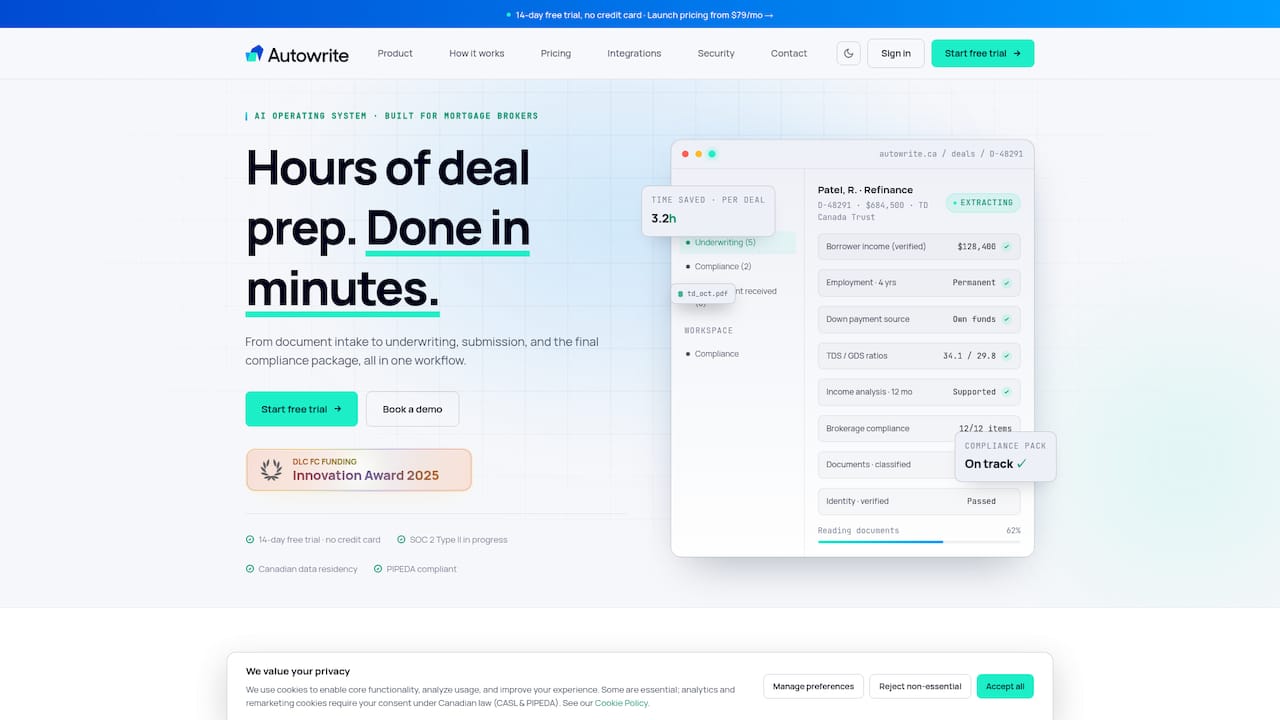
If you want down payment evidence, draft copies and compliance paperwork handled in one place, start at the Autowrite site.
FAQ
What is a bank draft in Canada?
A bank draft is a document issued by a financial institution that certifies the funds are available. The bank takes the amount from the customer's account into a reserve account, so the payment is guaranteed when the draft is cashed. National Bank notes it is used for large transactions such as a down payment on a property, and that it cannot be cancelled once issued.
How do you check a bank draft?
Contact the issuing financial institution using a number you found independently and ask it to confirm the draft. You can also ask your own bank to call the issuing bank, which the CBA describes as a way to ensure the item is legitimate. Record the name of the person you spoke to and what they confirmed.
How long before a bank draft is safe to rely on?
A deposit that shows as credited is provisional. The CBA says a Canadian cheque drawn on a Canadian bank can take at least six business days to clear, and longer for a foreign bank account. Wait for confirmation from the receiving institution that the item has cleared before you rely on the funds or release anything.
What should I do if I think a draft is fraudulent?
Stop communicating with the sender and keep all records. Contact your bank right away and report to the Canadian Anti-Fraud Centre at 1-888-495-8501. Report to local police if the loss is large or involves identity theft, and tell your brokerage's compliance contact so the file is flagged.
Sources
- What is a bank draft? | National Bank
- Protecting yourself from cheque fraud | Canadian Bankers Association
- Overpayment Scam Alert | Strait Area Chamber of Commerce
- Common scams that target your money | Scotiabank
- Protecting your firm against fraud | LAWPRO and TLA, April 2023
- Fraud prevention toolkit for small and medium-sized businesses | Canadian Bankers Association, 2026
- Fraud guidance | Bank of Canada