
A complete Canadian mortgage file has five document groups: identity and consent, income, down payment and source of funds, debts and property, and the compliance forms your regulator and auditors expect. Lenders do not ask for exactly the same things, so the checklist below is a floor you adjust per lender and per borrower type. The slow part is rarely knowing what to ask for. It is collecting, reading, checking and filing every page for every file, which is the work Autowrite is built to take off your desk.
TL;DR
- Every file needs ID, proof of income, proof of down payment and its source, a list of debts, and property documents once there is an accepted offer.
- Lender requirements differ: CMHC advises that not all lenders ask for the same documents, so confirm the list before the first client interview.
- Since January 2026 the RMA requires a Mortgage Suitability Profile and Material Risk form in every file, and BC licensees can use consolidated disclosure packages from October 13, 2026.
- Most delays come from stale statements, missing pages, name and address mismatches and a file that is not in checklist order.
Table of Contents
- The five document groups at a glance
- Identity, address and consent
- Income documents by borrower type
- Down payment and source of funds
- Debts, liabilities and property
- Compliance documents that belong in every file
- Special cases: new to Canada, job changes and private files
- How to organize and check the file before submission
- Where Autowrite fits in your workflow
- Our perspective
- FAQ
- Sources
The five document groups at a glance
| Group | What it proves | Typical documents |
|---|---|---|
| Identity and consent | Who the borrower is and that they agreed to a credit check | Government photo ID, signed credit consent, AML forms, PEP declaration |
| Income | Ability to carry the payment | Letter of employment, pay stub, T4, T1 General, Notice of Assessment (NOA) |
| Down payment | Amount and origin of funds | 60 to 90 days of statements, gift letter, sale agreement, deposit cheque |
| Debts and obligations | Existing commitments | Credit card, loan, line of credit, support and mortgage statements |
| Property | What is being financed | Listing, accepted purchase and sale agreement, tax statement, condo fees, appraisal |
An NOA is the Canada Revenue Agency's assessment of a filed tax return, and a T1 General is the personal tax return itself. Both come up repeatedly below.
Identity, address and consent
CMHC's guidance for mortgage professionals lists several pieces of government-issued ID, preferably with a photo, the current address and at least two previous addresses, and a landlord letter for renters. It also asks for current and past employer names and addresses.
On the compliance side, the RMA's April 2026 audit guidelines call for:
- AML forms, including a politically exposed person (PEP) declaration for each borrower
- a client engagement letter with signed credit consent before any bureau is pulled
- the mortgage or credit application, initialed on each page
- photo ID
Where files go wrong: a consent signed after the bureau pull, an application with one uninitialed page, and names spelled differently on the ID and the application. Approved Financial's file compliance guide is explicit that every client's first and last name must be spelled correctly on the checklist and that the full property address, with city, province and postal code, must appear.
Income documents by borrower type
Income is where lenders differ most, so build the list from the borrower's situation, then check it against the lender's own sheet.
Salaried and hourly borrowers
CMHC's list covers proof of employment and income such as pay stubs and T4 slips. National Bank's document submission checklist asks for a letter of employment dated within 60 days and a pay stub dated within 60 days showing year-to-date figures. CIBC's required documents checklist adds evidence of electronic pay deposits and a T1 General with its NOA where applicable.
The common trap is dating. A letter that was current when collected can be outside the lender's window by the time the file is submitted, so track the date on each document, not only its presence.
Self-employed borrowers
Self-employed files carry the heaviest paper load. CMHC points to two years of NOAs. National Bank's checklist asks for an attestation letter, evidence the business has operated for at least two years (articles of incorporation, a business licence or a statement of business activities) and six months of bank statements, or 12 months for seasonal businesses.
Gateway Mortgage's June 2026 guidelines show how programs split. Proof of business (articles of incorporation, business licence, GST/HST registration) and ownership percentage are required either way. The Flex program adds a self-employed form and 12 months of bank statements. The Alt Provable program asks for accountant-prepared financials or T2 corporate returns, at least six months of bank statements, a supporting NOA and T1 Generals for the last two years.

Other income
According to National Bank's checklist, other income types need their own proof:
- Pension and child tax benefit: three months of bank statements.
- Long-term disability: a letter from the insurer stating the amount and duration, plus one month of bank statements.
- Alimony or child support: a separation agreement or court order, plus three months of bank statements.
- Rental income: per Gateway's guidelines, a current lease, fair market rents or three months of bank statements, and a completed rental income worksheet.
For a deeper walk through rental files, see our guide on rental income mortgages.
Down payment and source of funds
Lenders want the amount, and they want to know where it came from. CMHC lists savings, RRSP, proceeds of a property sale or a signed, non-repayable family gift letter as the usual sources. The detail comes from the lender's checklist. National Bank's sheet asks for:
- The deposit: a copy of the initial deposit cheque, plus 60 days of bank statements if the deposit is over $10,000.
- Savings: 60 days of bank or investment statements. CIBC's list says statements within the last 90 days.
- A gift: a gift letter, and potentially the donor's bank statement showing funds available and withdrawn.
- Sale of an existing property: the sale agreement with conditions waived, a recent mortgage statement showing balance and address, and either a solicitor's trust ledger with a current bank statement or a fully signed bridge-loan commitment.
CIBC also lists an RRSP Home Buyers' Plan withdrawal as a down payment source. Note that a 60-day rule at one lender and a 90-day rule at another means the same statement may pass in one file and fail in the next. Record the window per lender when you build the file.
Debts, liabilities and property
CMHC asks for a full list of current obligations: credit cards, car loans, student loans, lines of credit, support payments and other mortgages. CIBC adds a list of assets and liabilities, the bank account and transit number, and the pre-approval certificate where one exists.
Property documents arrive once the buyer has an accepted offer. Between CMHC and CIBC the set is:
- the MLS listing and the signed Offer to Purchase
- the full address with legal description
- property tax statements or estimates
- condo fees and heating costs
- previous appraisals and building specifications where relevant
- well and septic certificates for rural properties
- the lawyer's contact details
For refinances, Gateway's guidelines add title, the current mortgage statement and the property tax statement. Because purchase and refinance files turn on contracts, title and tax records, real estate legal essentials for buyers and sellers are a useful reference for what these documents mean for the borrower. Borrowers who ask about protecting the payment after closing can also read about mortgage protection insurance options.
Compliance documents that belong in every file
The borrower's paperwork gets the deal approved. Your own paperwork gets the file through an audit. The RMA's April 2026 guidelines list these items:
- a Mortgage Suitability Profile and Material Risk form, required in every file as of January 2026
- an Enhanced Suitability form for private mortgages, summarizing why the mortgage was appropriate and the recommended exit strategy
- the signed lender commitment, borrower disclosure and amortization schedule
- a commission record sheet
- the income, down payment and purchase documents used to fulfill the file
- e-signing certificates, if e-signing software was used
British Columbia: consolidated disclosure packages
For BC licensees, a BCFSA regulatory statement effective October 13, 2026 allows consolidated disclosure packages in place of individual disclosures under sections 70 to 75 of the Rules. There are four packages: #1 for represented borrowers, #2 for represented lenders, #3 for unrepresented borrowers and #4 for unrepresented lenders. Forms 1A, 1B and 1C (disclosure of representation) and 2A, 2B and 2C (disclosure of risks to unrepresented parties) accompany them, all version 1.0 dated October 13, 2026.
If you work across provinces, the RMA guidelines also require interprovincial files to include disclosures signed by a broker licensed in the property's province. Our related guides cover the FINTRAC compliance package and PIPEDA obligations for brokers.
Special cases: new to Canada, job changes and private files
Non-standard files need extra proof, and the rules sit in the lender's product sheet. Strive Capital's New to Canada program sheet is a good example. It requires immigration within the last five years, permanent resident status or a valid work permit, and at least three months of full-time Canadian employment (relocation is exempt). All foreign debts must be included in the qualification ratios. At 90.01 to 95% loan-to-value, the borrower must provide either an international credit report or 12 months of confirmed rental history with 12 months of bank statements and utility payment evidence.
Two habits help with these files. First, ask for the lender's current product sheet before you collect anything. Second, add a note in the file explaining unusual documents, such as a foreign credit report, so the underwriter and the auditor read them the same way.
How to organize and check the file before submission
A file that is complete but disordered still gets sent back. The RMA's guidelines and Approved Financial's guide point to the same routine:
- Build the list from the deal. Identify the mortgage type (Purchase, Refi or Switch) and the position (1st or 2nd) accurately, then choose the applicable documents.
- Collect with dates in mind. Note the issue date of each letter, pay stub and statement against the lender's window, whether that is 60 or 90 days.
- Check the identity data. Names, the full property address with postal code, the closing date and the mortgage amount must match across the checklist, the commitment and the funding. Approved Financial requires that the closing date match the date of actual funding and the amount match the commitment.
- Arrange in checklist order. Check off every applicable document and keep the file in the order of the mortgage checklist, filled out legibly, preferably typed.
- Record co-broker details. Show the other brokerage, the broker name and the split in both the checklist notes and the commission sheet.
- Attach e-signing certificates to the compliance package when e-signing was used.
Our longer guides cover how to organize mortgage documents, the mortgage file preparation checklist and the underwriting checklist.
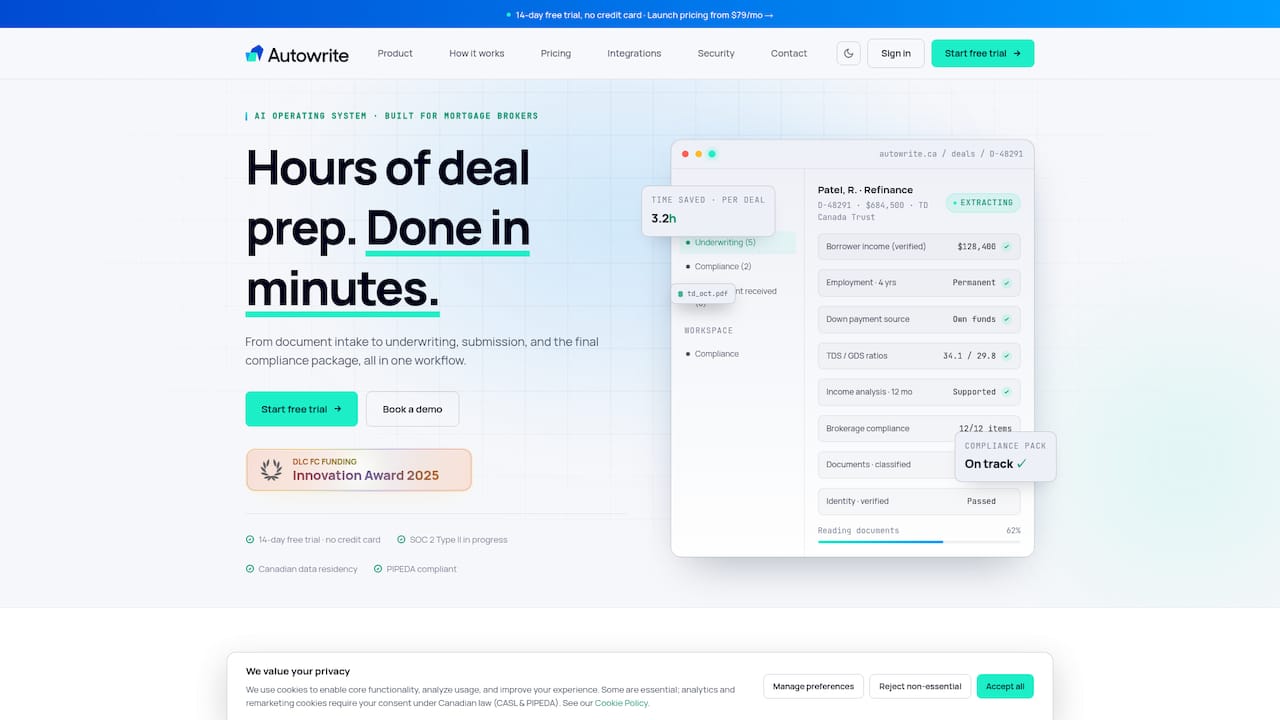
At steps 2 to 4, Autowrite takes the reading and re-keying off your hands. It classifies uploaded documents, extracts the data with line-level confidence, auto-fills underwriting forms and syncs with mortgage software. At step 6 it assembles e-sign and compliance packages, so the file reaches the lender and the audit in one piece.
Where Autowrite fits in your workflow
If you handle several files at once, the checklist above is repeated for every borrower, lender and province. Autowrite is an AI-powered operating system for Canadian mortgage brokers that covers document intake, classification, data extraction, income and down payment analysis, team pipeline management and compliance packages, with Canadian data residency.
Plans start at $99 per month (Starter), with Pro at $199 per month and Legend at $399 per month. Enterprise pricing is not published. An additional deal costs $20 one-off, and pay as you go is $35 one-off per deal. Every paid plan starts with a 14-day free trial. See Autowrite for brokerages for compliant files before payout, or start from the Autowrite home page.
Our perspective
A checklist tells you what a file needs. It does not stop a pay stub from expiring while the file waits for a missing gift letter, or a postal code from being typed three different ways.
We built Autowrite around the idea that paperwork should be read once. Documents are classified and their data extracted on intake, with line-level confidence so you can see which values to trust and which to glance at. The same data then fills underwriting forms and feeds the compliance package, so the file you submit and the file you keep for audit come from one source.
For brokerage owners, the gain is consistency. Every agent works to the same list, files arrive in the same order, and Canadian data residency keeps client documents in the country. For brokers, the gain is hours returned to client conversations.
Anant Bawa
FAQ
What documents does a broker need for a mortgage pre-approval in Canada?
At minimum: government photo ID, proof of income (letter of employment and pay stub, or NOAs for self-employed borrowers), proof of down payment, a list of debts and signed consents. CMHC notes that lenders differ, so confirm the exact list with the lender before the borrower's first meeting.
How recent must statements and letters be?
That depends on the lender. National Bank asks for a letter of employment and pay stub dated within 60 days and 60 days of savings statements, while CIBC refers to statements within the last 90 days. Record the window in the file for each lender.
What proof does a gifted down payment need?
A signed gift letter stating the funds are non-repayable, per CMHC. National Bank may also require the donor's bank statement confirming the funds were available and withdrawn.
Which compliance forms changed recently?
The RMA requires a Mortgage Suitability Profile and Material Risk form in every file as of January 2026. BC licensees can also use the consolidated disclosure packages authorized from October 13, 2026.
Sources
- CMHC: Mortgage application tips for mortgage professionals
- CIBC: Required mortgage document checklist
- National Bank: Document submission checklist
- Gateway Mortgage Guidelines, June 2026
- RMA: Audit Compliance Guidelines, April 2026
- BCFSA: Disclosures, representation and forms packages
- Strive Capital: Mortgage product sheets
- Approved Financial: File compliance requirements
- Real estate legal essentials for buyers and sellers
- Mortgage protection insurance for Canadian homeowners