

A clean underwriting file in Canada proves six things: who the borrower is, what they earn, where the down payment came from, what they owe, what the property is, and that every figure agrees across documents. This checklist walks through each in the order most brokers work, with the Canadian documents lenders ask for and the rules behind them.
TL;DR
- Missing or incomplete information is the most common cause of mortgage approval delays, according to CMHC, so complete the file before it goes to the lender.
- Income, down payment source, debts, property details and the decision rationale all need to be documented under OSFI Guideline B-20.
- Check consistency last: the application, credit report, income documents and property documents should tell the same story.
- Keep the compliance trail (identity, FINTRAC records, disclosures, retention) alongside the underwriting documents, not after the fact.
Table of Contents
- How to use this checklist
- 1. Identity and application basics
- 2. Income and employment
- 3. Down payment, assets and source of funds
- 4. Credit, debts and ratios
- 5. Property and purchase documents
- 6. Final review: consistency and compliance
- Turn the checklist into a workflow with Autowrite
- Perspective
- FAQ
- Sources
How to use this checklist
Underwriting is the lender's decision, but the broker decides how good the file is when it arrives. Lenders differ on details such as how old a pay stub can be, so treat the items below as the common core and confirm the specifics on each lender's own submission checklist.
Work through the file in the same order every time. A fixed order makes gaps visible: if the identity section is complete but the income section has a stale letter of employment, you see it before the underwriter does.
For a broader view of how Canadian documents fit together, see our Canadian mortgage document and underwriting resources. For the pre-submission step in more depth, we also keep a mortgage file preparation checklist.
1. Identity and application basics
Start here because every other document is matched against it.
- Legal name on the application matches the government-issued photo identification.
- Date of birth and contact information verified.
- Current and previous addresses completed.
- Marital status recorded, with any matrimonial home implications noted.
- Dependants disclosed.
- Credit consent signed before the credit inquiry.
That list follows the identity and application items in HopeWell Mortgages' residential checklist. One small habit saves real time: confirm the spelling of every borrower's first and last name against the ID before anything else. Approved Financial Services, for example, requires names to be spelled correctly on the file checklist, and a mismatch between the ID and a downstream document is a classic reason for a file to bounce back.
The Financial Consumer Agency of Canada notes that before preapproving a borrower, a lender or broker will look at assets, income and level of debt, so the application should already carry all three.
2. Income and employment
Income is where most files are won or lost. OSFI expects income to be verified by an independent source, using a source that is difficult to falsify, that directly addresses the declared amount, and that does not contradict other information in the file. It also expects temporarily high income such as overtime, irregular commissions and bonuses to be normalized or discounted.
Salaried borrowers
A typical Canadian package looks like this:
| Document | What the underwriter looks for |
|---|---|
| Letter of employment | Hire date, position, remuneration, recent date |
| Recent pay stubs | Year-to-date figures, consistent with the letter |
| T4 slips | Prior-year employment income |
| Notice of Assessment (NOA) | Prior-year income as confirmed by CRA |
| Bank statements | Payroll deposits matching the stubs |
National Bank's Optimum Mortgage checklist asks for a letter of employment and pay stubs both dated within 60 days. CIBC asks for recent pay slips, evidence of pay deposited electronically, and the T1 General with its Notice of Assessment. CMHC lists pay stubs or T4 and NOA for the previous two years as proof of employment.
Check that the stub, the letter and the deposits agree. If the letter says one salary and the deposits suggest another, resolve it before submission.
Self-employed borrowers
The same National Bank checklist asks for an attestation letter, evidence of the business for a minimum of two years, and six months of bank statements, or twelve months for seasonal businesses. Add the T1 General and NOAs for the relevant years so the lender can see how income was declared.
For non-traditional income, our guides on gig income mortgages and 24 months of NOAs and work permit mortgage documents cover the extra documents lenders tend to request.
3. Down payment, assets and source of funds
Lenders need to see that the funds exist, that they belong to the borrower, and where they came from. CIBC asks for a savings or investment statement from the last 90 days, a sale agreement if an existing property is being sold, an RRSP Home Buyers' Plan withdrawal confirmation if applicable, and a gift letter if funds are gifted.
A workable down payment checklist:
- Ninety days of statements for each account holding the funds.
- An explanation, with documents, for any large deposit that is not payroll.
- A sale agreement and expected net proceeds when the down payment depends on selling a property.
- RRSP withdrawal documentation when the Home Buyers' Plan is used.
- A gift letter and transfer trail when family is helping.
- Proof of closing cost funds, separate from the down payment.
Gifted funds
A gift letter usually names the donor, their address and relationship to the buyer, the exact amount, a statement that repayment is not expected, and signatures from both parties. Supporting records often include the donor's bank statement and a transfer or cheque record showing the money landed in the buyer's account. Ask for these at the start, because chasing a donor for a bank statement late in the deal is one of the most common ways a closing date slips. Each lender sets its own gift rules, so confirm them before you collect.
Our guide to audit-ready down payment analysis goes deeper on tracing funds through statements.
4. Credit, debts and ratios
Credit is more than a score. HopeWell's checklist calls for reviewing the credit history of both borrowers, treating the score as one input among several, and disclosing balances, support obligations and co-signed debts. It also covers explaining any collections, judgments, proposals or bankruptcy, looking into recent inquiries, and identifying debts to be paid out at closing.
Before submission, confirm:
- Every liability on the credit report appears on the application, or the difference is explained.
- Support payments and co-signed debts are included.
- Debts to be paid at closing are flagged, with the post-closing liabilities recalculated.
- Rent or mortgage history is on file where the lender requires it.
GDS and TDS
OSFI expects gross and total debt service ratios to be calculated conservatively and stressed for higher interest rates. Contributing factors include principal and interest, income, heating costs, property taxes, condominium or strata fees and payments on all other credit facilities.
CMHC's calculation guidance caps ratios at 39% GDS and 44% TDS, qualifying at the greater of the contract rate plus 2% or 5.25%. The same page says 50% of condominium fees go into the GDS and TDS calculations, and heat costs come from actual records or a reasonable estimate based on the size, location and heating type of the property. Confirm current limits on CMHC's page, as insurer and lender policies can change.

The arithmetic is simple but easy to get wrong when several inputs come from different documents. Our step-by-step guide to calculating GDS and TDS ratios shows a worked example.
5. Property and purchase documents
The property side of the file is where small errors, such as a wrong address or an unreviewed condition, create late-stage conditions.
CIBC asks for the real estate listing, the accepted purchase and sale agreement, the full address with legal description and postal code, property tax estimates, condo fees and heating costs, well and septic certificates for rural properties, and the lawyer's contact information. CMHC adds the signed offer to purchase and current property tax statements to its list of items to bring.
HopeWell's property checklist adds useful review points:
- Civic address and legal description or PIN are correct.
- Property type and unit count are confirmed, and occupancy is classified correctly (owner-occupied, rental, second home).
- The MLS listing and the agreement of purchase and sale are read together, so price and incentives match.
- The appraisal type the lender accepts is on file.
- For condos, the status certificate is reviewed by the lawyer or lender.
- Well, septic, rural access or leasehold issues are identified early.
All of these appear in the residential mortgage checklist.
6. Final review: consistency and compliance
Before you hit submit, read the file as an underwriter would. The MPC Origination Standards say the originator should ensure the application is complete and consistent with other documents such as the credit report, note and explain inconsistencies, and not submit the application if the applicant cannot give a reasonable explanation.
A five-minute consistency pass:
- Names, addresses and dates of birth match across the ID, application, credit report and income documents.
- Income on the application equals the income supported by the documents.
- Down payment on the application equals the verified balances.
- Purchase price, address and closing date match the agreement of purchase and sale.
- Every explanation letter is signed and dated.
Compliance records
Underwriting documents and compliance documents belong in the same file.
- Identity and FINTRAC. FINTRAC requires mortgage brokers, administrators and lenders to verify identity for certain activities, keep an information record and a mortgage loan record, record the purpose and intended nature of the relationship, begin ongoing monitoring, and take reasonable measures to determine whether a third party or a politically exposed person is involved. Our FINTRAC checklist for mortgage compliance packages covers this in more detail.
- Ontario standards. Under O. Reg. 188/08, Ontario brokerages must have policies for verifying borrower identity, determining suitability, disclosing material risks and conflicts of interest, preventing fraud, and keeping records. Brokers in other provinces should check their own regulator's rules.
- Disclosures. Brokerage compliance guides typically expect completed documents such as the commitment, disclosure to borrower, material risk disclosure and reasoning letter, as in the Approved Financial Services file guide.
- Lender-specific fraud steps. Some lenders add their own requirements. One lender's 2026 checklist requires the ID verification and fraud risk section, an agent fraud sign-off form and detailed agent notes to be completed before submission.
- Retention. The MPC standards call for keeping funded loan files for no less than seven years or the provincial minimum if longer, and unfunded files for at least one year.
For the full submission package, see our guide to the seven core underwriting documents, and for storage and retention habits, five steps from lender requests to retention.
Turn the checklist into a workflow with Autowrite
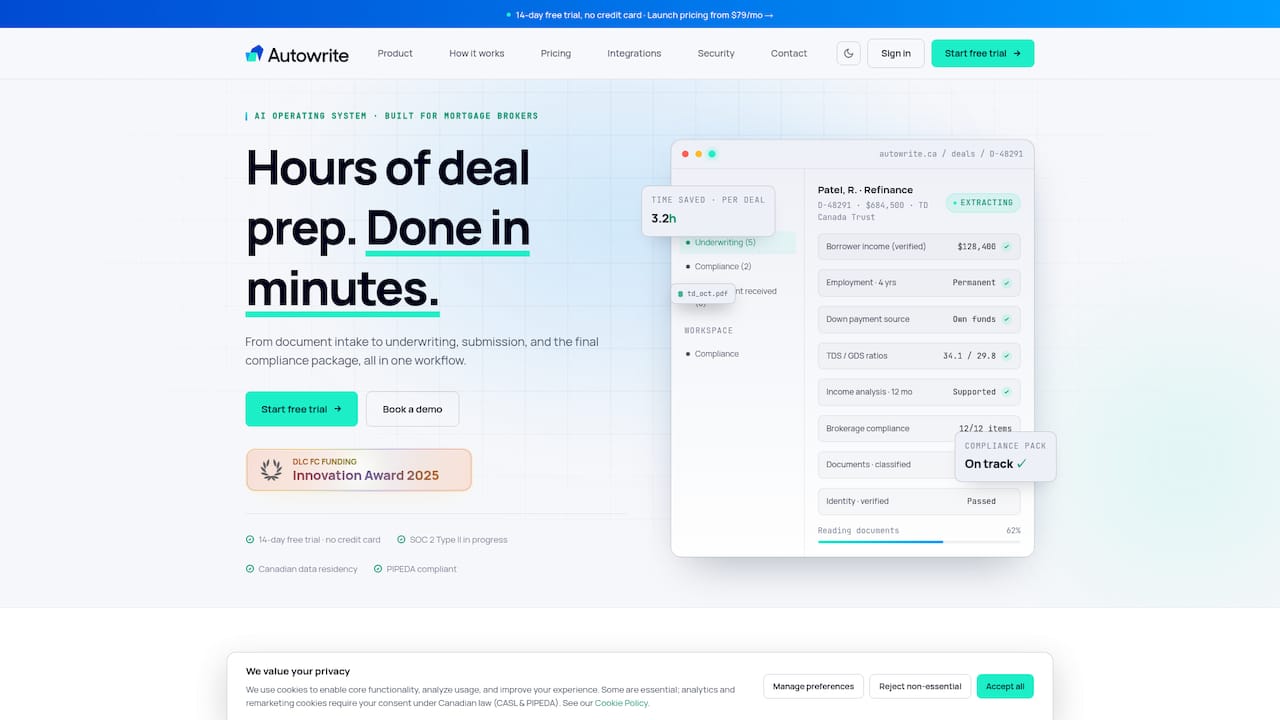
A checklist only helps if it is applied the same way on every file. Autowrite is built for licensed Canadian mortgage brokers, agents and brokerage owners. It handles document intake, classification and data extraction, auto-fills underwriting forms, syncs with mortgage software, assembles e-sign and compliance packages, and supports income and down payment analysis, with Canadian data residency.
Plans are billed monthly: Starter is $99 per month, Pro is $199 per month and Legend is $399 per month. Enterprise has no published price. Additional deals cost $20 each, and every paid plan starts with a 14-day free trial. See the current details on the Autowrite pricing page or start from autowrite.ca.
Perspective
Most delays we see in broker files are not underwriting problems. They are filing problems: the right document exists, but it is in the wrong folder, the wrong version, or three emails deep.
That is why we built Autowrite around the document itself. When intake, classification and extraction happen automatically, with line-level confidence on what was read, a broker reviews the file instead of assembling it. The checklist above stops being a to-do list and becomes a set of checks the system helps you complete.
We also believe compliance belongs inside the workflow. A file that carries its identity records, disclosures and retention trail from day one is a file a brokerage owner can stand behind, and one that hours of rework never touch.
Anant Bawa
FAQ
What is the first thing an underwriter checks in a mortgage file?
Identity and the application come first, because every other document is matched against them. After that, the underwriter looks at income and employment verification, then debts, down payment source and the property. Names and addresses that match across documents prevent most early questions.
How old can income documents be?
It depends on the lender. One major bank's checklist asks for a letter of employment and pay stubs dated within 60 days, while savings and investment statements are often requested from the last 90 days. Check the target lender's checklist before you collect.
Do I need a gift letter for gifted down payment funds?
Yes, lenders typically ask for one, signed by the donor and the borrower, stating the amount and that no repayment is expected. Add the donor's bank statement and a transfer record showing the deposit into the buyer's account where the lender requires it.
Which ratios do lenders use to qualify borrowers?
Lenders use gross debt service (GDS) and total debt service (TDS) ratios, stressed at a higher qualifying rate. CMHC's guidance sets 39% GDS and 44% TDS for insured mortgages, with the qualifying rate at the greater of the contract rate plus 2% or 5.25%.
How long should a brokerage keep mortgage files?
The MPC Origination Standards say no less than seven years for funded loans, or longer if the provincial regulator requires it, and at least one year for unfunded files. Confirm your own province's rule with your regulator.
Sources
- OSFI Guideline B-20: Residential Mortgage Underwriting Practices and Procedures
- CMHC: Mortgage Application Tips
- CMHC: Calculating GDS / TDS
- Financial Consumer Agency of Canada: Getting preapproved for a mortgage
- National Bank: Optimum Mortgage document submission checklist
- CIBC: Required Mortgage Document Checklist
- HopeWell Mortgages: Residential Mortgage Checklist
- Vicki Kaplan: What to Know About Using Gifted Funds for a Down Payment
- MPC Origination Standards
- Ontario O. Reg. 188/08: Mortgage Brokerages, Standards of Practice
- Approved Financial Services: File Compliance Guide
- FINTRAC Mortgage Sector Compliance Checklists
- Citadel Mortgages: Mortgage Document Checklist