
Automated down payment analysis is broker-side software that extracts, classifies, and provenance-tags a borrower's fund documents, then produces a lender-ready summary for underwriting. It cuts review time, reduces insurer escalations, and creates a defensible audit trail that satisfies FINTRAC, OSFI B-20, and mortgage insurer requirements. For brokers buried in bank statements and gift letters, that summary is the difference between a same-week approval and a file stuck in exceptions, highlighting why mortgage broker readiness matters.
TL;DR:
- Automated analysis classifies and extracts deposit details, producing a single, organized summary that links each fund to its supporting document in under eight weeks.
- Cash deposits and structuring patterns trigger scrutiny and delays unless documented with receipts, donor statements, or transaction histories.
- Cross-document validation compares deposits against declared income, gift letters, and wire transfers to flag mismatches early.
- Best practices include pre-screening deposit history, coaching clients to avoid cash, and standardizing documentation packages for efficient underwriter review.
- Using confidence scores and human review thresholds ensures the system flags only uncertain data, reducing conditions and file rejections.
Table of Contents
- What documents do lenders require for down payment verification?
- What red flags trigger a down payment review?
- How does automation produce an auditable down payment summary?
- What best practices should brokers adopt right now?
- How do FINTRAC and OSFI B-20 shape documentation requirements?
- How do you pilot automated down payment analysis?
- What does automated down payment analysis look like in practice?
- How Autowrite handles down payment analysis for you
- Sources
What documents do lenders require for down payment verification?
Lenders want proof that every dollar of the down payment is traceable to a legitimate source, and that proof has to arrive in a specific, predictable format. Most lenders ask for 90 days of account history at minimum, and high-ratio insured files almost always require it. If a large deposit shows up on day 88, expect the lender to ask for statements that go back further to trace it.
The document set breaks down by source type, and each one has its own paper trail:
- Personal savings: 90-day statements showing account holder name, account number, and every deposit line item, not just the closing balance.
- Gifted funds: a signed donor statement plus a lender-specific gift letter confirming the money is non-repayable.
- Sale or investment proceeds: closing statements from the prior sale, wire transfer traces, and brokerage trade confirmations for liquidated investments.
- Business-sourced funds: business account statements, supporting invoices, and proof the transfer moved from the business account to the borrower's personal account.
Once the documents are in hand, assemble them into one navigable package rather than a folder of loose PDFs. Lender guidance consistently favors a single one-page summary with running totals, a list of every account referenced, and page numbers that map directly to the underlying statements. A document checklist with a consistent numbering convention, page 1 through page N across the entire package, saves the underwriter from hunting for a specific deposit across five different PDFs.
What red flags trigger a down payment review?
Underwriters and compliance teams look for patterns, not just missing paperwork, and certain patterns almost guarantee a second look at the file.
- Cash deposits carry no verifiable audit trail, which makes them one of the fastest ways to trigger AML and insurer scrutiny. A $4,000 cash deposit with no receipt or explanation can stall an otherwise clean file for days.
- Structuring, or breaking a large sum into several smaller deposits, along with frequent internal transfers between accounts, multiplies the verification work and reads as evasive even when it isn't.
- Large, unexplained deposits above a lender's internal threshold typically trigger a request for donor documentation; if that documentation doesn't materialize, the lender may exclude the funds or decline the file outright.
- Inconsistent savings patterns get compared directly against declared income; a borrower reporting $60,000 in salary who somehow banked $40,000 in six months invites questions the file needs to answer before it moves forward.
None of these are automatic declines. They're friction points that add days to a timeline that already runs tight against a purchase closing date.
How does automation produce an auditable down payment summary?
The output that matters to an underwriter isn't a faster process. It's a file they can trust without re-checking every line themselves, and that trust comes from structure, not speed.
Schema-driven extraction is the starting point. Instead of a broker manually scanning a 12-page bank statement for deposits over $1,000, automation classifies the document type (bank statement, wire confirmation, gift letter, closing statement) and pulls every relevant field, deposit dates, amounts, account numbers, sender information, against a predefined schema built for that document type.
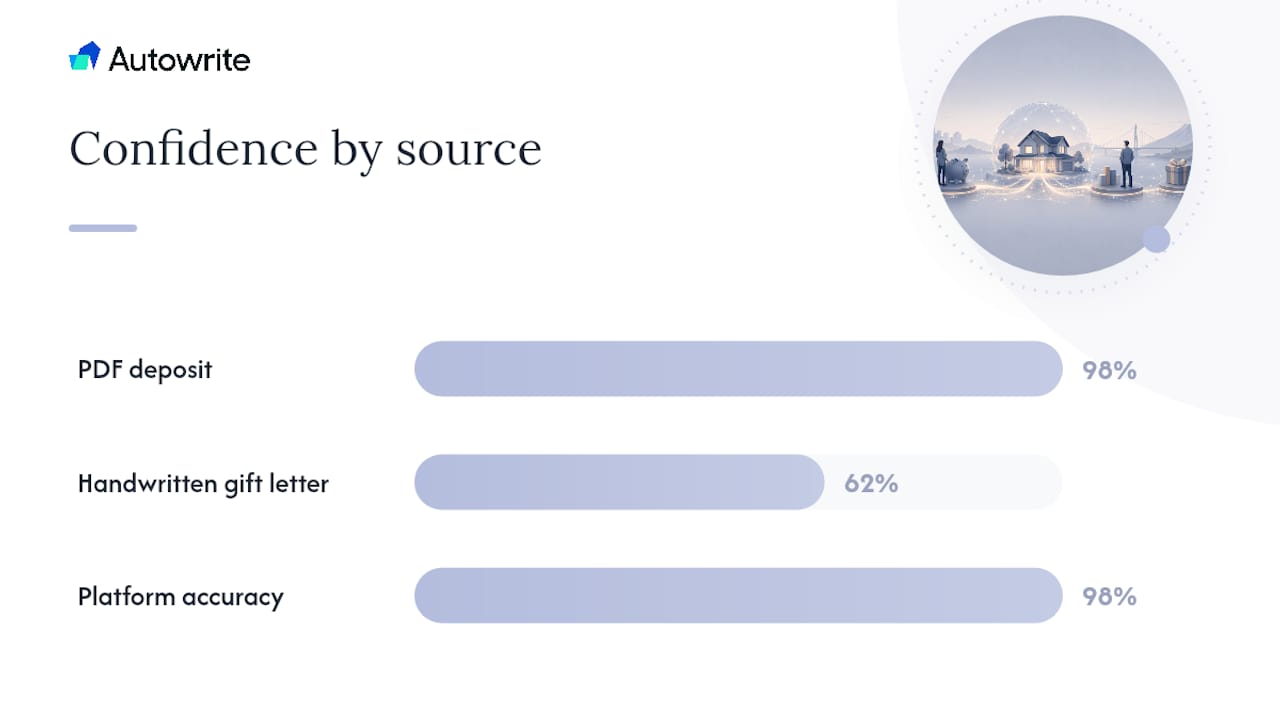
Every extracted field carries two things: a confidence score and a source tag. A deposit amount pulled cleanly from a machine-readable PDF might score 98% confidence. A handwritten annotation on a scanned gift letter might score 62%, which routes it straight to a human reviewer instead of auto-populating the file. This is the mechanism that made it possible for one automated income-verification platform to cut processing time from two hours to two minutes at 98% accuracy, because the system only asks for human attention where the data actually warrants it.
Cross-document validation adds another layer: deposits get reconciled against declared income, gift letter amounts get matched against the actual wire that landed in the account, and mismatches get flagged before the file ever reaches an underwriter's desk.
What lands in the lender's inbox typically includes:
- A one-page summary with totals by source and account.
- Annotated PDFs with page-level citations tying every dollar back to its statement.
- An evidence matrix mapping each fund source to its supporting document.
- An immutable audit log showing what was extracted, when, and by what confidence threshold.
That combination, per-field provenance plus a human-in-the-loop threshold for anything uncertain, is what makes automated output defensible to a compliance officer instead of just fast.
What best practices should brokers adopt right now?
The biggest time-saver isn't a tool. It's catching problems before the file ever reaches the lender.
- Pre-screen the 90-day history yourself before submission. Flag any deposit that doesn't obviously match payroll or a known account pattern, and ask the borrower about it before the underwriter does.
- Coach clients early. Tell them to avoid cash deposits entirely, consolidate scattered savings into one staging account, and do it months before the purchase, not the week before closing.
- Standardize the package. Numbered pages, consistent highlighting for key deposits, and one summary page up front. A pre-screened, well-documented file moves through underwriting with far less back-and-forth.
- Document third-party sources properly. For gifts, overseas transfers, or business proceeds, get corroborating documentation (a donor's bank statement, a business accountant's letter) up front rather than waiting for the lender to ask twice.
Pro Tip: Call the donor directly before you submit a gift letter. A two-minute verification call catches inconsistencies (wrong amount, wrong relationship, wrong account) that would otherwise surface as a lender condition three weeks into the file.
How do FINTRAC and OSFI B-20 shape documentation requirements?
Every requirement in a down payment package traces back to a regulatory or insurer expectation, and knowing which one drives which document saves arguments later.
- FINTRAC sets the baseline for fund traceability. Anti-money-laundering obligations are why cash deposits and structuring patterns get flagged automatically, regardless of how the file otherwise looks.
- OSFI B-20 shapes the underwriting standards lenders apply to residential mortgages, including how rigorously down payment sources get scrutinized before a loan gets approved.
- CMHC, Sagen, and Canada Guaranty each apply their own documentation expectations for insured high-ratio files, and all three expect the same core traceability: source, timing, and a paper trail that doesn't require a phone call to explain.
- Privacy and data residency matter once you're sharing evidence electronically. Redact account numbers where possible, confirm the borrower has consented to the specific documents being shared, and keep the data within Canadian infrastructure where your compliance policy requires it.
When a file has a pattern the insurer is unlikely to accept, cash-heavy savings with no consistent income match, for example, escalate to your compliance team or consider a lender with a documented history of flexibility on that fund type rather than submitting and hoping.
How do you pilot automated down payment analysis?
Start narrow. A broad rollout on day one guarantees confusion; a focused pilot proves the concept fast.
- Pick your pilot files. Target purchases with bank-statement-heavy documentation or a high-volume loan type where you process similar files repeatedly.
- Run in parallel first. Set a confidence score cutoff (commonly in the low-to-mid 90s) below which items route to an exception queue for manual review, and compare automated output against your existing manual process for two to four weeks.
- Expand in stages. Budget four to eight weeks for integration and field mapping to your loan origination system, then eight to sixteen weeks to scale across your full file volume.
- Track three numbers: cycle-time reduction, conditions requested per file, and insurer escalation rate. Those three tell you whether the pilot is actually working or just feels faster.
What does automated down payment analysis look like in practice?
Brokers who move from manual file review to a structured, source-tagged package usually see the same shift: fewer conditions coming back from underwriting, and fewer files bounced to compliance for a second look at fund sources. The difference isn't magic. It's that every deposit already has a citation before the underwriter asks for one.
A lender-ready package that works looks almost boring: one summary page up top, every deposit traced to a page number, gift letters matched to actual wires, and nothing left for the underwriter to chase down. That's the whole point. A quiet file is a fast file, and speed in this business comes from removing the questions before anyone has to ask them.
— Anant Bawa
How Autowrite handles down payment analysis for you
Autowrite is built specifically for the workflow described above: document intake, schema-based extraction, per-field confidence scoring, and lender-ready summaries generated automatically instead of assembled by hand at midnight before a closing. Instead of a broker manually cross-referencing bank statements against gift letters, Autowrite classifies each document, tags every deposit with its source, and flags anything below your confidence threshold for review rather than guessing.
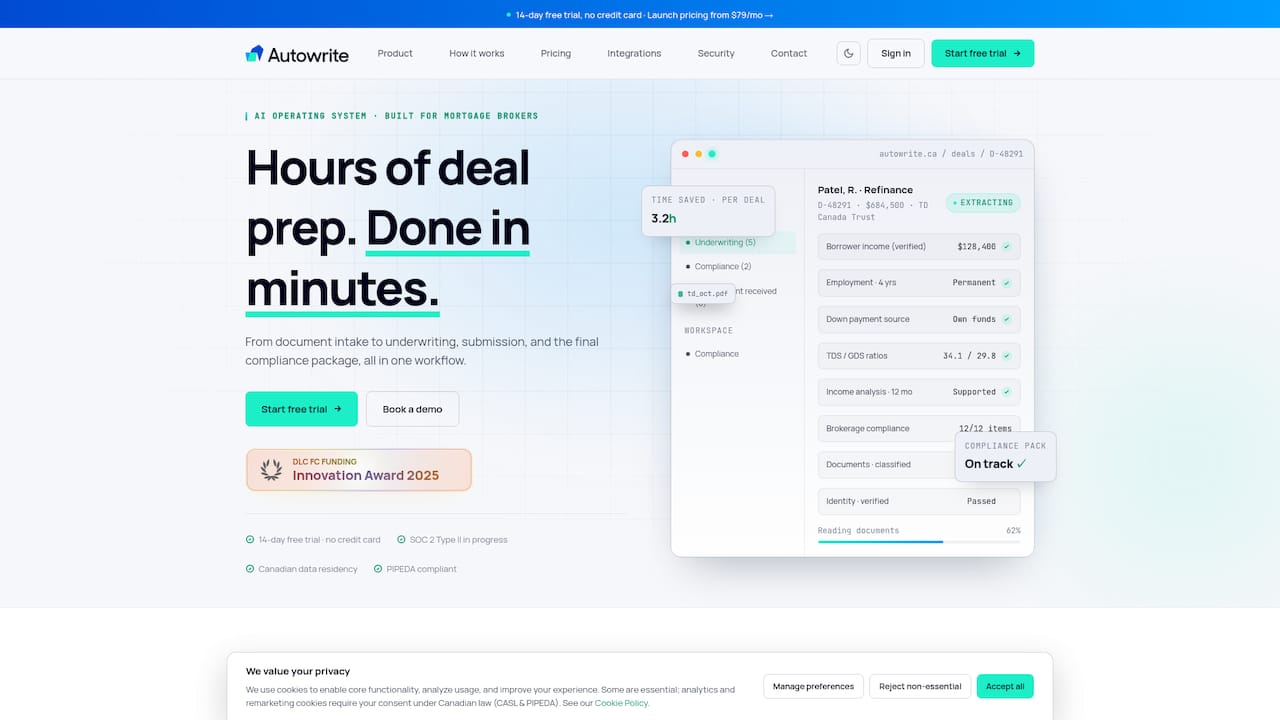
The platform maps to the pilot approach outlined above: a narrow rollout on your most document-heavy files, a parallel-run comparison against your current process, and a scale-up once you trust the exception queue. Most brokers see the time-to-value inside the same four-to-eight week integration window that manual automation projects typically require. Autowrite offers a trial, so you can run it against a real file before deciding whether it earns a permanent spot in your workflow. Start the trial at Autowrite and see what a lender-ready package looks like when the system builds it instead of you.
Sources
- Why Cash Deposits Create Problems in Down‑Payment Verification - The Broker
- Proof of down payment: The biggest hurdle for mortgage professionals - CMT News
- How Autyn Cut Loan Processing from 2 Hours to 2 Minutes at 98% Accuracy - LandingAI