

A complete mortgage file has seven parts: identification, income and employment, down payment, debts and credit, property and purchase documents, consents and disclosures, and a clean submission package. Lenders send files back when one of these is missing, stale or unreadable, so the fastest way to a decision is to build the file in that order, check each document against a date and a name, and submit it as separate, labelled PDFs. This checklist walks through each part, shows what changes for self-employed, rental and gifted-funds files, and covers what you must keep after the deal funds.
TL;DR
- Build every file in the same order: ID, income, down payment, debts, property, consents, then submission. A fixed order makes gaps obvious before the lender finds them.
- Check dates first. Several lenders want employment letters and pay stubs dated within 60 days, and bank statements covering a set number of months.
- Submit separate, labelled PDFs, not one scanned bundle, and note any inconsistency in the file with an explanation.
- Keep client records for at least five years after your last business transaction with the client under FINTRAC rules, and confirm any longer provincial requirement with your regulator.
- Template checklists catch missing items. Document intelligence can catch the mismatches between documents that cause most conditions.
Table of Contents
- What a complete Canadian mortgage file contains
- Step 1: Identification and consents
- Step 2: Income and employment documents
- Step 3: Down payment and source of funds
- Step 4: Debts, credit and existing properties
- Step 5: Property and purchase documents, and how pre-approval differs from final approval
- Step 6: Label, separate and submit
- Step 7: Explain inconsistencies before the lender asks
- Pre-submission quality check
- What to keep after the file closes
- Perspective: where file prep time actually goes
- How Autowrite fits into file preparation
- FAQ
- Sources
What a complete Canadian mortgage file contains
FSRAO describes a Canadian mortgage application as drawing on employment and income information, assets, debts, down-payment evidence, property documents, a signed credit authorization and written acknowledgement of disclosed risks. That list is the skeleton. Every lender then adds its own preferences on dates, formats and statement lengths.
Treat the checklist below as the working core, and keep a short note per lender for the exceptions. Most delays come from the same few causes: an expired document, a page missing from a statement, a name that does not match across documents, or a deposit nobody has explained.

Step 1: Identification and consents
Start here because nothing else can move without it.
- One valid, unexpired piece of government-issued photo identification for each borrower and guarantor.
- A second piece of identification or proof of address if the lender asks for it, such as a recent utility bill or property tax bill.
- Your identity verification record, completed in line with FINTRAC requirements.
- Signed borrower consent to collect and keep copies of supporting documents.
- Signed written consent to obtain a credit report.
The Mortgage Professionals Canada origination standards say originators should generally obtain borrower consent before taking or retaining copies of supporting documents and must obtain proper written consent to pull a credit report. Get consent at the start of the file, not when a lender asks for a document you have already collected.
If your brokerage is adding AI tools to this intake step, review how they handle personal information against a PIPEDA checklist for AI tools before you upload client documents to them.
Step 2: Income and employment documents
Income is where files stall most often, because every borrower type has its own proof and lenders differ on how recent it must be.
Salaried and hourly borrowers
A typical package includes:
- A signed employer letter confirming position, start date, salary or hourly rate and hours.
- A recent pay stub showing year-to-date earnings.
- A T4 slip and Notice of Assessment for recent years.
- A bank statement showing the payroll deposit, or several months of statements showing regular deposits.
One national lender's submission checklist asks for an employment letter and a pay stub each dated within 60 days. The origination standards list acceptable proof as a signed employer letter, a Notice of Assessment, a pay stub with a bank statement showing the payroll deposit, or three months of statements showing payroll deposits. Ask the client for the most recent documents the day you start, because a 60-day window can close while a purchase is still being negotiated.
Self-employed borrowers
The same lender's checklist points to an attestation letter, evidence of at least two years in business and six months of bank statements. In practice, add:
- Two to three years of personal T1 Generals and Notices of Assessment.
- Financial statements and, for incorporated borrowers, incorporation documents.
- Business bank statements if the lender uses them to test cash flow.
The gap between gross revenue and the income a lender will accept is where most of the work sits. Our guide to preparing a self-employed income mortgage file covers how to present it, and the one on gig income and 24 months of NOAs covers borrowers with platform income.
Rental, support, pension and disability income
For rental income, the lender checklist cited above lists a lease, three months of bank statements showing rent deposits, a property tax statement, a mortgage statement and market rents. Support payments may need a separation agreement or court order, and pension and disability income each have their own requirements. Ask which income types are in play at the first meeting, not after the lender's first condition list.
Step 3: Down payment and source of funds
Lenders want the amount, where it came from and how long it has been there. CMHC advises borrowers to provide proof of the down payment and its source, recent financial statements for the past several months, and a signed letter confirming that a family member's gift is non-repayable.
Collect:
- Savings, TFSA, RRSP or investment statements, with every page, not only the summary.
- A record of transfers between the client's own accounts, so a deposit does not look like an unexplained lump sum.
- Withdrawal documents for an RRSP Home Buyers' Plan withdrawal, if used.
- The agreement of purchase and sale and recent mortgage statement, insurance policy and tax bill for the current home, if the down payment depends on a sale.
- A gift letter from the donor when family is contributing.
A major bank's finalizing checklist asks for savings or investment statements from the past 90 days and a gift letter confirming the amount and that there are no repayment terms. Because each lender sets its own window, record the longest one you expect to meet and collect to that.
Gift letters are a common failure point. See our guides to gift letter requirements for Canadian brokers and the fields every gift letter should contain.
Step 4: Debts, credit and existing properties
The application, the credit report and the supporting statements must agree. The origination standards say originators should make sure credit cards and loans listed on the application are consistent with the credit report.
For each borrower, gather:
- Credit report, pulled with signed consent.
- Statements for loans, lines of credit and cards that carry a balance or that the client plans to keep.
- Proof of payout for any debt being cleared at closing.
- Support obligations, with the agreement or order.
If the client owns other property, CMHC notes borrowers may need details of other mortgage loans, current property tax statements, heating costs and condominium fees where applicable. Collect the most recent mortgage statement and property tax bill for each one.
Step 5: Property and purchase documents, and how pre-approval differs from final approval
A pre-approval file is mostly about the borrower: ID, income, down payment, debts and credit. There is no property yet, so there is nothing to attach beyond the client's intended price range and, if they own a home, the documents for that home. Final approval adds the property and the deal.
For a purchase, one major bank's finalizing guide lists:
- A copy of the signed agreement of purchase and sale.
- The lawyer's name and contact details.
- The full property address, including postal code, and legal description.
- Square footage of the home and land size.
- A copy of the real estate listing.
- Property tax and heating cost estimates, often found on the listing.
- Monthly condo fees for condominiums.
- Well and septic certificates for rural properties without municipal water and sewer.
Add the appraisal if the lender orders one through you, and for condominiums the status certificate or the equivalent document in the client's province. In Quebec, remember that the notary plays the role the lawyer plays elsewhere, so capture the notary's details instead.
| Item | Pre-approval | Final approval |
|---|---|---|
| ID and consents | Yes | Yes, refreshed if expired |
| Income and employment | Yes | Updated if the lender's date window has passed |
| Down payment proof | Yes | Yes, with source and any gift letter |
| Debts and credit | Yes | Yes, with payouts confirmed |
| Agreement of purchase and sale | No | Yes |
| Property details, tax and fees | No | Yes |
| Lawyer or notary details | Not usually | Yes |
Treat the table as a planning aid, since each lender sets its own conditions.
Step 6: Label, separate and submit
A complete file can still be slowed by how it arrives. One national lender's checklist says documents should be labelled accordingly, separated into individual documents and submitted in PDF format. A mortgage insurer's broker notes recommend submitting upfront as separate, labelled PDFs divided into sections such as income confirmation, purchase agreement and MLS, bank statements, and gift letter.
A naming pattern that works:
- Borrower surname, first name.
- Document type (T4, NOA, pay stub, bank statement, gift letter).
- Period or date covered.
For example: Singh_Priya_PayStub_2026-10.pdf. Keep one folder per borrower and one for the property, so that a lender's request for "the second applicant's January statement" takes ten seconds to answer.
We cover the full flow from lender request to retention in five steps for organizing mortgage documents.
Step 7: Explain inconsistencies before the lender asks
Files rarely look perfect. A new job, a large deposit, a name spelled two ways, or a move last year are all normal. What matters is whether the file explains them. The origination standards say originators must note inconsistencies in lender documentation and explain them, including inconsistencies about income, profession, or place and length of residence.
Add a short broker note to the file for each one: what the discrepancy is, what the client said and which document supports the explanation. This note is also what lets another broker pick up the file.
Pre-submission quality check
Run this list before you hit send:
- Are all names, addresses and employer names identical across documents?
- Is every document inside the lender's date window?
- Does each bank statement show every page, the account holder and the account number?
- Do the debts on the application match the credit report?
- Is every large deposit traced to a source?
- Are signed consents on file?
- Is each document a separate, labelled PDF?
This is the check software does well. Our roundup of mortgage document automation tools explains what to look for when you compare them.
What to keep after the file closes
The file is also your record of what you did and why. FINTRAC's guidance for mortgage administrators, brokers and agents says records must be kept for at least five years after the last business transaction with the client, and that electronic or machine-readable form is acceptable if a paper copy can easily be produced. Provincial regulators may set their own retention period, so confirm it with yours; our comparison of FINTRAC and FSRA retention periods shows how they differ.
In Ontario, FSRA says an adequate record should give a document-based narrative of what was done and why, so another agent or broker can explain the product recommendation without extra help. FSRA also notes that accurate, complete records help demonstrate why a product was recommended and assist with insurance and legal proceedings.
The risks are real. FSRA revoked a brokerage's licence after finding failures involving suitability, written risk and conflict disclosures, inaccurate information and mortgage record retention.
Personal email deserves a policy. FSRA advises that brokers who use it for business need formal controls or data-sharing agreements so the brokerage keeps access to client correspondence through the retention period. For the compliance side of the package, see our FINTRAC checklist for the mortgage compliance package.

Perspective: where file prep time actually goes
We built Autowrite for Canadian brokers because the checklist is the easy part. Everyone knows a file needs ID, income proof and a down payment source. The hours go into reading forty pages of statements, matching names and figures between documents, filling the same data into underwriting forms, and assembling the e-sign and compliance package at the end.
That is why we focus on document intelligence: classifying each upload, extracting the data with line-level confidence so you can see which figures to verify, and flagging gaps early. Our view is that a broker's time belongs with the client, and that a file built from labelled, checked documents is also a better compliance record, because it shows what was received, when and why a recommendation was made.
A checklist tells you what is missing. Software should tell you what does not match.
— Anant Bawa
How Autowrite fits into file preparation
Autowrite is an AI-powered operating system for Canadian mortgage brokers. It handles document intake and classification, data extraction, auto-filling of underwriting forms, syncing with mortgage software, e-sign and compliance package assembly, and income and down payment analysis. Data is held with Canadian data residency.
Plans on our pricing page are Starter at $99 per month, Pro at $199 per month and Legend at $399 per month, with Enterprise available without a published price. An additional deal costs $20 per deal, and there is a 14-day free trial for licensed professionals.
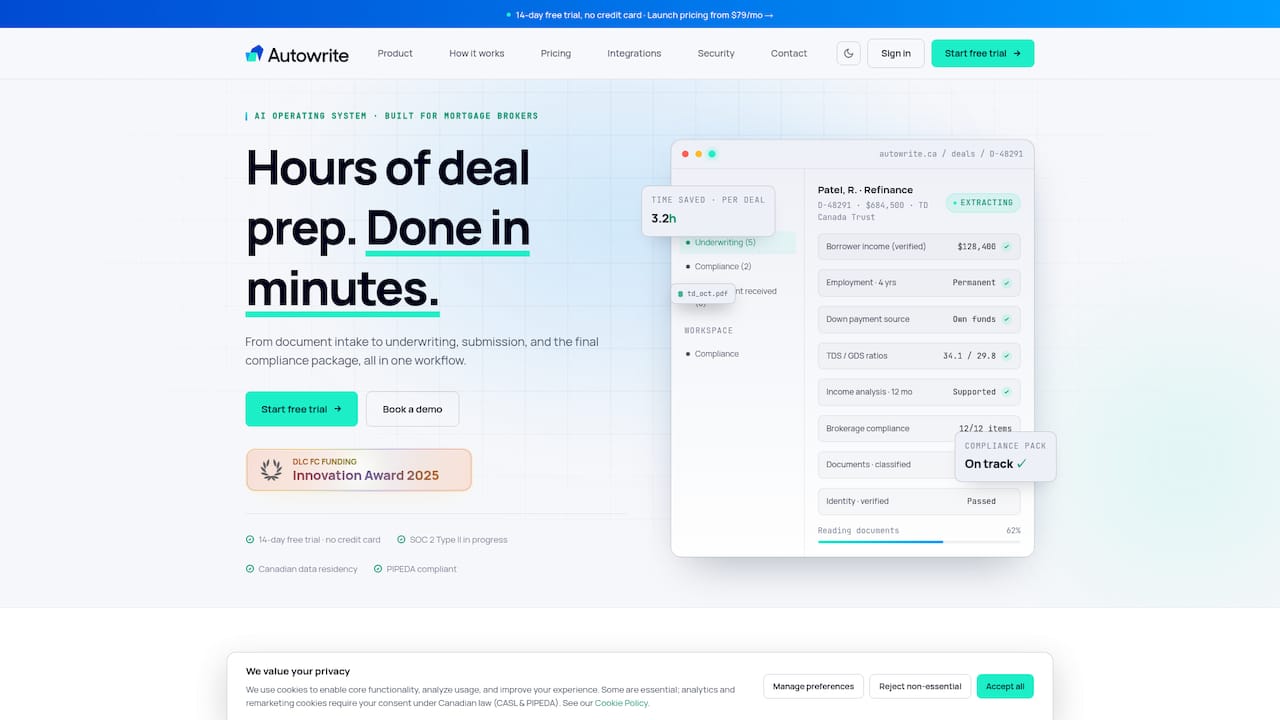
If you want to see your own next file go through it, start from the Autowrite homepage.
FAQ
What documents do I need for a mortgage pre-approval in Canada?
You need documents about the borrower: photo ID, proof of income and employment, down payment and savings statements, and details of debts, plus signed consent for a credit check. The property documents are added later at final approval. Exact requirements vary by lender.
How recent do pay stubs and employment letters need to be?
It depends on the lender. One national lender's checklist asks for both to be dated within 60 days. Confirm the window for each lender before you collect, and refresh documents if the purchase takes longer than expected.
How should I document a gift for a down payment?
Get a signed letter from the donor confirming the amount and that it does not have to be repaid, and keep the transfer record showing the funds arriving. Lenders may also ask for the donor's relationship to the borrower.
How long do I have to keep mortgage files?
FINTRAC's rules require records to be kept for at least five years after the last business transaction with the client. Provincial regulators may set additional requirements, so check yours.
Should I send one combined PDF or separate files?
Send separate, labelled PDFs. Lender checklists ask for documents to be labelled and separated into individual files, which makes each item easier to find and each missing item easier to spot.
Sources
- Mortgage Application Process, FSRAO
- Document submission checklist, National Bank of Canada
- Mortgage Origination Standards, Mortgage Professionals Canada
- Mortgage Application Tips, CMHC
- Finalizing your mortgage: Documents to provide, CIBC
- Record keeping requirements for mortgage administrators, brokers and agents, FINTRAC
- Keep good records to protect your reputation, FSRAO
- Show your work: documenting that a mortgage is suitable for your client, FSRAO
- FSRA revokes the licence of Mortgage Smart Inc., FSRAO