

PIPEDA applies to virtually every mortgage broker in Canada, because collecting a borrower's SIN, credit report, and bank statements to arrange financing is textbook "commercial activity." Three immediate priorities: name a Privacy Officer, obtain express consent before pulling credit reports or sharing files with lenders, and secure access to high-sensitivity documents. Brokers in BC, Alberta, and Quebec face a provincial overlay, but the baseline obligations below still apply. The checklists and OPC findings that follow turn that verdict into a working system.
TL;DR:
- Mortgage brokers must comply with PIPEDA when handling personal financial data across borders or with federally regulated lenders, often defaulting to PIPEDA safeguards regardless of provincial laws.
- Key compliance actions include appointing a Privacy Officer, obtaining specific consent before sensitive data collection, and enforcing strict data retention and destruction protocols aligned with FINTRAC and PIPEDA rules.
- Breach responses require prompt containment, risk assessment, and notification to the OPC or provincial regulators, with clear documentation of every step taken and affected clients notified in plain language.
- Automating consent capture, file logging, and deletion processes reduces manual errors, simplifies audit preparation, and demonstrates actual compliance during OPC investigations.
- Regular review through checklists on intake, vendor security, and data retention is crucial, as most breaches stem from inconsistent manual practices rather than lack of awareness.
Table of Contents
- Does PIPEDA Apply to Your Mortgage Brokerage?
- The 10 Fair Information Principles, Translated for Brokers
- What Meaningful Consent Actually Looks Like at Intake
- Locking Down Files: Safeguards That Match the Risk
- When a Breach Happens: The Notification Playbook
- Building Compliance Into Daily Operations
- What OPC Audits Actually Find (And How to Fix It)
- Three Checklists You Can Apply This Week
- Why Most Brokers Treat Privacy as an Afterthought, and What That Costs Them
- How Autowrite Keeps Your Files PIPEDA-Ready Without Slowing Down Deals
- Sources
Does PIPEDA Apply to Your Mortgage Brokerage?
Yes, almost always. PIPEDA governs private-sector organizations that collect, use, or disclose personal information "in the course of commercial activity," and arranging a mortgage is exactly that. Every application, credit pull, income document, and lender submission you handle counts. The Office of the Privacy Commissioner of Canada treats this coverage as automatic once money changes hands for a service, and mortgage brokering has always been a service business built on personal financial data.
Where it gets more complicated is the provincial layer. British Columbia, Alberta, and Quebec each have private-sector privacy laws deemed "substantially similar" to PIPEDA, which means those provincial statutes govern purely intra-provincial handling of personal information. A broker in Calgary who collects, stores, and shares a file entirely within Alberta, with an Alberta-regulated lender, falls under Alberta's Personal Information Protection Act rather than PIPEDA for that transaction.
That carve-out disappears fast in real mortgage work, though. The moment a file crosses a provincial border, involves a federally regulated lender (most of the big banks), or gets processed by a cloud vendor with servers or support staff outside the province, PIPEDA typically reasserts itself. Since most brokerages submit deals to national lender panels, in practice PIPEDA ends up as the operative law for the majority of files even in BC, Alberta, and Quebec.
The practical consequences show up hardest during a breach:
- If a file only ever touched provincial systems and a provincially regulated lender, you notify the provincial regulator (the OIPC in BC, the OIPC in Alberta, or the CAI in Quebec).
- If the file touched a federally regulated bank, crossed a border, or ran through an out-of-province vendor, the OPC is your notification body.
- Mixed-jurisdiction brokerages (most of them) should default to PIPEDA-level safeguards across the board, since sorting files by jurisdiction after the fact during a breach is a scramble nobody wants.
If you can't say with certainty which regime covers a given file, treat it as PIPEDA-governed. The standard is higher in almost no meaningful way and the operational simplicity is worth it.
The 10 Fair Information Principles, Translated for Brokers
PIPEDA doesn't hand brokers a mortgage-specific rulebook. It hands every private-sector organization the same 10 fair information principles, and it's on you to translate them into how you actually run files. Here's what that translation looks like in a brokerage.
- Accountability. Name a Privacy Officer, in writing, with a title and contact method listed in your privacy policy. This person owns breach response, training, and vendor reviews. In a two-person shop, that's usually the principal broker; in a larger office, it's often a dedicated compliance role.
- Identifying purposes. State why you're collecting each document at the point of collection. "We collect your T4s and bank statements to verify income and assets for lender submission" is specific. "For processing your application" is not.
- Consent. Get express, informed consent before collecting sensitive categories: SIN, credit reports, bank statements. Implied consent doesn't cut it for a credit bureau pull.
- Limiting collection. Collect only what underwriting actually requires. Don't ask for three years of bank statements when the lender's guidelines call for two months.
- Limiting use, disclosure, and retention. Use borrower data only for the stated mortgage purpose, and don't repurpose a client's file for a marketing list without separate consent.
- Accuracy. Keep income, employment, and identity data current, especially across a deal that stretches over weeks with updated pay stubs or letters.
- Safeguards. Apply technical and physical controls proportionate to how sensitive the file is, covered in more detail below.
- Openness. Publish an accessible privacy policy that plainly explains what you collect and who you share it with, including lenders, insurers, and any cloud processors.
- Individual access. Maintain a working process for a borrower to request their file and get a response within a reasonable timeframe.
- Challenging compliance. Give clients a real channel to complain, with your Privacy Officer's contact information front and center.
Pro Tip: Print the 10 principles on one page and pin it beside your intake checklist. Auditors and OPC investigators grade you on whether each principle maps to an actual, evidenced practice, not on whether your policy document uses the right vocabulary.
What Meaningful Consent Actually Looks Like at Intake
"Meaningful consent" is the phrase that trips up more brokers than any other part of PIPEDA. It means the client genuinely understood what they agreed to, not that they clicked a box on page four of a form they never read. For mortgage files, that bar rises further because you're handling some of the most sensitive personal information a consumer will ever hand over: a Social Insurance Number, full credit history, and bank statements showing every transaction for months.
Express consent, not implied, is the standard whenever you're about to pull a credit report, verify identity through a third-party service, or share a file with a lender the client hasn't dealt with before. A general "I consent to processing" clause buried in a 12-page intake package will not survive scrutiny if a complaint lands at the OPC.
Build your consent capture around a few concrete habits:
- Separate the consent for the credit pull from general intake consent, and time-stamp it before you submit the bureau request, not after.
- For remote or e-signature intake, log the IP address, timestamp, and document version the client actually signed, so you can reproduce exactly what they agreed to months later.
- Keep signed consent forms and any recorded verbal consent (with a timestamp and summary) in the client file itself, not in a separate system that could get disconnected from the record.
- Draft distinct consent language for each disclosure category: lenders, credit bureaus, mortgage insurers, and any cloud-based document processor you use. A single blanket clause covering all four invites a challenge.
- When a deal involves a co-signer or guarantor, capture their consent separately. It's their SIN and credit file too.
Frame disclosure consent in plain terms tied to the transaction: "We will share your application, income documents, and credit report with [Lender Name] to obtain a mortgage decision." Vague language like "our partners" or "affiliated companies" fails the specificity test the OPC applies.
Locking Down Files: Safeguards That Match the Risk
Mortgage files sit near the top of the sensitivity scale for personal information, combining SIN, income documents, credit history, and bank statements in one place, which is exactly the kind of combination that tends to produce a real risk of significant harm if it leaks. Treat these files the way a bank treats them, not the way you'd treat a marketing contact list.
On the technical side, encrypt data both in transit and at rest, require multi-factor authentication for anyone accessing your loan origination system, and use secure APIs rather than email attachments when submitting to lenders. Email is still the most common leak point in brokerage offices, largely because it's the path of least resistance for a busy agent trying to close a deal before 5 p.m.
Access controls matter as much as encryption. Give staff and agents role-based permissions so a junior processor can't browse every file in the office, log every access event, and review those logs periodically rather than only after something goes wrong. Run background checks on new agents and contractors who will touch borrower files, and revoke system access the same day someone leaves the brokerage, not at the end of the month.
Physical safeguards still count, even in a mostly digital office. Locked filing cabinets for any paper documents, a shredding policy for anything printed for review, and a controlled process for removing files from the office (no borrower file goes home on a laptop without encryption) round out the basics.
- Encrypt files in transit and at rest; require MFA for system access.
- Use lender-approved secure submission channels instead of unencrypted email.
- Apply role-based, least-privilege access with regular log reviews.
- Background-check agents and staff who handle sensitive files.
- Shred paper records and lock any physical storage.
Pro Tip: If your brokerage still emails PDF bank statements to lenders as attachments, that's the single highest-risk habit in most offices. Switch to a lender portal or secure file-transfer tool before you fix anything else on this list.
When a Breach Happens: The Notification Playbook
A breach doesn't start with a phone call to the OPC. It starts with containment, and how you handle the first hour often determines how the rest of the process goes.
- Contain first. Cut off the exposed system, revoke compromised credentials, and secure any physical documents involved before you do anything else.
- Assess the risk. Determine whether there's a real risk of significant harm, weighing the sensitivity of the data (a leaked SIN and credit report is high risk; a leaked name and phone number alone usually isn't) against how many people are affected and whether the data could realistically be misused.
- Notify the OPC as soon as feasible if the risk assessment lands on "real risk of significant harm." There's no fixed statutory deadline, but the OPC expects notification without unreasonable delay, and stalling looks worse than an imperfect early report.
- Check provincial obligations. If the file was intra-provincial in BC, Alberta, or Quebec, the relevant provincial regulator may also need notice, sometimes on a different timeline.
- Notify affected borrowers directly, in plain language, describing what happened, what data was involved, what you've done to contain it, and what steps they should take (credit monitoring, fraud alerts with the bureaus, password changes).
- Loop in lenders whose submitted files were part of the exposure. They have their own regulatory and client-facing obligations that your notification triggers.
- Document everything. Keep a breach register recording the incident, your risk assessment, who you notified and when, and what remediation followed. This register is exactly what an auditor asks for first.
Building Compliance Into Daily Operations
A privacy policy that lives in a drawer doesn't protect anyone. What auditors actually look for is evidence that your Privacy Officer role, training, vendor management, and retention rules function as ongoing habits rather than a document you wrote once and filed away.
Start with governance. Your Privacy Officer needs listed contact details in the public-facing privacy policy, a clear escalation path when a complaint or incident comes in, and enough authority to actually change a process when it's failing. Training should happen at onboarding for every new agent and staff member, then get refreshed at least annually, with attendance logs kept as proof for the day an OPC investigator asks for them.
Vendor contracts deserve the same rigor. Any cloud processor, e-signature platform, or document-storage vendor touching borrower files should have contract language covering security standards, breach-notification timelines back to you, subprocessor disclosure (who else touches the data downstream), and, where it matters to your clients, Canadian data residency commitments.
Retention is where FINTRAC and PIPEDA collide, and getting the reconciliation wrong is one of the most common gaps in brokerage offices. PIPEDA says keep personal information only as long as necessary for the stated purpose. FINTRAC says identity-verification records must be retained for five years, full stop. The fix isn't complicated: cite FINTRAC explicitly as the legal basis for the extended retention period in your written policy, and set anything not covered by that requirement to delete automatically once its original purpose expires. Automated deletion with an audit trail beats a manual process someone forgets to run.
- Publish Privacy Officer contact details in your privacy policy.
- Run onboarding training plus annual refreshers, with attendance logged.
- Require security, breach-notification, and data-residency clauses in every vendor contract.
- Cite FINTRAC's five-year rule explicitly where it overrides PIPEDA's general retention limit.
- Automate deletion schedules for anything past its retention window.
What OPC Audits Actually Find (And How to Fix It)
The OPC's audit of selected mortgage brokers is the closest thing brokers have to an answer key, and its findings weren't subtle. Auditors found brokers pulling credit reports before obtaining consent, privacy policies too vague to tell a client what actually happened to their data, disposal practices that left old files sitting in unsecured storage, and almost no documented training or accountability structure. The pattern across nearly every deficiency was the same: privacy treated as paperwork rather than an operating discipline.
PIPEDA case summary 2012-011 sharpens one specific point brokers get wrong constantly. A mortgage-related organization argued that because certain records were publicly available (court records, in that case), it didn't need fresh consent to use them. The OPC's finding rejected that logic: the "publicly available" exception only applies when your intended use matches the original purpose the information was made public for. Pulling a public record for a purpose the original disclosure never contemplated still requires consent, a distinction that also matters if you ever rely on third-party document sources like gift letters or court filings during underwriting.
What auditors expect as remedies isn't complicated, just consistently missing:
- Written, dated consent captured before any credit pull, not logged retroactively.
- A disposal schedule with evidence of execution (shred logs, deletion timestamps).
- Training attendance records, not just a training policy document.
- Vendor contracts with actual clauses, not vague references to "industry-standard security."
- A breach register showing you've thought through the process before you ever need it.
Three Checklists You Can Apply This Week
None of this requires a compliance consultant to implement. Three short checklists cover most of what an OPC investigator or auditor will ask to see.
- Intake consent checklist. Confirm you have separate signed or logged consent for the credit pull, distinct disclosure language for each recipient (lender, insurer, bureau), a timestamp on every consent capture, and stored proof of exactly what version of the form the client signed.
- Vendor due diligence checklist. Confirm the contract specifies encryption standards, a breach-notification SLA back to your brokerage, whether data resides in Canada or crosses borders, subprocessor disclosure, and the vendor's own audit or certification history.
- Retention and destruction checklist. Confirm you've documented FINTRAC's five-year identity-record requirement as the legal basis for extended retention, set automated deletion for everything outside that window, and keep a log proving destruction actually happened, not just that it was scheduled.
Run through all three lists quarterly rather than once a year. Files move fast in a busy pipeline, and a document intake workflow that builds consent capture and retention flags into the process itself catches far more gaps than a once-a-year policy review ever will.
Why Most Brokers Treat Privacy as an Afterthought, and What That Costs Them
The OPC's own audit findings point to something brokers rarely admit out loud: privacy compliance usually gets bolted onto an existing workflow instead of built into it. A broker pulls credit, gets the consent form signed an hour later because the client was on the phone, and nobody notices the sequencing problem until an investigator does. That's not negligence in the way people picture it. It's just what happens when consent capture depends on someone remembering to do it in the middle of a chaotic file load.
The gap isn't awareness. Most brokers know PIPEDA exists and roughly what it demands. The gap is evidence. An OPC investigator doesn't want to hear that you always get consent first; they want a timestamp proving it. They don't want to hear that old files get shredded; they want a disposal log. Manual processes generate neither of those reliably, because logging isn't the task anyone's actually focused on when they're trying to close a deal.
This is exactly where document automation earns its place, not as a compliance nicety but as the mechanism that produces the evidence auditors ask for without adding a step to anyone's day. When a system classifies incoming documents and captures consent at the point of intake, the timestamp and access log exist automatically. When retention rules are coded into the workflow instead of tracked on someone's calendar, deletion happens on schedule instead of eighteen months late. Teams evaluating this shift should look for automation that reduces admin time without removing the audit trail; the two goals aren't in tension, they're the same fix.
— Anant Bawa
How Autowrite Keeps Your Files PIPEDA-Ready Without Slowing Down Deals
The brokers who pass an OPC review cleanly aren't the ones with the longest privacy policy. They're the ones whose systems generate proof automatically, without anyone having to remember to log it.
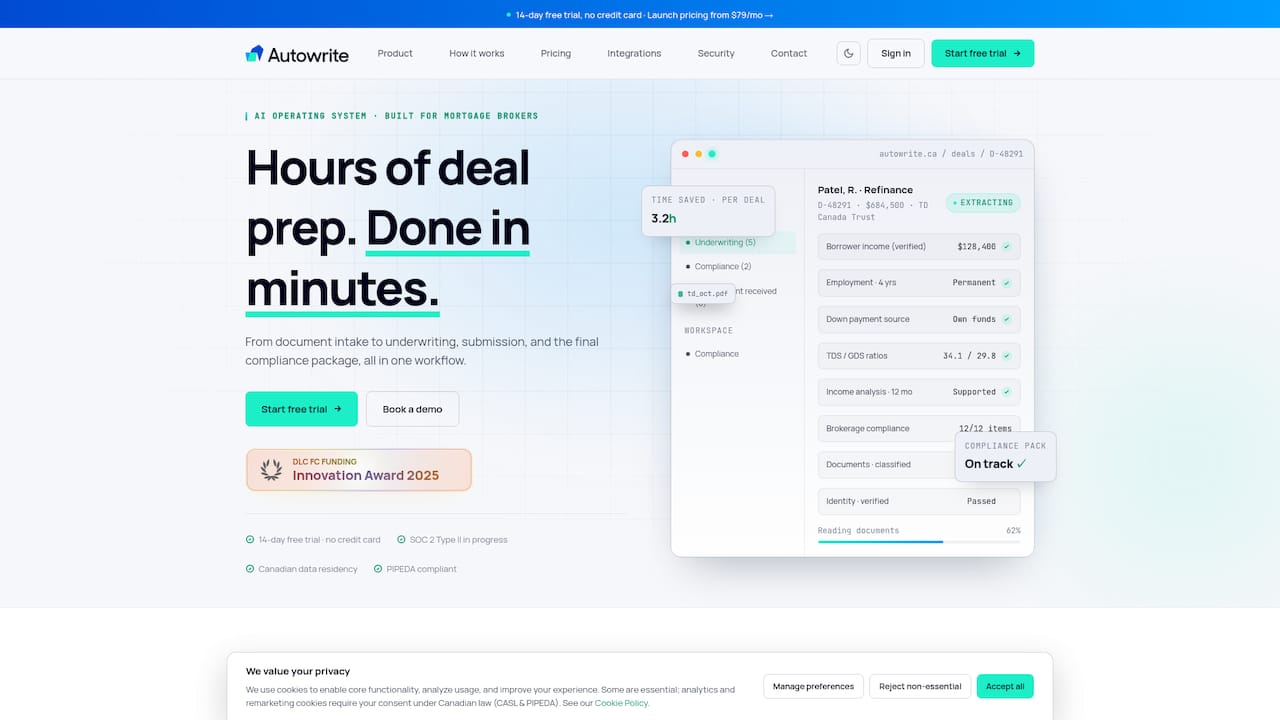
Autowrite was built for the exact operational gap the OPC's own audits keep exposing: consent captured after the fact, disposal that never gets logged, training records nobody can locate. Autowrite classifies incoming mortgage documents, extracts the data your underwriting requires, and timestamps consent and access at every step, so the evidence an auditor asks for already exists instead of getting reconstructed under deadline pressure. Files stay under role-based access with Canadian data residency options, and retention rules can be coded to match your FINTRAC obligations rather than tracked manually on a spreadsheet. That combination, less time spent on admin, more evidence of the exact controls PIPEDA requires, is what separates a brokerage that dreads an audit from one that welcomes it.
If your current intake process still relies on someone remembering to log a consent form or shred an old file, start a free trial with Autowrite and see how much of that evidence generates itself.
Sources
For the primary sources behind this playbook, start with the OPC's own explanations of PIPEDA's scope and its 10 fair information principles. Review the 2010 audit of mortgage brokers and case summary 2012-011 for real enforcement precedent. For retention obligations that interact with PIPEDA, consult FINTRAC's recordkeeping guidance directly rather than relying on secondhand summaries.
- PIPEDA requirements in brief - Office of the Privacy Commissioner of Canada
- Audit of selected mortgage brokers — Office of the Privacy Commissioner (2010)
- FINTRAC recordkeeping guidance