

Keep one consolidated, searchable mortgage master file: a digital copy backed up in two places, plus a secure physical copy of the originals you need to retain. Sort everything into categories that match what lenders ask for: income, debts, assets, property, and closing. Name files with a YYYY-MM-DD convention and set an annual review date so the system stays current.
TL;DR:
- Salaried applicants should keep two years of employment records; applicants who work for themselves need Notices of Assessment and business financial statements.
- Keep the property deed, signed mortgage instrument, and lawyer’s closing statement permanently; routine financial records can generally be destroyed after six years.
- Store originals of the deed, mortgage instrument, and purchase offer securely; an offsite safe deposit box protects irreplaceable papers from fire or flood.
- Lender requirements extend beyond standard checklists, so ask your mortgage professional for a tailored document list before your preapproval meeting.
- For closing, keep photo ID, the signed offer, deposit receipt, recent bank statement, and broker and lawyer contact details together; revoke shared links afterward.
Table of Contents
- Step 1: gather every mortgage- and home-related document into one place
- Step 2: sort into functional categories homeowners and lenders use
- Step 3: choose storage: digital, physical or hybrid and how to split documents safely
- Step 4: file-naming and folder conventions that make retrieval instant
- Step 5: maintain, retain and purge, timelines and a review routine
- Mortgage document checklist: the papers lenders commonly require
- Quick-access kit and emergency copies for closing day and urgent needs
- Tools, templates and workflows to implement the system quickly
- Why proactive organization matters for mortgage timing and stress reduction
- For mortgage professionals: an automated option for document intake and compliance
- FAQ
- Sources
Step 1: gather every mortgage- and home-related document into one place
Before you can organize anything, you need to find it. Mortgage paperwork tends to scatter across kitchen drawers, email attachments, online banking portals, and old phone photos, so a short collection sweep saves hours later.
Start by checking three places systematically: physical storage at home (filing cabinets, drawers, folders), your email inbox and archived folders, and online accounts for your bank, employer payroll portal, and the Canada Revenue Agency. Open one temporary holding folder on your computer and one physical folder or box, and drop everything into those two spots as you find it, without sorting yet.
Prioritize the documents lenders ask for first, since these are the ones that cause delays when missing:
- Proof of income, including recent pay stubs and, for salaried employees, two years of employment records
- Notices of Assessment, especially important if you're self-employed
- Recent bank statements covering your chequing and savings accounts
- Any existing mortgage statements or loan agreements tied to your property
As you collect each item, jot a quick note of where you found it, such as "email, a recent statement" or "bottom drawer, filing cabinet." This small habit pays off later when a lender asks for a follow-up document and you need to retrieve it fast rather than searching from scratch.
Step 2: sort into functional categories homeowners and lenders use
Once everything is in one place, sort it into categories that mirror how lenders actually review a file. CMHC guidance points to core documentation including employment verification, debt obligations such as loans and lines of credit, and down payment source verification, which gives a practical starting point for your own categories.
A functional system works well with categories such as:
- Identification: driver's licence, passport, or other government ID
- Income and employment: pay stubs, T4 slips, Notices of Assessment, employment letters
- Assets: bank statements, RRSP statements, investment account summaries
- Liabilities: credit card statements, loan agreements, lines of credit
- Property and purchase: signed offer to purchase, MLS listing, appraisal report
- Closing and legal: mortgage instrument, title or deed, lawyer's statement of adjustments
- Ongoing statements: property tax bills, condo fees, home insurance proof
These categories exist because lenders check specific risk factors in each one, and tax or retention rules often apply differently to each too. Keeping income records separate from property records, for instance, means you can update one category (pay stubs change monthly) without disturbing another that barely changes (your deed).
Step 3: choose storage: digital, physical or hybrid and how to split documents safely
A hybrid approach works best for most homeowners: a searchable digital master file for everyday access, paired with secure physical storage for the handful of documents where the original matters legally. Your signed mortgage instrument, property deed, and offer to purchase fall into that second group, since a court, lawyer, or lender may eventually need the original rather than a copy.

For physical originals, a fireproof home safe works for documents you might need on short notice. For anything truly irreplaceable, such as your property deed, a bank safe deposit box or offsite secure storage offers better protection against fire or flood than a home safe alone.
When digitizing, aim for consistency:
- Scan at a resolution that keeps text legible when zoomed in
- Save everything as searchable PDFs rather than image-only files
- Use one file format throughout so your system stays predictable
- Back up digital files to an encrypted cloud service and a secondary local drive
Pro Tip: Scan double-sided documents as a single PDF rather than two separate files. Lenders and lawyers review paperwork faster when pages stay in their original order.
Step 4: file-naming and folder conventions that make retrieval instant
A consistent naming pattern turns a messy folder into a searchable archive in minutes. Use a date-forward format: YYYY-MM-DD, then document type, then a short description. For example: "YYYY-MM-DD - Pay Stub - Month.pdf" or "YYYY-MM-DD - Bank Statement - Chequing.pdf."
Build your folders in a clear hierarchy that mirrors your categories from Step 2:
- Home > [your address] > Mortgage > Income
- Home > [your address] > Mortgage > Debts
- Home > [your address] > Mortgage > Property
- Home > [your address] > Mortgage > Closing
Most scanner apps and cloud storage tools include optical character recognition, which makes scanned text searchable even inside an image file, so a quick keyword search pulls up the right document without opening every folder. Keep a one-page naming cheat sheet saved alongside your file system so anyone helping you (a spouse, a mortgage professional, a lawyer) can follow the same pattern.
Step 5: maintain, retain and purge, timelines and a review routine
Some documents need to stay forever, others can go after a set number of years. Canada Revenue Agency guidance points to a six-year retention period as a common baseline for financial and transaction records, and homeowners can reasonably apply the same standard to major mortgage-related paperwork even though personal retention isn't legislated the same way as it is for licensed businesses.
Keep these permanently, since they prove ownership and legal standing:
- Your property title or deed
- The signed mortgage instrument and any discharge documents
- Closing statements from your lawyer
Everything else, including routine bank statements, old pay stubs, and utility bills tied to a sold property, can typically be purged after six years. Set one recurring date each year, such as the first weekend in January, to review your file: shred physical documents you no longer need using a cross-cut shredder, and use your operating system's secure delete function (not just the recycle bin) for digital files containing account numbers or identification details.
Mortgage document checklist: the papers lenders commonly require
This checklist mirrors what CMHC guidance identifies as core documentation for a mortgage application, organized so you can work through it before a pre-approval meeting.
- Income verification: recent pay stubs, T4 slips, and Notices of Assessment; self-employed applicants should add business financial statements and a statement of business activities.
- Assets and down payment proof: recent bank statements showing the funds, RRSP withdrawal statements if applicable, and a gift letter if any portion of the down payment comes from a family member.
- Debts and obligations: current statements for car loans, student loans, credit cards, lines of credit, and any spousal or child support payments.
- Property and purchase documents: the signed offer to purchase, the MLS listing, an appraisal or valuation report, and current property tax, condo fee, and home insurance statements.
CMHC guidance also notes that debt obligations beyond the obvious, such as support payments or smaller lines of credit, are easy to overlook but routinely requested. Since lender requirements can vary beyond this baseline, it's worth asking your mortgage professional for their specific checklist before your first meeting rather than assuming this list covers every document they'll want.
Quick-access kit and emergency copies for closing day and urgent needs
Closing day moves fast, and having a ready kit avoids last-minute scrambling. Put together one folder, physical or digital, containing photo ID, the signed offer to purchase, your deposit receipt, a recent bank statement, and contact details for your mortgage broker and lawyer.
For sharing these securely:
- Use password-protected PDFs when emailing sensitive documents
- Set expiring links through your cloud storage provider rather than permanent shares
- Prepare a sealed physical envelope with copies as a backup if digital access fails
Share full access only when a lawyer or lender specifically requests it for closing, and revoke link access or change shared-folder permissions once the transaction completes.
Pro Tip: Set a calendar reminder after closing to revoke any temporary file access you granted during the transaction.
Tools, templates and workflows to implement the system quickly
You don't need specialized software to run this system well. A scanner app with optical character recognition handles digitization from your phone, an encrypted cloud storage service holds your searchable master file, and an external drive or secondary cloud account covers your backup.
Three templates are worth preparing in advance:
- A printable version of the mortgage document checklist from Step 5
- A one-page file-naming cheat sheet to keep beside your computer
- An annual review checklist listing what to check, keep, and shred
The workflow itself stays simple: receive the document, scan it, name it using your convention, file it in the right category folder, then back it up. Following the same process every time keeps the system consistent even months after you set it up.
Why proactive organization matters for mortgage timing and stress reduction
CMHC guidance points to proactive document management as one of the most effective ways to avoid approval delays, and that advice holds true well beyond the application itself. A living mortgage file, kept current rather than assembled under deadline pressure, makes refinancing, selling, or filing taxes considerably less stressful years down the road. Before your next meeting with a mortgage professional, ask for their specific document checklist. Requirements shift between lenders, and a tailored list beats guessing.
— Anant Bawa
For mortgage professionals: an automated option for document intake and compliance
If you're a licensed mortgage broker or agent reading this for your own practice rather than your personal file, the manual system above doesn't scale across dozens of client deals. We built Autowrite specifically for that problem: our platform automates document classification and data extraction so your team spends less time sorting paperwork and more time with clients.
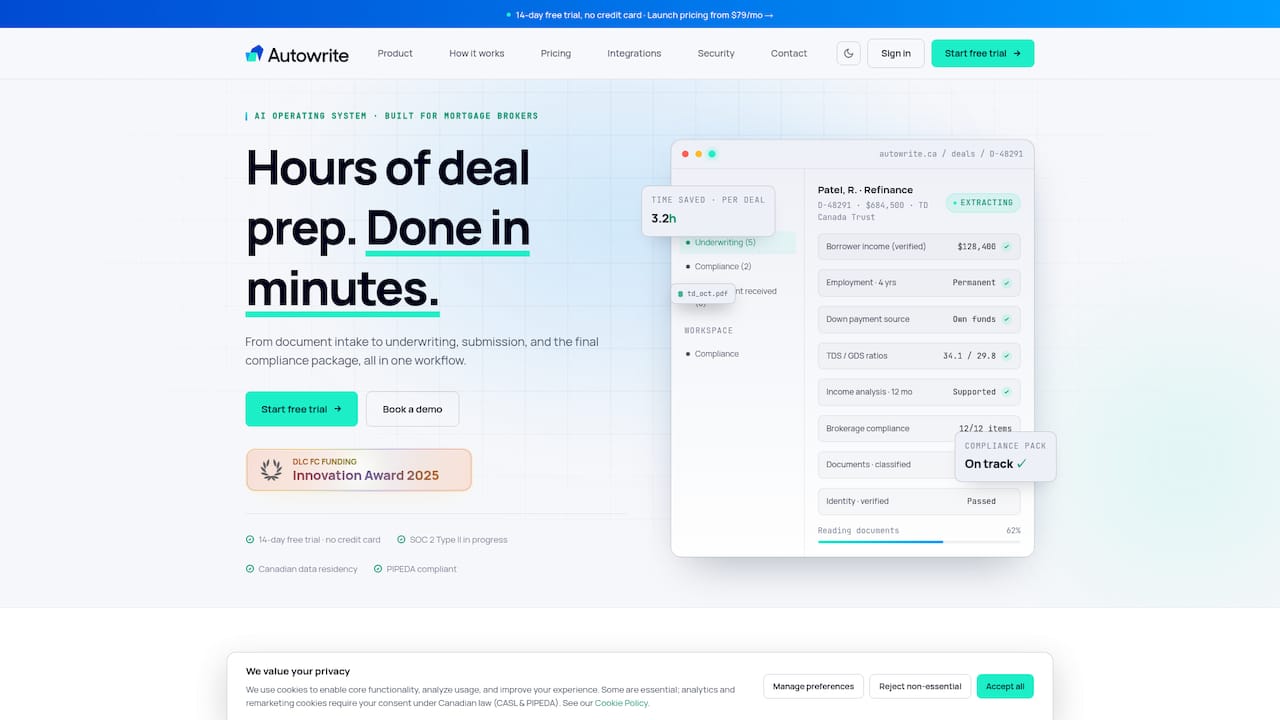
- We auto-fill underwriting forms and assemble audit-ready compliance packages from the documents your clients submit
- We sync with the mortgage software your brokerage already uses
- We keep Canadian data residency for every file processed through the platform
Explore Starter, Pro, Legend, and Enterprise plans with a 14-day free trial to see how much faster document intake moves when it's automated.
FAQ
What is the 10-10-10 rule for decluttering?
For mortgage paperwork, retention is better guided by the timelines in this article, since legal and tax considerations outweigh general decluttering rules.
What is the best way to organize my home documents?
The most reliable method is a hybrid system: a searchable digital master file sorted into categories like income, property, and legal documents, backed up in two places, with physical originals of irreplaceable items stored securely. Consistent file naming, such as a date-forward format, makes retrieval fast regardless of how many documents accumulate.
What is the best way to organize my financial records?
Sort financial records into functional categories such as income, assets, liabilities, and property, mirroring how lenders and tax authorities review them. Canada Revenue Agency guidance points to a six-year retention baseline for financial and transaction records, which works well as a general rule for personal files too.
What are the most common household filing categories?
Common categories include identification, income and employment, assets, liabilities, property and purchase, closing and legal documents, and ongoing statements like utility or insurance bills. These categories work because they match what lenders, accountants, and legal professionals typically request when reviewing your financial picture.
How long should I keep my mortgage documents?
Keep your property title, mortgage instrument, and closing statements permanently, since they prove ownership and legal standing. Routine records like bank statements and pay stubs can generally be purged after six years, following the baseline referenced in Canada Revenue Agency guidance.