
A complete underwriting submission package contains seven core document groups: borrower ID and signed application, income and employment verification, credit and debt evidence, down payment source, property valuation and appraisal, insurance and title documentation, and a written rationale for the recommendation. Every document must be independently verifiable, and the file needs a clear explanation of why the product fits the borrower.
TL;DR:
- Submitting documents in a consistent order, with clear labeling and cross-checked figures, significantly reduces underwriting delays caused by missing or incomplete information.
- Income verification must come from independent sources and include detailed calculations of debt service ratios, with all recurring costs clearly documented.
- Property documents should include a signed offer, tax statements, and appraisal reports, with explanations provided when appraisal values are below purchase prices.
- A detailed written rationale explaining the product choice, client facts, and any exceptions improves review speed and minimizes regulatory scrutiny.
- Automating document classification, data extraction, and compliance assembly with tools like Autowrite can save hours and improve package accuracy.
Table of Contents
- Lender submission checklist for faster underwriter review
- Income and employment verification: what lenders expect to see
- Property documentation, valuation and LTV support
- Credit, liabilities and proving down payment source
- Written rationale, file notes and suitability narrative
- Compliance, retention and file security brokers should enforce
- Workflow efficiency and common pitfalls in package assembly
- Why disciplined packages matter more than speed
- Autowrite: automate intake and build audit-ready packages
- Sources
- FAQ
Lender submission checklist for faster underwriter review
A well-ordered file gets reviewed faster because the underwriter spends less time hunting for missing pieces. Group documents the same way every time, and submit them in the order the underwriter will actually use them.
- Borrower identification and application: signed and dated mortgage application, government ID, and consent forms.
- Income and employment: pay stubs, letters of employment, Notices of Assessment, or financial statements depending on income type.
- Credit and liabilities: credit bureau report and a list of existing debts with balances and payments.
- Down payment source: bank statements, gift letters, or proof of sale proceeds.
- Property documents: MLS listing, signed Offer to Purchase, tax statement, and appraisal.
- Insurance and title: proof of property insurance and title search or insurance binder.
- Rationale: a short written note explaining the product choice and any exceptions.
Name files by category and date (for example, "Income_PayStub_2026-01") so reviewers can scan a folder without opening every document. CMHC's practitioner guidance notes that missing or incomplete information is the leading cause of underwriting delays, which makes consistent ordering worth the extra five minutes.
Pro Tip: Cross-check every figure in the application against its source document before submission: a mismatched income number is one of the fastest ways to trigger a second request.

Income and employment verification: what lenders expect to see
Acceptable evidence depends on how the borrower earns money, and underwriters expect proof that comes from an independent source rather than a borrower's own statement.
- Salaried employees: recent pay stubs, a letter of employment confirming position and salary, and T4 slips.
- Commission or variable income: typically two years of Notices of Assessment plus T4s to show an averaged income trend.
- Self-employed borrowers: two years of Notices of Assessment, business financial statements, and often an accountant letter confirming income.
- Rental income: lease agreements, rent rolls, or a property's historical rental statements.
OSFI Guideline B-20 directs lenders to verify income from independent sources that directly address the declared amount, and to document the debt service ratio calculation behind every approval. That calculation needs heating costs, property taxes, condo fees where applicable, and all other recurring debts listed with their monthly payments, so the underwriter can see exactly how gross and total debt service ratios were derived rather than taking a summary number on faith.
Property documentation, valuation and LTV support
Property-side evidence lets the underwriter confirm the loan-to-value ratio and spot any valuation gap before it becomes a last-minute problem.
- MLS listing showing the property as marketed.
- Signed Offer to Purchase with all amendments attached.
- Municipal tax statement confirming annual property taxes.
- Appraisal or valuation report supporting the lender's required loan-to-value calculation.
- Condo documents (status certificate, bylaws, budget) when the property is a condominium.
CMHC's practitioner guidance for mortgage professionals lists property tax statements, heating costs and condo fees among the items lenders routinely request. Include contractor quotes or improvement estimates only when planned renovations affect the appraised value. When the appraisal comes in below the purchase price, attach a short note explaining the gap, limited comparable sales or market timing are common reasons, so the underwriter isn't left to guess.
Credit, liabilities and proving down payment source
The credit report tells the underwriter about payment history, current balances, and any recent inquiries that need an explanation. Flag disputes or recent hard pulls with a one-line note rather than leaving the underwriter to ask.
- Credit bureau report pulled within the lender's required window.
- Liability list covering every open account: credit cards, lines of credit, car loans, and other mortgages.
- Down payment proof: 90 days of bank statements showing the funds, or an RRSP withdrawal letter, sale proceeds statement, or signed gift letter for gifted funds.
Every liability on the credit report needs to appear in the total debt service calculation with its actual monthly payment, not an estimate, since an inaccurate liability list throws off both GDS and TDS and invites a request for clarification.
Written rationale, file notes and suitability narrative
A suitability narrative is the document that explains the recommendation itself, and its absence is one of the most common gaps regulators find.
- State the client's facts: income, goals, and any constraints that shaped the recommendation.
- Name the product chosen and explain why it fits those facts better than the alternatives considered.
- Document any exception (a higher ratio, an unusual income type) and how it was mitigated.
- Log the date and format of every client conversation that informed the decision.
FSRA's review of brokerage files found that files often collect client data but fail to preserve the reasoning behind the recommendation, a gap examiners flag during supervision. Store notes in a dated, searchable format so a reviewer can reconstruct the decision months later.
Compliance, retention and file security brokers should enforce
FSRA requires brokerages to retain complete transaction records for at least six years after the mortgage term expires, and that retention obligation covers more than the signed forms.
- Keep emails, texts, and call summaries alongside the formal application documents.
- Centralize storage so files remain accessible after an agent leaves the brokerage.
- Run periodic spot audits to confirm files are complete before a regulator asks.
Principal brokers carry the responsibility for preserving access to these records, which means a shared, permission-controlled archive matters more than any individual agent's personal filing habit.
Pro Tip: Treat every client text and informal note as a file document from day one: reconstructing a conversation six months later is far harder than saving it once.
Workflow efficiency and common pitfalls in package assembly
The same handful of errors cause most underwriting holdbacks: unlabeled bank statements, missing signature pages, income documents that do not match the application, and property documents submitted out of order.
- Run an intake checklist the moment documents arrive, before the file moves further.
- Use a second-reviewer preflight pass to catch omissions before submission.
- Apply consistent file naming across every deal so any team member can find a document fast.
- Follow a handoff checklist when a file moves between processor and broker.
Autowrite's document intelligence applies these same checks automatically: it classifies incoming documents, extracts the data needed for underwriting forms, and keeps an audit trail of what was received and when. Autowrite's own lender submission checklist and intake workflow guide walk through these steps in more detail, including how to handle self-employed income documentation and gift letter requirements.
Why disciplined packages matter more than speed
The brokers who close fastest are rarely the ones who submit first. They're the ones whose files come back clean because every figure matches its source and every exception has a note attached. A documented rationale is what turns a supervisory review from a scramble into a formality. For deeper operational detail on building that discipline into daily workflow, Autowrite's blog covers specific document types and submission patterns worth reading before your next complex file.
— Anant Bawa
Autowrite: automate intake and build audit-ready packages
Assembling a complete package by hand means chasing documents, renaming files, and cross-checking numbers across a dozen PDFs, work that eats hours a broker could spend with clients. Autowrite is built for exactly this: it automates document intake, classifies each file as it arrives, extracts the data underwriters need, and assembles a compliance-ready package with an audit trail attached.
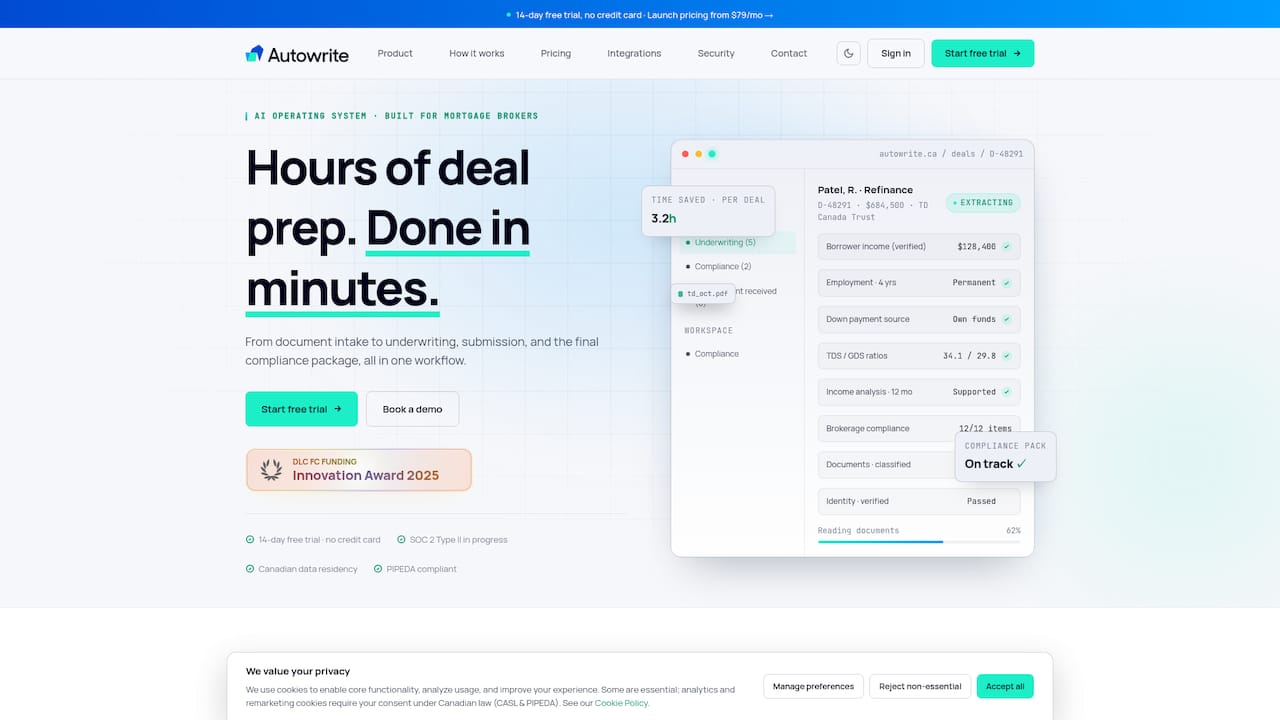
- Document intelligence classifies and extracts data from income, credit, and property documents automatically.
- Auto-filled underwriting forms reduce manual re-entry and transcription errors.
- Compliance package assembly keeps file notes and communications organized for retention requirements.
Plans are available in multiple tiers, listed on the pricing page. A 14-day free trial lets you test the workflow on a real file before committing, through the Autowrite product page.
Sources
OSFI Guideline B-20 backs the debt serviceability, LTV, and independent-verification standards cited above. CMHC's mortgage application guidance supports the property and down payment document list. FSRA's recordkeeping guidance and its suitability documentation review support the retention and rationale sections. For supporting insurance documentation, brokers can also reference third-party resources such as this overview of mortgage protection insurance options.
- Residential mortgage underwriting practices and procedures Guideline (B-20) - OSFI
- Mortgage Application Tips — What Your Mortgage Professional Needs to Know - CMHC
- Show your work: documenting mortgage suitability for your client - FSRA
FAQ
How long must brokerages keep underwriting submission records?
Brokerages must retain complete transaction records, including communications and file notes, for at least six years after the mortgage term expires. This covers emails, texts, and call summaries, not just the signed application forms.
Are electronic or scanned copies acceptable in a submission package?
Most lenders accept clear electronic copies of income, property, and identification documents as long as they are legible and complete. Originals may still be requested for specific items like gift letters or identification depending on the lender's own policy.
How should self-employed income be documented for underwriting?
Self-employed borrowers typically need two years of Notices of Assessment, business financial statements, and often an accountant letter confirming income stability. OSFI's guideline expects this evidence to come from an independent source rather than the borrower's own declaration.
What happens if the appraisal comes in below the purchase price?
Attach a short written note explaining the likely cause, such as limited comparable sales or market timing, along with any supporting detail that helps the underwriter reconcile the gap. Lenders generally base the loan-to-value calculation on the lower of the appraised value or purchase price, so this discrepancy can affect the approved loan amount.
What is the fastest way to reduce back-and-forth with underwriters?
Submit a complete, well-ordered package with a written rationale attached, since missing or mismatched documents are the leading cause of delays according to CMHC's practitioner guidance. A consistent preflight review before submission catches most common omissions before the underwriter ever sees the file.