
Yes, electronic signatures are legally valid for most mortgage documents in Canada, provided they meet statutory reliability standards and evidentiary safeguards. Federal law under PIPEDA and provincial Electronic Commerce Acts treat e-signatures as equivalent to wet-ink signatures. The real risk isn't legality. It's whether your identity verification and audit trail can survive a dispute or a lender's underwriting review.
TL;DR:
- Electronic signatures are legally valid for most mortgage documents in Canada if they include verified identities and a tamper-proof audit trail.
- Not all land registry and registry-related documents can be e-signed everywhere, with Ontario offering more flexibility than Alberta or British Columbia.
- Proper remote commissioning and identity verification, including live video and government ID checks, are essential to ensure the signature's reliability and defendability.
- Industry acceptance by lenders and title insurers hinges on meeting underwriting standards related to documented verification and retention, not just legal recognition.
- The key to a defendable e-signature process is sequencing steps correctly, maintaining immutable PDFs, and ensuring audit trail data meets provincial and industry requirements.
Table of Contents
- E-Signature Mortgage Legality in Canada: The Statutory Framework
- Which Mortgage Documents Can You E-Sign in Canada?
- Identity Verification and Remote Commissioning Standards
- What Lenders, CMHC, and Title Insurers Actually Expect
- What to Demand From an E-Sign and Closing Platform
- A Step-by-Step Checklist for a Defensible E-Sign Closing
- How Document Intelligence Supports Compliant E-Sign Workflows
- What Brokers and Borrowers Should Prioritize Now
- Autowrite: Built for Brokers Who Need Audit-Ready E-Sign Files
- Sources
- FAQ
E-Signature Mortgage Legality in Canada: The Statutory Framework
Canada never passed a single national law declaring e-signatures valid. Instead, it built a patchwork of federal and provincial statutes that, together, give electronic signatures the same legal weight as pen-and-paper ones for the vast majority of contracts, including most mortgage documents.
At the federal level, PIPEDA established that electronic documents can satisfy legal requirements traditionally reserved for paper. Its companion regulation, SOR/2014-117, goes further. It lays out the specific reliability factors an electronic signature needs to hold up: the signature method must reliably link the identity of the signer to the document, demonstrate that the signer intended to approve its contents, and allow verification that no alterations occurred after signing. Critically, this regulation confirms that an electronic document can stand in for the original source document, as long as its integrity is maintained throughout its lifecycle.
Provincial law does most of the heavy lifting for real estate and mortgage transactions specifically. Ontario's Electronic Commerce Act gives broad legal recognition to e-signatures across most contract types, including agreements tied to real property. Alberta and British Columbia have similar electronic transactions legislation, but both provinces layer on registry-specific requirements that Ontario doesn't impose as heavily, which matters enormously once you get into land title filings.
Here's where mortgage professionals often get tripped up: statutory equivalence is not the same as automatic courtroom acceptance. The Government of Canada's guidance on electronic signatures states plainly that a signature must be verifiable and its reliability demonstrable over time. That means:
- The law says e-signatures can be valid, not that every e-signature automatically is valid.
- Courts and regulators will still scrutinize how identity was confirmed at the moment of signing.
- Evidence rules require you to show the document wasn't tampered with after execution.
- Assurance levels matter. A simple checkbox click carries less evidentiary weight than a signature backed by verified ID and biometric or credential checks.
Legal commentary from Torys LLP makes a point worth repeating: the practical risk in most disputes isn't whether e-signatures are recognized by statute. It's whether you can prove, after the fact, exactly who signed, when, and that nothing changed afterward. That shifts the real work from "is this legal" to "can I prove it happened the way I say it did."
Which Mortgage Documents Can You E-Sign in Canada?
Not every document in a mortgage file gets the same treatment. Some slide through e-signing without friction. Others still expect ink on paper, and the split runs largely along provincial lines.
- Agreements of purchase and sale. These are generally e-signable across Canada, and most real estate boards have supported digital execution for years.
- Mortgage commitment letters and loan agreements. Lenders routinely accept these electronically, particularly when a recognized digital-closing platform handles the package.
- Standard disclosure and consent forms. Cost-of-borrowing disclosures, privacy consents, and similar documents typically qualify without issue.
- Certain registry and land-title documents. This is where things get complicated. Ontario permits e-signatures for many registry-related filings, but Cassels' analysis notes that Alberta and British Columbia retain wet-ink requirements for specific land-title registration steps.
- Powers of attorney and certain affidavits. Many provinces still require physical signing and, in some cases, in-person witnessing for these documents, regardless of how the rest of the file is handled.
- Wills and estate-related documents tied to a mortgage file. These almost always fall outside e-signature acceptance and need traditional execution.
The practical decision rule for brokers is simple: if a document eventually needs to be filed at a provincial land registry, check that province's specific rules before assuming digital execution will fly. Ontario brokers have more flexibility than their Alberta or BC counterparts. When in doubt, loop in the closing lawyer early rather than discovering a registration rejection after the fact.
Identity Verification and Remote Commissioning Standards
A signature is only as strong as the identity behind it. That's the piece regulators and Law Societies focus on most heavily, and it's the piece that separates a defensible digital closing from a vulnerable one.
Ontario and Alberta's Law Societies have both issued guidance supporting remote commissioning under specific safeguards, generally requiring live video verification, government-issued ID checks, and a documented process that a licensed lawyer supervises. This isn't a loophole. It's a structured alternative to in-person witnessing, built with enough friction to catch impersonation attempts and enough documentation to survive scrutiny later.
Effective identity verification for a mortgage closing typically includes:
- Live video identity checks conducted by a licensed commissioner or lawyer, not an automated bot alone.
- Verified government ID uploads cross-checked against credential databases.
- A recorded statement of the signer's intent, captured at the moment of signing.
- Secure, tamper-evident timestamping tied to the specific document version being executed.
The Canadian Centre for Cyber Security's authentication guidance reinforces this: strong authentication and proper audit trails aren't optional extras. They're the mechanism that gives an electronic document its legal teeth. Without them, you have a signature with no reliable way to prove who actually made it.
Pro Tip: Never rely on email confirmation alone as your identity trail. If a dispute arises, a lender or court will ask for the actual verification record, not just the timestamp of when a document was opened.
What Lenders, CMHC, and Title Insurers Actually Expect
Legal validity gets you in the door. Industry acceptance determines whether the deal actually closes without a hiccup.
Major Canadian lenders and CMHC generally accept digital closings when the underlying process satisfies their underwriting and anti-fraud standards, not because of any particular software brand. What they're checking for is consistent: was identity properly verified, does an audit trail exist, and is the retention process documented. When those boxes are checked, digital closings move through underwriting about as smoothly as paper ones.
Title insurers add another layer of caution. Their concern sits specifically at the registration point, where provincial land-title rules can still demand a wet-ink original regardless of how the rest of the transaction was handled. A digitally executed mortgage commitment can be airtight, and the registration step can still stall if the province requires a physical document at the registry.
Before running a file digitally, brokers should confirm a short list of items with both lender and insurer:
- Does the lender's underwriting system accept the specific e-sign platform or process being used?
- Does the title insurer require a wet-ink copy for this particular document type in this province?
- Is the audit trail format compatible with what the lender's compliance team expects for file review?
- Are retention timelines aligned with provincial recordkeeping requirements?
Deeded's analysis of remote and hybrid closings points out that platforms operating under Ontario's Law Society Access to Innovation framework, paired with video ID verification and full audit trails, have become standard enough that lenders and CMHC treat them as routine rather than exceptional. Acceptance is no longer the obstacle it was five years ago. Process discipline is.
What to Demand From an E-Sign and Closing Platform
Not every e-signature tool produces a document that will survive a challenge. The platform matters less than the specific features it captures behind the scenes.
At minimum, a mortgage-grade e-sign process should generate an immutable final PDF with a visible tamper seal, meaning any post-signing alteration is detectable. It needs a timestamped audit trail that records IP address, device information, and signer authentication method for every party on the document. Role-based routing matters too. It ensures the borrower, co-signer, and witness each sign in the correct sequence with their identity independently confirmed at each step.
Operationally, look for platforms that:
- Display explicit consent language before signing, confirming the signer understands they're executing a legally binding document electronically.
- Maintain version control so there's never ambiguity about which draft was actually signed.
- Log witness or commissioning details separately from the signature event itself.
- Apply retention policies that match provincial recordkeeping rules rather than a generic default.
- Flag registry exceptions automatically, before a broker wastes a closing day discovering a document needed wet ink after all.
Pro Tip: Ask any e-sign vendor directly whether their audit trail output has ever been tested in a legal dispute. A platform that can't answer that clearly is asking you to be the test case.
Partner tools that support pre-deal verification, such as AddBack's pre-deal intelligence platform, can add another layer of data checking before a file moves to signing, which reduces the odds of a downstream registry surprise.
A Step-by-Step Checklist for a Defensible E-Sign Closing
Getting this right isn't complicated, but it does require sequence discipline. Skipping a step early tends to surface as a registration problem weeks later.
- Confirm acceptance before you start. Check with the lender, the title insurer, and the relevant land registry that digital execution is acceptable for every document in this specific file.
- Collect informed consent. Have the borrower explicitly acknowledge they understand and accept electronic execution before any document is sent for signature.
- Gather and verify identity documents. Collect government-issued ID and run it through a verified check, not a visual glance.
- Conduct the signing session properly. Use Law Society approved remote commissioning with live video, or arrange in-person witnessing where the document type demands it.
- Generate the tamper-evident final document. Confirm the platform produces an immutable PDF with the full audit trail attached, including timestamps and device metadata.
- Deliver copies to all required parties. Send the completed package to the lender, the insurer, and the borrower promptly after execution.
- Retain the audit trail and originals. Store records according to the retention period your province requires, and keep the audit trail alongside the document rather than in a separate system that could get disconnected.
Following this order matters more than most brokers assume. A file assembled out of sequence, say, gathering consent after the signing session instead of before it, creates exactly the kind of gap a lender's compliance reviewer or a court will flag first.
How Document Intelligence Supports Compliant E-Sign Workflows
Manually tracking which documents need wet ink, which lender accepts which e-sign format, and where every audit trail record lives is exactly the kind of repetitive, detail-heavy work that produces mistakes under deadline pressure. That's precisely where automation earns its keep.

Autowrite applies document intelligence to classify incoming mortgage paperwork automatically, extract the data underwriters need, and assemble compliant e-sign packages without a broker manually cross-checking each form against provincial rules. Because the platform maintains Canadian data residency, files and their associated metadata stay within compliance boundaries.
The operational payoff shows up in a few concrete ways:
- Consistent metadata capture across every file, so audit trails look the same whether a junior agent or a senior broker handled the closing.
- Automated pre-checks that flag when a specific document, based on province and document type, still requires wet-ink execution.
- Centralized retention that keeps the signed package and its audit trail together, ready for a lender's file review or a compliance audit without a scramble.
For a deeper look at how automated intake supports this kind of consistency, Autowrite's guide to mortgage document automation walks through the workflow in more detail.
What Brokers and Borrowers Should Prioritize Now
The legal question around e-signed mortgages in Canada is largely settled. PIPEDA, the provincial Electronic Commerce Acts, and SOR/2014-117 together give electronic signatures real statutory footing, and lenders, CMHC, and most title insurers have caught up with practice that reflects it. What hasn't caught up, in a lot of brokerages, is the operational rigor needed to make an e-signed file bulletproof if it's ever challenged.
That's the gap worth closing. Adopting Law Society aligned remote commissioning isn't a compliance checkbox. It's the difference between a signature that looks valid and one that can survive a dispute years later. The same goes for audit trails: capturing IP data and timestamps because a platform happens to log them is different from designing a workflow specifically to preserve that evidence.
Brokers who treat identity verification and audit-trail retention as core parts of the closing process, not afterthoughts, are the ones who won't get caught flat-footed when a lender's compliance team asks for backup documentation. For a practical starting point, Autowrite's mortgage document checklist outlines the intake steps that make this discipline easier to maintain file after file.
— Anant Bawa
Autowrite: Built for Brokers Who Need Audit-Ready E-Sign Files
A specialized workflow connects document intake straight through to a compliant, audit-ready closing package, reducing manual cross-checking against provincial rules.
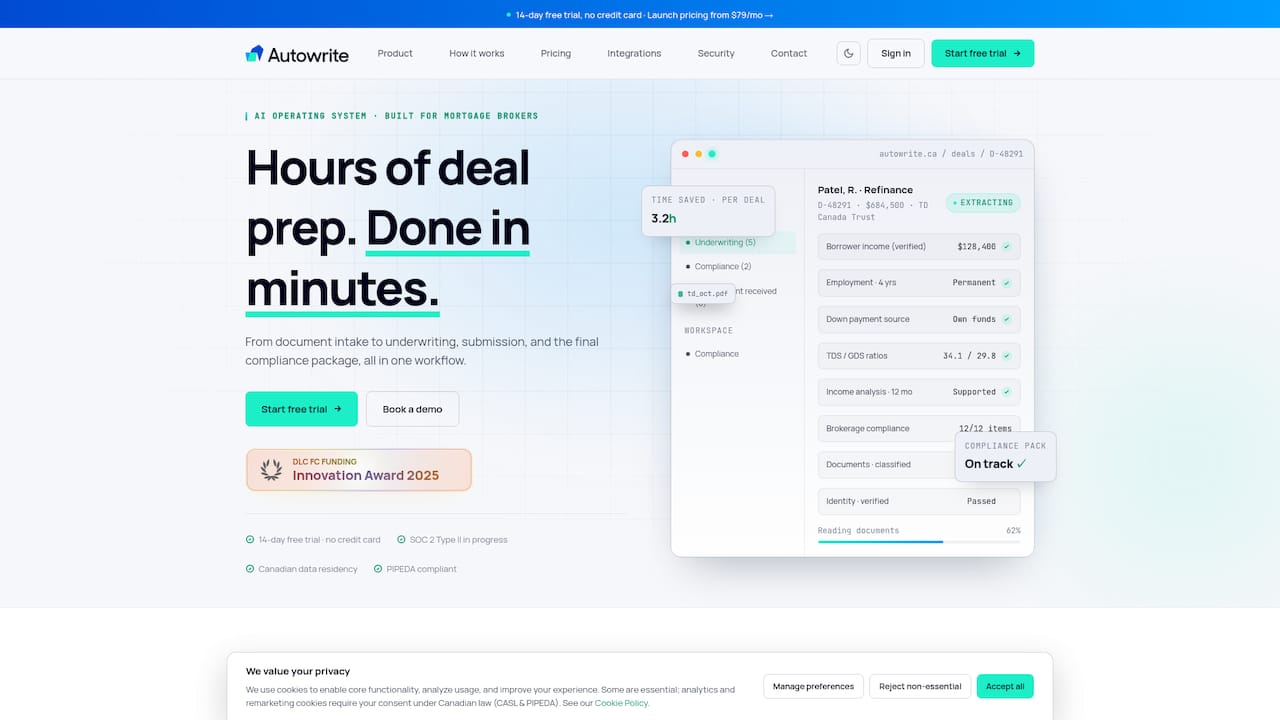
Instead of juggling separate systems for document classification, data extraction, and e-sign assembly, some platforms handle the full chain in one place. They automatically classify incoming paperwork, extract the data underwriting forms need, flag documents that still require wet-ink execution based on provincial rules, and package everything with metadata lenders or title insurers expect to see.
If your brokerage is still stitching together separate tools for intake, underwriting prep, and e-sign packaging, start a trial at Autowrite and see how much of that manual cross-checking disappears from your closing process.
Sources
- Government of Canada Guidance on Using Electronic Signatures
- Electronic signatures in commercial transactions | Cassels
FAQ
Is an e-signature legal in Canada?
Yes. Federal law under PIPEDA and provincial Electronic Commerce Acts give e-signatures the same legal standing as handwritten ones for most contracts, provided reliability and integrity requirements under SOR/2014-117 are met.
Can a mortgage deed be electronically signed?
Many mortgage documents can be e-signed, but deeds and registry filings tied to land title are subject to provincial exceptions. Alberta and British Columbia often require wet-ink execution for specific title registration steps, while Ontario permits broader digital acceptance.
Can mortgage documents be DocuSigned?
Mortgage commitment letters, disclosure forms, and purchase agreements are commonly executed through recognized e-sign platforms, and lenders and CMHC generally accept these when identity verification and audit trails meet underwriting standards. Some registry specific documents still require wet-ink signing depending on the province.
Do e-signatures hold up in court?
They can, but courts focus on whether you can demonstrate the signer's identity and prove the document wasn't altered after signing, not just on the fact that a signature was made electronically. A platform with a documented audit trail and verified identity checks gives you a far stronger position than a basic click-to-sign process.