
Gift letter verification means a lender confirms three things: the money is truly a gift with no repayment expected, the donor can prove where the funds came from, and the paper trail connects the donor's account to the borrower's deposit. Underwriters at most institutions, guided by standards like CMHC's oversight of mortgage loan insurance, will not accept a signed letter alone. They want bank statements, wire receipts, and donor identification behind it, and tools exist to help automate the assembly of that trail, saving brokers significant time.
TL;DR:
- Gift letters must clearly state the funds are a gift with no expectation of repayment to prevent reclassification as debt.
- Lenders require detailed donor information, source account details, and traceable proof that funds originate from verified accounts.
- Proper documentation includes bank statements, wire receipts, and matching account digits, with deposit timing affecting approval chances.
- Unexplained large deposits, cash gifts, or interested-party contributions trigger additional scrutiny or rejection.
- The entire process relies on thorough, complete paperwork prepared before submission, avoiding delays and potential loan approval issues.
Table of Contents
- What Underwriters Check When They Verify a Gift
- Required Contents of a Mortgage Gift Letter (Checklist)
- Documentation Lenders Demand and How to Assemble the Audit Trail
- Timing, Seasoned Funds, and When Lenders Increase Verification
- Common Red Flags, Underwriting Triggers, and How to Prevent Them
- Legal Implications and Obligations for Donors and Recipients
- How Gift Letter Requirements Differ Across Loan Types and Lenders
- The Step-by-Step Approval Process for a Gift Letter
- How Gift Letters Affect Underwriting and Loan Approval
- Examples of Acceptable and Unacceptable Gift Letter Formats
- An Industry Practitioner's Note on Avoiding Delays
- Authoritative Pages and Templates to Check
- Sources
What Underwriters Check When They Verify a Gift
An underwriter reading a gift letter is really asking one question: does this money create an obligation the borrower didn't disclose? A loan disguised as a gift changes the debt-to-income calculation and can sink an approval that looked solid on paper. That's why every gift letter gets read against a short list of specific facts, not just skimmed for a signature.
Here's what actually gets checked:
- Gift versus loan language. The letter must state, in plain terms, that the money is a gift and carries no expectation of repayment. Any hint of a future payback arrangement reclassifies it as debt.
- Donor identity and relationship. Lenders want to know who gave the money and how they're related to the borrower, since not every donor qualifies under a program's rules.
- No ownership claim. The donor has to confirm they're not acquiring any interest in the property. This is also a legal safeguard: once signed, the donor generally waives any future claim on the home, a point Canadian legal guidance on gift letters for mortgage down payments explains clearly.
- Traceable source of funds. Anti-money-laundering rules require lenders to confirm where large deposits originate, not just that a letter says they're clean.
Miss any one of these and the file stalls, sometimes for weeks, while the lender chases documentation that should have been ready at submission.
Required Contents of a Mortgage Gift Letter (Checklist)
A gift letter isn't a casual note. Lenders expect a specific set of fields, and Investopedia's breakdown of standard gift letter contents matches what most Canadian lenders request. Use this as your working checklist before you submit anything:
- Full legal names of both donor and recipient, spelled exactly as they appear on government ID.
- The relationship between donor and recipient (parent, grandparent, sibling, etc.), since some programs restrict acceptable donors.
- Donor contact information, including address and phone number, so the lender can follow up if needed.
- The exact gift amount, stated in dollars, with no rounding or ranges.
- The transfer date, matching the date funds actually left the donor's account.
- Source account details, typically the last four digits of the donor's account number.
- A no-repayment statement, explicit and unambiguous.
- A no-ownership-interest declaration, confirming the donor has no claim on the property.
- An arm's-length statement, where applicable, confirming the gift isn't tied to the sale itself.
- Signatures and date from the donor, with the recipient's signature often required too.
Some lenders will also ask for notarization on larger gifts or when the donor lives outside Canada. Check with your loan officer before assuming a standard template covers your situation.
Documentation Lenders Demand and How to Assemble the Audit Trail
A signed letter tells the underwriter what happened. The documents behind it prove it. Most lenders want a matched set: donor bank statements showing the funds sitting in the account before the transfer, a wire confirmation or cleared check showing the movement, and the recipient's deposit record showing the same amount landing in the borrower's account.
The connective tissue is the account numbers. Underwriters look for the last four digits on the donor's statement to match the incoming transfer on the borrower's statement. If those numbers don't line up, or if the deposit shows up as an unexplained lump sum with no corresponding withdrawal on the donor's side, expect a request for more paperwork.
For larger gifts, particularly six-figure amounts tied to the sale of an investment account or property, lenders may ask for a fuller trail: statements showing the liquidation of securities, or a letter from the donor's investment firm confirming the source, a step Investopedia notes is common when funds don't originate from a simple chequing account.
A few habits speed this along:
- Request PDF statements directly from the donor's bank rather than photos of paper statements.
- Label each file clearly (for example, "Donor_Statement_March2026" and "Wire_Confirmation_March2026") so nothing gets misfiled.
- Keep the wire confirmation and the gift letter in the same submission batch.
Pro Tip: Ask the donor to keep a digital copy of the wire receipt the moment the transfer clears. Retrieving it from a bank branch three weeks later, after the underwriter has already flagged the file, costs you time you don't get back.
Timing, Seasoned Funds, and When Lenders Increase Verification
"Seasoned funds" means money that's been sitting in an account for a set period, commonly 30 to 60 days, before the mortgage application. Lenders treat seasoned deposits as lower risk because there's a visible history behind them, not a mystery lump sum that showed up the week before closing.
RBC's guidance for parents helping with a down payment recommends depositing gift funds well ahead of the application specifically to avoid this friction. A large, unseasoned deposit almost always draws a follow-up request.
Three moves reduce your odds of delay:
- Deposit gifted funds as early in the process as possible, ideally before you even apply.
- Keep every wire receipt and donor bank statement from the transfer, not just a screenshot.
- Tell your lender about the gift in advance rather than letting it surface as a surprise deposit mid-underwriting.
Common Red Flags, Underwriting Triggers, and How to Prevent Them
Certain patterns almost guarantee a second look from underwriting, and most of them are avoidable with a little planning. An unexplained large deposit with no paper trail is the single biggest trigger. Cash deposits are another, since cash has no account history to verify. Gifts from someone with a financial interest in the transaction, such as the seller or the real estate agent, raise immediate questions about arm's-length dealing. An unsigned letter or one missing donor bank statements gets kicked back before it even reaches underwriting review.
Each of these has a straightforward fix:
- Unexplained deposits: attach the donor's bank statement showing the withdrawal that matches the deposit.
- Cash gifts: ask the donor to deposit the cash into their own account first, let it season, then wire it, rather than handing cash directly to the borrower.
- Interested-party gifts: disclose the relationship upfront and expect additional scrutiny or outright rejection depending on the loan program.
- Unsigned or incomplete letters: get the donor's signature and, where the lender requests it, notarization, before submission.
Gifted funds account for a meaningful share of down payments among Canadian buyers, according to industry surveys referenced in consumer guidance like Zillow's explainer on gift letters, which is exactly why lenders have standardized their scrutiny around them rather than treating each gift as a one-off.
Legal Implications and Obligations for Donors and Recipients
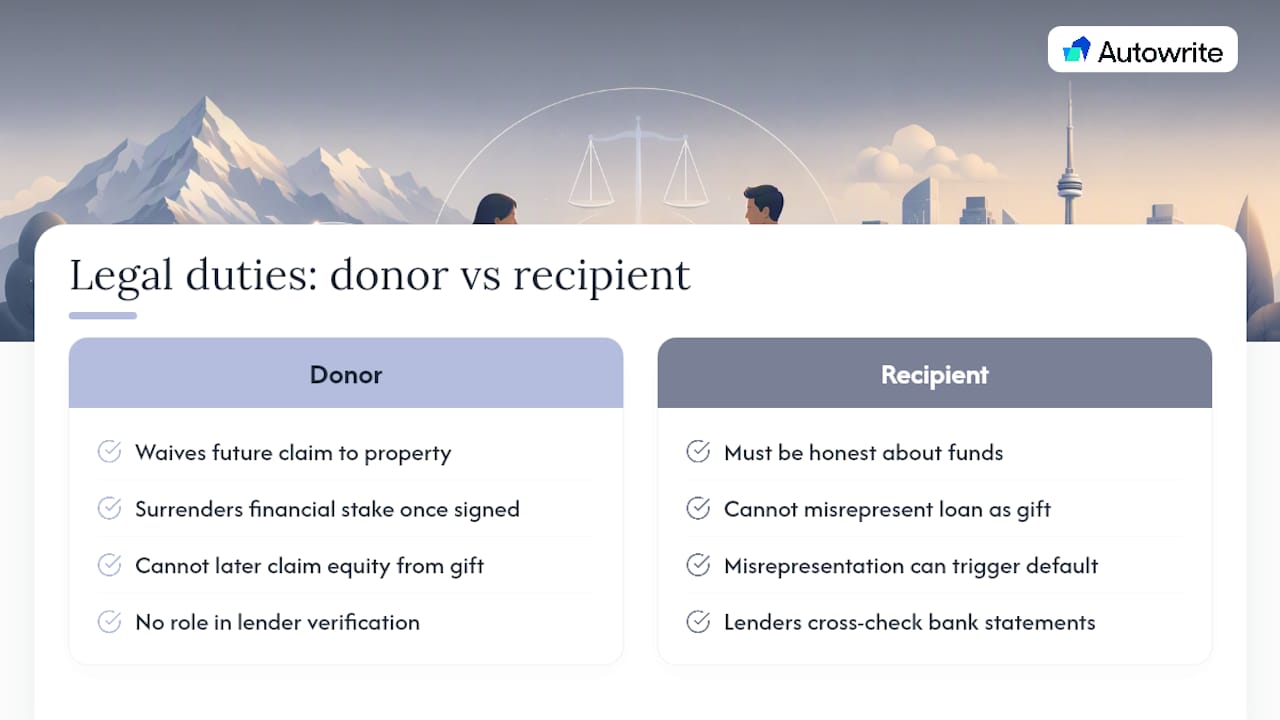
Signing a gift letter isn't a formality. It's a legal declaration, and both sides carry weight once the signature is on the page. For the donor, the letter typically waives any future claim to the property, meaning if the relationship sours later, they can't argue they have equity in the home because they contributed to the down payment. Canadian legal guidance on gift letters for down payments is direct about this: once signed, the donor's financial stake in the transaction ends.
For the recipient, the obligation is honesty. Misrepresenting a loan as a gift to improve debt ratios isn't a paperwork shortcut. It's misrepresentation on a federally regulated loan application, and if discovered after closing, it can trigger a loan default clause or worse. Lenders cross-check gift letters against bank statements precisely because this kind of misrepresentation has a track record.
There's also a tax dimension worth flagging generally: while gifts of money between individuals typically don't create tax obligations in Canada the way they might elsewhere, large transfers involving investment accounts or foreign donors can carry reporting implications. That's a conversation for an accountant, not a mortgage broker, but it's worth having before the money moves.
Both parties should keep a copy of the signed letter indefinitely. It's the record that settles any future dispute about what the money was and wasn't.
How Gift Letter Requirements Differ Across Loan Types and Lenders
Not every lender treats gift funds the same way, and the differences matter more than most borrowers expect. Insured mortgages, the kind requiring mortgage loan insurance because the down payment is under 20%, tend to carry the strictest documentation rules, since CMHC and private insurers set baseline standards that lenders must follow to qualify the loan for insurance.
Conventional mortgages with a larger down payment sometimes get a lighter touch, though "lighter" still means bank statements and a signed letter at minimum. Credit unions and smaller lenders often use their own templates and may be more flexible about acceptable donor relationships, while major banks tend to stick closely to standardized forms that leave less room for a customized letter.
Programs aimed at first-time buyers sometimes restrict acceptable donors to immediate family only, ruling out gifts from friends, extended relatives, or business associates. Rocket Mortgage's guidance on gift letter rules and templates notes that lenders frequently supply their own preferred format rather than accepting a generic one, which is worth checking before you draft anything from scratch.
The practical takeaway: never assume the rules from one lender or one mortgage product carry over to another. A gift letter accepted at a credit union six months ago might get rejected outright by a bank underwriting an insured loan today.
The Step-by-Step Approval Process for a Gift Letter
Getting a gift letter approved follows a fairly consistent sequence, even though the paperwork details shift by lender. First, ask your loan officer for their preferred template rather than downloading a generic one, since using the lender's own format cuts down on back-and-forth. Second, have the donor complete and sign the letter with every required field filled in, no blanks left for "we'll add that later."
Third, gather the supporting documents: the donor's bank statement showing the funds available before transfer, the wire confirmation or cleared check, and the recipient's deposit record. Fourth, submit everything together as one package rather than trickling documents in over several days, which tends to confuse the file and slow review.

Fifth, expect a follow-up request if anything doesn't match. This is normal, not a red flag on your file. It usually just means the underwriter needs a clearer statement or a missing document. Sixth, once the underwriter confirms the source and amount match the letter, the gift gets logged as verified funds and folded into the overall down payment calculation.
The entire cycle, when documents are complete on the first submission, typically resolves within the standard underwriting timeline. When it drags out, it's almost always because a document was missing or a number didn't reconcile, not because gift funds are inherently harder to approve.
How Gift Letters Affect Underwriting and Loan Approval
A verified gift doesn't just get checked off a list. It directly shapes the numbers underwriting uses to approve or deny the loan. Down payment percentage, loan-to-value ratio, and in some cases the interest rate offered all depend on how much of the purchase price comes from verified funds versus the borrower's own savings.
If a gift can't be verified in time, or gets kicked back for insufficient documentation, the underwriter may recalculate the deal using only the borrower's confirmed funds. That can push the loan-to-value ratio higher, potentially triggering mortgage loan insurance requirements that weren't part of the original plan, a scenario CMHC's consumer guidance touches on when explaining insurance eligibility thresholds.
A cleanly verified gift, by contrast, moves through underwriting without disrupting the loan structure at all. It simply gets added to the down payment calculation, and the file proceeds as if the borrower had saved the money independently. The difference between a smooth close and a delayed one often comes down entirely to whether the gift documentation was complete before underwriting started reviewing the file, not after.
Examples of Acceptable and Unacceptable Gift Letter Formats
An acceptable letter reads like a short legal statement, not a casual note. It names both parties, states the exact amount, specifies the transfer date, and includes the no-repayment and no-ownership-interest language in plain sentences. It's signed, dated, and accompanied by the donor's bank statement and a wire receipt.
An unacceptable letter is vague where it needs to be specific. "My daughter gave me $20,000 to help with my house" with no date, no account details, and no signature will get bounced back every time. So will a letter that hedges on repayment, using language like "she doesn't expect it back right away," which reads as a loan with a flexible timeline rather than a genuine gift.
Templates from lenders, and consumer resources like NerdWallet's gift letter guide, tend to follow the same skeleton: names, relationship, amount, date, source account, and the three key statements. If your letter is missing any of those fields, it's not ready to submit, no matter how sincere the wording sounds.
An Industry Practitioner's Note on Avoiding Delays
The mistake I see most often isn't fraud. It's procrastination. Borrowers wait until the week of closing to ask a donor for a bank statement, and by then the donor is traveling, or the statement takes days to generate, and the whole file stalls over paperwork that should have taken an afternoon.
Ask your loan officer for their exact template before the donor writes anything, and keep the donor's contact information handy in case underwriting has follow-up questions. That single habit prevents most of the delays I've seen.
— Anant Bawa
Authoritative Pages and Templates to Check
Start with CMHC's consumer guidance on mortgage loan insurance for the federal framework, then check your specific bank's gift fund policy, since guidance like RBC's page for parents helping with a down payment varies by institution. For sample wording, Investopedia's gift letter breakdown and Rocket Mortgage's template guide both offer usable starting points. Always confirm the exact rules with your own lender before submitting, since program requirements shift.
For brokers managing this on behalf of clients, Autowrite's guide on gift letter requirements for Canadian mortgage brokers walks through the intake checklist in more detail, and the source of funds verification playbook covers how to trace larger or more complex deposits. If gift documentation keeps stalling files on your desk, Autowrite's mortgage document platform automates the classification and matching work that otherwise eats an afternoon per file, letting you move from intake to a complete, underwriter-ready package faster.
This article is general information, not a substitute for advice from a qualified financial advisor. Consult a qualified financial professional about your own circumstances before acting on anything here.
Sources
- Mortgage loan insurance for consumers — CMHC
- What Is a Gift Letter? — Investopedia
- Gift Letters for a Mortgage Down Payment in Canada — Merovitz Potechin
- Helping your child buy their first or next home — RBC