
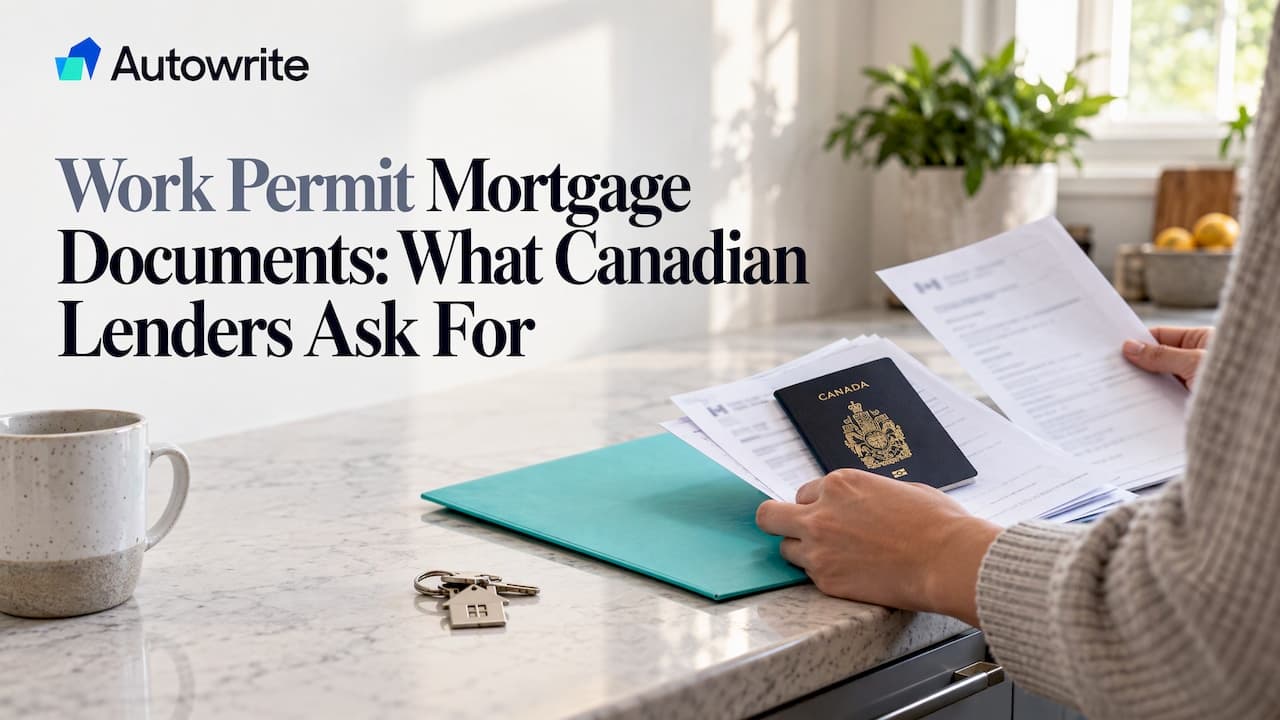
A work permit holder can get a mortgage in Canada, and the file comes down to four things: valid status, proof of income and employment, a documented down payment source, and a credit picture the lender can read. If you are a broker or agent, the work is in collecting these cleanly the first time, because lenders will confirm employment independently and flag any inconsistency. This guide lists the documents, explains how verification works, and shows how to keep a work permit file moving.
TL;DR
- Non-permanent residents who are legally authorized to work in Canada can qualify for CMHC-insured financing, with no minimum period of residency required.
- The core package is a valid work permit, a signed letter of employment, a recent pay stub, a T4 or Notice of Assessment where available, and proof of the down payment source.
- Lenders are expected to take steps to verify income with a third party, and verbal employment confirmation is recommended, so contact details on the letter must hold up.
- Documents should be dated no more than 60 days before the mortgage insurance application, and any gaps or inconsistencies need an explanation in the file.
- Thin Canadian credit is common for work permit clients. Alternative credit evidence belongs in the file from day one.
Table of Contents
- Can a work permit holder get a mortgage in Canada?
- The work permit mortgage document checklist
- How lenders verify employment
- Keeping the file clean and current
- Choosing the right lender for a work permit client
- Perspective: why work permit files are a paperwork problem first
- Where Autowrite fits into a work permit file
- A working routine for your next work permit client
- FAQ
- Sources
Can a work permit holder get a mortgage in Canada?
Yes. CMHC states that non-permanent residents who are legally authorized to work in Canada, for example with a work permit, can access its mortgage loan insurance for one-to-four-unit properties, and it does not set a minimum period of residency. The property and credit criteria still apply, as they do for any borrower.
Individual lenders layer their own rules on top. TD's newcomer mortgage solutions, for instance, ask for at least three months of full-time employment in Canada. Other lenders set different thresholds for tenure, permit length and down payment. That is why work permit files reward a broker who knows which lender fits which profile before the application goes in.
The practical consequence for you as a broker: the work permit itself is rarely the obstacle. The obstacle is a file that is slow to assemble, has documents that do not agree with each other, or leaves the underwriter guessing about income stability.

The work permit mortgage document checklist
Here is the package most work permit files need. Exact requirements vary by lender and insurer, so treat this as the working baseline and confirm against the lender's own list.
Proof of identity and status
- A valid work permit. TD's newcomer program names the work permit (IMM Form #1442) alongside a Permanent Resident Card as accepted status documents.
- A passport.
- Any additional identification the lender requires for the specific product.
Check the expiry date on the permit before anything else. A short remaining validity can change which lenders are appropriate, so note it at intake and not at underwriting.
Proof of income and employment
For employment income, a typical set is a letter of employment, a pay stub dated within 30 days, a T4 slip and a Notice of Assessment, as one Ontario brokerage's document list lays out. For a work permit holder who recently arrived, the T4 and Notice of Assessment may not exist yet, which is why the letter and pay stubs carry more weight.
Sagen's underwriting guidance is specific about what an employment letter should contain. It should be dated and signed by an appropriate authority, and list:
- the employer
- the borrower
- the length of employment and hire date
- the position
- gross earnings
- employment status
For fixed income, the same guidance accepts a current pay stub showing year-to-date earnings, or two months of direct-deposit history. A T4 or Notice of Assessment can serve as a secondary source.
Two practical points on the letter. First, the signature should be real: a handwritten or properly applied digital signature, not a typed name. Second, the contract end date matters for work permit holders, so ask the employer to state whether the position is permanent, contract or probationary, since that is exactly the question an underwriter will ask.
Down payment documentation
Lenders want to see where the down payment came from and how long it has been in the account. Typical evidence includes recent bank statements, investment statements, and a gift letter where family is contributing. Funds held abroad add a step, because the transfer trail needs to be visible. If a relative is gifting funds, our gift letter requirements for Canadian brokers walks through what the letter needs to say.
Credit history for clients new to Canada
Many work permit holders have little or no Canadian credit file. Where that is the case, alternatives that may help include an international credit report, a reference letter from a financial institution in the home country, or a record of Canadian rent, utility or phone payments. Which of these a lender accepts differs, so ask early and collect them in parallel with the income documents.
Purchase documents
Once there is an accepted offer, the file also needs the agreement of purchase and sale, the listing, and for condos the status certificate or equivalent. These are the same as for any buyer, but a work permit file often has less slack in the timeline, so get them in the file the day they exist.
How lenders verify employment
Employment verification in Canada is not a formality. Sagen's guidance says lenders must make reasonable inquiries and take steps to obtain third-party verification of income, including employment status and tenure. It recommends verbal confirmation of employment.
What verbal employment confirmation looks like
The same guidance describes how the call should work. The lender initiates it, using a contact number that was verified independently rather than one printed only on the applicant's letter. The person doing the verification should record the verifier's name, contact information and position.
That has a direct consequence for how you prepare the client:
- Tell the client their employer may receive a call from the lender.
- Ask the employer to name a contact in HR or payroll who can confirm the details quickly.
- Make sure the company's switchboard or HR number can be found independently, for example on its public website.
- Make sure the letter's details match what the employer will say: title, hire date, pay and status.
If a lender cannot confirm employment, one mortgage lender's guidance notes the loan may be declined, and that the borrower can contact the employer's department to clarify what happened. It is much better to prevent that than to repair it.
A second check near closing
The same source notes that a lender may confirm employment a second time closer to closing. So if your client changes jobs, gets a new contract or has a change in hours between approval and closing, tell the lender straight away. A surprise at the second check is far worse than a disclosed change.
Keeping the file clean and current
Most delays on work permit files are not about eligibility. They are about stale or conflicting paper.
- Date discipline. Sagen's guidance says applicable documents should be dated no more than 60 days before the mortgage insurance application. Track document dates from the moment they arrive.
- Independent contact details. Employment letter contact details need to be independently verifiable, as above.
- Explain inconsistencies. If the pay stub shows a different title from the letter, or the hours differ, address it in the lender's file rather than hoping it is missed. Underwriters read for contradictions.
- Match the story. The permit, the letter, the pay stubs and the bank deposits should tell one consistent story about who the employer is and what the client earns.
Variable income on a work permit
Work permit holders are not all salaried. Some earn commissions, overtime or gig income, and each needs its own paper trail. We cover the specifics in our guides to commission income mortgages, overtime income and gig income with 24 months of NOAs. For a client who only recently started in Canada, these can be harder to qualify, so the sooner you know the income type, the sooner you can match the lender.
Choosing the right lender for a work permit client
Not every lender treats a work permit the same way. Some institutions with newcomer programs set clear tenure rules, while alternative and private lenders can be more flexible on status, tenure or credit history, usually at a different price. As a broker, your value is in matching the profile to the lender before the file is submitted, so the client does not collect declines.
A simple triage at intake helps:
| Question | Why it matters |
|---|---|
| How many months has the client worked for the current employer? | Some programs set a minimum, such as three months of full-time employment at TD |
| How long is the work permit valid? | Remaining validity can narrow the lender list |
| Is the position permanent, contract or probationary? | The letter of employment must state it |
| Is there a Canadian credit file? | Determines whether alternative credit evidence is needed |
| Where is the down payment held, and since when? | Foreign funds need a visible trail |
| Is the client seeking insured or uninsured financing? | Insurer rules, including CMHC's, shape the document set |
If you want a broader view of how a complete file is built, see our mortgage file preparation checklist and our Canadian mortgage document and underwriting resources.
Perspective: why work permit files are a paperwork problem first
We see the same pattern on work permit files. The client is eligible, the lender is willing, and the deal still slows down because the documents arrive in pieces, in different formats, with dates that no longer line up.
That is the problem Autowrite was built for. Our platform is designed to handle document intake, classification and data extraction, so a pay stub, a letter of employment and a work permit are sorted and read without someone retyping them. Our document intelligence is built to show line-level confidence for extracted fields, so a broker can see where to look rather than rereading every page.
For newcomer and work permit clients, where the file has fewer documents and each one matters more, that discipline pays off. Fewer retyping errors, a file that is organized the same way every time, and compliance and e-sign packages assembled for you mean more of your day goes to the client conversation and the lender relationship.
We built it for Canadian brokers, with Canadian data residency and Canadian document types in mind, because a T4, a Notice of Assessment and a signed employment letter are not generic forms.
Anant Bawa
Where Autowrite fits into a work permit file
Autowrite is an AI-powered operating system for Canadian mortgage brokers. It is designed to take a file from document intake through classification and data extraction, auto-fill underwriting forms, sync with mortgage software, and assemble e-sign and compliance packages. It also provides income and down payment analysis, which is where a work permit client's thinner file benefits from a second look.
Plans are billed monthly: Starter at $99 per month, Pro at $199 per month and Legend at $399 per month, with Enterprise available without a published price. An additional deal costs $20 one-off, and pay as you go is $35 one-off. Paid plans start with a 14-day free trial. See the Autowrite pricing page for what each plan includes.
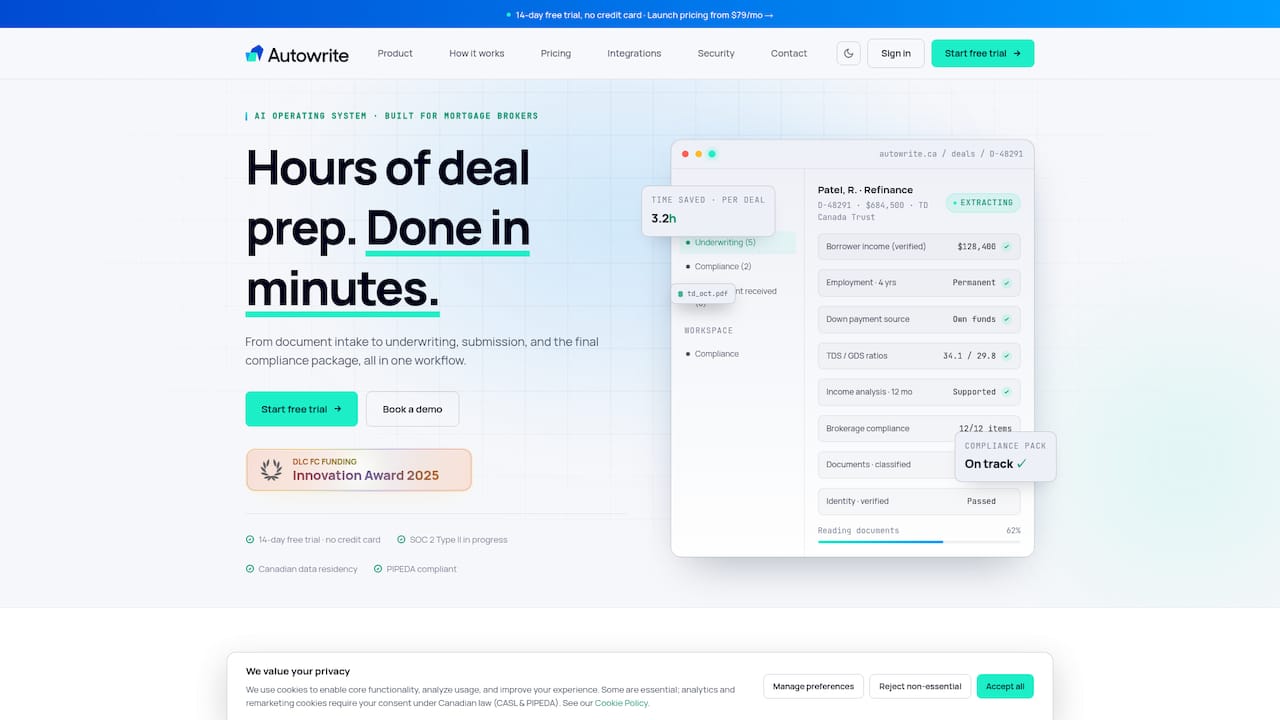
If your brokerage handles a steady flow of newcomer and work permit files, you can also see how the platform works in practice on the Autowrite site.
A working routine for your next work permit client
Here is a sequence that keeps these files short:
- At first contact, note permit expiry, employer start date, position type and whether there is any Canadian credit history.
- Send a document request that names each item and its format: signed employment letter with the required details, a pay stub within 30 days, T4 and Notice of Assessment if they exist, down payment statements, and alternative credit evidence if needed.
- Prepare the employer. Let the client brief HR that a verification call may come, and confirm the letter's contact details can be independently verified.
- Check the dates. Flag anything approaching the 60-day window before submission.
- Reconcile. Compare title, pay, hours and deposits across documents, and write a short explanation for any difference.
- Keep watching after approval. Ask the client to report any job or contract change immediately, since the lender may re-confirm employment before closing.
- Document the signing process. If you are using e-sign, our seven steps for defensible e-signed mortgages in Canada covers what to keep.
Done in this order, the file reaches the lender complete, and the underwriter spends time on the decision rather than on chasing paper.
FAQ
Can a work permit holder get a mortgage in Canada?
Yes. CMHC says non-permanent residents who are legally authorized to work in Canada can access its mortgage loan insurance, and it sets no minimum residency period. Lenders add their own requirements, such as TD's three months of full-time employment for its newcomer mortgage solutions.
What documents can be used as proof of income for a mortgage in Canada?
Common options are a signed letter of employment, a pay stub dated within 30 days, a T4 slip and a Notice of Assessment. Sagen's guidance also accepts two months of direct-deposit history for fixed income. Lenders may want different combinations, so confirm the list per file.
What is verbal verification of employment in Canada?
It is a call from the lender to the employer to confirm the applicant's employment details. Sagen's guidance says the lender should start the call using an independently verified number, and record the verifier's name, contact information and position.
How recent do mortgage documents need to be?
Sagen's guidance says applicable documents should be dated no more than 60 days before the mortgage insurance application. Pay stubs are commonly expected within 30 days, so refresh them if the file sits.
What if I have no Canadian credit history?
A lender may accept alternatives such as an international credit report, a reference letter from a bank in your home country, or a record of Canadian rent, utility or phone payments. Ask your broker which the lender prefers before you gather them.
Sources
- CMHC: Newcomers mortgage loan insurance
- TD Canada Trust: Mortgages for Newcomers, A Complete Guide
- Sagen: Covenant Underwriting
- MFCO: Mortgage Documents
- Pegasus Lending: How Mortgage Lenders Verify Employment