
Yes, overtime income counts toward a mortgage in Canada, but only when it's documented, has a track record, and looks likely to continue. Lenders typically average the last 24 months of overtime pay, though some will work with 12 months if you bring strong compensating factors. The deciding factor almost every time comes down to paperwork: pay stubs, T4s, and a solid employer letter.
TL;DR:
- Overtime income can count toward a mortgage only if it is well-documented, has a steady or increasing pattern over at least 24 months, and is supported by employer confirmation.
- Lenders average documented overtime over the past 24 months, with some accepting 12 months if a strong employment letter and reserves are provided, but declining overtime is usually excluded.
- A comprehensive paper trail including T4s, detailed pay stubs, an employer letter, and matching bank deposits is essential for maximum approval chances.
- Shorter overtime histories may still qualify if the borrower has strong credit, reserves, stable employment, and the overtime is consistent with previous roles.
- Variability among lenders and programs means a well-prepared, organized file is critical, and working with a knowledgeable broker can improve the speed and approval likelihood.
Table of Contents
- How Lenders Evaluate Overtime Income Mortgage Applications
- Calculating Qualifying Overtime: The 24-Month Averaging Method
- Documentation That Actually Gets Overtime Approved
- When Less Than Two Years of Overtime Still Works
- How Overtime Changes Your Debt-to-Income and Approval Amount
- Your Pre-Application Checklist for Overtime Income
- Why Clean Documentation Speeds Up Underwriting
- Guaranteed Overtime vs. Voluntary Overtime: Why the Distinction Matters
- Conventional Mortgages vs. Government-Backed Programs and Overtime Treatment
- How Self-Employed Borrowers Can Document Overtime-Equivalent Income
- Common Pitfalls That Sink Overtime Approvals
- How Overtime Acceptance Varies Between Lenders
- The Real Trade-Off Behind Overtime Approvals
- If You're Working With a Broker, Ask About Faster Verification
- Sources
- FAQ
How Lenders Evaluate Overtime Income Mortgage Applications
Underwriters aren't just checking whether the money showed up in your bank account. They're trying to answer one question: will this income keep showing up after closing day? That means looking past the number on your pay stub and into the pattern behind it.
A lone strong month is less persuasive; a longer documented history with steady or increasing overtime is preferable. Fannie Mae's Selling Guide, used widely as a reference for how agencies approach trending variable income, breaks the evaluation down into three buckets:
- Stable or increasing overtime gets averaged and counted in full, usually over 24 months.
- Declining overtime often gets reduced, or in some cases dropped from qualifying income entirely.
- Irregular, one-off overtime with no clear pattern is the hardest to get credited at all.
In Canada, OSFI's guidance on residential mortgage underwriting sets the expectation that federally regulated lenders apply prudent, consistent verification standards. How each lender applies that in practice, though, varies quite a bit.
Calculating Qualifying Overtime: The 24-Month Averaging Method
Most lenders calculate qualifying overtime by adding documented overtime earnings over a recent period and averaging that to obtain a monthly figure. When your current year-to-date overtime is running below that average, some lenders will use the lower of the two numbers to stay conservative.
Here's how it plays out with real numbers:
- Add your overtime income from T4s or pay stubs for the two most recent years. Say that's $9,600 last year and $10,800 this year, for a total of $20,400.
- Divide by 24 months. That gives you $850 per month in qualifying overtime.
- Compare that against your current year-to-date pace. If YTD overtime annualizes to less than the 24-month average, expect the underwriter to use the lower figure.
- Add that monthly amount to your base income before running debt service ratios.
This is essentially the same trending logic Fannie Mae documents for U.S. underwriting, and Canadian lenders follow a similar pattern even though the exact overlay rules differ by institution.
Documentation That Actually Gets Overtime Approved
Paper trail beats promise every time. Underwriters want to see the same story told three or four different ways before they'll count your overtime as reliable income.
The strongest file typically includes:
- T4s showing total employment income over a suitable timeframe help lenders differentiate base salary from variable pay.
- The most recent 30 to 60 days of consecutive pay stubs with overtime hours itemized, not lumped into a single gross figure.
- A signed employer letter confirming your role, your overtime pattern, and whether it's expected to continue.
- Bank statements showing deposits that match the pay stub amounts, since mismatched deposits are one of the fastest ways to trigger extra underwriter questions.
A good employer letter isn't generic. It should state your position, roughly how many overtime hours you work per pay period, and a line confirming the employer expects that pattern to continue. Vague letters that just confirm employment status without touching overtime tend to get bounced back for clarification, which slows everything down.
Pro Tip: Ask your employer's payroll or HR contact to sign the letter on letterhead, not a generic template pulled off the internet. Underwriters flag boilerplate letters far more often than ones with specific, verifiable details.
When Less Than Two Years of Overtime Still Works
A shorter history isn't automatically disqualifying. Some lenders will accept 12 to 24 months of overtime when you bring compensating factors that offset the shorter track record.
Those factors typically include:
- A strong credit score, usually in the high 600s or above.
- Cash reserves beyond your down payment.
- A low overall debt-to-income ratio outside of the overtime question.
- Long tenure with the same employer, even if the overtime itself is newer.
If you switched jobs but kept doing essentially the same work with a similar overtime structure, some underwriters will let that history carry over, especially with a strong employer letter bridging the two roles. What almost never flies is overtime that's trending down. Unless you can document a clear, temporary reason for the dip, like a short-term project ending, declining variable income is one of the most common reasons lenders exclude it from qualifying income.
How Overtime Changes Your Debt-to-Income and Approval Amount
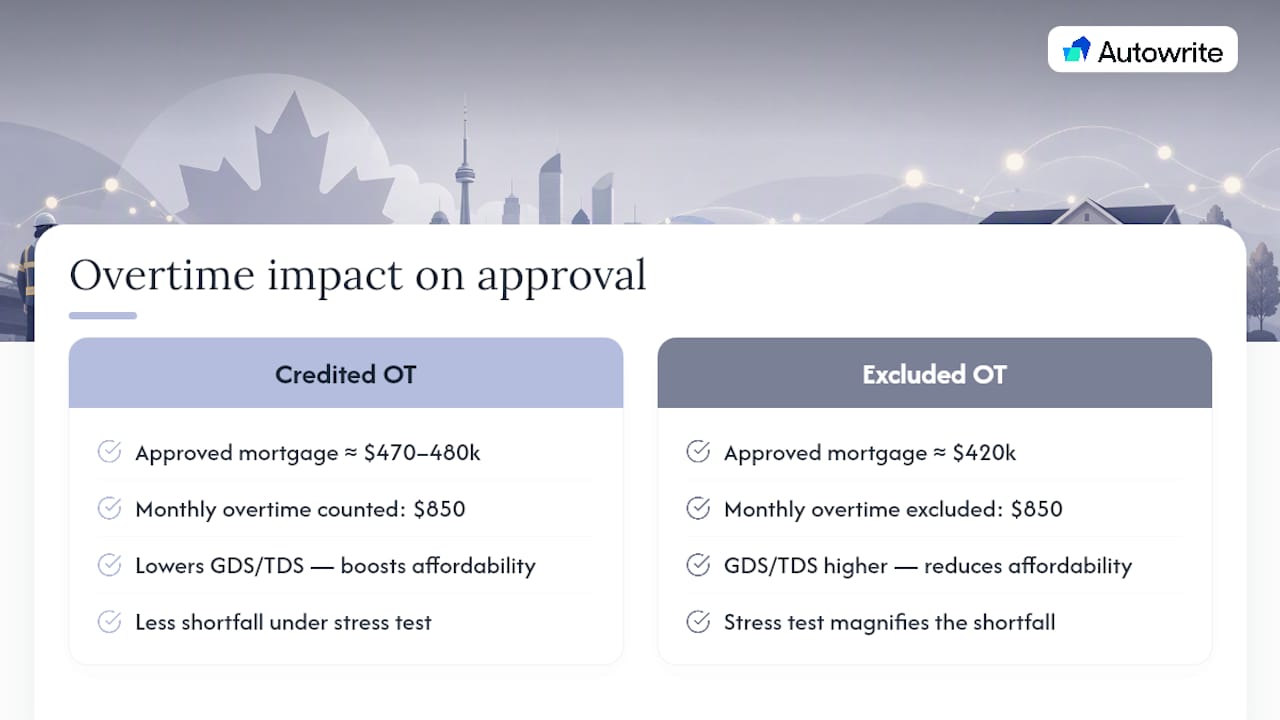
Every dollar of qualifying overtime income lowers your gross debt service (GDS) and total debt service (TDS) ratios, which directly expands how much mortgage you can carry. Miss that overtime and your approved amount can shrink fast.
Say your base salary qualifies you for a $420,000 mortgage on its own. Add $850 a month in credited overtime, and depending on your rate and amortization, that can push your approval closer to $470,000 to $480,000, since lenders apply that extra monthly income straight into the affordability calculation.
Now flip it. If an underwriter decides your overtime doesn't meet the bar, that $850 a month disappears from your file entirely. You're not just losing a nice-to-have; you may drop out of the price range you'd been house hunting in. This is exactly why the stress test hits harder for borrowers who lean on variable income. It qualifies you at a higher benchmark rate, so every dollar of overtime that gets excluded compounds the shortfall.
Your Pre-Application Checklist for Overtime Income
Timing and preparation matter more here than almost any other part of the mortgage process. A few weeks of extra prep can be the difference between overtime getting fully credited or getting waved off.
- Pull two years of T4s and at least 60 days of recent pay stubs, with overtime hours clearly broken out.
- Request your employer letter early. HR departments are often slow, and a late letter can hold up your whole file.
- If your overtime dipped at any point, write a one-paragraph explanation with dates and reasons, ready to hand to your broker before they ask.
- If you're at 18 to 20 months of overtime history and not in a rush, consider waiting until you cross the 24-month mark. It removes the compensating-factor conversation entirely.
Apply now if your overtime has been stable or rising for two years and your documentation is already clean. Wait if you're a few months short of 24 months and your current rate or price target isn't at risk.
Pro Tip: Shift and seasonal workers should ask for a letter that explicitly describes the seasonal pattern rather than a flat average, since a smoothed number can understate genuinely reliable peak-season overtime. Workers with overtime from a second job should treat that income as a separate file entirely, with its own T4 and its own employer confirmation.
Why Clean Documentation Speeds Up Underwriting
A messy file doesn't just slow things down. It invites underwriters to default to the conservative reading of your income, which usually means less overtime gets counted, not more. The brokers who get overtime credited consistently are the ones who hand underwriters a complete, organized package on the first pass instead of trickling in documents over three weeks.
That's part of why broker-side workflow tools have become more relevant to this exact problem. Autowrite is one example of software built to help Canadian brokers classify pay stubs, T4s, and employer letters automatically and flag missing pieces before a file ever reaches underwriting.
For a borrower, the practical benefit shows up indirectly: fewer follow-up requests, fewer delays, and a cleaner shot at getting variable income like overtime credited on the first review rather than after a back-and-forth. This piece was put together with that broker-side view in mind, drawing on how documentation gaps typically show up in underwriting.
- Complete files reduce the number of underwriter follow-up requests.
- Faster document classification means fewer conditions attached to your approval.
- Consistent formatting across pay stubs and letters reduces manual reading errors.
Guaranteed Overtime vs. Voluntary Overtime: Why the Distinction Matters
Not all overtime looks the same to an underwriter, and the difference between guaranteed and voluntary overtime can swing your approval either way.
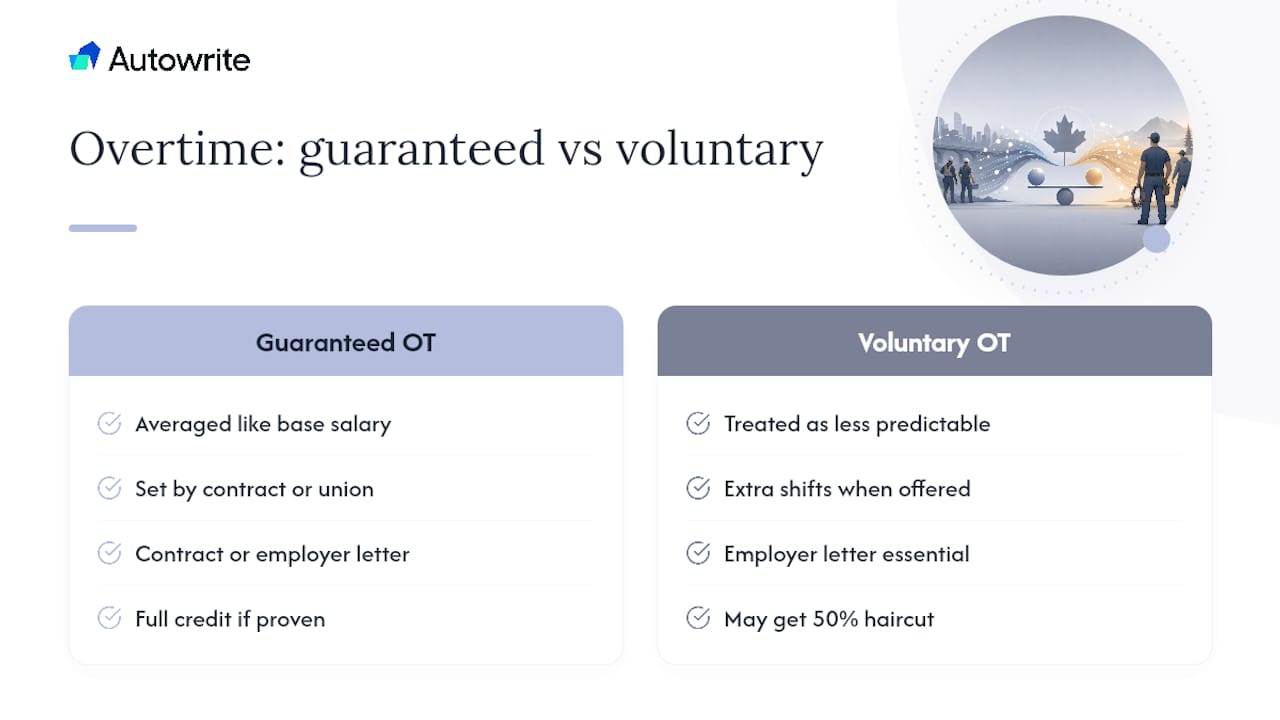
Guaranteed overtime, sometimes written into a union agreement or employment contract, is treated closer to base salary. If your contract specifies a minimum number of overtime hours per pay period, or your role structurally requires it (think shift workers in manufacturing or healthcare), lenders are more comfortable averaging it in with less scrutiny on the trend.
Voluntary overtime is a tougher sell. If you pick up extra shifts when they're offered but your base role doesn't require it, underwriters treat that income as inherently less predictable, even if you've picked up overtime every single pay period for two years. The employer letter becomes far more important here, since it's the only document that can confirm the extra hours are actually expected to continue rather than being a temporary bump tied to a busy quarter or a coworker's medical leave.
The practical takeaway: if your overtime is guaranteed or contractual, say so explicitly on your application and make sure your employer letter uses that specific language. Don't let a payroll department describe contractual overtime the same way they'd describe a one-off shift pickup. The wording gap between "guaranteed" and "available" can be the difference between full credit and a 50% haircut on that income when the underwriter builds your qualifying figure.
Conventional Mortgages vs. Government-Backed Programs and Overtime Treatment
Overtime income gets weighed differently depending on which mortgage program you're using, and the gap is bigger than most borrowers expect.
Conventional mortgages, the standard route through banks and most monoline lenders, tend to follow the 24-month averaging approach fairly closely, with individual lender overlays determining exactly how strict the trend analysis gets. A well-documented, stable overtime history usually sails through with minimal friction.
Insured mortgages, which apply to lower down payment scenarios and go through mortgage insurers, often come with tighter documentation standards and less flexibility on shorter overtime histories. Because the insurer is taking on additional risk with a smaller down payment, expect less appetite for compensating-factor workarounds if you're under the 24-month mark.
Programs aimed at newer immigrants, self-employed borrowers, or first-time buyers sometimes carry their own income-verification rules layered on top of standard overtime treatment, which can mean extra documentation requests specific to that program rather than the general underwriting guideline. If you're applying under one of these programs, ask your broker early which overlay rules apply to variable income, since they're rarely published in plain language on a lender's public website.
How Self-Employed Borrowers Can Document Overtime-Equivalent Income
Self-employed borrowers don't get a T4 with overtime hours listed, so the concept translates differently. What lenders are really looking for is proof that your income has a variable component tied to extra work volume, and that it follows a pattern rather than random spikes.
The closest equivalent to an overtime history is two years of Notice of Assessment and T1 General filings showing consistent or rising gross business income, paired with financial statements that break down revenue by month or by project. If your business income includes a component that functions like overtime, extra client work, rush jobs, seasonal surges, invoices and contracts documenting those specific projects help build the same trend story a T4 employee gets from pay stubs.
A letter from your accountant summarizing your income pattern over the last two years often carries the same weight an employer letter does for a salaried applicant. It won't get the same terminology, but it serves the identical purpose: confirming the extra income is a recurring, reliable feature of the business rather than a one-time windfall.
Common Pitfalls That Sink Overtime Approvals
The single biggest mistake borrowers make is assuming overtime will automatically be counted just because it shows up on their T4. It won't, unless the documentation backs it up with a clear pattern the underwriter can verify.
Other pitfalls show up repeatedly across files:
Employer letters that confirm employment but say nothing about overtime specifically get sent back for revision, which costs you time you may not have if you're racing a closing date. Pay stubs that lump overtime into gross pay without breaking out the hours make it impossible for an underwriter to verify the trend independently, forcing them to fall back on T4 totals alone, which flattens seasonal patterns that might have actually helped your case.
Lender-specific overlays are the wildcard most borrowers don't see coming. Two lenders looking at an identical file can land in different places, since OSFI sets the prudential expectations but leaves plenty of room for individual institutions to apply their own overlays. One lender's underwriter might require a full 24 months with no exceptions, while another accepts 18 months with a strong employer letter and solid reserves. This is exactly why shopping around, or working with a broker who knows which lenders are flexible on variable income, matters more for overtime-heavy applicants than for straight-salary borrowers.
How Overtime Acceptance Varies Between Lenders
There's no single national standard dictating exactly how much overtime a lender must count, which means acceptance genuinely varies by institution, not just by borrower profile.
Major banks tend to run the most conservative playbook: full 24-month history, strict trend analysis, and limited appetite for compensating factors on shorter histories. Monoline lenders and credit unions, competing for volume in a tighter niche, are often more willing to consider 12 to 18 months of overtime when the rest of the application is strong, particularly on reserves and credit score. Mortgage insurers add another layer of variability on insured deals, since their own risk appetite can be stricter than the underlying lender's standard policy.
The practical implication is that a borrower rejected on overtime income at one institution isn't necessarily rejected everywhere. This is where a broker's knowledge of specific lender overlays pays for itself, since matching your file to a lender whose policy already fits your overtime pattern beats trying to force a file through a lender whose standard policy doesn't.
The Real Trade-Off Behind Overtime Approvals
Overtime tips approvals when it's boring: predictable, well documented, and confirmed by someone other than the borrower. The mistake I see most often isn't lying about overtime, it's assuming a decent pay stub speaks for itself. It doesn't. Underwriters are trained to be skeptical of income that isn't guaranteed, and the burden sits entirely on the borrower to prove otherwise.
Don't wait until you're mid-application to start assembling proof. Build the paper trail as if you already know it'll be challenged, because it usually will be.
— Anant Bawa
If You're Working With a Broker, Ask About Faster Verification
If your broker is buried in pay stubs, T4s, and employer letters trying to build your overtime case, the bottleneck usually isn't the lender, it's how long it takes to organize your file before it ever reaches underwriting. That's the specific problem Autowrite was built to solve for Canadian mortgage brokers: automated document classification and data extraction that turns a stack of variable-income paperwork into an organized, underwriting-ready file in minutes instead of hours.
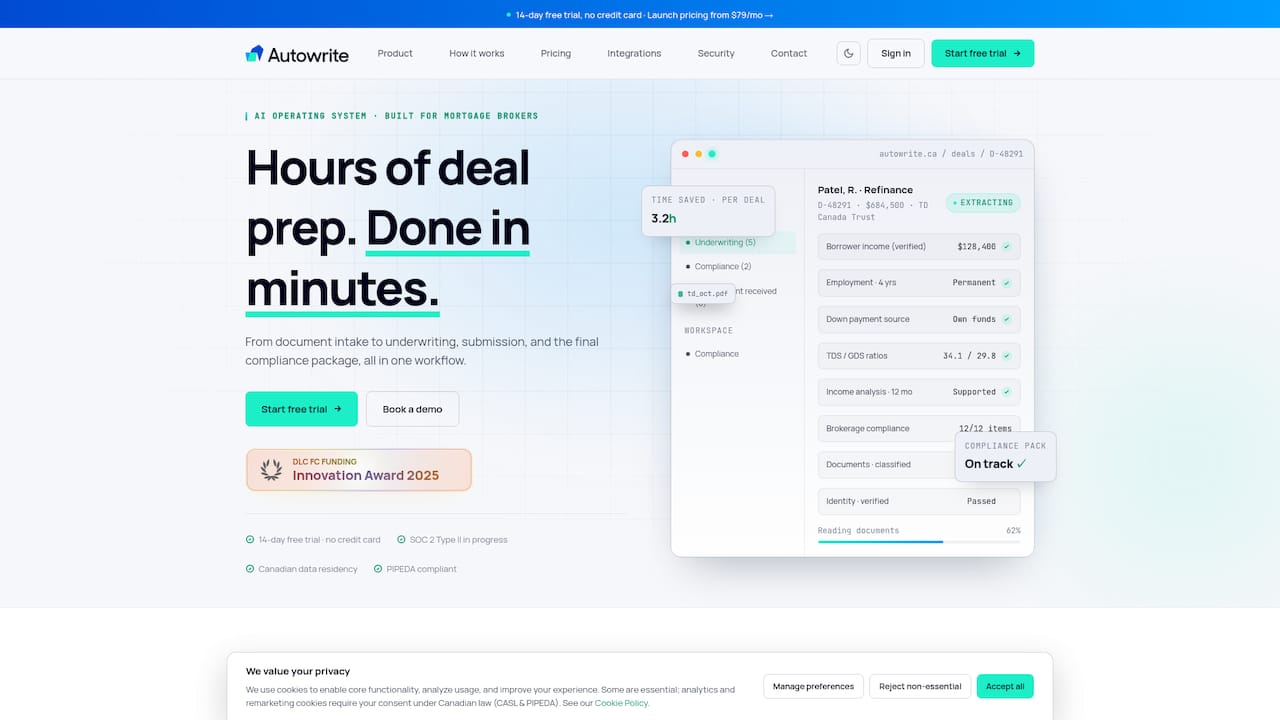
For a borrower with overtime income, that speed matters directly. Faster document intake means your broker can spot a missing employer letter or a gap in your pay stub history before the underwriter does, instead of after a stalled file forces a scramble. Brokers evaluating whether this fits their workflow can review current plan details on the pricing page, or explore the platform's broker tools to see how document verification runs on a sample file.
Sources
Beyond your broker or lender, a few sources are worth checking directly before you apply.
- OSFI — Residential mortgage underwriting practices and procedures (2017)
- Canada
- Fannie Mae — Bonus, commission, overtime and tip income (Selling Guide)
This article is general information, not a substitute for advice from a qualified financial advisor. Consult a qualified financial professional about your own circumstances before acting on anything here.
FAQ
Does overtime count for a mortgage?
Yes, most lenders count overtime income when it's documented over a consistent period, usually 24 months, and confirmed by an employer letter stating it's likely to continue.
What income do you need for a $500,000 mortgage in Canada?
It depends heavily on your rate, amortization, down payment, and existing debt, but most borrowers need combined qualifying income to meet the mortgage stress test; a mortgage professional can run your exact numbers against current rates.
What income do you need for an $800,000 mortgage in Canada?
Qualifying income for a high-value mortgage typically varies depending on your down payment, debt load, and the stress-test rate in effect, and overtime income can factor into that total if it's properly documented and averaged.
What income do you need for a $1,000,000 mortgage in Canada?
Borrowers usually need qualifying income that depends on your down payment size, other debts, and the specific stress-test rate your lender applies at the time for a mortgage of that size.
How does an underwriter treat overtime that's been declining for the past year?
Declining overtime is usually reduced or excluded from qualifying income unless you can document a clear, temporary reason for the drop, since underwriters read a downward trend as a sign the income may not continue.
Can Autowrite help me get my overtime income approved faster?
Autowrite is a broker-side tool, not a borrower-facing product, but if your broker uses it, it can speed up how quickly your pay stubs, T4s, and employer letter get organized and verified before reaching underwriting.