
Canadian mortgage brokers must know and verify their clients under the Proceeds of Crime (Money Laundering) and Terrorist Financing Act (PCMLTFA). The rules are enforced by FINTRAC. In practice, that means keeping an information record on every client, verifying identity when the rules require it, assessing client risk, and keeping client information current through ongoing monitoring. There is no single fixed refresh date. The frequency follows your own risk-based policies.
This guide walks through each duty in the order a file actually moves, and flags the provincial layer for Ontario, British Columbia, Quebec and Alberta.
TL;DR
- Mortgage brokers, administrators and lenders have been reporting entities under the PCMLTFA since October 11, 2024, with KYC measures as part of the compliance program.
- You must keep an information record for every client you arrange a mortgage for, and be able to give records to FINTRAC within 30 days of a request.
- KYC refresh has no fixed calendar interval: the frequency is risk-based and written into your policies and procedures.
- High-risk clients call for enhanced measures and more frequent monitoring.
- Good file structure at intake makes every one of these duties easier to prove in an exam.
Table of Contents
- Who has to comply
- The information record: what you collect on every client
- When you must verify identity
- How often must KYC be refreshed?
- Ongoing monitoring and the compliance program
- Reports that KYC feeds into
- Penalties and the provincial layer
- Helping first-time buyers bring the right documents
- Our perspective
- Put your KYC files on rails with Autowrite
- FAQ
- Sources
Who has to comply
FINTRAC's mortgage sector page says that mortgage administrators, mortgage brokers and mortgage lenders must meet obligations under the PCMLTFA and its regulations, including know your client measures. A mortgage broker, in FINTRAC's terms, is a person or entity authorized under provincial legislation to act as an intermediary between a lender and a borrower on loans secured by mortgages on real property, or hypothecs on immovables in Quebec.
That definition matters for two reasons.
First, it follows your provincial authorization. If you hold a licence as a mortgage broker or agent in Ontario, British Columbia, Alberta or Quebec, and you do the work of an intermediary, you are in scope. Second, the obligation sits at the level of the reporting entity. FINTRAC's mortgage sector training makes the point that compliance is not optional just because other businesses in the same transaction, such as the lender or a lawyer, have their own compliance programs. Each participant may carry its own duties.
FINTRAC lists the core obligations for the sector as implementing a compliance program, submitting transaction reports, keeping records, implementing know your client measures and applying Ministerial Directives. KYC is one pillar, and it only works when the other four are in place.

The information record: what you collect on every client
The starting point is the mortgage information record. FINTRAC requires mortgage administrators, brokers and lenders to keep an information record on every person or entity for which they arrange, provide or service a mortgage or hypothec. Where a transaction has several clients, such as co-borrowers, a record is kept about each one.
The content depends on who the client is:
| Client type | What the information record must include |
|---|---|
| Individual | Name, address, date of birth and occupation |
| Sole proprietor | The above, plus the nature of their principal business |
| Entity (for example a corporation) | Name, address and the nature of its principal business |
Two practical points follow from this table.
Co-borrowers each need their own record. A file with a couple and a guarantor means three records, not one shared note.
Occupation is a required field. A vague entry such as "employed" is a weak record. Capture the actual occupation and, for self-employed clients, the nature of the business. Your underwriting documents usually contain the answer already, so the work is mostly transferring it consistently.
How long you have to produce records
FINTRAC expects records to be kept so that you can provide them within 30 days of a request. They can be held electronically in machine-readable form, as long as a paper copy can easily be produced. If your files live across email threads, shared drives and personal devices, that 30-day clock is where the pain shows up. A single searchable file per client is the cleanest answer.
For how long you hold files, retention periods differ between federal and provincial rules. Our guide to FINTRAC's five-year and FSRA's six-year file retention explains how to reconcile them in Ontario.
When you must verify identity
Collecting information is not the same as verifying identity. FINTRAC's mortgage guidance ties verification to specific triggers. Two of the clearest are:
- Suspicious transactions. You must verify identity for a suspicious transaction regardless of the amount, including transactions that would normally be exempt, before you send a Suspicious Transaction Report.
- Large cash transactions. You must verify the identity of every person or entity from whom you receive $10,000 or more in cash when the transaction takes place. This includes cases where you are deemed to have received the cash because someone else received it on your behalf, subject to the 24-hour rule.
Outside those triggers, your own compliance program and risk assessment decide how you identify clients at onboarding, and lenders will typically ask for ID as part of their own process. Many brokerages simply verify every client at intake. It is one consistent step, it avoids missed triggers, and it keeps the file complete if a transaction later becomes reportable.
For the methods themselves, see our breakdown of the five FINTRAC client ID methods. Whichever method you use, record how you verified: the document or source, the date, and who did the check.
If a transaction involves cash, our guide to FINTRAC large cash reporting covers the reporting side. For red flags and reporting thresholds on suspicious activity, read the mortgage broker's guide to suspicious transaction reports.
How often must KYC be refreshed?
This is the question brokers ask most, and the answer is often misunderstood. There is no universal "refresh every X years" rule for mortgage brokers.
FINTRAC's guidance says that client identification information must be kept up to date at a frequency that varies with the risk assessment and is set out in your policies and procedures. Keeping information up to date does not mean re-identifying the client with the identity verification methods again.
The companion duty is ongoing monitoring. FINTRAC requires mortgage administrators, brokers and lenders to periodically conduct ongoing monitoring of a business relationship based on their risk assessment. Low-risk relationships are monitored less often and high-risk ones more often, and your policies should state the frequency.
A simple way to write your refresh policy
Because the interval is yours to define, the policy has to be written down and followed. A workable structure looks like this:
- Low risk: review client information at renewal, refinance or the next time you work with the client.
- Medium risk: review at a shorter interval your compliance officer sets, and at any material change such as a new employer or a change of property use.
- High risk: review more frequently and apply enhanced measures.
The intervals above are a template for how to organize the policy, not a figure FINTRAC prescribes. Choose intervals you can realistically meet and document each review. An exam rewards a policy that is followed far more than one that is ambitious on paper.
For clients identified as high risk, FINTRAC's compliance regime guidance describes enhanced measures and enhanced ongoing monitoring, including more frequent monitoring and updating of client identification information.
Ongoing monitoring and the compliance program
FINTRAC defines ongoing monitoring as reviewing information about clients in a business relationship in order to detect reportable suspicious transactions, keep identification, beneficial ownership and business relationship information up to date, reassess risk, and check that activity is consistent with the client profile and your risk assessment. That is a lot of work packed into one definition, so it helps to split it into four habits:
- Note the client's expected profile at intake: income source, purpose of the mortgage, source of down payment.
- Compare each new document or request against that profile.
- Update the record when something changes.
- Reassess the risk rating when the picture changes.
Monitoring needs evidence. FINTRAC states that you must keep records of the measures taken and information obtained, and that ongoing monitoring records must be kept for at least five years from the date the record was created.
The five elements of a compliance regime
KYC sits inside a broader program. FINTRAC's guideline on implementing a compliance regime describes five elements: appointing a compliance officer, written policies and procedures, a documented risk assessment, an ongoing training program, and a two-year effectiveness review. Your KYC refresh frequencies belong in the policies and procedures, and the two-year review is the natural moment to check that they were actually followed.

Our FINTRAC checklist for the mortgage compliance package and the broader guide to anti-money laundering duties for mortgage brokers go deeper on building each element.
Reports that KYC feeds into
Good KYC data is what lets you file accurate reports. FINTRAC's mortgage sector page lists the reports that mortgage administrators, brokers and lenders must submit: Suspicious Transaction Reports, Listed Person or Entity Property Reports, Large Cash Transaction Reports and Large Virtual Currency Transaction Reports. The 24-hour rule also applies to large cash and large virtual currency transactions.
A report with a missing date of birth or an unclear occupation is a report that reflects badly on the whole file. Complete information records are the cheapest way to avoid that.
Penalties and the provincial layer
BCFSA's November 2023 advisory told registrants that the amended regulations would require compliance programs, due diligence including identity verification and beneficial ownership, record keeping, transaction reporting and adherence to ministerial directives. The same advisory set out expected penalty ranges under the federal administrative monetary penalty regime:
| Violation class | Range per violation |
|---|---|
| Minor | $1 to $1,000 |
| Serious | $1 to $100,000 |
| Very serious | $1 to $100,000 for an individual, $1 to $500,000 for an entity |
Check FINTRAC's current penalties page for the regulations as they stand today, since these are the ranges as announced at that time.
Provincial rules sit alongside the federal ones
FINTRAC obligations do not replace your provincial regulator's expectations. They add to them.
- Ontario: FSRA expects brokerages to keep proper file documentation. See our guide to the three proofs Ontario brokers must keep on file.
- British Columbia: BCFSA has directed registrants to review the PCMLTFA requirements, as its advisory shows.
- Alberta and Quebec: check your regulator's current guidance alongside FINTRAC's, since file and record expectations can differ.
Privacy law also applies to everything you collect. Client ID copies and income documents are personal information, so pair your KYC process with a privacy program. Our PIPEDA checklists for mortgage brokers cover that side.
Helping first-time buyers bring the right documents
First-time buyers are often the clients who struggle most with paperwork, and a clear intake request saves days. Give them a short list in plain language:
- One piece of valid, unexpired government-issued photo ID.
- Proof of current address, such as a recent utility bill or bank statement.
- Employment and income documents, such as a recent pay stub and a letter of employment, and for the self-employed, Notices of Assessment from the Canada Revenue Agency.
- Down payment evidence, such as recent statements for the account the funds come from, and a gift letter if family is contributing.
Which ID methods you can accept depends on your policy and the FINTRAC methods you rely on, so confirm with your compliance officer before you publish a list to clients. Clients who keep their paperwork in tidy folders tend to move faster. Ideas for organizing mortgage documents can help them get there before they ever call you.
Our perspective
Most KYC failures we see in brokerages are not failures of knowledge. Brokers know they need the information. The problem is that it lives in places they cannot find under pressure: an email attachment from March, a photo of ID on a phone, a spreadsheet that one assistant maintains.
Our view is that KYC should be a by-product of intake, not a separate project. When documents are classified and their data extracted as they arrive, the information record is largely filled in before the broker has finished the first call. That is how we designed Autowrite: document intelligence with line-level confidence on extraction, so a broker can see what was read and how sure the system is.
We also think a risk-based refresh policy is only as good as your ability to follow it. A policy that says high-risk clients are reviewed more often needs a pipeline that surfaces those clients and a file that shows what was done. We built compliance packages and team pipeline management with that in mind, and we keep data in Canada.
The goal is simple: spend your time on clients, and walk into a FINTRAC exam with files that speak for themselves.
Anant Bawa
Put your KYC files on rails with Autowrite
Autowrite is an AI-powered operating system for Canadian mortgage brokers. It handles document intake, classification and data extraction, auto-fills underwriting forms, syncs with mortgage software, assembles e-sign and compliance packages, and supports income and down payment analysis. Data residency is in Canada.
Plans are billed monthly: Starter at $99 per month, Pro at $199 per month and Legend at $399 per month, with Enterprise available on request. Additional deals are $20 each, and pay as you go is $35 per deal. Every paid plan starts with a 14-day free trial. Details are on the Autowrite site.
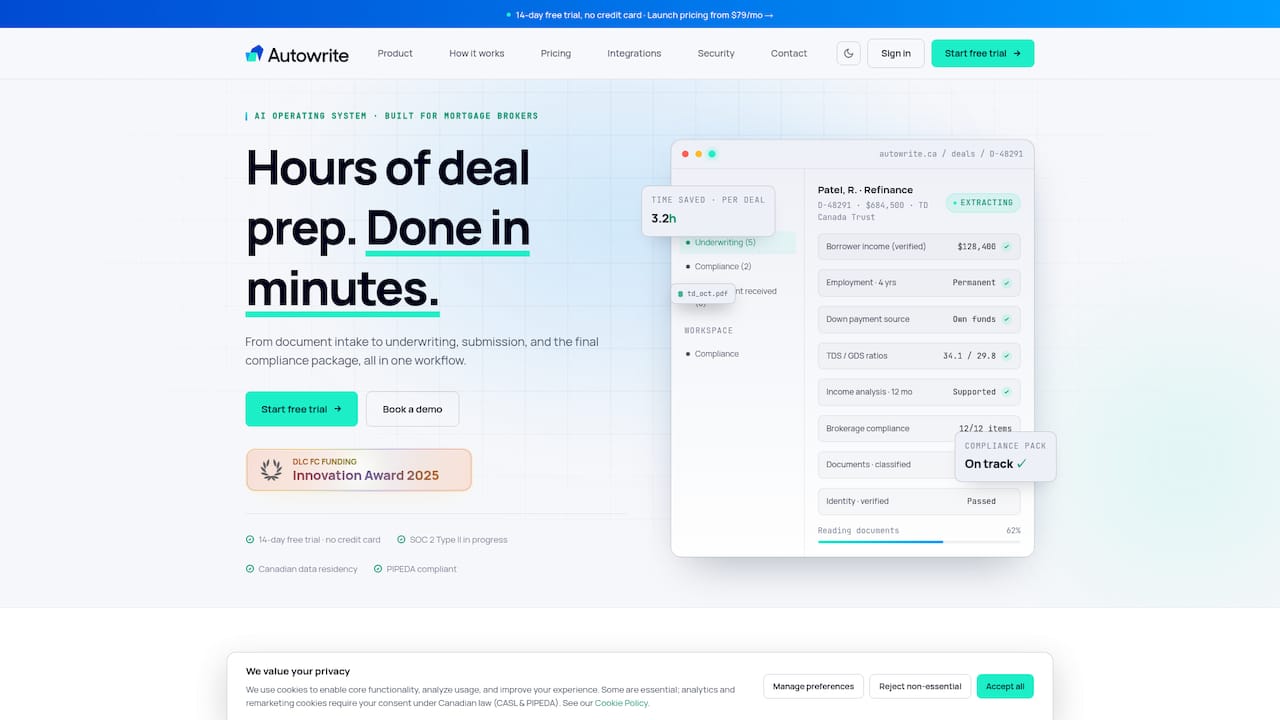
Licensed brokers, agents and brokerage owners can start the trial and see how a single organized file per client changes their next compliance review.
FAQ
Do mortgage brokers in Canada really have to follow FINTRAC rules?
Yes. Since October 11, 2024, anyone providing the services of a mortgage administrator, mortgage broker or mortgage lender is a reporting entity under the PCMLTFA. That brings a compliance program, record keeping, reporting and know your client measures. Broker status follows your provincial authorization.
How often do I need to refresh client KYC information?
FINTRAC does not set a fixed interval. You keep client information up to date at a frequency tied to the client's risk level, and you write that frequency into your policies and procedures. Updating information does not require re-identifying the client with the verification methods.
What must be in a mortgage information record?
For an individual: name, address, date of birth and occupation, plus the nature of the principal business for a sole proprietor. For an entity: name, address and the nature of its principal business. Each client on a transaction needs their own record.
How quickly must I hand over records if FINTRAC asks?
Within 30 days of a request. Electronic records are acceptable as long as a paper copy can easily be produced. Ongoing monitoring records must be kept for at least five years from the date they were created.
Sources
- Mortgage administrators, brokers and lenders, FINTRAC
- Video: Mortgage Sector, Compliance program requirements, FINTRAC
- Record keeping requirements for mortgage administrators, brokers and lenders, FINTRAC
- When to verify the identity of persons and entities, mortgage sector, FINTRAC
- Ongoing monitoring requirements, FINTRAC
- Guideline 4: Implementation of a Compliance Regime, FINTRAC
- Advisory on PCMLTFA requirements, BCFSA
- Organizing mortgage documents