
FSRA regulates every mortgage broker, agent, brokerage, and administrator operating in Ontario, and three obligations sit at the top of any review: documented suitability with written borrower acknowledgement, advertising that clearly shows your brokerage name and licence number, and visible evidence of principal broker oversight. Get these three right and most of the rest of the Financial Services Regulatory Authority of Ontario's checklist falls into place, along with the fraud-prevention controls and MBRCC Code of Conduct expectations layered on top. Autowrite's clients treat these as system requirements, not paperwork.
TL;DR:
- Verifying license status and displaying brokerage name and license number on all public-facing materials are the most common compliance issues for brokerages.
- Building suitability files requires detailed documentation of client needs, risks, alternatives considered, and signed borrower acknowledgements to pass FSRA scrutiny.
- Advertising across all platforms must include current brokerage disclosures, licensed titles, and avoid misleading statements, with frequent updates and audits recommended.
- Supervisory controls should include regular file reviews, documented sign-off authority, and logs of oversight activities to demonstrate 'reasonable steps' to FSRA.
- Automated templates and audit trail tools help prevent compliance drift by enforcing disclosure, supervision, and advertising standards during each file's lifecycle.
Table of Contents
- Who FSRA Regulates and What Baseline Compliance Looks Like
- Building Audit-Proof Suitability Files Under O. Reg. 188/08
- Advertising and Public Relations: The Rules Brokers Get Wrong
- Principal Broker Duties: Proving 'Reasonable Steps' to FSRA
- Detecting Mortgage Fraud Before It Reaches Funding
- Essential FSRA Resources for Your Compliance Handbook
- Using Automation to Stop Compliance Drift Before It Starts
- Where Brokerages Actually Fail Before an FSRA Review
- Autowrite: Built for FSRA-Regulated Brokerages
Who FSRA Regulates and What Baseline Compliance Looks Like
FSRA's authority covers anyone "dealing or trading in mortgages" in Ontario. That includes mortgage brokers, agents, brokerages, and administrators, and it applies whether you're arranging a residential first mortgage or placing a client into a private Mortgage Investment Corporation. If you're negotiating terms, presenting lender options, or collecting a fee tied to a mortgage transaction, you're inside FSRA's scope. Brokers used to operating loosely under a "just help the client" mindset often underestimate how broadly this net is cast.
Verifying your own licence status, and checking a colleague's before referring business, takes seconds through FSRA's public registry. Every piece of public-facing material you produce needs to display your brokerage's authorized name and licence number, a requirement that trips up more brokerages than any other single rule.
Administrative duties that draw regulatory attention during a review include:
- Keeping complete transaction files with time-stamped entries for every material step
- Filing renewal and change-of-information notices with FSRA promptly
- Maintaining trust account records where applicable
- Retaining suitability and disclosure documents for the period FSRA specifies
- Logging staff licence status and training completion internally
Brokerages that treat licence verification and record retention as one-time setup tasks, rather than ongoing operational habits, are the ones that scramble when FSRA schedules an examination.
Building Audit-Proof Suitability Files Under O. Reg. 188/08
Section 24 of O. Reg. 188/08 requires that a mortgage or a mortgage investment be suitable for the client based on their needs and circumstances. Section 25 goes further: it requires written disclosure of material risks and a written acknowledgement signed by the borrower confirming they received and understood that disclosure. FSRA has run targeted examinations focused specifically on disclosure and suitability, particularly in private mortgage placements, so this isn't a theoretical risk.
A suitability file that would survive scrutiny needs these components, in order:
- A documented assessment of the client's needs, income situation, and risk tolerance
- A record of the alternatives considered, including why conventional lending was or wasn't recommended
- Clear identification of material risks specific to the product, not boilerplate language
- Full disclosure of fees, commissions, and any conflicts of interest, including related-party lender relationships
- A signed, dated written acknowledgement from the borrower
Private placements and MIC deals face heightened supervisory attention when the lender is related to the brokerage, so document your rationale for choosing that product over a conventional one in explicit terms.
Pro Tip: Build a required-field template that won't let a file move to funding until every disclosure and acknowledgement field is populated and time-stamped. A missing signature caught at intake costs minutes; caught during an FSRA examination, it costs a finding.
Advertising and Public Relations: The Rules Brokers Get Wrong
FSRA's definition of advertising is broader than most brokers assume. It covers websites, email signatures, business cards, social media profiles, print ads, and anything else presented to the public. The advertising requirements under MBLAA require every one of those formats to clearly display your brokerage's authorized name and licence number, use only approved titles for named brokers and agents, and avoid any statement that could mislead a consumer about rates, approval odds, or affiliation.
Common violations and quick fixes:
- Outdated email signatures missing the licence number: fix with a locked, brand-approved signature template
- Personal social media bios using "mortgage specialist" instead of the licensed title: standardize titles across all profiles
- Old business cards printed before a licence renewal or brokerage name change: audit inventory annually
- Website footers missing the brokerage disclosure block entirely: add it site-wide, not per-page
Principal Broker Duties: Proving 'Reasonable Steps' to FSRA
FSRA expects principal brokers to demonstrate integrity, competency, sufficient authority, adequate resources, and independence when overseeing a brokerage's agents and brokers. Supervision has to scale with risk and experience. A newly licensed agent handling private mortgage placements needs closer oversight than a fifteen-year veteran doing straightforward residential renewals.
Controls that make this supervision concrete rather than aspirational:
- Periodic file reviews, sampled by risk tier, not just by convenience
- Training records showing completion dates, not just enrollment
- A written escalation procedure for flagged files and consumer complaints
- Documented sign-off authority separating routine approvals from high-risk ones
Pro Tip: Keep a running log of every supervisory review with the reviewer's name, date, and outcome. FSRA has said plainly that a check-the-box approach isn't sufficient. A dated log of actual reviews is the difference between claiming supervision happened and proving it did.
Detecting Mortgage Fraud Before It Reaches Funding
Mortgage fraud in Canada runs into hundreds of millions of dollars annually, and FSRA built a dedicated checklist specifically to help brokerages catch it earlier. Red flags worth training your team to spot include identity documents that don't quite match across a file, source-of-funds explanations that shift between conversations, and referral patterns where the same third party keeps appearing across unrelated deals.
Build these controls into intake, not just underwriting:
- Verify identity documents against a second independent source at first contact
- Require documented source-of-funds explanations, including gift letter verification where applicable
- Track referral sources across your pipeline to catch unusual clustering
- Mandate a second sign-off on any file flagged as high-risk before it proceeds
Mapping FSRA's checklist against your own intake workflow, rather than treating it as a separate compliance exercise, is what actually catches fraud red flags before funding, not after a lender complains.
Essential FSRA Resources for Your Compliance Handbook
FSRA keeps its guidance centralized, and pulling the right documents into an internal handbook saves real time during any review.
| FSRA resource | What to extract for internal policy |
|---|---|
| Compliance and fraud checklists | Fraud red flags and intake verification steps |
| Advertising and public relations guidance | Required disclosure elements for all public materials |
| Principal broker responsibilities guidance | Supervisory indicators and documentation standards |
| Mortgage brokerage disclosure requirements | Suitability and written acknowledgement requirements |
Combine these with the MBRCC Code of Conduct and the specific MBLAA and O. Reg. 188/08 sections that govern each obligation, and cite the section numbers directly in your internal policy so staff aren't guessing which rule applies where.
Using Automation to Stop Compliance Drift Before It Starts
Compliance drift happens gradually. A disclosure field gets skipped under deadline pressure, a signature gets collected after funding instead of before, and nobody notices until an examination flags a pattern across dozens of files. Autowrite's document intelligence maps directly onto FSRA's requirements: automated suitability templates that won't advance without required disclosures, advertising template controls that lock in the correct brokerage name and licence number, and immutable audit logs stored on Canadian servers.
A typical workflow looks like this: intake, automated suitability package generation, supervisory sign-off, and a permanent audit trail attached to the file.
- Disclosure fields that can't be skipped or backdated
- Advertising templates enforced brand-wide, not per-agent
- Retention and audit trail automation mapped to FSRA's document retention expectations
Pro Tip: Run a self-audit using FSRA's own checklists before FSRA runs one for you. A brokerage that catches its own gap fixes it quietly; one that waits for an examiner explains it formally.
Where Brokerages Actually Fail Before an FSRA Review
Before any review, audit three things first: suitability files, advertising materials, and evidence that principal broker supervision actually happened, not just that it was assigned on paper. Most brokerages I've studied treat compliance as a document-collection exercise when FSRA is explicitly evaluating outcomes. A file with every signature but no genuine suitability reasoning behind it will not hold up. Automation helps here not because it replaces judgment, but because it makes consistency the default instead of the exception.
— Anant Bawa
Autowrite: Built for FSRA-Regulated Brokerages
Autowrite is the practical answer to compliance drift for Ontario brokerages tired of chasing missing signatures after the fact. Instead of relying on memory to enforce disclosure requirements, suitability documentation, and advertising standards across every agent, Autowrite locks those requirements into the workflow itself, capturing written acknowledgements, applying brand-approved advertising templates automatically, and generating the audit trail FSRA examiners actually want to see, all on Canadian infrastructure.
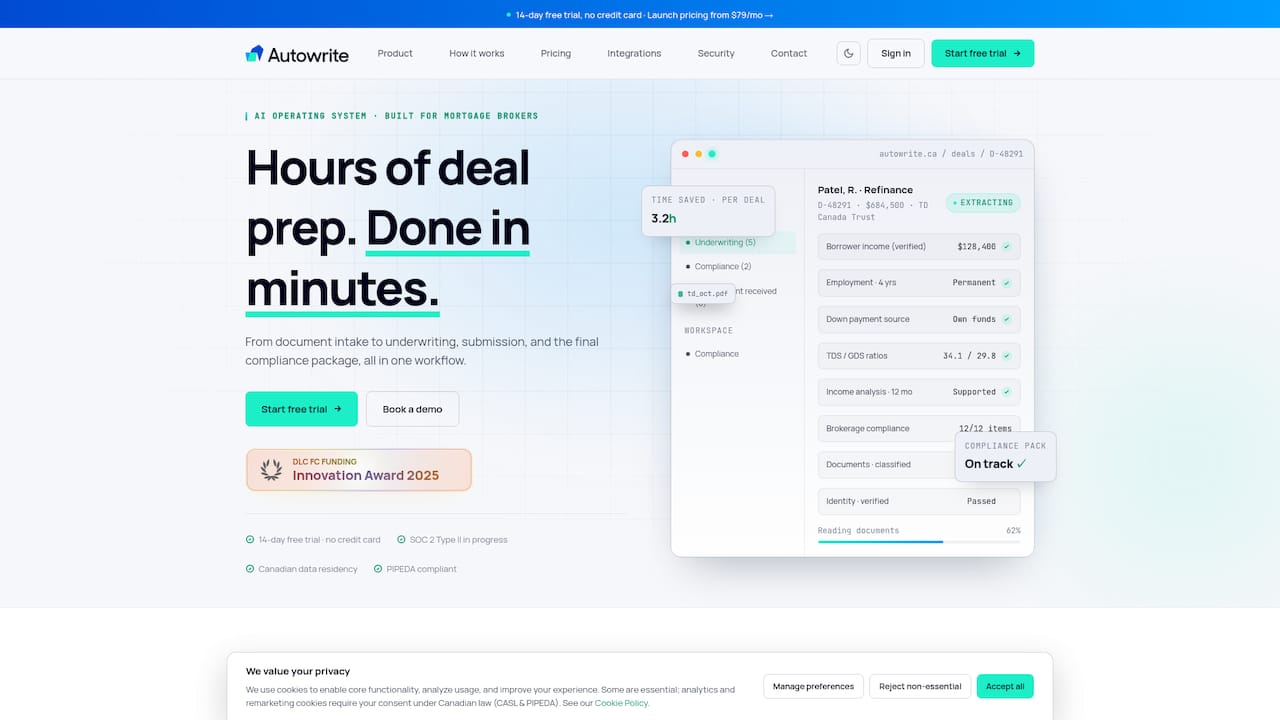
If your brokerage is still assembling suitability packages by hand or checking advertising materials one agent at a time, that's exactly where compliance drift starts. Autowrite's AI-powered platform turns document intake, underwriting prep, and compliance packaging into a single automated flow built specifically for Canadian mortgage brokers. Start a 14-day free trial to see how your next file moves from intake to audit-ready in a fraction of the usual time.