
When a borrower is a corporation, a trust or another entity, you must identify the individuals who own or control it, record what you learned and take reasonable measures to confirm it is accurate. FINTRAC sets that rule for mortgage brokers, administrators and lenders. The ownership threshold is 25%, the records must be kept for at least five years, and a missing answer is never a reason to skip the step. This guide covers who counts, what to collect, what to do when owners stay hidden, and how bilingual and foreign-language documents fit into the file.
TL;DR
- A beneficial owner is an individual who directly or indirectly owns or controls 25% or more of a corporation or other entity. A corporation can never be the final answer.
- Collect beneficial ownership information when you verify the entity, then take reasonable measures to confirm it and keep it current through ongoing monitoring.
- If you cannot obtain or confirm the information, verify the entity's chief executive officer or equivalent and treat the client as high risk.
- Lenders expect certified English or French translations of foreign-language documents. In Quebec, land register documents must be in French.
- Keep every record for at least 5 years in a form you can produce to FINTRAC within 30 days of a request.
Table of Contents
- What beneficial ownership means in a mortgage file
- Who must do this
- When you have to ask
- What to collect and record
- Confirming the information is accurate
- When ownership is unclear or information is missing
- Bilingual and foreign-language documents
- Organizing and retaining the file
- Our perspective
- Putting this into practice with Autowrite
- FAQ
- Sources
What beneficial ownership means in a mortgage file
Beneficial owners are the real people behind an entity. FINTRAC defines them as individuals who directly or indirectly own or control at least 25% of a corporation or of an entity other than a corporation. For a trust, the relevant people are the trustees, the known beneficiaries and the settlors. For a widely held or publicly traded trust, they are the trustees and anyone who owns or controls at least 25% of its units.
The word "indirectly" matters. If Numbered Co. A holds 60% of your borrower and Jane Tremblay holds 100% of Numbered Co. A, Jane is a beneficial owner of your borrower. FINTRAC's sector page is explicit that the ultimate beneficial owner cannot be another corporation or entity. It has to be the individual or individuals who own or control it.
Control is wider than shares. Someone holding 10% who can direct the entity through a shareholder agreement, board appointments or signing authority still belongs in your analysis, even though no percentage test is met.
Who must do this
FINTRAC treats a mortgage broker as a person or entity authorized under provincial legislation to act as an intermediary between a lender and a borrower on loans secured by mortgages on real property, or by hypothecs on immovables in Quebec. The same page covers mortgage administrators and lenders, and says all three must obtain beneficial ownership information for entities and take reasonable measures to confirm it.
The federal obligations for mortgage originators, administrators and lenders came into force on October 11, 2024. BCFSA Advisory 2-043 told B.C. brokers to expect a compliance program, customer due diligence including identity verification and beneficial ownership, record keeping, reporting to FINTRAC and compliance with ministerial directives. The advisory also describes administrative monetary penalties of $1 to $1,000 per violation for minor violations and $1 to $100,000 per violation for serious ones, depending on the harm done and the entity's compliance history.
If your brokerage is not set up around a documented compliance program yet, our guide to anti-money laundering compliance for mortgage brokers is a good place to build the wider framework this task sits inside.

When you have to ask
FINTRAC requires the information when you verify an entity's identity, and requires reasonable measures to confirm its accuracy when you first obtain it and during ongoing monitoring. In practice, that covers situations like these:
- A new corporate or other entity client, such as a holding company buying a rental property.
- An entity that is not your client but is providing funds, for example a company gifting a down payment.
- An entity conducting a suspicious or attempted suspicious transaction.
- Entities providing large cash or large virtual currency amounts.
The NLAR Resource FINTRAC FAQs list these same triggers for agents. They also state that the information has to be kept up to date as part of ongoing monitoring of the business relationship, so a file you closed two years ago for a repeat client is not a file you can simply reuse.
Provincial regulators add their own layer. The BCFSA identity verification guideline requires licensees to verify the identity of the client and any personal or legal representative before providing mortgage services. Even where someone is not your client, you must take reasonable steps to verify each borrower and lender you intend to present a transaction to. Our BCFSA compliance guide walks through how that fits with the federal rules.
What to collect and record
For each entity, FINTRAC's guidance asks you to gather the applicable names and addresses of owners, trustees, beneficiaries and settlors, plus information that establishes the entity's ownership, control and structure. A workable checklist for a typical corporate borrower:
- Legal name, corporation number and jurisdiction of incorporation.
- Names and addresses of every individual who owns or controls 25% or more, directly or indirectly.
- The ownership chain: a simple chart from the borrower up through any holding companies to the individuals.
- Directors and anyone with signing authority.
- For a trust: trustees, known beneficiaries and settlors, plus the trust deed.
- For not-for-profit entities, the additional information that applies to them.
- For a corporation, a copy of the part of the corporate records that contains any provision on the power to bind the corporation in the transaction.
That last item does double duty. It supports your beneficial ownership record and also helps you confirm the entity has authority to enter into the mortgage. The BCFSA guideline reminds licensees that their duties go beyond identity: they must take reasonable steps to determine that a borrower has legal authority and capacity, and to assess the accuracy, completeness and consistency of the application and transaction records.
The NLAR FAQs describe a five-step flow that CREA built into a Beneficial Ownership Record template for agents: obtain type-specific information, obtain ownership and control information, obtain not-for-profit information if it applies, confirm accuracy, and a last-resort step when the earlier ones fail. Even if you are not a real estate agent, that sequence is a sensible way to structure your own file note.
Confirming the information is accurate
Collecting names is not enough. FINTRAC expects reasonable measures to confirm accuracy, and its guidance points to sources such as official records, registries, supporting documents, open-source searches or commercial information. A shareholder register, articles of incorporation and a recent annual return will normally carry more weight than a client's email.
A few habits make this faster and more defensible:
- Record the source and the date for every confirmation, not just the conclusion.
- Compare names and addresses against the identification you already hold. A mismatch is a signal worth noting.
- Apply the BCFSA test of consistency: if the ownership story conflicts with the application, the income documents or the source of the down payment, escalate to the prospective lender rather than smoothing it over.
Our article on five FINTRAC client ID methods covers the individual side of verification, which you will repeat for each beneficial owner you identify who is also a signer or guarantor.
When ownership is unclear or information is missing
Sometimes a client cannot or will not tell you who owns the entity. FINTRAC's guidance gives you a fallback, not an exit. If you cannot obtain the information or cannot confirm it, you verify the identity of the entity's chief executive officer or equivalent, and apply the special measures for high-risk clients, including enhanced ongoing monitoring. The difficulty itself belongs in your risk assessment of that client.
In plain terms:
- Document what you asked for, when, and what the client said.
- Verify the CEO or equivalent and keep that record.
- Raise the client's risk rating and note why.
- Apply enhanced monitoring for as long as the relationship lasts.
- Consider whether the pattern calls for a suspicious transaction report. Our guide to suspicious transaction reports explains the threshold.
The BCFSA guideline goes further for B.C. licensees: they must refuse to participate in, facilitate or continue acting on a transaction they know, or reasonably ought to know, is unlawful.
Bilingual and foreign-language documents
Beneficial ownership files often arrive with documents that are not in English: a shareholder register from abroad, a trust deed, a foreign passport, or French-language corporate records from Quebec. Three separate questions come up.
Foreign-language supporting documents
For mortgage applications, lenders require certified English or French translations of foreign-language documents, according to a Canadian brokerage's guidance on translations. That page says self-translations, translations by family members and machine translation outputs are not accepted, and that notarization is not always mandatory but may be used for legal contracts, wills, inheritance papers and government-issued identification. Because lender requirements differ, confirm the specific standard with the lender before the client pays for translation.
For beneficial ownership records, the practical rule is simple: if you cannot read the document, you cannot confirm what it says. A certified translation of an overseas share register or trust deed is what lets you take reasonable measures to confirm ownership, and it protects the file if FINTRAC or your regulator reviews it later.
Signing when a party is not fluent in English
In B.C., the Land Title Practice Manual says that when an individual appears unable to read English, the witnessing officer certifies that the contents and effect of the instrument were sufficiently communicated and fully understood, and may require an interpreter at signing. Brokers should flag this early when a borrower or signing officer of a company has limited English, so the closing is not delayed.
Quebec and French
Quebec has its own language rules. OACIQ states that since September 1, 2022, applications for registration in the Land Register and the documents attached to them, such as the deed of sale and mortgage deed, must be drafted in French. If they were drafted in another language, they need an authenticated translation by a certified translator who is a member of the Ordre des traducteurs, terminologues et interprètes agréés du Québec. Certain residential brokerage contracts must also be in French unless the parties unanimously choose English.
Outside Quebec, disclosure rules focus on clarity. FSRAO says Ontario brokers and agents must disclose the material risks of a mortgage in writing and in plain language, and borrowers are entitled to at least two business days to review a mortgage disclosure statement before signing. The Financial Consumer Agency of Canada says federally regulated lenders must disclose key information in clear, simple, not misleading language, in a disclosure statement and an information box.
Organizing and retaining the file
FINTRAC requires an information record on every person or entity for which you arrange a mortgage loan. Records must be kept so they can be provided to FINTRAC within 30 days of a request, and electronic or machine-readable storage is fine as long as a paper copy can be produced easily. The minimum retention is five years. For information records it runs from the day the last business transaction was conducted.
Fasken's summary lists the records mortgage entities keep for at least five years: receipt of funds records, information records, a record of the client's financial capacity and loan terms, beneficial ownership records, third-party determination records, and the corporate power-to-bind extract.
For entity files, a clean structure looks like this:
| Folder item | What it holds | Notes |
|---|---|---|
| Entity identity | Articles, certificate, corporation number | Link to the verification record |
| Ownership chart | Chain from borrower to individuals | Date it and note who prepared it |
| Beneficial owner records | Names, addresses, percentage or control basis | One record per individual |
| Confirmation evidence | Registry extract, share register, open-source notes | Source and date on each |
| Original-language documents | Foreign or French originals | Keep alongside translation |
| Certified translations | Translator's certification and text | Same retention as the original |
| Risk note | Rating, reasons, any fallback measures | Update at each ongoing monitoring review |
Keep the original and its translation together and name them so the pairing is obvious. If you are weighing provincial retention periods against the federal minimum, our comparison of FINTRAC and FSRA retention on mortgage files sets them side by side.
Our perspective
Beneficial ownership is where paperwork and judgment meet. The rule is easy to state: find the individuals behind the entity, confirm them, keep the evidence. The work is hard because the evidence arrives as a pile of PDFs, scans and translations that no one has time to line up.
We built Autowrite for Canadian brokers so that the pile stops being the broker's problem. Our platform is designed to classify incoming documents, extract the data with line-level confidence, and assemble compliance packages, so you can see what is on file and what is missing before you submit. Your attention goes to the judgment calls: does this ownership chart make sense, and do the numbers match the application?
We also think Canadian data residency matters for this kind of file. Ownership records contain personal information about people who are not even your clients. Keeping them in Canada, in a system built around Canadian rules, is how we approach that responsibility.
The best compliance process is one your whole team follows on every file, not only on the ones that feel risky.
Anant Bawa
Putting this into practice with Autowrite
Autowrite is an AI-powered operating system for Canadian mortgage brokers. It automates document intake, classification and data extraction, auto-fills underwriting forms, syncs with mortgage software, and assembles e-sign and compliance packages, with Canadian data residency. For entity files, that means ownership documents, translations and supporting records can sit in one organized file instead of scattered inboxes.
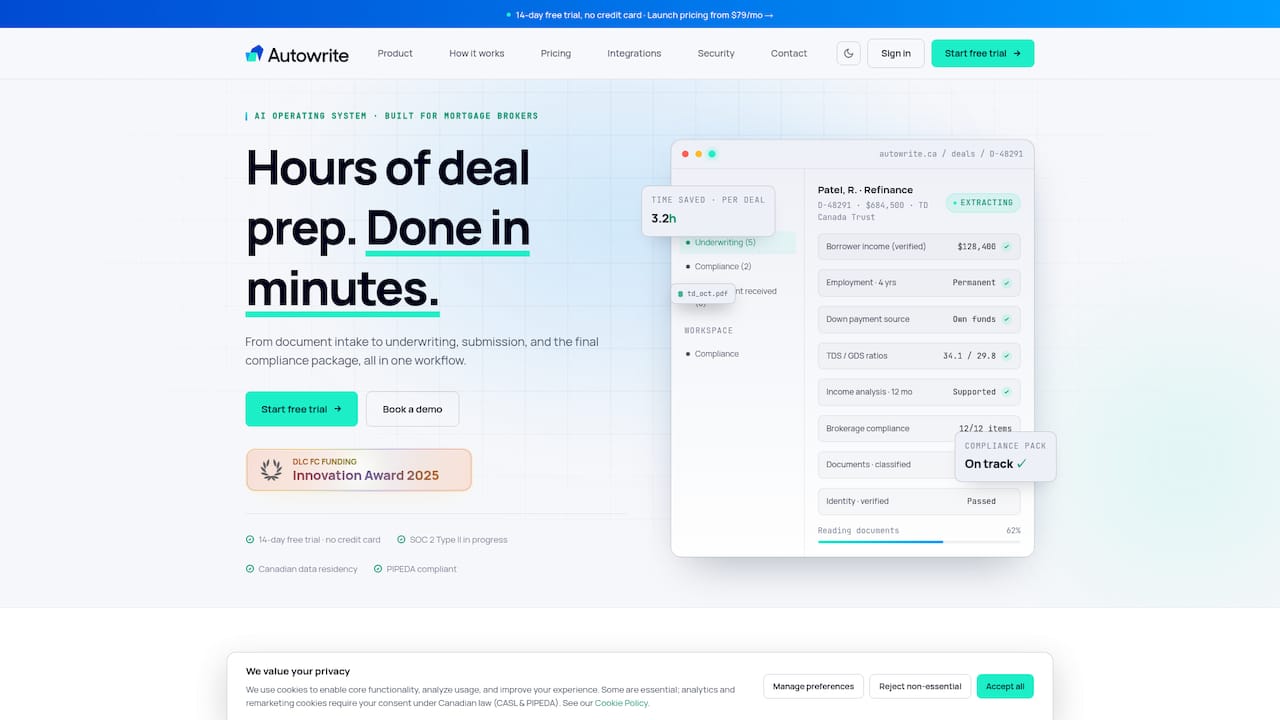
Plans are Starter at $99 per month, Pro at $199 per month and Legend at $399 per month, with Enterprise available on request. An additional deal costs $20 one-off, and pay as you go is $35 one-off. Paid plans come with a 14-day free trial. You can see the details on the Autowrite pricing page. For how the compliance side fits together, read our FINTRAC checklist for the mortgage compliance package.
FAQ
Is the 25% threshold the only test for a beneficial owner?
No. FINTRAC's definition covers individuals who directly or indirectly own or control at least 25%. Control can come from agreements or influence over decisions, so look at how the entity is run as well as at the shares.
What if the owner is another corporation?
Keep going up the chain until you reach individuals. FINTRAC states the ultimate beneficial owner cannot be another corporation or entity. Record the chain, the individuals and how you confirmed each link.
Do I need a certified translation for every foreign document?
For mortgage applications, lenders require certified English or French translations of foreign-language documents, and they do not accept self-translations or machine translations. Check your lender's exact standard. In Quebec, land register documents must be in French or carry an authenticated translation.
How long do I keep beneficial ownership records?
At least five years. For information records the clock starts from the day the last business transaction was conducted. Records must be producible to FINTRAC within 30 days of a request.
Sources
- FINTRAC: Beneficial ownership requirements
- FINTRAC: Mortgage administrators, brokers and lenders
- FINTRAC: Record keeping requirements for mortgage administrators, brokers and lenders
- BCFSA: Guideline on identity verification and transaction integrity
- BCFSA: Advisory 2-043
- NLAR Resource: FINTRAC FAQs 2025
- Fasken: New anti-money laundering requirements for mortgage entities
- OACIQ: Bill 96 and amendment to the Civil Code of Québec
- FSRAO: Signing a mortgage contract
- Financial Consumer Agency of Canada: Getting a mortgage, know your rights
- Allen Ehlert: Getting mortgage documents translated
- BC Land Title Practice Manual: Witnessing persons not fluent in English