

Condition tracking for mortgage brokers means recording every lender condition's status, owner, evidence, and deadline in one system, then enforcing service-level timelines until each item clears. Done well, it produces faster condition clears, fewer underwriting exceptions, and files that hold up under FSRA or FINTRAC review. Automation platforms like Autowrite build these capabilities directly into the brokerage workflow rather than leaving them to scattered email threads.
TL;DR:
- Use one fixed status taxonomy and attach every upload to an immutable condition ID with evidence links, dates, an owner, and confidence notes.
- Set initial client outreach within 24–48 hours and document return within five business days; route items more than 48 hours overdue to the principal broker.
- Let automation autofill only when extraction confidence clears a defined threshold; send lower confidence files to a human reviewer with a same day deadline.
- FINTRAC and FSRA have different retention windows, five and six years respectively, so brokerage policy should track each regulator’s requirement separately.
- FSRA expects files to show how client facts support the recommendation, not merely list the facts, so reviewers can reassess suitability independently.
Table of Contents
- What broker-facing condition tracking is and why it matters
- Essential fields and status taxonomy every condition tracker needs
- Document intake and condition-to-document checklist
- Operational workflow: assign, chase, verify, clear
- Automation and integrations that materially reduce time and errors
- Reporting, audit trail, and regulator expectations
- Author perspective: prioritized implementation tips and pilot plan
- How Autowrite supports condition tracking from intake to clear
- FAQ
- Sources
What broker-facing condition tracking is and why it matters
For brokers, a "condition" is a lender requirement that must be satisfied before funding: proof of income, a down payment source, an updated appraisal, an insurer document. Condition tracking is the discipline, and increasingly the software, that records what each condition needs, who owns it, and whether the evidence has been collected and verified. This is distinct from any consumer-facing tool that helps a borrower track their own mortgage, and brokerages should not confuse the two.
Regulators care about this process as much as brokers do. FSRA guidance on records management requires brokerages to keep complete, accurate, and promptly retrievable records of each transaction. Auditors most often cite three failure modes: evidence scattered across personal inboxes, missing dates on when a condition was requested or cleared, and no documented rationale tying client facts to the final recommendation.

Essential fields and status taxonomy every condition tracker needs
A condition tracker only works if every deal uses the same fields and the same status labels. Without that consistency, reporting breaks down and audit trails have gaps that are hard to explain later.
- Condition ID: a unique, immutable identifier per lender request, never reused across deals.
- Lender reference: the lender's own condition number or description, copied exactly.
- Status: requested, assigned, in progress, submitted, under lender review, cleared, or waived.
- Owner: the team member responsible for chasing and verifying the item.
- Assigned date and due date: with a suggested SLA of 24 to 48 hours for initial client outreach and 5 business days for document return.
- Evidence links: pointers to the actual file, not a description of it.
- Confidence notes: any flag on document quality, legibility, or extraction accuracy.
Consistent taxonomy matters because a reviewer reconstructing a file months later needs to see the same status language on every deal, not a mix of shorthand that only one broker understands.
Document intake and condition-to-document checklist
Most lender conditions map to a small, predictable set of documents. Building intake around that mapping prevents the back-and-forth that slows deals down.
- Income conditions: pay stubs, T4s or Notices of Assessment, and employment letters.
- Down payment conditions: 90-day bank statements, gift letters, or sale proceeds confirmation.
- Identity conditions: government-issued ID matching the application exactly.
- Appraisal and insurer conditions: appraisal reports and any insurer-specific forms.
- Private lender or investor disclosures: documents required under provincial rules such as Ontario's Standards of Practice when a mortgage is presented to investors.
Intake should run through a single source of truth rather than a shared inbox. Use consistent filenames (deal number, condition ID, document type), capture metadata at upload, and avoid letting evidence live in anyone's personal email. A mortgage document checklist and intake workflow built around this structure removes most of the ambiguity that causes delays.
Retention timing matters too. FSRA and FINTRAC apply different retention windows, and brokerages need to know both; a side-by-side comparison of FINTRAC's five-year and FSRA's six-year retention rules is worth keeping on hand for compliance staff.
Pro Tip: Tie every uploaded document to its condition ID at the moment of intake, not after the fact, so retrieval never depends on anyone's memory of where a file went.
Operational workflow: assign, chase, verify, clear
A condition only clears reliably when someone owns each step and handoffs are explicit. The workflow below keeps deals moving without losing the audit trail.
- Assign: the processor or broker logs the condition within hours of receiving the lender's commitment letter, naming an owner immediately.
- Chase: the owner contacts the client or source within the SLA window, using a templated request that names the exact document needed.
- Verify: a second team member or the broker confirms the document actually satisfies the condition, not just that something was uploaded.
- Clear: the condition is marked cleared with the evidence link attached, and the lender is notified.
- Escalate: any condition that misses its due date by more than 48 hours routes automatically to the principal broker for review.
Smaller brokerages often have one person performing all four steps, but even then, separating "chase" from "verify" catches errors that a single rushed reviewer would miss. Escalation to the principal broker should not wait for a deal to be in jeopardy; a consistent trigger, such as two missed SLA dates in a row, keeps problems from compounding near closing.
Automation and integrations that materially reduce time and errors
Document intelligence is the automation layer that changes condition tracking from a manual chase into a managed pipeline. Classification engines sort incoming files by type, extraction tools pull the relevant data points, and confidence scoring flags anything that needs a human look before it moves forward.
- Classification: incoming documents are sorted into income, down payment, identity, or insurer categories without manual tagging.
- Line-level extraction: specific figures and fields are pulled directly into underwriting forms.
- LOS and CRM sync: condition status updates flow into the loan origination system and client record automatically.
- E-sign and lender portal ingestion: signed documents and lender responses are captured without re-uploading.
- Email parsing: attachments sent by clients or lenders are routed to the correct condition ID without manual sorting.
Not every extraction should move forward untouched. Low-confidence extractions, anything below a set accuracy threshold, should route to human review with a short turnaround SLA rather than autofill directly into a form. Autowrite applies this confidence-gated approach across document intake, pairing automated classification with human checks where the data warrants it, and compliance-focused checklists like FINTRAC's automation checklist for compliance packages outline how that balance should work in practice.
Pro Tip: Set your automation to autofill only above a defined confidence threshold, and send everything below it to a reviewer with a same-day deadline so low-confidence files never sit untouched.
Reporting, audit trail, and regulator expectations
Regulators do not just want conditions cleared; they want to see how and when. FINTRAC's recordkeeping guidance names mortgage brokers and administrators specifically and expects records that remain accessible and well organized. FSRA's suitability documentation guidance goes further, expecting brokerages to document the rationale connecting client facts to the recommendation, not just the facts themselves.
A condition-tracking system should be able to produce, at minimum:
- An outstanding conditions dashboard showing every open item across active deals.
- Time-to-clear metrics by condition type and by lender.
- An evidence-linked transaction log tying every document to its condition ID and deal.
- A suitability rationale export that a reviewer can read without asking the broker to explain it verbally.
Files built this way let a reviewer re-perform the suitability assessment independently, which is the standard FSRA's guidance is actually testing for.
Author perspective: prioritized implementation tips and pilot plan
Start where the pain is worst: the loan type or lender with the highest condition-failure rate, not the easiest one to automate. That is where a working system earns trust fastest.
Change management matters more than the software choice. Train staff on one taxonomy, consolidate every inbox into the tracker, and name someone to own taxonomy governance so status labels do not drift deal by deal.
Run a 30/60/90 pilot limited to one loan type and two originators. Track time-to-clear, the percentage of conditions cleared without manual chasing, and a file completeness score. Those three numbers tell you whether to scale or adjust before committing the whole team.
— Anant Bawa
How Autowrite supports condition tracking from intake to clear
We built Autowrite around the exact workflow brokers run every day: document intake, classification, extraction, and the chase that follows. Our platform applies document intelligence with line-level confidence scoring to sort incoming files, autofill underwriting forms, and keep every piece of evidence linked to its condition inside one system that syncs with your loan origination software.
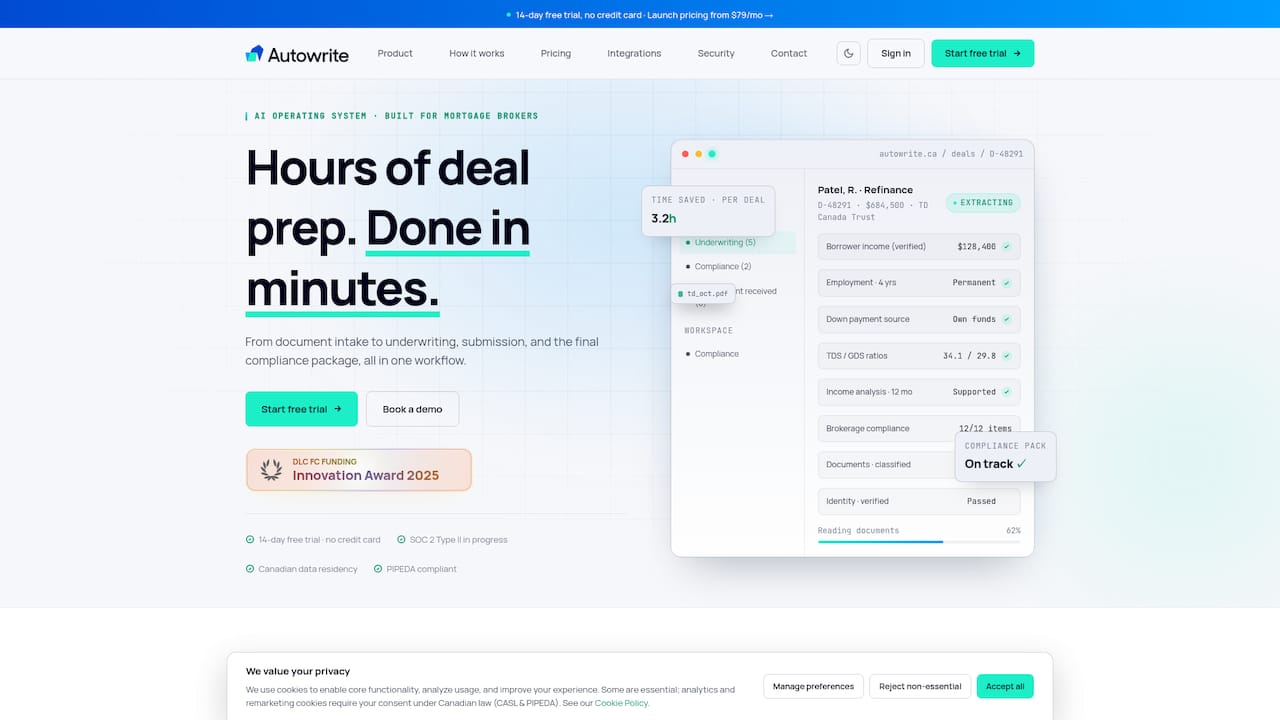
We designed our platform to ensure audit trails stay accessible and organized to meet regulatory expectations. If your team is still tracking conditions across email and spreadsheets, our Starter, Pro, Legend, and Enterprise plans give you a path to automate that work, starting at $149 per month for Starter. Visit our product page to see the workflow in detail, or start a trial to test it against your own deal pipeline before committing.
FAQ
What does "condition tracking" mean for a mortgage broker?
It means recording each lender condition's status, owner, deadline, and supporting evidence in one system so nothing falls through email. Brokerages use it to speed up clears and to produce the retrievable records that FSRA expects during a review.
What documents should a brokerage collect at intake?
The most common categories are income documents, down payment proof, identification, appraisal reports, and any insurer or investor disclosures required under provincial rules. Mapping each lender condition to its document type before the file arrives prevents repeated requests to the client.
How long must mortgage brokerages retain records?
Retention periods differ by regulator: FINTRAC and FSRA both set recordkeeping expectations, and brokerages need to track both. A direct comparison of the FINTRAC and FSRA retention windows is useful for compliance staff setting internal policy.
Does Autowrite replace manual condition tracking entirely?
Autowrite automates classification, extraction, and autofill, and routes low-confidence documents to human review rather than skipping that step. Pricing starts at $149 per month on the Starter plan, with higher tiers for larger teams.
How do brokers know when to escalate a stalled condition?
A common trigger is two missed SLA dates in a row, which should route the deal to the principal broker automatically rather than waiting until closing is at risk. Clear escalation rules, paired with consistent financing condition language in the purchase contract as discussed in guidance on financing conditions, keep deals from stalling quietly.
Sources
- Mortgage brokerage and administrator records management and up-front fees
- Record keeping requirements for mortgage administrators, brokers and lenders