
Digital compliance records are any machine-readable business documents plus their timestamped audit trails that regulators can process, and you must retain them in accessible formats for the statutory period. That means invoices, contracts, signed forms, transaction logs, and the metadata proving who touched them and when. Before anything else, check three things: your file formats open without special software, every document has an audit trail attached, and your backups actually restore.
TL;DR:
- Digital records must include a complete and accessible audit trail that captures who touched each document, what they did, and when, with linked metadata.
- Retention periods start at six years for tax records, but sector-specific rules like FINTRAC's require records to be available within 30 days of request.
- Backup formats must remain readable and compatible after migration, and regular testing of restoration processes is essential to ensure ongoing recoverability.
- Automation tools that classify, extract data, and tag metadata at intake help preserve audit trails and meet regulatory demands as volume scales.
- Recent regulatory shifts favor ongoing, automated evidence collection over periodic manual reviews, emphasizing continuous compliance practices.
Table of Contents
- Regulatory baseline and retention timelines you must meet
- Essential technical and process controls auditors expect
- Classify, tag, and schedule records so they stay usable
- Building an audit response playbook before you need one
- How automation keeps the audit trail intact as you scale
- How recent regulatory changes are reshaping recordkeeping expectations
- Where digital recordkeeping programs break down
- Treat compliance as a capability, not a cost center
- Autowrite: how our platform maps to the compliance checklist
- FAQ
- Sources
Regulatory baseline and retention timelines you must meet
The starting point for any digital recordkeeping program is the six-year rule. Under the Income Tax Act and related guidance, businesses must keep electronic records in an electronically readable and useable format for a minimum of six years from the end of the last tax year the records relate to.
Six years is the floor, not the ceiling. CRA guidance states that machine-sensible records must stay accessible on CRA equipment, and if a proprietary or encrypted backup format cannot be restored to a readable state, you have failed the test even if the file technically still exists.
A few other obligations layer on top of the tax rules, depending on your sector:
- Financial entities covered by FINTRAC must keep specific transaction and identification records and be able to produce them within 30 days of a request.
- Records stored outside your home jurisdiction are generally acceptable only if you can still produce a usable, readable copy on demand and the storage location does not conflict with sector-specific residency expectations.
- When machine-sensible records are lost or damaged, CRA expects you to report the loss and recreate the records within a reasonable period.
- If your software vendor changes formats or sunsets a product, contact the Electronic Commerce Audit Specialist team (ECAS) before migrating, so your historical records stay compatible with CRA review tools.
Compliance officers who treat these as separate checklists often miss the overlap. A record that satisfies tax retention rules is not automatically FINTRAC-ready, and the reverse is also true.
Essential technical and process controls auditors expect
Retention periods tell you how long to keep something. Controls tell you whether what you kept actually proves anything.
An audit trail needs to answer three questions for every document: who touched it, what they did, and when. CRA guidance on reviewing business systems notes that a usable audit trail often includes linked metadata like web logs, email records, and digital signature certificates, not just a single timestamp field. This is the piece most firms lose when they migrate to new software: the document survives, but the surrounding evidence trail does not.
Access controls matter just as much as the trail itself:
- Role-based permissions limit who can view, edit, or delete a record, and the permission structure itself should be logged.
- Multi-factor authentication on any system holding compliance records closes the most common gap auditors flag.
- Privileged access, meaning anyone who can bypass normal controls, needs its own separate log, reviewed periodically rather than left unchecked.
For electronically signed documents, CRA guidance on e-signatures recommends retaining a certificate of completion along with identity verification evidence and a timestamp, since the signature alone does not prove who signed or when.
Pro Tip: Test your backup restoration process once a quarter, not just when you suspect a problem. A backup you have never restored is a backup you do not actually have.
Classify, tag, and schedule records so they stay usable
A record that cannot be found or trusted is functionally the same as no record. Four steps keep digital compliance records searchable and defensible:
- Tag consistent metadata on intake: document type, transaction ID, author, creation date, and retention expiry date, so every file carries its own audit context.
- Apply version control, with a clear "approved" or "final" stamp that distinguishes a signed, binding document from drafts still in circulation.
- Automate retention schedules tied to the metadata you captured, including legal-hold exceptions that pause deletion when a file becomes relevant to an investigation or dispute.
- Export in formats regulator tools can read, with consistent indexing, so a request for records does not turn into a manual reformatting project.
Naming conventions sound minor until an auditor asks for every mortgage file touched by one underwriter in a given quarter, and your team spends two days manually searching folders because the file names carry no structured data.
Building an audit response playbook before you need one
When a regulator requests records, the firms that struggle are the ones improvising a response for the first time. A short, rehearsed checklist changes that:
- Confirm every requested document exports in a readable, non-proprietary format.
- Attach the linked audit trail, including signature certificates and access logs, not just the document itself.
- Check for missing metadata fields before submission; this is the single most common reason a first submission gets rejected.
- Package records with a clear index so the reviewer can map each file to the request item.
FINTRAC's own guidance sets a 30-day production window for certain record requests, which is tighter than it sounds once you account for internal review time. If a format question comes up on the tax side, CRA's Electronic Commerce Audit Specialist contacts exist specifically to resolve compatibility issues before they become a bigger problem.
How automation keeps the audit trail intact as you scale
Manual recordkeeping holds up fine at low volume. It breaks down the moment a compliance officer is managing hundreds of files a month, because metadata tagging and audit trail capture are the first steps people skip under time pressure.
Document intelligence tools that classify and extract data automatically can capture required metadata and preserve audit trails at the point of intake, rather than relying on someone remembering to log it later. For mortgage brokers specifically, we've written about the metadata and evidence expectations tied to source of funds verification and the practical questions around Canadian data residency that come up when evaluating any new system.
Before piloting an automation tool, confirm its scope, define what success looks like for your team, and verify where your data physically lives.
How recent regulatory changes are reshaping recordkeeping expectations
Regulators have shifted their posture from reactive audits toward proactive risk assessment, and that shift changes what counts as adequate recordkeeping. OSFI's technology and cyber risk guidance encourages federally regulated entities to move from manual compliance checks toward automated evidence collection, paired with a maturity self-assessment tool meant to surface gaps before an examiner does.
That framing matters beyond federally regulated institutions. The expectation that compliance evidence should be continuously generated, not assembled after the fact when a request arrives, is becoming the working standard across sectors that handle financial or personal data.
On the privacy side, the Office of the Privacy Commissioner has emphasized accountability as an ongoing practice rather than a one-time policy document. Guidance on privacy management programs describes the expectation that organizations maintain documented governance, conduct internal reviews, and assign clear responsibility for privacy compliance, not just publish a privacy policy and move on.
For businesses handling recorded communications, recent attention to consent and retention rules for call recordings adds another layer worth checking, particularly for firms in regulated financial services where phone conversations can become part of a compliance record. A useful overview of the consent and retention considerations is available in this guide to call recording laws.
The practical takeaway: a compliance program built around a single annual review is increasingly out of step with what regulators expect. Continuous, automated evidence generation is replacing periodic manual checks as the baseline.

Where digital recordkeeping programs break down
Most compliance record failures trace back to a small set of repeat problems, not exotic edge cases.

Proprietary backup formats are the most common silent failure. A file might technically be "retained," but if it only opens in software your firm no longer licenses, it fails the readable and useable test CRA guidance sets out.
Missing metadata after migration shows up constantly when firms switch document management systems. The documents move, but the audit trail, including who approved what and when, often does not transfer cleanly, leaving a gap that only surfaces during an actual audit request.
Inconsistent access logging is another recurring issue. Role-based permissions get set up correctly at launch, then drift as staff change roles, and nobody revisits who can still access sensitive compliance files.
Personal email and informal storage create a specific problem in sectors like mortgage brokering, where guidance from FSRA notes that principal brokers remain responsible for agents' records even when those records live in personal email accounts or unfunded deal files that get overlooked.
Unfunded or abandoned transactions get deprioritized because they never closed, but regulators still expect records for deals that fell through, not just completed ones.
Addressing these means building the control into the workflow itself rather than relying on a periodic manual cleanup. A retention schedule that fires automatically catches more gaps than a quarterly review ever will.
Treat compliance as a capability, not a cost center
Firms that treat recordkeeping as a once-a-year scramble spend far more time on it than firms that build controls into daily workflow. Audit requests stop being disruptive when the metadata, audit trail, and access logs are already sitting next to the document instead of being reconstructed under deadline pressure.
If I were prioritizing a 12-month roadmap, I would fix metadata tagging first, automated retention scheduling second, and access log review third. Each builds on the last, and each removes a specific category of audit-day panic.
— Anant Bawa
Autowrite: how our platform maps to the compliance checklist
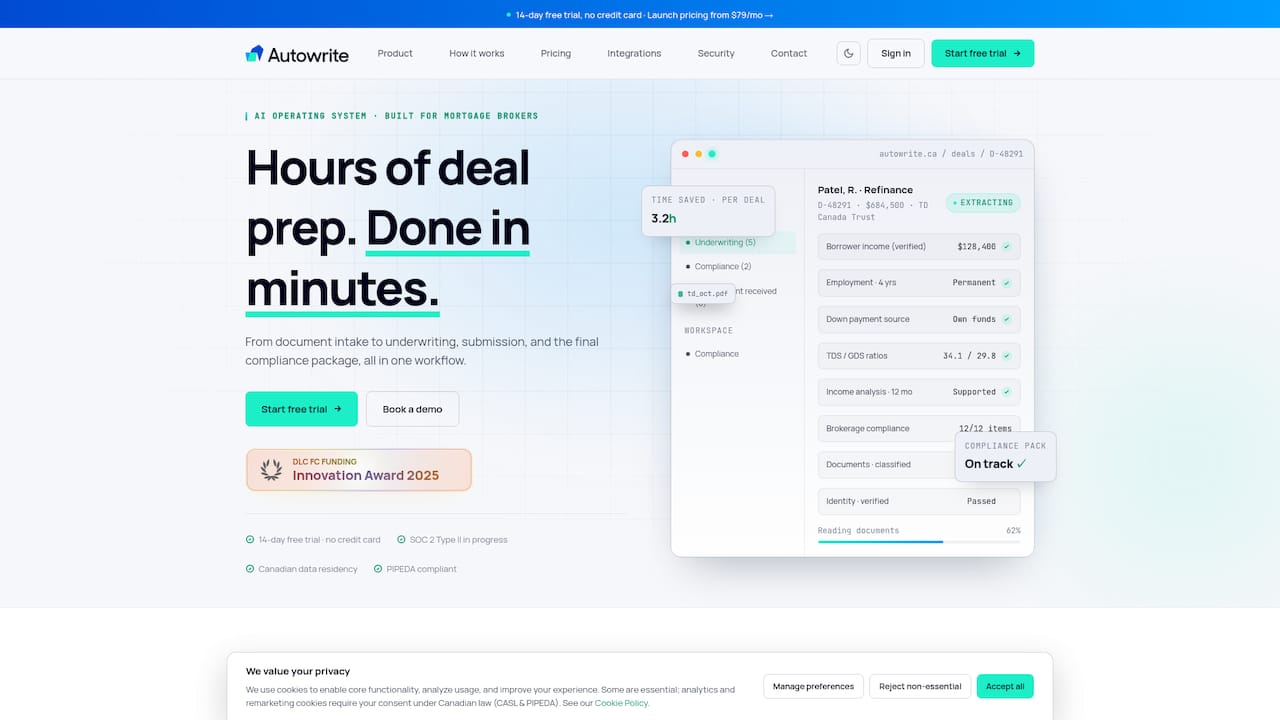
We built Autowrite around the same gaps this checklist covers: document classification, data extraction, and audit-package assembly happen automatically as files come in, rather than depending on someone remembering to tag metadata later. For mortgage brokers, that means audit trails and compliance packages stay attached to the deal from intake, with data residency kept in Canada throughout.
Before onboarding any new system, confirm these three things:
- Your pilot scope covers a realistic volume of deals, not just a handful of clean test files.
- You have a clear success metric, such as time saved per file or reduction in missing-metadata flags.
- Data residency and storage location match what your compliance program requires.
Our Starter plan runs $149 per month, Pro is $269 per month, and Legend is $499 per month, each with a 14-day free trial. Explore the full feature set or start a trial to see how the workflow fits your pipeline.
This article is general information, not a substitute for advice from a qualified lawyer. Consult a qualified legal professional about your own circumstances before acting on anything here.
FAQ
What are compliance records?
Compliance records are the documents and supporting data a business must keep to prove it met legal, tax, or regulatory obligations, including contracts, transaction logs, and signed forms. They become digital compliance records when stored electronically, which adds requirements around format readability and audit trails.
What does digital compliance mean?
Digital compliance means meeting regulatory recordkeeping and reporting obligations using electronic systems instead of paper, while still satisfying the same legal standards for retention, accessibility, and evidence. It requires that electronic files remain readable and useable for the full statutory retention period.
What are some common examples of compliance documents?
Common examples include signed contracts, invoices, identity verification records, transaction logs, and audit trail metadata like access logs and signature certificates. In regulated financial sectors, records required by FINTRAC also count, such as client identification files and suspicious transaction reports.
Can you give me an example of a compliance report?
A compliance report might document a completed source-of-funds review for a mortgage transaction, showing the documents collected, verification steps taken, and the reviewer's sign-off with a timestamp. Our guide to source of funds verification walks through what that kind of report typically includes for mortgage brokers.
How long must digital compliance records be kept?
Under Canadian tax rules, businesses must retain electronic records for a minimum of six years from the end of the last tax year they relate to. Some sector-specific rules, such as FINTRAC's recordkeeping requirements, may set additional conditions on top of that baseline.
Sources
- Canada
- Record keeping requirements for financial entities — FINTRAC
- Technology and cyber risk management — OSFI