
Yes, automated document classification works well for mortgage workflows when it runs as a hybrid, auditable pipeline that pairs selective OCR, rule evidence, ML validation, and conservative human review. Done this way, it cuts manual sorting time, speeds throughput, and supports compliance. The one requirement that cannot be skipped is a human-review step with logged, auditable decisions.
TL;DR:
- The pipeline combines native text extraction, selective OCR, rule-based evidence, and AI validation to improve accuracy without excessive costs.
- All classification decisions and evidence must be logged and auditable to comply with Canadian recordkeeping and identity verification regulations.
- Manual review remains essential for uncertain or ambiguous cases, with clear thresholds to ensure safety and explainability.
- Monitoring metrics such as accuracy, review rates, and classification times helps measure system performance and guide incremental expansion.
- Starting with a conservative, layered approach reduces risks while gradually increasing automation volume based on real-world results.
Table of Contents
- What mortgage document classification has to get right
- Building a pipeline that goes from raw upload to verified document
- What automation actually changes for your KPIs
- Compliance and record-keeping you need to design around
- Rolling it out without creating a brittle mess
- Turning this into an intake checklist your team can use
- Why hybrid, explainable systems are the pragmatic path forward
- How Autowrite handles classification, intake, and compliance
- FAQ
- Sources
What mortgage document classification has to get right
A mortgage file arrives as a pile of unrelated paperwork: proof of income, bank statements, T4s and tax returns, credit reports, title and deed documents, purchase agreements, and government-issued ID, making mortgage pre-approval in Canada a process that relies heavily on gathering and documenting all these correctly. Classification means sorting every page into the right bucket, then grouping scattered pages into one coherent multi-page document rather than leaving them as loose fragments.
The harder job sits underneath the sorting: pulling keyed fields such as dates, dollar amounts, and account numbers out of each document type so underwriting systems get clean, structured inputs instead of raw scans.
Real-world uploads make this messy. Borrowers submit multi-document PDFs that mix a pay stub with a bank statement in one file, scan pages at an angle, or photograph a document with a phone camera under bad lighting. A classification system has to handle:
- Multi-document PDFs where several file types are bundled into one upload.
- Scanned images with low resolution or uneven lighting.
- Rotated or skewed pages that break naive text extraction.
- Pages from the same document split across separate uploads.
Getting classification right at this stage determines how clean everything downstream looks, from underwriting to compliance packaging.
Building a pipeline that goes from raw upload to verified document
A workable pipeline runs through several stages, each one narrowing down what needs human attention. Native text extraction comes first: most digital PDFs contain extractable text, so pulling it directly is faster and cheaper than defaulting to optical character recognition. Selective OCR kicks in only for scanned images or pages where native extraction fails or returns garbled output, which keeps processing costs and latency down.
Next comes rule-based evidence: weighted rules that look for known headers, logos, or field patterns common to T4 slips, standard bank statement layouts, or government ID formats. These rules can confidently classify a large share of incoming documents without ever touching a model, which is both fast and explainable.
For documents that do not fit a known template, such as ambiguous layouts, unusual bank formats, or paperwork with no clear labels, machine learning or large language model validation steps in to make the call. A practical staged pipeline that combines native extraction, selective OCR, rule evidence, and optional AI validation delivers better accuracy and lower processing cost than rules-only systems.
The full sequence looks like this:
- Extract native text where the file format allows it.
- Apply OCR selectively to scanned or low-quality pages.
- Run weighted rule evidence to catch high-confidence, well-known document formats.
- Send ambiguous or label-free documents to ML or LLM validation.
- Score confidence and group contiguous pages into a single logical document.
- Route anything below a set confidence threshold, or marked as an unresolved "other" class, to a human reviewer.
Pro Tip: Keep rule evidence and ML outputs visible side by side in the review interface so a human reviewer can see why the system made its call, not just what the call was.
What automation actually changes for your KPIs
The operational payoff shows up quickly once classification stops eating analyst hours. Teams typically see fewer manual sorting hours per file, faster turnaround between intake and underwriting, and less rework from misfiled or mislabeled documents.
Downstream, cleaner classification means underwriting works from better-structured inputs, which shortens time-to-close and lets a team handle more files without adding headcount.
A hybrid pipeline that blends native extraction, selective OCR, rule evidence, and optional AI validation improves accuracy while controlling processing cost compared with rules-only systems. That efficiency gain is what turns document classification from a back-office chore into a measurable lever on capacity.
Track these to know if the system is pulling its weight:
- Classification accuracy across your core document types.
- The percentage of files routed to human review.
- Mean time to classify a complete file.
- Hours saved per file compared with manual sorting.
Compliance and record-keeping you need to design around
A classification system that ignores record-keeping obligations will create problems long before it saves time. FinTRAC guidance sets out specific obligations for mortgage brokers, lenders, and administrators, including maintaining mortgage loan records and information records whenever a loan is arranged. Whatever pipeline you build has to produce records that satisfy these requirements, not just sorted folders.

Identity verification is part of the same picture. Mortgage administrators, brokers, and lenders face specific triggers for when client identity must be verified, and an automated intake system needs to document that verification happened and how, not simply assume it did.
On the technology side, the federal Directive on automated decision-making requires documentation of system logic and safeguards for automated systems whose outputs affect clients. Applied to mortgage document processing. That means:
- Logging every classification decision and the evidence behind it.
- Keeping mortgage loan and information records as FinTRAC specifies.
- Documenting identity-verification steps tied to each file.
- Maintaining clear, auditable records of how the automated logic reached its conclusion.
None of this is optional if the system's output feeds into decisions that affect a borrower's file.
Rolling it out without creating a brittle mess
The teams that get the most out of automated classification start conservative and expand carefully. Begin with a tiered pipeline, measure what the rules and ML catch confidently, and only widen automation scope once accuracy holds steady at the edges, not just in the easy cases.
Keep rule evidence paired with ML outputs throughout rather than retiring the rules once a model is in place. That pairing is what makes the system explainable during an audit instead of a black box.
A few practices separate systems that hold up from ones that quietly degrade:
- Log every human correction, not just the final classification, so the correction itself becomes training signal.
- Build a retraining loop that feeds those corrections back into the model on a regular cadence.
- Monitor for drift as document formats change, lenders update their statement layouts, or new government ID formats appear.
- Set confidence thresholds conservatively and route anything uncertain, or anything landing in an unresolved "other" category, to a person.
Pro Tip: Treat every "other" classification as a signal, not noise. Patterns in what the system can't confidently categorize usually point to a document type you haven't trained for yet.
Industry writeups on mortgage document processing note that brittle, rules-only automation breaks down as document variability increases, which is exactly why the hybrid approach above holds up better at scale.
Turning this into an intake checklist your team can use
Translating a pipeline into daily practice starts with a clear intake structure. A Mortgage Document Checklist and Intake Workflow gives a practical starting point for organizing what comes in, what fields need extracting, and where a document sits in the underwriting sequence.
Automation shortens the gap between intake and underwriting by sorting and extracting data the moment a file lands, instead of waiting for someone to open each PDF. Human review slots in at the points the pipeline flags: low-confidence classifications, unfamiliar formats, or files where rule evidence and model output disagree.
A workable intake routine typically includes:
- A checklist of required document types for each file.
- Defined extraction fields for each document class.
- Clear criteria for what triggers human review versus automatic processing.
- A logged record of every correction made during review.
Why hybrid, explainable systems are the pragmatic path forward
The pitch for fully automated document classification oversells what any single model can reliably do across the range of formats a mortgage file produces. Hybrid systems that pair rules, ML, and conservative routing scale better precisely because they fail safely: uncertain cases go to a person instead of a wrong answer going to underwriting. Pair that with documented decision logic and data controls that satisfy Canadian recordkeeping obligations, and pilot on real production files before expanding scope.
— Anant Bawa
How Autowrite handles classification, intake, and compliance
We built Autowrite as an AI-powered operating system for mortgage brokers that automates document intake, classification, and data extraction, then carries that structured data into underwriting forms and compliance packaging.
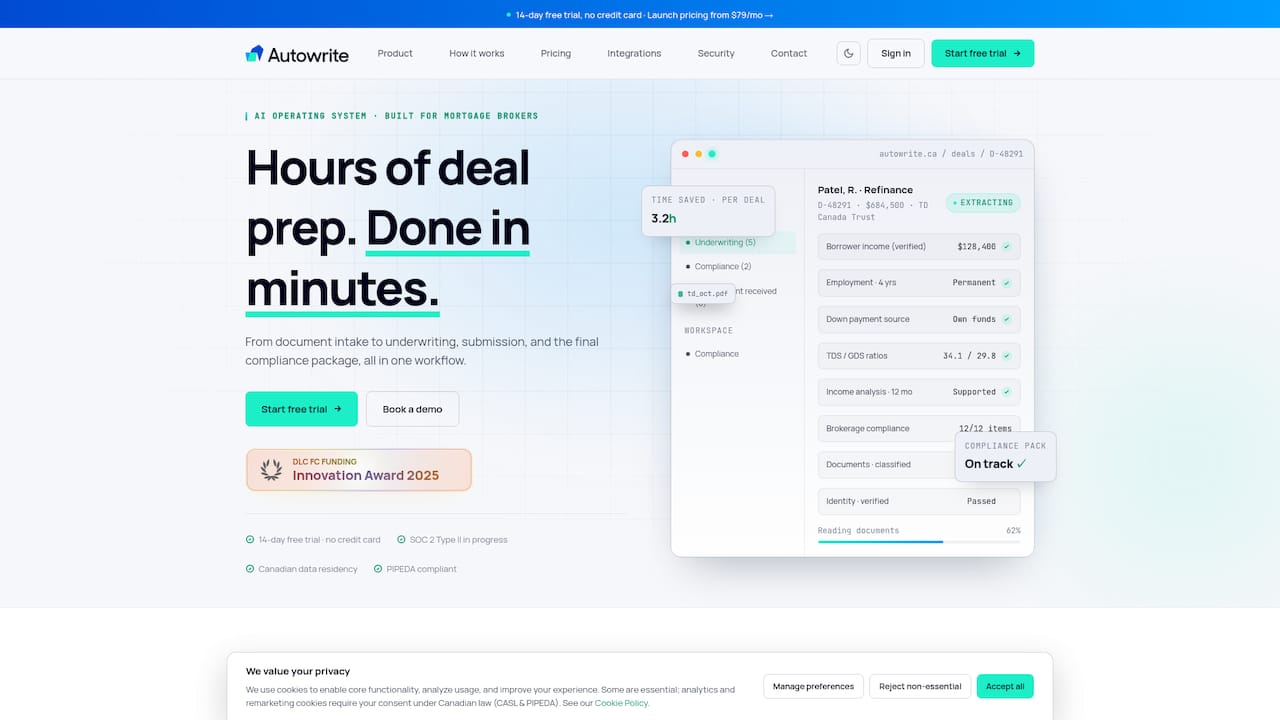
When you evaluate any classification tool, check for Canadian data residency, audit logs tied to every classification decision, confidence-based routing to human reviewers, integration with the loan origination systems you already use, and clear record-retention policies. Such tools should offer document intelligence with line-level confidence scoring on every extracted field. Plans start at Starter for $149 per month, with Pro and Legend tiers available as your deal volume grows, and a 14-day free trial if you want to test it against your own files first.
This article is general information, not a substitute for advice from a qualified financial advisor. Consult a qualified financial professional about your own circumstances before acting on anything here.
FAQ
What is indexing in a mortgage?
Indexing in a mortgage context refers to sorting and tagging documents by type and loan file so they can be retrieved and processed in the correct sequence. In an automated pipeline, indexing happens as part of classification, where each page gets grouped into its parent document and tied to the right borrower file.
What happens if I pay an extra $200 a month on my 30-year mortgage?
Extra principal payments reduce the loan balance faster, which shortens the total repayment term and lowers the total interest paid over the life of the loan. The exact savings depend on your interest rate, remaining balance, and loan terms, so check with your lender or a mortgage calculator for numbers specific to your file.
What are the stages of a mortgage?
A mortgage typically moves through application, document intake, underwriting, approval, and closing, with each stage depending on accurate and complete paperwork from the one before it. Document classification and extraction speed up the intake and underwriting stages specifically, since clean, sorted data reduces back-and-forth requests for missing information.
What type of account is a mortgage?
A mortgage is a secured loan, not a deposit or transaction account, where the property itself serves as collateral for the lender. It appears on a borrower's records as a long-term liability rather than as a bank account type.
Sources
- Record keeping requirements for mortgage administrators, brokers and lenders
- seungchan1122/mk-document-classifier - Docker Hub
- Mortgage Document Processing at Scale