
If you arrange mortgage-secured loans in Canada, FINTRAC compliance comes down to five program elements, identity checks done at the right moment, a complete record for every client, and the right reports filed when they apply. Most of the work is paperwork, and that is where brokerages slip. This checklist walks through each obligation in order and shows where the file usually goes wrong, so you can build a routine that holds up in a review.
TL;DR
- Mortgage brokers, administrators and lenders (other than financial entities) have been subject to the Proceeds of Crime (Money Laundering) and Terrorist Financing Act (PCMLTFA) since October 11, 2024.
- A compliant program has five parts: a compliance officer, written policies, a documented risk assessment, a training program, and a two-year effectiveness review.
- Every client needs an information record, and identity must be verified at the moments FINTRAC specifies.
- You stay responsible for your own program, records and reports even when a lender also has obligations on the same file.
- The most reliable way to stay on top of it is a repeatable file routine, where document intake and compliance packages are assembled the same way every time.
Table of Contents
- Who FINTRAC's mortgage rules apply to
- The five-part compliance program checklist
- Know when a business relationship starts
- Client identification: the checklist
- Records: what every file needs
- Reporting: what you may have to file
- A one-page FINTRAC checklist you can adapt
- Where the paperwork breaks down
- How Autowrite fits the routine
- Our view on FINTRAC and the broker's desk
- FAQ
- Sources
Who FINTRAC's mortgage rules apply to
FINTRAC is the Financial Transactions and Reports Analysis Centre of Canada, the federal agency that supervises anti-money laundering and anti-terrorist financing rules. Its mortgage sector guidance applies the Act and its Regulations to three groups: mortgage administrators who service mortgage agreements, mortgage brokers authorized under provincial law to intermediate mortgage-secured loans, and mortgage lenders other than financial entities.
The same page confirms that these businesses became subject to the PCMLTFA on October 11, 2024. If you work as a licensed broker or agent in Ontario, British Columbia, Alberta or Quebec, the federal rules sit on top of your provincial licensing requirements. They do not replace them, and the provincial regulator's rules continue to apply on every file.
One point trips people up. If your brokerage is the reporting entity, the obligations belong to the brokerage as a business, and agents working under it must follow the program. FINTRAC's mortgage-sector training video says the program must be in writing and followed by employees and agents, and that its size and complexity should fit your business model. A two-person shop and a 200-agent brokerage need different programs, but both need one.

The five-part compliance program checklist
FINTRAC's compliance program requirements set out five elements. Use this as your master checklist.
1. A designated compliance officer
Someone must be named as responsible for the program. At a small brokerage that is often the owner. Write the appointment down, with the date and the person's name, and keep it where an examiner can find it.
Where it goes wrong: the name on the policy belongs to someone who left the firm two years ago. Review the appointment whenever your team changes.
2. Written, current policies and procedures
FINTRAC says your policies and procedures should cover:
- client identity verification
- politically exposed persons (PEPs), heads of international organizations (HIOs), and their family members and close associates
- beneficial ownership
- third-party determination
- business relationships and ongoing monitoring
- recordkeeping
- reporting
- travel-rule requirements, where they apply
The word that matters is current. A policy copied from a template and never adjusted to how your agents actually work is a common gap. Walk through one real file from first call to funding and check that your written procedure describes what happened.
3. A documented risk assessment
You must assess and document the risk that your business could be used for money laundering or terrorist financing. In practice that means looking at your clients, the products and services you offer, how clients reach you (in person, by video, through a referral partner), and where you operate. Record the conclusion and the reasoning, not only the rating.
4. An ongoing training program
The guidance calls for a written training program and plan, and for training to be delivered. Keep a log: who was trained, on what, and when. A plan with no attendance record fails the "delivered" half of the requirement.
5. A two-year effectiveness review
You need a documented plan for reviewing the program, and a review carried out at least every two years. The review tests whether your policies, risk assessment and training actually work. Put the next review date in a calendar the day you finish the current one.
Know when a business relationship starts
FINTRAC's business relationship guidance lists the mortgage activities that can create a relationship: processing mortgage payments, negotiating and arranging mortgage loans, funding mortgage loans, and mortgage renewals. It adds that the relationship begins the first time you are required to verify a client's identity.
This matters because ongoing monitoring flows from it. Once a relationship exists, you record its purpose and intended nature, and you keep monitoring it. A renewal is the example FINTRAC gives for the purpose and intended nature of the relationship, so a client you arranged a mortgage for last year and see again at renewal is not a fresh start with a blank file.
Client identification: the checklist
FINTRAC's guidance on when to verify the identity of persons and entities for mortgage entities sets the timing. Two triggers are worth building into your intake:
- Funds received, in any amount: verify the individual at the time of the transaction. For an entity that funds are received from, or on whose behalf they are received, verification is due within 30 days.
- Suspicious transactions: take reasonable measures to verify each person or entity, regardless of amount, before you submit a suspicious transaction report (STR). The exceptions are when you have already verified them and have no doubts, or when verifying would alert them to your suspicion.
For the methods you can use to confirm identity, see our guide to five client ID methods Canadian brokers must use. For a wider view of know-your-client duties, our KYC guide for mortgage brokers in Canada covers the file as a whole.
Beneficial ownership for entities
When your client is a corporation or other entity, for example a numbered company buying a rental property, you must obtain its beneficial ownership information and take reasonable measures to confirm it is accurate. FINTRAC's mortgage sector page defines beneficial owners as individuals who directly or indirectly own or control 25% or more of the shares or units, along with specified parties to a trust.
Worked example: a client buys through a holding company with three shareholders at 40%, 35% and 25%. All three reach the 25% line, so all three belong in the ownership record. A common slip is to list only the person sitting across the desk.

Records: what every file needs
FINTRAC's recordkeeping guidance for mortgage administrators, brokers and lenders says a broker must keep an information record for each person or entity for which it arranges a mortgage-secured loan. In a transaction with several clients, each one needs a record.
Content depends on who the client is:
| Client type | What the information record must include |
|---|---|
| Individual | Name, address, date of birth, occupation, and for a sole proprietor the nature of the principal business |
| Entity | Name, address, nature of principal business |
The usual failure is a joint application where the co-borrower's occupation or date of birth sits only in an application form and never reaches a record that can be produced quickly. Keep the records retrievable, not buried across email threads and shared drives.
Retention is where federal and provincial rules meet. Our article comparing FINTRAC and FSRA retention periods on mortgage files lays out how to reconcile them, and you should confirm the period that applies to you with your provincial regulator.
Reporting: what you may have to file
The mortgage sector guidance says administrators, brokers and lenders must submit, when applicable:
- suspicious transaction reports
- listed person or entity property reports
- large cash transaction reports
- large virtual currency transaction reports
Build a short decision step into your file review for each. Our guides cover suspicious transaction reports for mortgage brokers and large cash reporting in more depth. Reports are filed with FINTRAC itself. That step belongs to the regulator's own reporting system, and it is part of your process, not something software replaces.
You are responsible for your own role
FINTRAC's training video explains that a broker remains responsible for its own program, reporting and records even when it submits an application to a lender. Each participant has separate obligations based on its own role. Never assume that because the lender will verify the borrower again, your own verification and record can be thin.
A one-page FINTRAC checklist you can adapt
Use this as a quarterly review. Tick each line against a real file, not against your memory.
Program
- Compliance officer named and appointment documented
- Policies and procedures written, current, and matched to how your team works
- Risk assessment documented and reviewed after any change in services or client types
- Training plan written, sessions delivered and logged
- Effectiveness review scheduled, at least every two years
Per file
- Client identity verified at the right time, method noted
- Entity clients: beneficial ownership obtained and accuracy confirmed
- Information record complete for every client on the file
- Business relationship purpose and intended nature noted
- Suspicious activity, listed person or entity, large cash and virtual currency reporting considered and the decision recorded
- Third-party determination addressed where relevant
Housekeeping
- Records retrievable without searching inboxes
- Retention period checked against your provincial regulator's rule
For a deeper look at how a compliance package is put together, see our FINTRAC checklist and compliance package guide and the broader piece on anti-money laundering mortgage compliance.
Where the paperwork breaks down
The rules above are not complicated on their own. The pain comes from volume. A single file can carry ID, income documents, entity papers, bank statements and signed forms, arriving as photos, scans and forwarded emails. Each needs to be identified, read, filed and matched to the right client record.
Three patterns cause most gaps:
- Documents arrive unsorted. Someone must work out what each page is before anything can be recorded.
- Data is retyped. The same name, address and occupation are keyed into the application, the record and the compliance file, and each retype is a chance for a mismatch.
- The package is assembled at the end. When the compliance file is built after funding, missing items surface when the client is already gone.
A routine that classifies documents the moment they arrive, extracts the data once, and assembles the compliance package alongside the application removes all three. For a wider look at audit readiness, read our piece on passing FINTRAC audits with compliance automation.
How Autowrite fits the routine
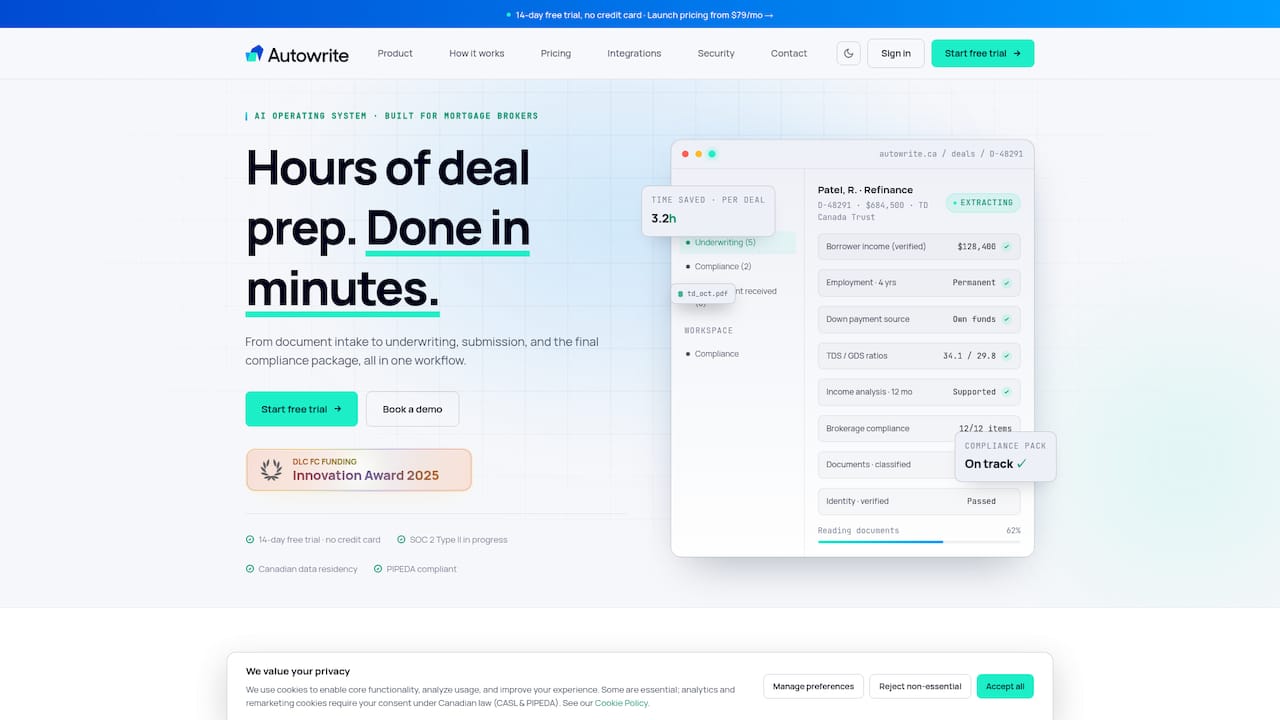
Autowrite is an AI-powered operating system built for Canadian mortgage brokers. It automates document intake, classification and data extraction, auto-fills underwriting forms, syncs with mortgage software, and assembles e-sign and compliance packages. Its document intelligence gives line-level confidence on extracted data, so you can see how sure the extraction is for each line. Canadian data residency is part of the platform.
In terms of this checklist, that means the per-file steps (documents sorted, data pulled once, compliance package assembled with the file) are handled in one place rather than across inboxes and spreadsheets. Your compliance officer, your risk assessment and your reporting decisions stay with you, where the law puts them.
Plans are billed monthly or annually, and every paid plan starts with a 14-day free trial:
| Plan | Price |
|---|---|
| Starter | $99 per month |
| Pro | $199 per month |
| Legend | $399 per month |
| Enterprise | No published price |
An additional deal costs a one-off $20, and pay as you go is a one-off $35. Full details are on the Autowrite site, where you can start the trial.
Our view on FINTRAC and the broker's desk
Since October 2024, compliance has become part of every mortgage file, not a separate project that happens once a year. The brokers we hear from are not struggling to understand what FINTRAC wants. They are struggling to produce it consistently when the file is moving fast.
That is why we built Autowrite as one platform for the whole workflow, from document intake to underwriting and compliance. When classification, extraction and compliance package assembly happen as the documents arrive, the checklist stops being a scramble and becomes a by-product of doing the deal.
Canadian brokers also need their data to stay in Canada and their tools to work with the systems they already use. We designed Autowrite around both, so that an owner can ask for a file and find it complete.
Anant Bawa
FAQ
What are the five FINTRAC obligations for a mortgage brokerage?
They are the five compliance program elements: a designated compliance officer, written and current policies and procedures, a documented risk assessment, a written training program with training delivered, and a documented plan for reviewing the program's effectiveness. The review itself must happen at least every two years, according to FINTRAC's compliance program requirements.
Does the lender's verification replace the broker's?
No. FINTRAC's mortgage-sector video explains that a broker stays responsible for its own program, reporting and records even when it submits an application to a lender. Each party has separate obligations based on its own role, so your own client verification and records must be complete.
What must a client information record contain?
For an individual: name, address, date of birth and occupation, plus the nature of the principal business for a sole proprietor. For an entity: name, address and the nature of its principal business. Every client on a multi-client transaction needs their own record, per FINTRAC's recordkeeping guidance.
When does the FINTRAC business relationship begin?
It begins the first time you are required to verify a client's identity. Activities such as negotiating and arranging a mortgage loan, funding it, processing payments or handling a renewal can create it, as FINTRAC's business relationship guidance explains. Once it exists, you keep monitoring it and record its purpose.
Sources
- Mortgage administrators, brokers and lenders, FINTRAC
- Compliance program requirements, FINTRAC
- Video: Mortgage Sector, Compliance program requirements, FINTRAC
- Business relationship requirements, FINTRAC
- When to verify the identity of persons and entities, mortgage sector, FINTRAC
- Record keeping requirements for mortgage administrators, brokers and lenders, FINTRAC