
Automation, when built for Canadian rules, produces audit-ready records, automated KYC triggers, and defensible exception workflows that satisfy FINTRAC, OSFI, and provincial supervisors like FSRA. It shortens the distance between a document landing in your inbox and a file that passes review, and it does that through SOC 2 backed infrastructure and version-controlled rules. What it cannot do is replace your compliance officer's judgment, sign off on your risk assessment, or make the effectiveness review disappear.
TL;DR:
- Automated recordkeeping must be able to produce a complete, exportable file within 30 days, including detailed evidence of underwriting decisions and rule changes.
- Software should support version-controlled workflows, a change log for rules, and attestations that a compliance officer can sign without uncertainty about recent modifications.
- Vendors must demonstrate SOC 2 Type II controls, data residency in Canada, and encryption standards, along with the ability to test data exports immediately before signing.
- Automation should be used to route files and flag exceptions for human review, not to replace human judgment or final approvals in underwriting decisions.
- Start automation with a small pilot focused on document intake and compliance package assembly, then expand based on measurable metrics like exception rates and turnaround times.
Table of Contents
- What Do FINTRAC, OSFI, and Provincial Regulators Expect From Mortgage Firms?
- How Does Automation Map to FINTRAC's Five Program Elements?
- Security, Data Residency, and Vendor Trust Signals to Demand
- Human-in-the-Loop Design and AI Governance That Holds Up
- Which Automation Features Actually Move Compliance Forward?
- What Should a Vendor Evaluation Checklist Include?
- How Should Brokerages Roll Out Compliance Automation?
- Why This Matters: A Practitioner's View on Compliance Automation
- Common Mistakes Brokerages Make When Automating Compliance
- How Autowrite Fits Into a Canadian Compliance Stack
- Where to Verify Canadian Mortgage Compliance Requirements
- Sources
- FAQ
What Do FINTRAC, OSFI, and Provincial Regulators Expect From Mortgage Firms?
FINTRAC treats mortgage administrators, brokers, and lenders as reporting entities under the Proceeds of Crime (Money Laundering) and Terrorist Financing Act. Guidance effective October 11, 2024 requires these firms to run a full compliance program, not just keep a file of forms. That program rests on five pillars: a designated compliance officer, written policies and procedures, a documented risk assessment, staff and agent training, and a review of program effectiveness at least every two years.
None of that is optional, and none of it is satisfied by software alone. What software can do is make each pillar operational instead of theoretical.
Recordkeeping is where automation earns its keep fastest. FINTRAC expects records to be producible within 30 days, and it accepts electronic records as long as they can be exported into a paper-ready format on demand. A platform that stores documents as scanned images with no searchable index technically has records. It just cannot find them fast enough when an examiner calls.
OSFI enters the picture through Guideline B-20, which governs prudent underwriting for federally regulated lenders. B-20 does not dictate software, but it does expect consistent credit risk management and internal controls proportional to a lender's operations. Automated affordability calculations and qualifying-rate logic fall squarely under that expectation. If your underwriting rules change when a stress test threshold moves, the old version and the new version both need a paper trail showing who approved the change and when it took effect.
FSRA, meanwhile, supervises Ontario's mortgage brokerages and administrators directly, and its 2025-26 supervision plan flags a specific worry: brokerages that have grown fast without scaling their compliance controls to match. That is a governance problem as much as a paperwork problem, and it is exactly the gap automation is supposed to close, not widen.
Put together, a defensible automated system needs to produce:
-
A searchable, exportable record set that meets the 30-day producibility standard
-
Evidence tying every underwriting exception to a documented human decision
-
A version history for any rule that affects affordability, risk scoring, or approval logic
-
Attestations a compliance officer can sign without guessing what changed since last quarter
Miss any one of those, and the software is a convenience tool, not a compliance tool.
How Does Automation Map to FINTRAC's Five Program Elements?
Break FINTRAC's program requirements down one at a time, and the fit between each element and what software can actually deliver gets a lot clearer.
- Compliance officer oversight. The officer still runs the program. Software's job is to hand that person a dashboard showing pending exceptions, overdue training, and open risk flags, so the effectiveness review becomes a matter of pulling evidence rather than reconstructing a year of activity from memory.
- Written policies and procedures. A policy document that sits in a shared drive and never gets checked against actual behavior is a liability, not a control. Enforceable, version-controlled workflows turn the policy into the software's actual behavior, so a change to the identity-verification rule shows up in both the procedure manual and the system logs on the same day.
- Risk assessment. Automated risk scoring should feed directly into know-your-customer and enhanced due diligence triggers, flagging files that need a closer look before they move forward, not after.
- Training. FINTRAC expects training records, not just training sessions. Systems that log who completed what training, and when, turn an annual scramble into a query.
- Effectiveness review. This is the two-year checkpoint FINTRAC requires, and it is also the point where automation pays off most. A platform that can pull a random sample of files, show the identity checks performed, and produce the exception log for each one turns a multi-week audit prep exercise into an afternoon.
Pro Tip: Run a mock effectiveness review on a random sample of ten closed files every quarter, not just every two years. If your software cannot reconstruct the identity verification trail for any one of them in under ten minutes, you have found the gap before FINTRAC does.
The common failure mode here is treating automation as a replacement for the officer's sign-off rather than an input to it. Software should shorten the distance between "something happened" and "here is the evidence," never remove the human decision at the end of that chain.
Security, Data Residency, and Vendor Trust Signals to Demand
A mortgage file contains Social Insurance Numbers, bank statements, credit reports, and identity documents. Any vendor handling that data needs to prove its controls before you hand over a single client file, not after.
SOC 2 Type II attestation is the baseline ask. Unlike a Type I report, which checks whether controls exist on a single date, a Type II report tests whether those controls actually operated correctly over a period of months. Ask for the report directly, and read the exceptions section, not just the cover letter.
Canadian data residency matters both for privacy law and for straightforward operational sense: it is far easier to satisfy a FINTRAC or FSRA inquiry when your data never left the country to begin with. Provincial and MBRCC cybersecurity guidance pushes vendors to be explicit about where data lives and who touches it, including subprocessors and third-party integrations. Get that list in writing as part of the contract, not as a verbal assurance during the sales call.
Beyond residency, the checklist should cover:
- Encryption at rest and in transit, not just one or the other
- Access logging that records who viewed or edited a client file and when
- A documented incident response plan with defined notification timelines
- Backup and disaster recovery testing, not just a backup schedule that exists on paper
None of this is theoretical. A vendor that cannot produce a SOC 2 report, an encryption summary, and a subprocessor list within a week of being asked is telling you something about how the rest of the relationship will go.
The most useful validation step costs nothing extra: before signing, request an export test on a sample historical file, including identity evidence, decision rationale, and every approval in the chain. If the export takes longer than the 30 days FINTRAC allows for producibility, that is your answer.
Human-in-the-Loop Design and AI Governance That Holds Up
The single most common mistake in mortgage automation is treating a confidence score as an approval. It is not one. A confidence score is a routing signal, telling the system how sure it is about an extracted number or classified document, nothing more.

Treating either number as a final decision, rather than a trigger for a workflow, is how errors compound quietly across hundreds of files before anyone notices the pattern.
A workable governance model has a few consistent features:
- Defined confidence thresholds that route files to human review, with the thresholds themselves version-controlled and periodically re-tested
- A permanent log of every override, including who made it and what the original automated output said
- Rollback capability for any rule change, so a bad update to an affordability calculation can be reversed without a manual data-cleanup project
- Documented test cases that prove a rule behaves as expected before it goes live, not just after a client complains
Pro Tip: Keep a running log of every human override of an automated decision, even the ones that seem trivial. If overrides cluster around one document type or one lender's forms, that pattern is worth investigating long before it becomes an exception FSRA asks about.
FSRA's supervision plan makes a specific point of examining whether large, fast-growing brokerages have kept their governance controls in step with their growth. A rule change log with effective dates, owner approvals, and rollback history is the exact artifact that answers a regulator's question about how AI and automation get managed internally. Build that log from day one, because reconstructing it after the fact from scattered emails and spreadsheet versions is close to impossible.
Which Automation Features Actually Move Compliance Forward?
Not every feature marketed as "compliance automation" earns the label. Here is what actually does, ranked by the frequency with which brokerages report friction in each area.
- Document intake and classification. Sorting a mixed upload of pay stubs, T4s, bank statements, and identification into the correct categories, with a confidence score attached to each classification and a flag for anything missing from the file, is the entry point most brokerages need first. This is the foundation of document automation that everything else builds on.
- Automated KYC and AML triggers. Identity verification tied directly to the creation of a required record, rather than a fixed annual reminder, matches how FINTRAC actually structures the requirement. Bank-statement analytics that flag unusual deposit patterns feed the same risk-scoring engine.
- Prefilled underwriting fields with version-controlled affordability logic. When a qualifying-rate rule changes, the old calculation method and the new one both need to be traceable, with a clear cutover date, which is exactly what lender submission checklists are built to track.
- Exception queues that route, not bury. A file that fails an automated check should land in front of a specific reviewer with the reason attached, not disappear into a general inbox where it sits until someone notices it is late.
- Pipeline dashboards and audit-package exports. These support two very different regulator conversations at once: an FSRA question about how a large brokerage supervises its team, and a FINTRAC request for evidence tied to a specific file, both of which need the same underlying data pulled two different ways.
The gift letter is a small but useful example of how granular this gets: automation that flags a missing gift letter, confirms it contains the required attestations, and routes an incomplete one back before the file moves further downstream saves more time than any single dashboard feature.
What Should a Vendor Evaluation Checklist Include?
Procurement conversations in this space tend to drift toward interface design and integration speed. Those matter, but they are not where deals fail six months in. Deals fail on the items below.
Regulatory fit. Does the vendor understand FINTRAC's mortgage-sector guidance specifically, not just generic AML terminology? Can it export a complete audit package, including identity evidence and decision history, on request? Does it store data in Canada, with subprocessors disclosed in writing?
Security and assurance. Is there a current SOC 2 Type II report available for review, not just a claim of compliance? What is the encryption standard for data at rest and in transit? Who has access to client files, and is that access logged?
Operational fit. How does the system route low-confidence extractions to a human reviewer, and what does that reviewer see? Can rules be versioned, rolled back, and tested before going live? What service-level commitments exist for support during a compliance deadline crunch?
Governance and AI behavior. Does the vendor document exactly how confidence scoring works and where the thresholds sit? Is there a change log for every rule update, with an owner attached to each change?
Commercial terms. What are the data retention and export rights after the contract ends? Is a proof-of-concept available before full commitment, and what does that scope actually cover?
| Evaluation area | What to ask for | Why it matters |
|---|---|---|
| Regulatory fit | FINTRAC-mapped audit export sample | Confirms 30-day producibility in practice |
| Security | Current SOC 2 Type II report | Verifies controls operated correctly, not just existed on paper |
| Operational fit | Rule version history and rollback demo | Shows how affordability rule changes are tracked |
| Governance | Documented confidence thresholds | Proves AI outputs route to humans, not final decisions |
| Commercial | Data export rights post-contract | Protects your records if you switch vendors later |
How Should Brokerages Roll Out Compliance Automation?
Start narrow. A pilot covering document intake, missing-item tracking, and compliance-package assembly, run against a limited set of files, tells you more in six weeks than a full rollout tells you in six months of confusion.
- Pilot. Pick one workflow, run it in parallel with your existing process, and compare outcomes file by file rather than trusting a dashboard summary.
- Validate. Run an export test on five to ten completed files. Check reviewer agreement rates between the automated flags and what a human would have caught independently. Track how much the exception rate drops once staff get comfortable with the routing logic.
- Scale. Roll out templates and training to the rest of the team only after the pilot's rule set has been version-controlled and reviewed by whoever owns compliance sign-off.
The metrics worth tracking through all three phases are concrete, not vague satisfaction scores.
| Metric | What it tells you |
|---|---|
| Exception rate | How often files need human intervention versus straight-through processing |
| Average turnaround time | Days from document intake to underwriting-ready file |
| Audit retrieval time | Minutes or hours to produce a complete file record on request |
| Time saved per file | Staff hours reclaimed compared to the manual process |
| Percentage of rules version-controlled | How much of your underwriting logic has a documented change history |
A practical guide to workflow ROI is worth reading before you set these targets, since the numbers that matter change depending on brokerage size and deal mix.
Why This Matters: A Practitioner's View on Compliance Automation
Every claim in this article traces back to a specific regulatory requirement, not a generic software feature list. That distinction matters when you are the one signing an attestation for FINTRAC or answering an FSRA supervision question.
A few things worth carrying into your own evaluation:
- Read FINTRAC's AML guidance for the mortgage sector before you talk to any vendor, so you know what you are actually testing for.
- Look at how pipeline management tools handle supervisory attestations, since that is where FSRA's governance concerns show up in daily operations.
- Ask any AI vendor, including Autowrite, to walk through exactly where human review sits in their workflow, and be skeptical of anyone who cannot answer specifically about AI for financial due diligence.
- The metrics that matter most during a pilot are the ones that expose problems fast: exception rate and audit retrieval time, not headline time-savings claims.
Teams that treat their first ninety days with a new system as a measurement exercise, rather than a rollout to celebrate, end up with better compliance postures a year later.
Common Mistakes Brokerages Make When Automating Compliance
The pattern shows up again and again: a brokerage buys software, rolls it out firm-wide in month one, and only discovers the gaps when an examiner asks a question the system cannot answer. Scaling before you have tested exports, version control, and exception routing on a small sample is the single most avoidable mistake in this space.
The second mistake is subtler. Teams start trusting confidence scores as approvals rather than routing signals, and the errors that slip through do not show up until a pattern of them lands in front of a regulator. Start small, test your exports against a real file before you need it for an audit, and require a documented human decision on anything material. Governance is not the boring part of automation. It is the part that determines whether the automation survives contact with a real examination.
— Anant Bawa
How Autowrite Fits Into a Canadian Compliance Stack
This platform is designed for Canadian mortgage brokers, with document intake, classification, and compliance-package assembly aligned to FINTRAC and FSRA expectations as described above. It runs on Canadian data residency and syncs with mortgage software, aiming to streamline data entry and package assembly.
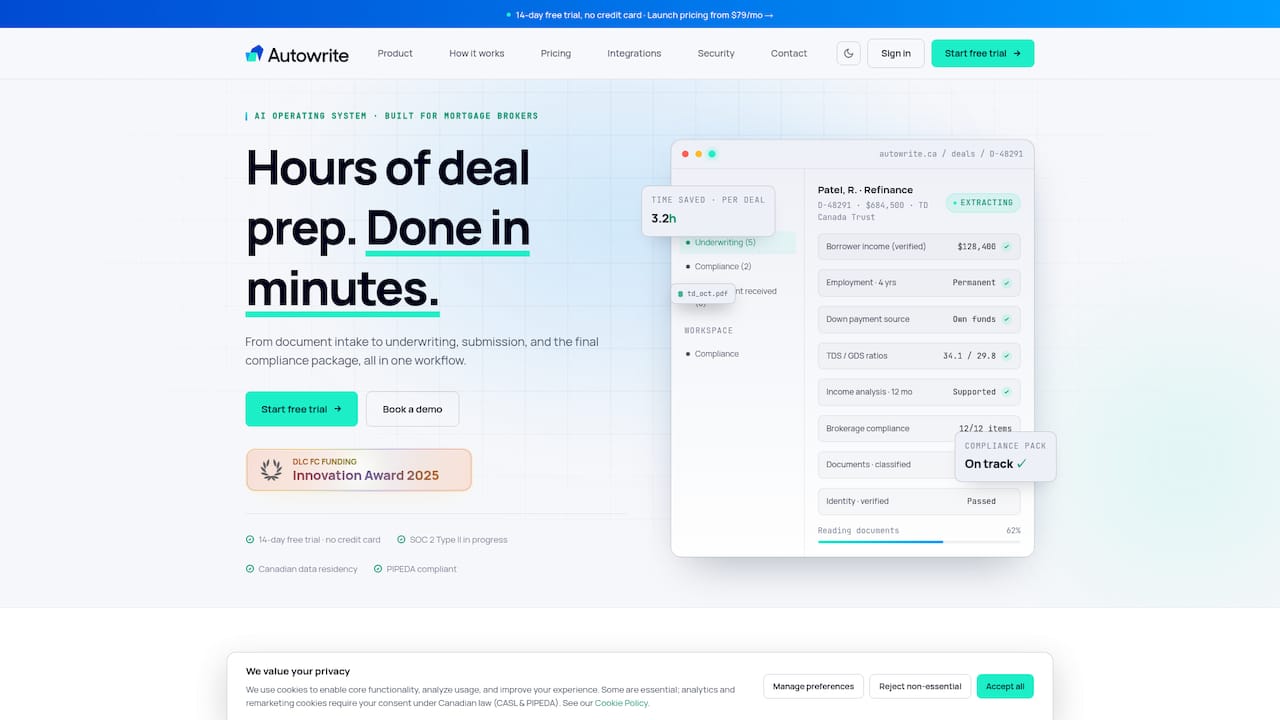
If you are evaluating options, treat a demo the same way you would treat any vendor in this checklist: ask to see document classification on a real file, ask how exception routing works when confidence is low, and ask what an audit export actually looks like. Autowrite offers a 14-day free trial across its Starter, Pro, Legend, and Enterprise plans, with an additional deal fee of $20 one-off per deal above plan limits, so you can run exactly that test on your own files before committing. Full pricing details are on the site, and you can start the trial directly from there whenever your team is ready to see how it handles a real pipeline.
Where to Verify Canadian Mortgage Compliance Requirements
Regulator guidance changes, and the sources below are worth bookmarking rather than relying on secondhand summaries, including this one.
- FINTRAC's mortgage-sector requirements, covering client identification, reporting, and program obligations
- FINTRAC recordkeeping guidance for producibility and export standards
- OSFI Guideline B-20 on prudent underwriting expectations
- FSRA's supervision plan and AIR filing guidance
- MBRCC cybersecurity principles, available through FSRA's published resources
Sources
- Mortgage administrators, brokers and lenders : FINTRAC's requirements (training video)
- FINTRAC recordkeeping guidance for the mortgage sector
- OSFI B-20 explained
- FSRA mortgage-brokering sector supervision plan 2025–26
FAQ
What Is Mortgage Compliance Automation in Canada?
It refers to software that automates document intake, identity verification triggers, recordkeeping, and audit-package preparation in ways mapped to FINTRAC, OSFI, and FSRA requirements. It is meant to support a compliance officer's work, not replace the officer's sign-off.
Does FINTRAC Require Specific Software for Mortgage Compliance?
No. FINTRAC does not mandate any particular platform, but it does require a compliance program with a compliance officer, written policies, risk assessment, training, and a two-year effectiveness review. Software has to support those five elements, not the other way around.
How Fast Must Records Be Producible Under FINTRAC Rules?
FINTRAC expects records to be producible within 30 days of a request, in a paper-ready format if they are stored electronically. Software that cannot run a fast, complete export on a historical file fails this test regardless of how polished its dashboard looks.
Can AI Confidence Scores Replace Human Review in Mortgage Underwriting?
No. A confidence score should route a file toward or away from human review, not serve as an automated final approval. OSFI's Guideline B-20 expects lender judgment and internal controls to remain part of every underwriting decision.
How Much Does Autowrite Cost for Canadian Mortgage Brokers?
Autowrite offers a Starter plan at $149 per month, Pro at $269 per month, and Legend at $499 per month, each with a 14-day free trial, plus a custom Enterprise plan. Full details, including the $20 one-off additional deal fee, are available on the Autowrite pricing page.