

Yes, Canadian brokers can automate underwriting and document workflows now, without breaking compliance rules. The realistic payoff is fewer admin hours per file, faster conditional clearance with lenders, and audit-ready record packages that satisfy FSRA and BCFSA retention rules. Tools like Autowrite are already built around those exact requirements.
TL;DR:
- Automating document workflows can significantly reduce admin hours and increase the number of files brokers can manage without risking compliance violations.
- Record retention rules in Ontario and British Columbia require electronic files to be control-held, accessible, and kept for at least six to seven years, with strict control over storage location.
- An automated pipeline involves intake, extraction, rule checks, package assembly, and exception routing, with human review remaining essential for complex judgments.
- Brokers should start automation with small, measurable pilots, focusing on high-volume, low-judgment tasks, and continuously track metrics like turnaround time and conditions cleared.
- Effective ROI depends on decreasing processing time, reducing rejections, and increasing funded deals, with training and controlled implementation key to success.
Table of Contents
- What Changes When You Automate Mortgage Underwriting
- What Are the Record Retention Rules for Mortgage Brokers?
- How Does an Automated Underwriting Pipeline Actually Work?
- How to Automate Underwriting Without Breaking Anything
- How Do You Measure ROI on Underwriting Automation?
- Where Brokers Get Automation Wrong
- Autowrite Brings Underwriting Automation to Canadian Brokers
- Sources
What Changes When You Automate Mortgage Underwriting
The gap between a broker running paper checklists and one running an automated pipeline shows up fastest in turnaround time. Instead of chasing a borrower for the third bank statement, the system flags missing pages the moment a file lands, and instead of retyping numbers into a lender template by hand, the data lands there automatically.
That matters more than usual right now. Lenders are dealing with capacity constraints and slower turnaround times, and Canadian Mortgage Professional reports that inconsistent pricing and stretched underwriting teams are becoming the norm. A clean, complete submission cuts the number of times a lender has to bounce a file back for a missing condition, which is where most of the delay actually lives.
Automation tends to move the needle on:
- Admin hours spent per file on data entry and document sorting
- Number of lender rejections or condition requests tied to incomplete paperwork
- How many files a broker can track without something slipping through the cracks
- How quickly clients get a status update instead of chasing their broker for one
Pro Tip: Track your current average "conditions cleared per week" for 30 days before automating anything. Without a baseline, you can't prove the automation actually moved the number.
What Are the Record Retention Rules for Mortgage Brokers?
Any automated system a Canadian broker adopts has to survive contact with provincial regulators, and the rules are specific rather than aspirational. FSRA requires Ontario brokerages to retain transaction-related records for at least six to seven years, and those records need to stay legible, printable, and ready for inspection on request. In British Columbia, BCFSA's bulletin MB 12-001 sets a seven-year retention window and adds a harder requirement: the broker must keep direct control over electronic records even when a third-party platform stores them, with retrieval expected within a set number of business days.
That control clause is the one brokers overlook most. Storing files in a vendor's cloud does not transfer responsibility for those files, and FINTRAC guidance reinforces that recordkeeping obligations sit with the broker, not the software.
Regulators generally accept electronic records as compliant when they are reproducible and accessible on demand. The bar is not paperless for its own sake. It's a printable, auditable package a compliance officer can pull up in minutes.
A workflow built for the Canadian market should produce that package automatically:
- Timestamped audit trails showing who touched a document and when
- Records exportable in a printable format for FSRA, BCFSA, or FinTRAC review
- Contractual guarantees that the broker, not the vendor, controls access and retrieval
- Retention timers that match provincial rules rather than a generic default
How Does an Automated Underwriting Pipeline Actually Work?
Strip away the marketing language and an automated pipeline does five concrete things in sequence:
- Intake. Documents arrive through a secure client portal, upload link, or monitored email inbox, where optical character recognition sorts pay stubs from bank statements from gift letters before a human ever opens the file.
- Extraction. The system pulls borrower names, income figures, asset balances, and liabilities directly off the source documents and populates the lender's underwriting template.
- Rule checks. Before anything reaches a lender portal, the platform flags missing signatures, expired documents, or inconsistent income figures against the deal's conditions.
- Package assembly. E-signatures get collected and the compliance package is built as a printable, audit-ready bundle rather than a folder of loose PDFs.
- Exception routing. Anything the system can't resolve with confidence, like an ambiguous self-employment income statement, gets routed to a human reviewer instead of guessed at.
That last step is not optional. Lenders themselves are using AI for document scanning and some pre-approvals, but Canadian Mortgage Trends reports that human underwriters remain the final word on complex adjudication. Any automation you adopt should mirror that split: machines handle the repeatable extraction and matching, people handle judgment calls.
Pro Tip: If your platform can't show you why it flagged a file for review, don't trust its output blindly. A black-box exception is worse than no automation at all.
How to Automate Underwriting Without Breaking Anything
Rolling out automation works better as a sequence than a switch flip. Here's the order that keeps risk low while you learn what the tool actually does with your files:
- Pick a narrow pilot. Start with one document type, like paystubs or bank statements, and define what success looks like before you touch a live file.
- Map your integrations. Confirm how the platform connects to your CRM, loan origination system, and lender portals, and whether it supports single sign on for your team.
- Assign reviewer roles. Decide who signs off on AI-extracted data before it reaches a lender, and write that step into your process, not just your head.
- Lock down data governance. Confirm Canadian data residency, access controls, and how the vendor's contract addresses the retention rules covered above.
- Set checkpoints. Review the pilot at 30, 60, and 90 days against the metrics you picked at the start, not against a vague sense that things feel faster.
Before any of that, get the basics right:
- Choose a task that occurs on close to every file, not an edge case
- Document your current baseline turnaround time before comparing after
- Train support staff to validate AI output, not just accept it
- Keep a fallback manual process for the first few pilot cycles
Brokers who skip straight to full automation without a bounded pilot tend to lose trust in the tool the first time it makes a visible mistake, even when the error rate is otherwise low. A mortgage document checklist built around your intake workflow makes the pilot scope easier to define from day one.
How Do You Measure ROI on Underwriting Automation?
The metrics that matter to a brokerage owner are the same ones lenders already judge you on, just measured internally first:
- Admin hours logged per file, before and after automation
- Average turnaround time from intake to lender submission
- Conditions cleared per week per broker or team
- Rejection or resubmission rate tied to document errors
- Funded deals closed per broker per month
A simple scenario: if a broker spends four hours per file on data entry and document chasing, and automation cuts that to one hour, a team closing 15 files a month reclaims 45 hours. That time converts directly into capacity for more files or more client conversations, and it compounds during the kind of lender bottlenecks the market is seeing now, where clean submissions move faster through an already stretched underwriting queue. Owners and principals should review these numbers monthly against the pilot targets, not just at renewal time. A practical ROI framework built around pipeline automation helps set those targets before the first invoice arrives.
Where Brokers Get Automation Wrong
The mistake I see most is treating automation as an all-or-nothing decision instead of a sequence of small, provable bets. Brokers who succeed pick one high-volume, low-judgment task first, like extracting numbers off a bank statement, and leave the nuanced conversations, like explaining a bruised credit history to an underwriter, entirely to humans.
The other failure mode is underinvesting in staff training. An extraction tool is only as good as the reviewer checking its output, and skipping that step to save time defeats the purpose. Automation should free up time for the parts of brokering that actually need a person: reading a client's situation, negotiating with a lender, catching the thing a machine has no context to notice.
— Anant Bawa
Autowrite Brings Underwriting Automation to Canadian Brokers
Some automation tools are built specifically for the paperwork side of Canadian mortgage brokering: document classification, data extraction, auto-filled underwriting forms, and compliance packages assembled with audit trails and e-signatures baked in. Instead of a generic document tool retrofitted for mortgages, these tools are designed around the retention and data residency rules FSRA and BCFSA already enforce, so what you build during a pilot is what a compliance officer expects to see later.
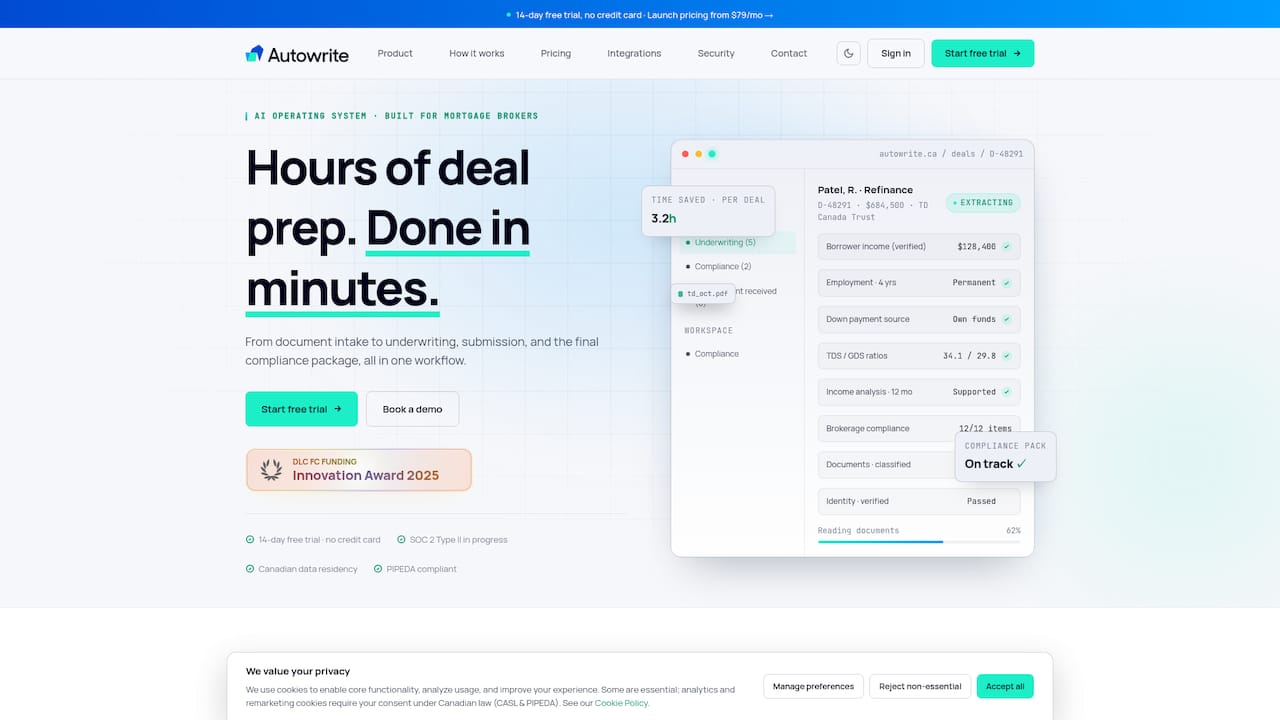
If your current process depends on a broker manually retyping figures from three different document types into a lender template, that's the exact task worth piloting first. Some tools handle that extraction and flag what's missing before submission, which pairs well with the pipeline management practices covered above. Firms weighing a broader AI adoption plan can also find useful framing in Byram Advisory Group's insights on rolling out AI tools without losing operational control.
Start with a demo of Autowrite and pick one document type to pilot for 30 days before deciding how far to expand it.
Sources
- Mortgage brokerage and administrator records management and up-front fees | Financial Services Regulatory Authority of Ontario
- MB 12-001 RECORD KEEPING REQUIREMENTS FOR MORTGAGE BROKERS
- Canadian brokers navigate pricing chaos, slow turnaround times | Canadian Mortgage Professional
- AI is coming for mortgage underwriting but underwriters aren't going anywhere, lenders say | Canadian Mortgage Trends