
If you find an error in mortgage paperwork, stop, make dated copies of the affected pages, and send written notice to your lender or servicer and the title or closing agent the same day. Gather the mortgage, deed, closing disclosure, title policy, survey, and recent payment statements before you call anyone. Most clerical mistakes get fixed within days; a wrong legal description can take much longer to correct.
TL;DR:
- Correcting clerical errors like misspelled names usually takes days, while correcting legal descriptions can require weeks or longer depending on the complexity.
- Inconsistencies in loan figures or legal descriptions can cause underwriting delays or outright application denials, especially if they reveal documentation gaps or title issues.
- Cross-checking all mortgage documents against each other and external land records minimizes errors that could delay closing or affect future refinancing.
- Automated cross-document reconciliation systems can catch errors early, reducing manual review time and preventing errors from slipping through in manual workflows.
- Conducting a sample review of recent files with automation helps identify prevalent errors, providing a basis for procedural improvements before full implementation.
Table of Contents
- What Are the Most Common Document Errors in a Mortgage File?
- How Do Mortgage Document Errors Cause Delays and Financial Harm?
- How Do You Audit a Mortgage File for Errors?
- How Do You Correct Errors Once You've Found Them?
- Can Automation Actually Prevent These Errors?
- One Procedural Change Worth Piloting Now
- Sources
- FAQ
What Are the Most Common Document Errors in a Mortgage File?
Errors in mortgage files fall into a handful of predictable buckets, and knowing which one you're looking at determines how fast it can be fixed. A misspelled name on a promissory note is a five-minute correction. A wrong legal description on a recorded deed is not.
Here's the compact catalog worth checking against your own file:
- Clerical and personal data errors: misspelled borrower names, wrong unit or apartment numbers, transposed borrower ID digits, or an incorrect Social Security number carried over from an old application.
- Missing pages, signatures, or bad scans: incomplete packets, an unsigned addendum, or a scanned closing disclosure with a page that's unreadable or cut off at the margin.
- Incorrect loan figures: wrong principal balance, mismatched interest rate between the note and disclosure, an APR that doesn't match the payment schedule, or fees that were quoted differently at closing than in the final documents.
- Property and legal description problems: wrong lot numbers, an inaccurate metes-and-bounds description, or a subdivision reference that doesn't match the county's recorded plat.
- Income and asset documentation gaps: missing tax schedules for self-employed borrowers, or gift funds deposited without a properly executed gift letter.
- Servicing and escrow errors: payments applied to the wrong loan or the wrong month, and escrow shortages calculated off outdated tax or insurance figures.
Industry monitoring of recordable documents has flagged lien releases, assignments, and modification agreements as some of the highest-frequency error categories in mortgage paperwork, which is worth knowing if you're auditing a file that involves a loan transfer or a prior modification.
How Do Mortgage Document Errors Cause Delays and Financial Harm?
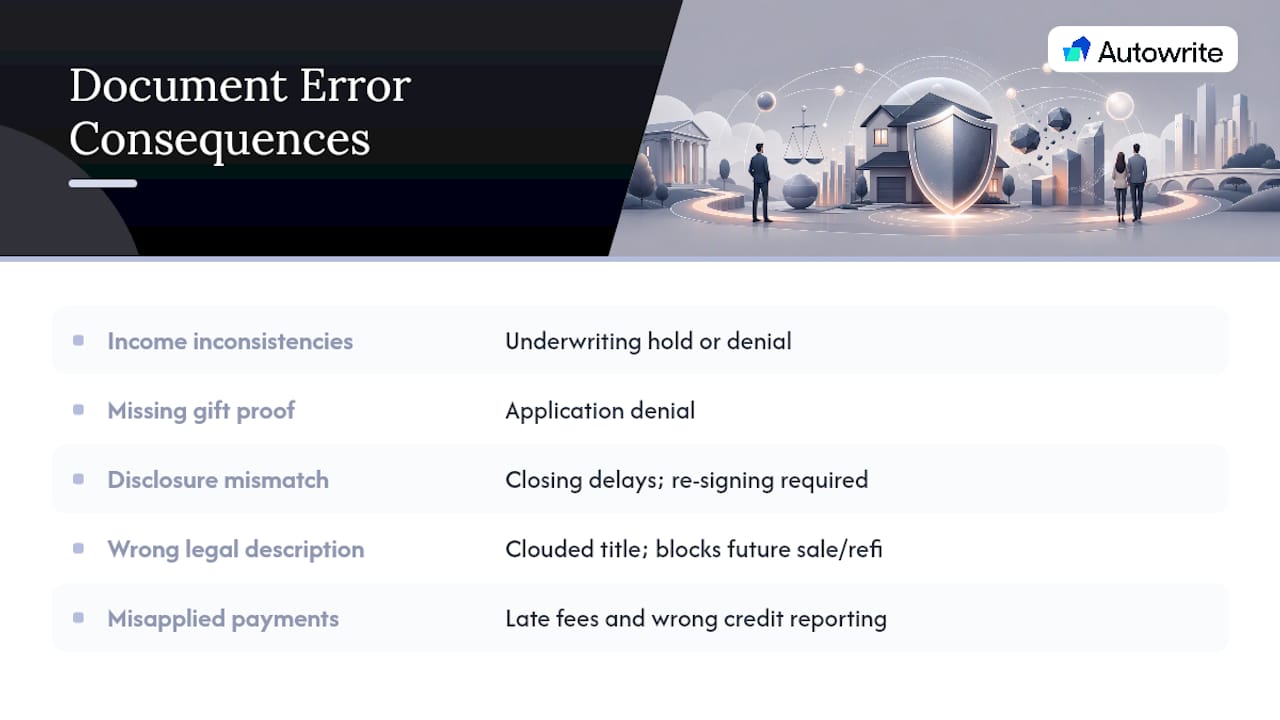
A missing income schedule or an inconsistent figure between two documents can put underwriting on hold, and in some cases it triggers a denial outright. Documentation gaps, including missing proof of gifted deposits and incomplete self-employed income files, rank among the most common reasons mortgage applications get denied.
Closing delays follow a similar pattern. If a disclosure number doesn't match the note, or a page is missing when the file reaches the closing table, everyone re-signs, and the closing date slips.
The bigger risk sits in the legal description. A wrong lot number or an inaccurate boundary reference can cloud title, which can quietly block a future refinance or sale years down the road. On the servicing side, misapplied payments can generate late fees and inaccurate credit reporting that takes months to unwind. For brokers and lenders, these same errors surface later as quality-control failures or rejected loans in investor delivery, which is a costly place to discover a typo.
How Do You Audit a Mortgage File for Errors?
A proper audit means checking every document against every other document, not just reading each one in isolation. Here's the sequence that catches what a quick skim misses:
- Pull the core documents. Locate the promissory note, mortgage or deed of trust, closing disclosure, title insurance policy, property survey, and your most recent payment statements.
- Reconcile the basics across all of them. Names, addresses, loan amounts, interest rates, payment terms, and the legal description should match word for word and number for number across every document.
- Flag every inconsistency as you find it. Don't fix mentally and move on. Write it down immediately.
- Build a dated error log. List each discrepancy with the specific page and line reference, and attach a copy or highlighted excerpt of the affected page.
- Pull the third-party records. Cross-check the recorded deed and legal description against county land records, and compare the survey to what's written in the title policy.
- Set a follow-up cadence. Servicers typically acknowledge a written error notice within about a week; recording a corrective document with the county can take anywhere from a few days to several weeks depending on the jurisdiction, so calendar a follow-up call if you haven't heard back.
Pro Tip: Keep your error log in a single running document, not scattered emails. When you escalate to a title company or attorney, a clean chronological record with page references gets you a faster response than a pile of forwarded messages.
Autowrite's own document checklist and intake workflow walks through which records to pull first and in what order, which is useful whether you're a broker running a file audit or a borrower doing this for the first time. If gift funds are part of the picture, check the gift letter requirements against what's actually in the file, since a missing or improperly worded letter is one of the more common reasons a closing gets pushed back.
How Do You Correct Errors Once You've Found Them?
Where you start depends on what kind of error you're dealing with. A typo gets fixed differently than a legal description problem, and knowing the difference saves weeks.
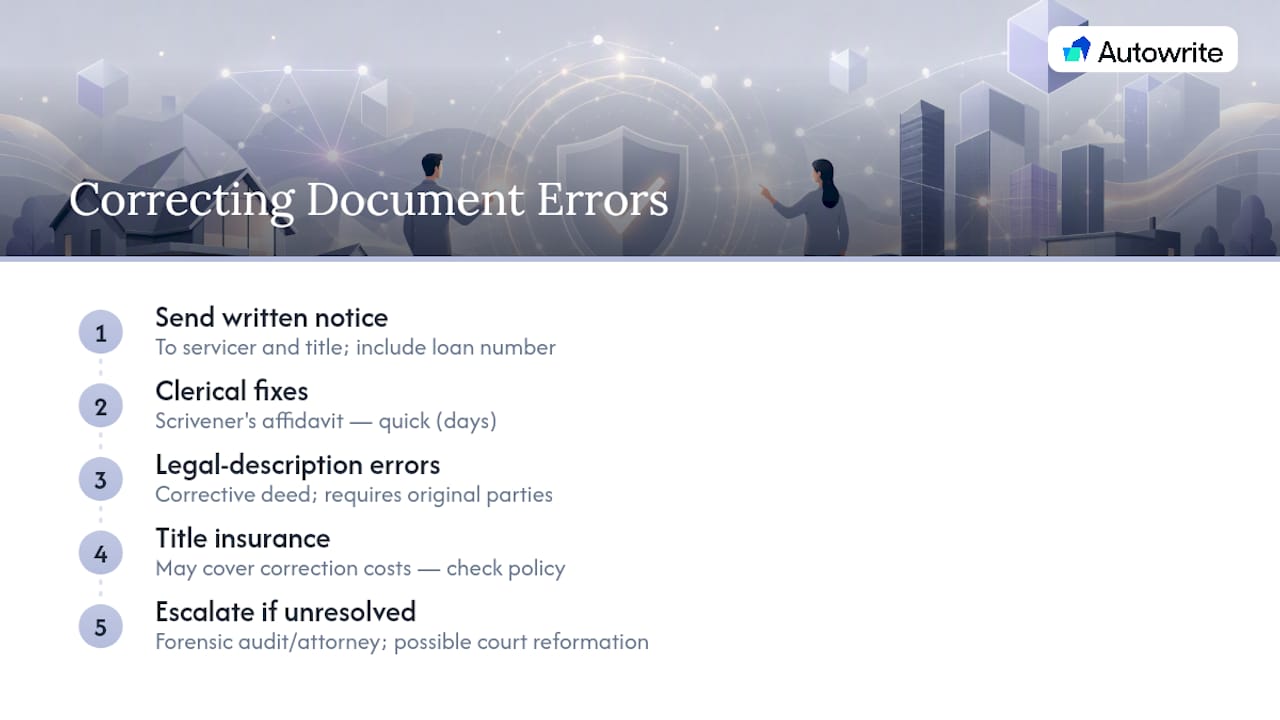
Start with written notice. Contact the servicing department directly and the title or closing agent, and put it in writing rather than relying on a phone call. Include your loan number, a description of the error, and copies of the pages showing the discrepancy. This written record matters if the issue escalates later.
Clerical fixes usually mean a scrivener's affidavit. A misspelled name or a transposed digit typically gets corrected through a short affidavit that the closing agent or a notary can prepare and record quickly, often within days.
Legal description errors need a corrective deed. This requires cooperation from the original parties to the transaction, and it can take considerably longer than a clerical fix, especially if a prior owner or lender has to sign off.
Title insurance often covers the cost. If the error originated with the closing or title agent, a title insurance claim frequently covers the correction, so check your policy before assuming you'll pay out of pocket.
Escalate when the servicer won't act. If you've sent written notice and nothing moves, the next step is often a forensic loan audit or a real estate attorney, and in the most serious title disputes, court reformation of the deed.
Can Automation Actually Prevent These Errors?
Most document errors trace back to one broken habit: checking each file in isolation instead of against everything else in the packet. A systematic reconciliation of names, addresses, loan amounts, and legal descriptions across every document in the file catches what a visual review misses almost every time.
Automated systems apply that same logic at scale, running validation at four levels: field, document, cross-document, and full process audit trail. That structure is specifically built to catch missing pages, mismatched values between documents, and outdated versions still floating around after a correction was made.
For brokerages, that means:
- Standardized intake checklists so nothing gets skipped during file setup.
- Version control that retires outdated documents instead of letting them linger next to corrected ones.
- QC sampling that flags exceptions before a file ever reaches an underwriter.
Autowrite applies this kind of cross-document automation to Canadian broker workflows, but automation still needs a human in the loop for anything touching legal description or title. Software flags the mismatch. A person still has to decide what to do about it.
One Procedural Change Worth Piloting Now
If there's one change I'd push mortgage brokerages to make this year, it's this: run automated cross-document reconciliation on a sample of files before rolling it out everywhere. Pick 20 recent closed files, run the checks, and log every exception you find against what your existing QC process caught.
That side-by-side comparison tells you something no vendor pitch will: exactly how many errors were already slipping through, and where. Autowrite's platform is built for exactly this kind of file review, and a 14-day trial is enough time to see the gap for yourself.
— Anant Bawa
Sources
For official guidance on closing-document errors, see the Consumer Financial Protection Bureau. For gift-fund documentation standards, review this partner guide on gift funds.
This article is general information, not a substitute for advice from a qualified financial advisor. Consult a qualified financial professional about your own circumstances before acting on anything here.
- 10 common reasons mortgage applications get denied and how to avoid them
- What to do about a wrong property description on a mortgage
- Common Mortgage Documentation Errors and How Automation Prevents Them
- What to Do if You Find Errors in Your Loan Documents
FAQ
What Are Red Flags on a Mortgage Application?
Mismatched income figures, undisclosed new debt, unexplained large deposits without a paper trail, and gift funds lacking a proper gift letter all raise underwriter scrutiny and can slow or stall approval.
What Would Disqualify You From a Mortgage?
Insufficient or inconsistent income documentation, especially for self-employed applicants who typically need two years of income evidence, along with new debt taken on during underwriting, are among the most common disqualifiers.
What Looks Bad on a Mortgage Application?
Inconsistent personal details across documents, unexplained gaps in employment history, and last-minute credit inquiries all look bad because they suggest the file wasn't carefully assembled or that something changed after the initial approval.
What Should You Not Tell a Mortgage Lender?
Don't downplay new debt, don't describe gift funds as your own savings, and don't guess at figures you're unsure about. Inaccurate statements create the same document inconsistencies that trigger delays and denials.
How Long Does It Take to Fix a Mortgage Document Error?
Clerical fixes through a scrivener's affidavit often record within days. Legal description corrections requiring a corrective deed or court reformation can take considerably longer since they depend on cooperation from the original signing parties.