
When brokers ask about M3 tech integration, they usually mean M3 Group's broker technology arm, M3 Tech, and its BOSS platform. Yes, it can connect with broker loan origination systems and document workflows, and the practical payoff is faster underwriting turnaround and cleaner compliance packaging. Before scoping anything, confirm the exact product version with the vendor and ask for developer documentation. That single step avoids the most common integration mistake brokers make.
TL;DR:
- M3 Tech's BOSS platform can connect with broker systems to improve underwriting speed and compliance, but product version confirmation is essential.
- Integration involves moving data through stages like document intake, data population, packaging, and status updates, often using standardized XML messages on the ION framework.
- Large projects may take several months when connecting multiple systems or legacy platforms without modern APIs, with timelines affected by data conflicts and coordination challenges.
- Security measures such as SOC 2 audits, encryption, and Canadian data residency are critical, along with identity controls like multi-factor authentication across all systems involved.
- Autowrite complements M3 integrations by automating document classification and data extraction, reducing manual work and fitting into existing broker workflows at varying price plans.
Table of Contents
- What Is M3 Tech (BOSS) and Why Do Brokers Mention It?
- How the Data Actually Moves Between Systems
- What an Integration Project Timeline Looks Like
- What Security and Compliance Proof Should You Demand?
- Questions to Bring to Every Vendor Call
- Where Autowrite Fits Alongside an M3-Style Integration
- A Broker-Technology Lead's Honest Take
- Autowrite: Built for Canadian Brokers Automating Around M3
- Where to Go Next for the Technical Details
- Sources
- FAQ
What Is M3 Tech (BOSS) and Why Do Brokers Mention It?
"M3" is not one company. There's M3 Solutions in device management, unrelated ERP vendors using the same three letters, and the M3 that runs on Infor's ION framework in manufacturing and distribution. For Canadian mortgage brokers, the relevant one is almost always M3 Group's technology division, M3 Tech, which builds the broker platform known as BOSS. Recent trade coverage has tracked CIO-led initiatives at M3 Tech aimed at expanding what BOSS can connect to.
BOSS touches several parts of a broker's daily workflow:
- A broker portal for deal submission and status tracking
- Loan packaging tools that assemble documents for lender review
- Lender connectors that push deal data to funding partners
- A pipeline dashboard showing where every file sits in the process
When people talk about M3 system integration, they mean linking these pieces to whatever document intake, e-sign, or compliance tools a brokerage already runs.
How the Data Actually Moves Between Systems
Integration isn't magic. It's a set of defined connections that move data from one system to another without a human retyping it. Infor M3 environments, which BOSS is built on, typically rely on the ION framework and Business Object Documents, standardized XML messages that let systems publish and subscribe to updates instead of polling each other constantly.
A typical broker file moves through four stages:
- Intake and extraction. Documents arrive and get classified, with key fields pulled out automatically using AI Document Extraction for Commercial Real Estate Brokers.
- Loan origination system entry. Extracted data populates the LOS record, which usually serves as the master source of truth for borrower and property details.
- Lender and compliance packaging. The system assembles the disclosure and compliance package required for submission.
- E-sign and pipeline update. Signed documents route back, and the dashboard reflects the new status automatically.
Middleware, often something like MuleSoft in Infor-style environments, handles the messy translation work between these stages: reformatting data, routing it to the right endpoint, and logging every transaction for audit purposes.
Pro Tip: Ask any integration vendor where they define the "source of truth" for borrower data before signing anything. If two systems both think they own that record, you'll spend more time reconciling conflicts than the automation ever saves you.
What an Integration Project Timeline Looks Like
M3 integration services follow a fairly predictable arc, even though every brokerage's tech stack is different. Discovery comes first: cataloging every system that needs to talk to BOSS, and confirming which fields exist where.
Design and data mapping tend to eat the most time here, since master data conflicts are the single biggest source of rework in ERP-style integrations. Skipping this step is the fastest way to end up with duplicate borrower records six months later.
From there, expect:
- A development phase building the actual connectors and transformation logic
- User acceptance testing (UAT) using real broker scenarios, not synthetic test data
- A pilot run with a small group of files before full rollout
- Go-live monitoring, with integration run logs and error alerts tracking every failed transaction
Timelines stretch when brokerages run legacy systems with no modern API, or when the number of connected touchpoints (multiple lenders, multiple e-sign tools, a separate CRM) climbs. A single-connector project might close in weeks; a full-stack rebuild touching five or six systems can run several months.
What Security and Compliance Proof Should You Demand?
Any vendor handling borrower financial data needs to answer for how it's protected, not just where it's stored. Ask for these before signing anything:
- SOC 2 attestation or equivalent third-party audit results
- Encryption details, both in transit and at rest
- Access logs showing who touched what data and when
- Confirmation of Canadian data residency for borrower records
M3DB, the metrics platform behind some Infor-adjacent monitoring stacks, exposes Prometheus metrics on port 7203 by default for operational visibility. That's a small technical detail, but it signals whether a vendor takes monitoring seriously or treats it as an afterthought.
Identity controls matter just as much. Single sign-on and multi-factor authentication should apply across every connected system, not just the primary portal, since compliance packages need an audit trail showing exactly who assembled and submitted each file.

Questions to Bring to Every Vendor Call
Before any integration kickoff meeting, get straight answers to these:
- Which specific M3 product and version are we integrating, and where's the developer documentation?
- Are data transfers real time or scheduled batch jobs, and what happens when one fails?
- What are the support SLAs, and who do we call when an integration run breaks at 6 p.m. on a Friday?
- Where exactly does borrower data reside, and does that location meet Canadian privacy requirements?
- Are there per-connector fees, and do they scale with deal volume?
A developer note on verifying the M3 platform before scoping makes the same point from a technical angle: confirm the product first, because "M3" alone tells you almost nothing about what you're connecting to.
Where Autowrite Fits Alongside an M3-Style Integration
An M3 integration handles the plumbing between systems. It doesn't necessarily solve the paperwork problem sitting upstream of all of it, the hours brokers spend classifying documents and manually keying data before anything reaches the LOS.
That's the gap Autowrite is built for. It automates document classification and line-level data extraction, assembles compliance packages, and syncs results into the loan origination system a broker already uses. In practice, that means:
- Documents get sorted and read automatically the moment they land in intake
- Extracted fields prefill underwriting forms instead of getting retyped
- Compliance packages assemble themselves alongside whatever M3-connected pipeline you're running
Pro Tip: Before assuming a gap needs custom development, check whether an automation layer like Autowrite already handles it. It often does, at a fraction of the integration cost. Confirm specific connector availability directly with your vendor, since that list changes as platforms grow. For a look at how document intake maps to broker workflows, see this mortgage document checklist and intake guide.
A Broker-Technology Lead's Honest Take
Integrations rarely fail on the technology. They fail because operations, compliance, and lender partners get looped in after the architecture is already locked. Bring them into the room during discovery, not testing. Expect the first month post launch to be adjustment, not celebration. Every integration keeps needing small fixes long after go-live.
— Anant Bawa
Autowrite: Built for Canadian Brokers Automating Around M3
If an M3 integration is the pipeline, Autowrite is what makes sure clean data actually flows into it. Instead of manually keying borrower details before they ever reach BOSS or your LOS, Autowrite classifies documents, extracts the fields, and assembles compliance packages automatically, cutting hours of prep work down to minutes.
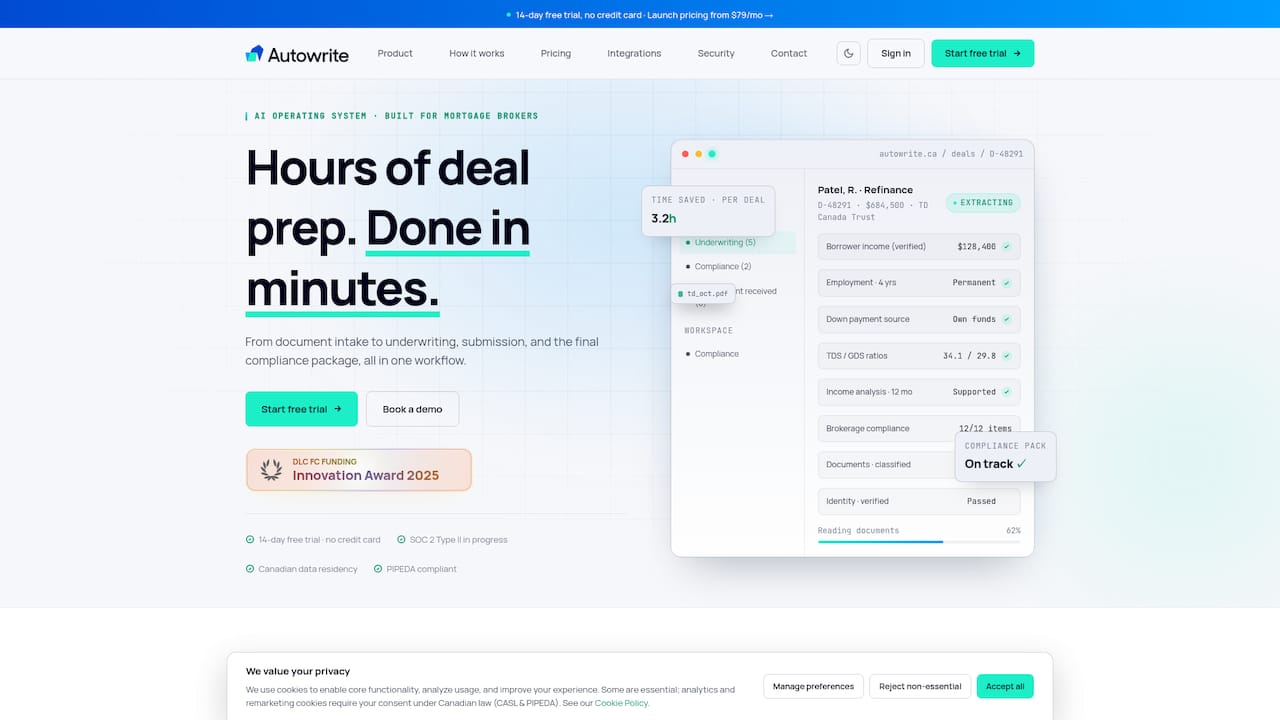
Autowrite runs on Canadian data residency and offers four plans built for how brokerages actually operate: Starter at $149 per month, Pro at $269 per month, Legend at $499 per month, and Enterprise with pricing available on request, plus a $20 fee per additional deal beyond plan limits. Every plan starts with a 14-day free trial, so you can see how it handles your actual document backlog before committing. For a deeper look at where document automation delivers the fastest return, check this guide to mortgage workflow ROI. Start your trial at Autowrite and see what a week of automated intake actually looks like.
Where to Go Next for the Technical Details
For teams scoping the work directly, these are worth opening first:
- M3 integration patterns and ION framework overview for technical architecture
- M3DB monitoring integrations for ops and alerting setup
- M3 Tech leadership and roadmap coverage for context on where the platform is headed
- Autowrite's pipeline management guide for the broker-facing side
Sources
- M3 overview and integration patterns (IntegrationWizards)
- M3db
- M3 Tech marks eight months of CIO Jerry Lo's leadership (MPA Magazine)
FAQ
Is M3 Tech Integration Available for Canadian Brokers Right Now?
Yes, M3 Tech's BOSS platform is built specifically for the Canadian broker market, and ongoing CIO-led initiatives point toward continued expansion of its connector options. Availability of specific integrations still depends on your existing systems, so confirm developer documentation directly with M3 Tech before scoping a project.
What's the Difference Between M3 Tech and Other Companies Named M3?
M3 Tech is M3 Group's technology division building the BOSS broker platform, while other "M3" names cover unrelated fields like device management or manufacturing ERP systems. Always verify the exact vendor and product version before starting integration work, since the name alone is not enough to identify the right system.
How Long Does a Typical M3 Integration Project Take?
A single-connector integration can close within a few weeks, while a full-stack project touching multiple lenders, e-sign tools, and a CRM can take several months. Legacy systems without modern APIs and a high number of connected touchpoints are the biggest factors that stretch timelines.
Does Autowrite Replace the Need for an M3 Integration?
No. Autowrite complements an M3-style integration by automating the document classification, data extraction, and compliance packaging that happens before data ever reaches your loan origination system. Pricing starts at $149 per month for the Starter plan, with a 14-day free trial available for brokers who want to test it against their own document volume.
What Should Brokers Ask Vendors Before Committing to an M3 Integration?
Ask which exact M3 product and version you're integrating, whether developer documentation exists, and whether data transfers happen in real time or on a schedule. Also confirm support SLAs, Canadian data residency, and whether connector fees scale with deal volume.