

Mortgage automation targeted at document-intensive, high-friction workflows can produce a positive return when you measure baseline metrics, apply quality adjustments, and count full costs. The method is simple to state: capture a baseline, implement the change, measure the result, adjust it for quality, then subtract every cost. The rest of this article walks through the formula, a pilot design, and the Canadian compliance notes that finance teams will ask about.
TL;DR:
- Before launch, measure weekly volume, peak versus average load, handling time including follow ups, error and exception rates, rework, and fully loaded cost per loan.
- The illustrative case processes 2,000 files annually, saves 12 quality adjusted minutes per file at a $45 hourly rate, and yields 1.0 ROI against $9,000 in annualized costs.
- Subtract post automation rework and exception time from raw savings, document the discount, and choose whether capacity will support redeployment, fewer staff, or added revenue.
- Run one workflow against a matched group or period for a full operating cycle, then test ROI assuming time savings are 20% lower than forecast.
- Include software, implementation, training, review, monitoring, data cleanup, and audit costs; Canadian lenders also need transaction records that remain accessible and ready for audit.
Table of Contents
- What to measure before you automate
- A reproducible ROI formula and a worked example
- How to avoid overstating savings: quality adjustments and realistic gains
- All costs to include: the CFO checklist for full-cost accounting
- Designing a pilot and the pilot report finance will accept
- How to present ROI to stakeholders and convert capacity into decisions
- Practical example and guidance using Autowrite's approach
- Why targeted pilots beat broad automation bets
- How Autowrite helps measure and realize mortgage automation ROI
- FAQ
- Sources
What to measure before you automate
A convincing automation business case starts with numbers collected before anything changes. Without that baseline, any later savings claim is a guess dressed up as a result.
Start with volume and variability: count items processed per week and note the gap between peak and average load, since automation often pays off fastest where peaks cause the most strain. Pair that with handling time per item, measured through time-motion sampling that includes follow-ups and escalations, not just the first pass. Error, rework, and exception rates matter just as much, because a step that looks fast on average can quietly generate hours of downstream correction work.
- Track items per week and the ratio of peak to average volume.
- Time-motion sample handling time, including follow-ups and escalations.
- Log error, rework, and exception rates and the extra work each one creates.
- Calculate cycle time and cost-per-loan using fully loaded labour rates and overhead.
- Where relevant, capture customer-facing metrics tied to retention or conversion.
These five data points form the denominator and numerator of every ROI calculation that follows.
A reproducible ROI formula and a worked example
Once a baseline exists, the formula is straightforward: net benefit equals quality-adjusted annual time saved converted to dollars, plus any revenue uplift, minus total annualized cost. ROI is then net benefit divided by total annualized cost.
- Convert minutes saved per item into annual hours, using fully loaded hourly rates that include benefits and overhead, not just base wage.
- Apply a quality adjustment (covered next) before converting hours to dollars, so the figure reflects real capacity, not raw time.
- Decide how that freed capacity gets monetized: redeployed to higher-value work, converted into headcount reduction, or used to generate new revenue through faster turnaround. Each choice changes the dollar value differently.
- Add any direct revenue uplift, such as faster time-to-decision improving conversion.
- Subtract total annualized cost (build, software, integration, and operations) to get net benefit, then divide by cost to get ROI as a ratio.
As an illustrative example only: say a team processes 2,000 files a year and automation saves 12 minutes per file after quality adjustment. At a fully loaded rate of $45 an hour, that is 400 hours saved, worth a substantial amount annually. If total annualized cost is $9,000, net benefit is $9,000 and ROI is 1.0, meaning the investment pays for itself in the first year. Break-even arrives when quality-adjusted savings equal annualized cost, so sensitivity testing on the time-saved assumption is worth doing before you present the number.
How to avoid overstating savings: quality adjustments and realistic gains
Raw hours saved almost always overstate the real benefit. A process that gets faster but generates more exceptions, more rework, or more customer callbacks has not actually freed up capacity, it has just moved the work somewhere else.
The fix is a quality-adjusted savings factor: measure error and exception handling time after automation goes live, then subtract that from the raw time saved before converting anything to dollars. A conservative rule of thumb is to discount raw time savings by the post-automation rework rate, and to document that discount so an auditor can see the assumption, not just the result.
- Measure raw time saved, then subtract post-automation rework and exception time.
- Apply a documented discount factor rather than assuming 100% of saved time is usable.
- Choose a monetization path (headcount, redeployment, or revenue) before finalizing the number, since each has different accounting treatment.
- Keep the discount factor and its source in the pilot file for later review.
Pro Tip: Treat the first quarter of quality-adjusted savings as provisional and revisit the discount factor once a full cycle of exception data is available.
All costs to include: the CFO checklist for full-cost accounting
ROI only holds up when the cost side is as complete as the savings side. A business case that lists subscription fees alone will not survive a finance review.
Upfront costs include licence fees, implementation and professional services, integration work, training, and change management time for staff adjusting to new workflows. Ongoing costs cover the subscription itself, infrastructure or model usage fees, human review time for exceptions, maintenance, monitoring, and governance activity required under frameworks like OSFI's FIFAI II guidance, which recommends ongoing oversight and monitoring for AI adoption in financial services.
- Upfront: licence, implementation, integration, training, and change management.
- Ongoing: subscription, infrastructure usage, human review, maintenance, and monitoring.
- Hidden: data cleaning, API workarounds, vendor exit costs, and regulatory audit support.
- Annualize multi-year contracts and add a contingency line for unplanned work.
Including governance and monitoring costs is not optional overhead, it is part of the denominator finance will expect to see.
Designing a pilot and the pilot report finance will accept
A pilot that finance will trust needs a narrow scope, a real comparison point, and a report structure built for scrutiny, not just enthusiasm.
- Pick one high-friction workflow, such as document intake or income verification, and define a counterfactual: a matched group or period that did not get the automation, so you can separate the automation's effect from normal variation. Practitioner guidance on mortgage automation points to intelligent document processing as a workflow where this kind of focused pilot tends to produce the fastest measurable returns.
- Run the pilot long enough to capture a representative sample of volume and seasonality, typically a full operating cycle rather than a single busy week.
- Build the report around baseline versus pilot metrics, the quality-adjusted savings figure, full-cost accounting, and a sensitivity analysis showing how ROI shifts if time saved is 20% lower than expected.
- Set sign-off criteria and a measurement cadence in advance, so approval does not depend on a single favourable month.
How to present ROI to stakeholders and convert capacity into decisions
Different stakeholders need different proof. A CFO wants the cost side and the payback period. A COO wants to see capacity: hours freed, files per person, and how that capacity gets redeployed. A head of lending wants to know whether approval rates or time-to-decision actually improved.
- Build a one-slide summary with baseline, pilot result, net benefit, and ROI ratio, with technical detail in an appendix for reviewers who want it.
- Track post-rollout KPIs like cost-per-loan, cycle time, and exception rate to confirm the gains hold once the pilot ends.
- Fold governance and compliance evidence into the same story, since regulators expect oversight to scale with adoption, not trail behind it.
- Frame capacity gains explicitly as a redeployment, headcount, or revenue decision, because leaving it vague undercuts the number.
A faster time-to-decision also shortens the path for borrowers moving through pre-approval, which gives lending leaders a concrete, client-facing metric to point to alongside the internal numbers.
Practical example and guidance using Autowrite's approach
Document intake, classification, and extraction are classic high-friction tasks: repetitive, time-consuming, and prone to the kind of rework that quietly erodes raw time savings. Mapping these steps to the baseline metrics above is how we built our own approach to the problem.
- Before automation: a file might take 45 minutes of manual sorting and data entry per loan, per our underwriting automation resource.
- After automation: document classification and extraction can cut that same step to minutes, with the gap feeding directly into the formula above.
- Templates for tracking baseline and pilot metrics are available in our guide to measuring workflow automation ROI.
Canadian record-retention expectations still apply once automation is in place. Lenders and brokers are expected to keep transaction records accessible and auditable for the periods set out in provincial record-keeping guidance, so any pilot should confirm it produces audit-ready exports from day one.
Why targeted pilots beat broad automation bets
Automation earns its return fastest when it is aimed at a specific bottleneck rather than rolled out as a general upgrade. The lenders who get burned are usually the ones who automated everything at once, with no baseline to compare against and no way to tell which change caused which result.

Governance is not a compliance afterthought here. Regulatory guidance on AI adoption in financial services is explicit that human oversight and ongoing monitoring need to scale with the automation itself, and Canadian industry coverage points to upskilling support staff as part of that, not replacing them outright.
If you start today, start by picking one workflow and writing down its current baseline before you touch anything else.
— Anant Bawa
How Autowrite helps measure and realize mortgage automation ROI
We built our platform specifically for mortgage brokers dealing with document-heavy workflows: intake, classification, extraction, and the underwriting forms that follow. Every step in that chain maps to the baseline metrics and quality adjustments described above, which means the data you need for a pilot report is captured as a byproduct of normal use rather than a separate measurement project.
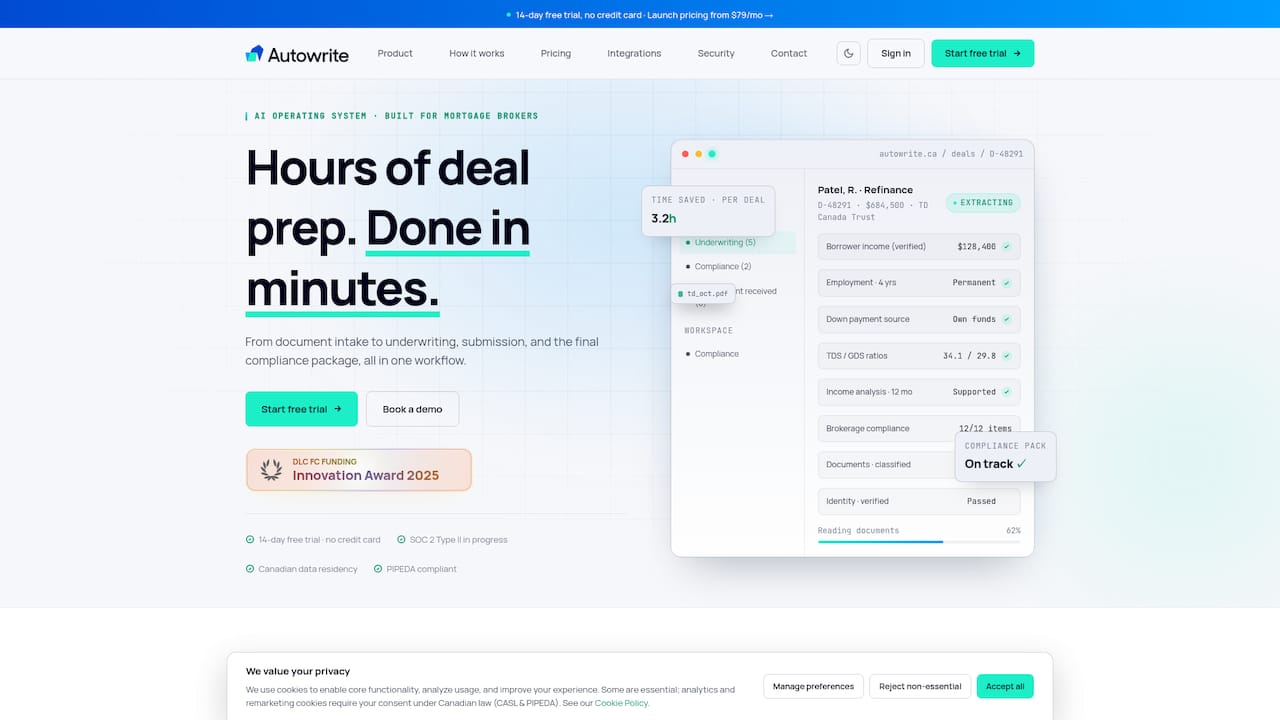
Our platform also assembles compliance packages and supports audit-ready exports, so the governance side of your ROI case does not become a separate scramble later.
We offer several subscription plans with different pricing tiers. Enterprise pricing is available on request. If you want to see how pricing applies to your own file volume, check plan details and start a trial.

FAQ
Is AI replacing mortgage loan officers?
AI is largely automating repetitive document and data-entry tasks rather than replacing the judgment and client relationship work loan officers do. Canadian industry coverage points to upskilling support staff to work alongside automation as the more common path than outright replacement.
What is automation ROI?
Automation ROI is the net financial benefit of an automation investment, divided by its total annualized cost. The benefit side should be quality-adjusted time saved converted to dollars, plus any revenue uplift, and the cost side should include every expected cost from licensing to governance.
What is a ROI mortgage?
This is not standard mortgage terminology. If you mean the return on investment from automating mortgage processes, it is calculated the same way as any other operational ROI: benefits minus full costs, divided by cost.
How many mortgage brokers fail?
There is no reliable, sourced figure for broker failure rates to cite here. What is better documented is that origination costs have risen for many lenders in recent years, which is part of why efficiency gains from automation have become more attractive.
Sources
- FIFAI II: AI risks and opportunities: adopting an AGILE framework in Canadian financial services
- Non-bank mortgage lending in the age of AI
- AI is coming for brokers' back office. Some will adapt. Many will not