
Yes: modern OCR paired with intelligent document processing (IDP) reliably extracts underwriting fields from mortgage packages, but only when it uses layout-aware parsing and field-level confidence routing. Plain OCR alone will not cut it. Autowrite builds this exact pattern into a broker-focused platform that handles intake, extraction, and loan origination system (LOS) sync in one pass.
TL;DR:
- OCR must be layout-aware and include field-level confidence routing to reliably extract and validate mortgage document data.
- Automated classification, stacking, and exception routing reduce manual review time and help handle large, unorganized document sets.
- Metrics like extraction accuracy, exception rate, review latency, and time-to-decision are key to measuring automation success.
- Proper schema design, bounding-box provenance, and secure data mapping ensure compliance and clear audit trails.
- Implementing these systems saves time, reduces errors, and enables brokers to process more deals efficiently.
Table of Contents
- What OCR and document intelligence mean for mortgage documents
- Where OCR and IDP fit into underwriting workflows
- The measurable payoff of automating mortgage document extraction
- Common failure points and how to fix them
- Rolling out OCR and IDP: a practical implementation sequence
- Extraction schemas, bounding boxes, and API choices
- Accuracy targets and the KPIs worth tracking
- Integration and compliance requirements you can't skip
- Why the automation gap is bigger than most brokers realize
- Get your document workflow off your desk and into Autowrite
- Sources
What OCR and document intelligence mean for mortgage documents
OCR reads text off a page. It converts pixels into characters. Intelligent document processing does the harder job: it classifies what kind of document you're looking at, extracts specific fields into a structured record, and validates that those fields make sense together. A pay stub run through plain OCR gives you a wall of text. Run through IDP, it gives you gross_pay, pay_period, and employer_name as discrete, labeled values ready to drop into an underwriting form.
A typical mortgage package includes several document types, each demanding different handling:
- Loan applications and disclosures with dense, multi-column layouts
- Pay stubs, W-2s, and tax returns with inconsistent formatting across employers and years
- Bank statements spanning dozens of pages with transaction tables
- Appraisals and title documents with embedded legal language
Structured outputs typically land as JSON or CSV, sometimes mapped directly to MISMO schema fields for investor delivery. Visual-first parsing, which reads a document's layout the way a person would rather than matching it to a fixed template, handles that variation without a separate configuration for every lender's pay stub format. Template-based systems break the moment a new layout shows up; visual-first models generalize.
Where OCR and IDP fit into underwriting workflows
A mortgage package rarely arrives as one clean file. It's dozens of documents, sometimes hundreds of pages, often stacked out of order with duplicates from resubmissions. IDP earns its place by solving that mess in a specific sequence:
- Classification and stacking. The system sorts incoming pages by document type and identifies which version of a duplicated document is the authoritative one, a step that trips up manual reviewers constantly.
- Field extraction for underwriting. Income figures, asset balances, property details, and borrower identifiers get pulled into structured fields that feed directly into the LOS, replacing manual re-keying.
- QC and exception handling. Fields the system can't extract with confidence get flagged and routed to a human reviewer instead of stalling the whole file.
- Investor delivery formatting. Mortgage industry guidance from the MBA's white paper on loan file submission stresses that investor-ready files need complete, auditable documentation, not just extracted numbers sitting in a database.
Exception routing is what separates a workable system from a frustrating one. Nobody wants a single unreadable signature block to knock an entire 200-page file back to a processor's desk. Well-built IDP routes only the specific uncertain field, not the whole document.
The measurable payoff of automating mortgage document extraction
The case for automating extraction comes down to three things: speed, accuracy, and a paper trail regulators actually accept.
- Processing speed. Packages that took a processor hours to key manually can be extracted and structured in minutes once classification and extraction run automatically.
- Fewer keying errors. Structured extraction with confidence routing catches ambiguous fields before they become underwriting mistakes, instead of after a QC audit finds them.
- Audit-ready documentation. Field-level confidence scores paired with bounding-box provenance, described in Microsoft's Document Intelligence mortgage models, give reviewers a defensible record of exactly where each extracted value came from on the page.
Pro Tip: Track review time per file, not just total processing time. A system that's fast on easy files but slow on exceptions hasn't actually solved your bottleneck.
The real win isn't that a computer reads faster than a person. It's that a computer can flag its own uncertainty, something a rushed processor at 4:45 p.m. on a Friday rarely does.
Common failure points and how to fix them
Mortgage files are messy by nature, and most extraction problems trace back to a handful of predictable causes.
- Poor scan quality. Faxed documents, phone-camera photos, and low-resolution scans degrade OCR accuracy; preprocessing steps like deskewing and contrast correction help, but some files will always need manual fallback.
- Layout variation across lenders and states. A pay stub template that works for one employer won't match the next. Schema-based extraction, where the system asks "find gross pay" rather than "read cell B12," handles this far better than rigid templates.
- Multi-document stacking confusion. When a borrower submits three versions of the same bank statement, the system needs explicit rules for detecting which one is current and authoritative, a bottleneck teams frequently underestimate.
- Overconfident automation. A system that extracts everything with no uncertainty signal is more dangerous than one that flags edge cases, because errors slip through silently.
Pro Tip: Set your confidence threshold slightly conservative in the first 60 days of any rollout, then loosen it once you've measured how often flagged fields actually turn out wrong.
Human-in-the-loop review isn't a weakness in the system.
Rolling out OCR and IDP: a practical implementation sequence
Deploying this well follows a fairly consistent sequence, whether you're a brokerage of five or a lender processing thousands of files a month.
- Set up intake connectors. Most teams route documents in through email, cloud storage folders, or SFTP drops from referral partners, rather than requiring manual uploads.
- Parse the package once. Following the single-parse, multi-extract pattern, run one layout-aware parse across the entire package rather than reprocessing the same pages for every extraction pass. This alone cuts compute cost and processing time significantly on large files.
- Run extraction schemas per document type. Once classified, each document type gets its own field schema. A W-2 pulls different fields than a bank statement.
- Route by confidence. Fields above your threshold flow straight into the record. Fields below it land in a review queue with the source page and bounding box attached.
- Push into the LOS. Validated data syncs into the loan origination system, auto-filling underwriting forms instead of requiring re-entry.
- Monitor and retrain. Track which fields get flagged most often and use that pattern to adjust schemas or thresholds over time.
Batch processing makes sense for high-volume intake windows, like month-end refinance surges, while single-file processing suits day-to-day new applications where speed to first review matters more.
Extraction schemas, bounding boxes, and API choices
An extraction schema is essentially a field list for a document type: borrower_name, loan_amount, property_address, each marked as required or nullable, with array fields for repeating structures like multiple income sources or asset accounts. A well-built schema anticipates that not every document will have every field filled in and won't error out when a field is legitimately blank.
Bounding-box grounding, where each extracted value links back to its exact pixel location on the source page, matters more than it sounds like it should. It's the difference between a reviewer trusting a number and a reviewer having to re-open the original PDF to check it manually.
When evaluating SDK and API options, look at:
- Whether prebuilt mortgage-document models exist, as Microsoft's Document Intelligence offers, versus building schemas from scratch
- Trial or sandbox access before committing to volume pricing
- File-size and page-count limits, since mortgage packages routinely run long
- Language and handwriting support, particularly for older or fax-originated documents
Read the API documentation for edge cases before you build around it, not after.
Accuracy targets and the KPIs worth tracking
Field-level confidence scoring should route on a per-field basis, not per-document. Routing the whole file back to a human wastes the automation you just paid for.
Four metrics matter more than any others:
- Extraction accuracy on the fields underwriting actually uses, not just overall OCR text accuracy
- Exception rate, the share of fields landing below your confidence threshold
- Review latency, how long flagged items sit before a human resolves them
- Time-to-decision, the metric that ultimately reflects whether the whole pipeline is working
Run periodic spot checks against a sample of auto-approved fields, not just the flagged ones. That's how you catch a model quietly drifting before it shows up in an audit.
Integration and compliance requirements you can't skip
Getting extraction right on your screen means nothing if it doesn't map cleanly into your LOS and investor delivery formats. A few non-negotiables:
- Map extracted fields to LOS and investor schemas, including MISMO where relevant, using consistent canonical identifiers so a "gross monthly income" field means the same thing everywhere in your pipeline
- Encrypt data in transit and at rest, and enforce role-based access control so only authorized reviewers see sensitive borrower data
- Retain bounding-box provenance and reviewer decision logs, since investor-delivery standards increasingly expect a defensible audit trail, not just a final number
- Minimize retained personally identifiable information (PII) to what's actually required, and set clear retention windows rather than keeping everything indefinitely
Brokers handling anti-money laundering obligations should treat this the same way: document where a number came from, not just what it says. Autowrite's guide on AML mortgage compliance covers what that documentation needs to include.
Why the automation gap is bigger than most brokers realize
Most brokers assume the bottleneck in their business is deal flow. It isn't. It's the eight to twelve hours per file spent chasing documents, re-keying numbers, and stacking duplicate bank statements by hand. That's the piece nobody talks about at industry conferences, and it's the piece that actually determines how many deals a single broker can run at once.
The mistake I see repeatedly is treating OCR as a solved problem because consumer scanning apps exist. Mortgage documents are a different animal: hundreds of pages, inconsistent formats across lenders, and zero tolerance for a misread income figure. Autowrite was built around that reality specifically for the Canadian brokerage market, combining document classification, schema-based extraction, and direct LOS sync so a broker isn't stitching together three separate tools to get a clean underwriting file. Resources like Autowrite's mortgage document checklist exist because intake, not underwriting judgment, is where most files lose time.
The brokers who adopt this earliest aren't the ones chasing efficiency for its own sake. They're the ones who understand that closing three extra deals a month has nothing to do with hustling harder and everything to do with not drowning in PDFs.
— Anant Bawa
Get your document workflow off your desk and into Autowrite
Autowrite gives Canadian mortgage brokers something a generic OCR tool never will: a workflow built around Canadian compliance requirements and direct integration with the systems brokers already use, instead of a standalone extraction tool you still have to bolt onto your LOS yourself.
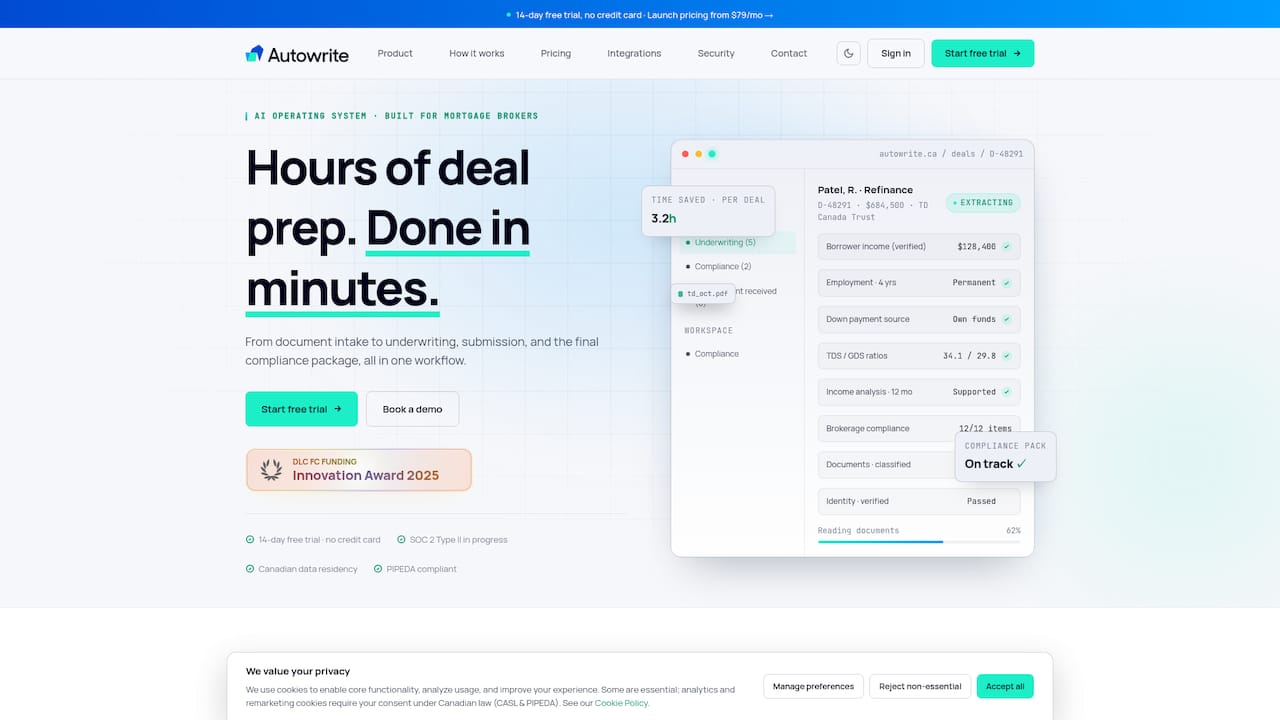
Instead of exporting fields from one platform and re-keying them into another, Autowrite classifies incoming documents, extracts underwriting fields with confidence scoring, and syncs the results straight into your workflow, from intake through e-sign and compliance packaging. A demo walks through your actual document types, what fields your team pulls most often, and how onboarding maps to your current intake process, whether that's email, cloud storage, or a referral partner's portal. If your team is still re-keying pay stubs by hand, start a free trial at Autowrite and see how much of that workload disappears in the first file you run through it.
Sources
- Document Intelligence mortgage document models
- MBA white paper on loan file submission and investor delivery
- Processing mortgage application document packages end to end