

AI driven autofill, paired with document intelligence and a human review step, can reliably populate most mortgage forms today. It is not a replacement for licensed broker judgment, especially where flat PDFs, conditional logic, or ambiguous source documents are involved. The most dependable setups treat autofill as a co-pilot: fast, accurate on structured fields, and always subject to a final human check before a form leaves the shop.
TL;DR:
- Autofill tools perform well on structured forms but struggle with scanned, handwritten, or conditional documents, requiring human oversight.
- A shared internal data model and version-controlled templates minimize mapping errors when new lender forms are introduced.
- Human review checkpoints and confidence scoring are essential to ensure autofill data is accurate enough for underwriters and regulators.
- Security and compliance measures including encryption, role-based access, and audit trails are mandatory for safe, lawful automation deployment.
- Starting with low-risk, well-defined workflows and continuously monitoring error rates optimize the benefits of mortgage form automation.
Table of Contents
- How mortgage form autofill actually works
- Where autofill breaks: common failure modes
- Building a reliable toolchain and technical patterns
- Making autofilled data underwriter ready
- Staying compliant: regulatory and security expectations
- Rolling out autofill without breaking your pipeline
- Where Autowrite fits into this workflow
- Where autofill and agentic AI are headed
- Try autofill built for mortgage paperwork
- Sources
- FAQ
How mortgage form autofill actually works
Autofill tools handle two very different problems depending on the document type. A form with built-in fields, known as an AcroForm, can be populated directly through standard PDF form APIs because each field already has a name and a data type. A flat PDF, which is really just an image of a form with no underlying field structure, needs layout aware extraction: tools that read the page geometry, locate labels, and infer where an answer belongs. This split matters because teams that build only for AcroForms hit a wall the moment a lender sends a scanned or flattened document.
A production pipeline generally moves through six stages:
- Ingestion: documents arrive by upload, e-mail, or portal and get queued for processing.
- Classification: the system identifies document type (pay stub, T4, purchase agreement) before extraction begins.
- OCR and layout parsing: text and its position on the page are captured together, not just the words.
- Named entity recognition: extracted text is tagged as income, address, employer, or another category the form expects.
- Field mapping: tagged data is matched to the target form's specific fields using a canonical data model.
- Confidence scoring and output: each mapped value gets a reliability score before it is pushed to a loan origination system or e-sign package.
The canonical data model is the part teams underestimate. Without a shared field dictionary that defines what "gross monthly income" or "subject property address" means across every lender form a brokerage handles, mapping logic turns into a patchwork of one-off rules. Every new lender template becomes a new exception instead of a variation on a known schema. Brokerages that invest early in a stable internal data model see fewer mapping errors later, because new forms only require new mappings to an existing set of fields rather than a rebuild of the extraction logic itself.
Where autofill breaks: common failure modes
Autofill tools fail in predictable places, and knowing the pattern helps a team catch problems before they reach a client file.
- Browser autofill on custom webforms. Standard browser autofill relies on HTML input naming conventions, and many mortgage portals use custom widgets, multi-step wizards, or JavaScript-rendered fields that the browser cannot recognize, so fields are skipped or filled incorrectly.
- Scanned and handwritten documents. A faxed pay stub or a handwritten letter of explanation defeats most OCR engines, producing low-confidence extractions that need a human to read the source directly.
- Conditional and multi-step forms. Many mortgage forms change which fields are required based on an earlier answer, for example a self-employment declaration that unlocks additional income fields, and static extraction logic often misses the branch entirely.
- Inconsistent lender templates. Two lenders asking for the same information often label it differently, which breaks a rigid, template-only mapping approach.
The fix is detection, not perfection. Systems should flag low per-field confidence scores and count field mismatches against the expected form schema, routing anything below a set threshold to a reviewer instead of letting it flow through silently.
Pro Tip: Track false-fill rate separately from missed-fill rate. A form that skips a field is safer than one that fills it with a plausible but wrong value.
Building a reliable toolchain and technical patterns
The choice between template-driven extraction and machine learning driven extraction is not either-or. Template matching works well for high-volume, standardized lender forms where field positions rarely change, while a named entity recognition model earns its keep on documents that vary in layout, like tax returns or non-standard pay stubs. A hybrid approach, applying templates where structure is stable and machine learning where it is not, tends to balance accuracy against the ongoing cost of maintaining rules.
A working toolchain generally needs:
- OCR engines to convert scanned images into machine readable text.
- Layout parsers, such as tools built on PyMuPDF or pdfplumber, to preserve where text sits on a page for flat PDFs.
- NER models trained on mortgage specific vocabulary to tag extracted values correctly.
- A rules engine to encode lender-specific logic and conditional field requirements.
- Connectors to loan origination systems and e-sign providers so verified data moves downstream without re-keying.
- Queueing infrastructure to hold documents awaiting classification, extraction, or human review without losing track of status.
Operational design decisions matter as much as the components themselves. Confidence thresholds need to be set per field type, since a misread name causes a different kind of problem than a misread interest rate. Human review queues should be prioritized by risk and dollar exposure rather than processed strictly in arrival order. Form templates need version control, because a lender that updates a form mid-quarter can silently break every mapping built against the old layout unless the system flags the version mismatch. Connectors into loan origination systems and e-sign platforms need to be built with secure, auditable data transfer, since this is the point where extracted data becomes part of an official file. A document checklist and intake workflow that standardizes what gets collected before extraction even starts reduces the number of edge cases the extraction layer has to handle later.
Making autofilled data underwriter ready
Autofill only earns its place in a workflow when the output can survive underwriter scrutiny. That means every extracted value needs a verification path, not just a confidence score.
- Income and employment: cross-check extracted pay stub and T4 figures against declared income, and reconcile against payroll verification APIs where available.
- Credit data: match extracted credit report figures against the source document rather than trusting a single extraction pass.
- Property data: reconcile automated valuation outputs against comparable sales and appraisal documents, consistent with the monitoring expectations in OSFI's Residential Mortgage Underwriting Policy, which calls for controlled use and ongoing monitoring of automated valuation tools.
- Exception routing: anything that fails a cross-check or falls below a confidence threshold goes to a human reviewer, not into the file automatically.
A deployment reported a 40 to 60% reduction in application processing time in its early cases, according to analysis of a major bank's agentic AI rollout, a figure worth treating as indicative of what disciplined automation can achieve rather than a guaranteed outcome for every brokerage. The same analysis notes that deployments tend to start with lower risk tasks like document collection, keeping the underwriting decision itself with a human.
Every exception, override, and manual correction should be logged in an immutable audit trail. Regulators and lenders alike will eventually ask not just what the final number was, but how it got there and who confirmed it.

Staying compliant: regulatory and security expectations
Automation does not remove the compliance obligations that already apply to mortgage underwriting and client data handling. OSFI's RMUP guidance expects federally regulated institutions to maintain controls and monitoring around automated tools used in underwriting, and it keeps the underwriting decision itself as a matter of human accountability rather than something a model can finalize unsupervised.
Cybersecurity expectations are just as concrete. The Mortgage Broker Regulators' Council of Canada's cybersecurity guidance, published with FSRA, sets out expectations for secure storage, incident response, and notification when a cybersecurity incident materially affects client information.
Canadian brokerages must view data residency and secure handling as operational requirements, not optional configuration flags; shared browser caches and international workspaces introduce real compliance risk.
Practical controls that reduce exposure include:
- Encryption at rest and in transit for every document that passes through an automated pipeline.
- Role-based access controls so only authorized staff can view or export client financial data.
- Incident response plans aligned with FSRA and MBRCC notification expectations, tested before they are needed.
- Data residency safeguards, keeping client information hosted and processed in line with PIPEDA and applicable provincial privacy rules.
- Use of approved forms, since Ontario's regulation on mortgage brokerage standards of practice requires brokerages to use the current approved version of any form the Superintendent has prescribed for a given purpose.
None of this is exotic. It is the same discipline any financial services firm applies to sensitive data, extended to cover the new pipeline an autofill tool introduces.
Rolling out autofill without breaking your pipeline
A pilot that tries to automate every product line at once tends to produce noisy results and slow adoption. A narrower start gives cleaner signal.
- Pick a low-risk scope first. Standard refinance or renewal files with well-known lender forms make a better pilot than complex self-employed or non-conforming deals.
- Set measurable KPIs before launch. Track processing time reduction, field-level error rate, and how much volume still needs human review.
- Define verification SLAs. Every autofilled form needs a named reviewer and a turnaround window before it moves downstream.
- Keep sign-off with the broker. Automation speeds up preparation, but the licensed broker remains accountable for the final submitted file.
- Monitor continuously. Sample completed files regularly, track error trends on a dashboard, and set a retraining trigger when error rates drift upward or a lender changes a form template.
Pro Tip: Treat a lender's form update as a change management event, not a surprise: version every template so a stale mapping never gets applied silently.
Governance built this way keeps the human accountable for the outcome while the tooling absorbs the repetitive extraction and mapping work. A broker's guide to pipeline management covers how to structure monitoring and retraining triggers once a pilot moves toward full rollout.
Where Autowrite fits into this workflow
Autowrite is built specifically for the workflow described above: document intake, classification, line-level data extraction, and compliance packaging for mortgage brokerages. It automates the intake and classification steps that would otherwise consume broker time, then applies document intelligence to extract and map values with per-field confidence, the same pattern described in the extraction and mapping sections above. Compliance package assembly and pipeline management round out the offering, matching the audit trail and monitoring practices outlined earlier. A guide to mortgage document automation walks through how intake, classification, and extraction connect in practice, and a workflow automation ROI guide covers the operational and compliance controls brokers should expect from any automated pre-underwriting process.
Brokerages evaluating any intake process, automated or manual, may also find it useful to compare against a structured lender-ready underwriting checklist for borrower preparation. For brokers who want to go deeper on the technical or compliance side of a specific deployment, reaching out directly remains the fastest way to get a concrete answer for your own file volume and lender mix.
Where autofill and agentic AI are headed
Agentic AI is already moving from pilot to production in mortgage lending, with banks deploying it as a pre-adjudication tool that compiles documents and prepares summaries while keeping the underwriting decision with a human underwriter. That is the right sequencing. The gains in speed are real, but they only hold up if governance and monitoring keep pace with adoption instead of trailing behind it. My recommendation for any brokerage considering this shift: run a narrow, well-measured pilot that tracks risk indicators as closely as it tracks time saved.
— Anant Bawa
Try autofill built for mortgage paperwork
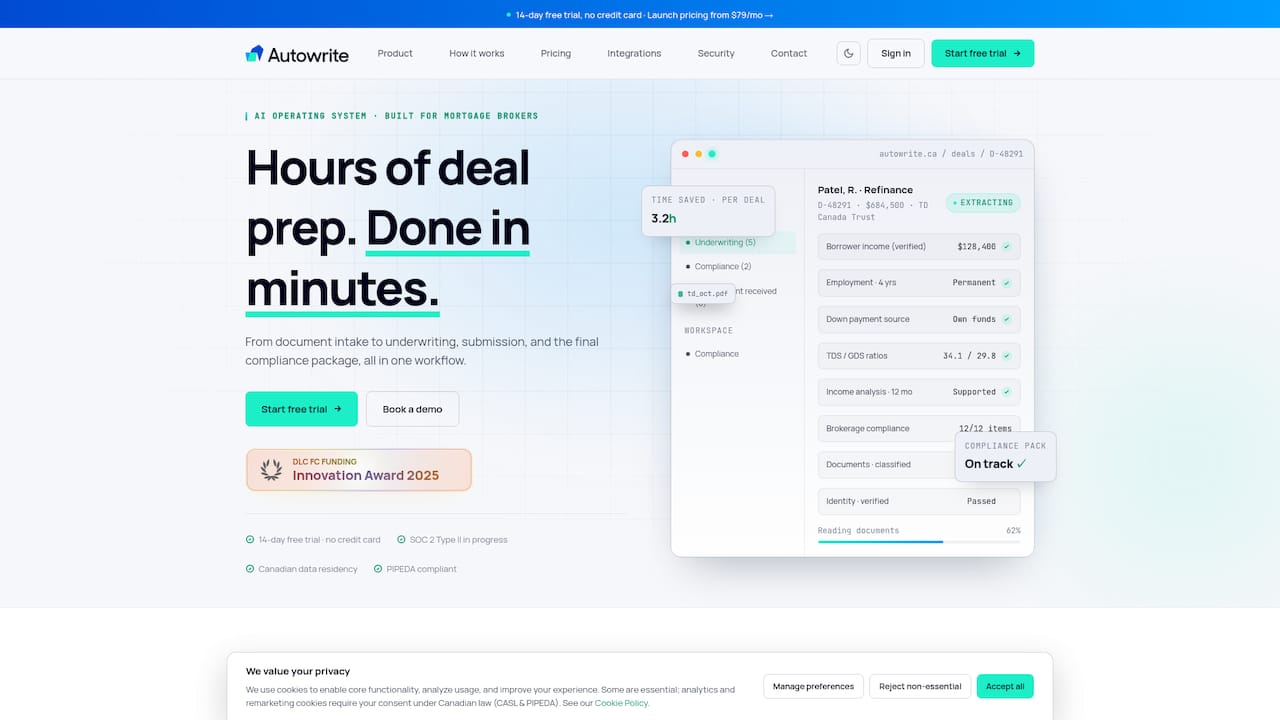
Everything covered above, field mapping, confidence scoring, audit trails, compliance packaging, is what Autowrite runs on for Canadian mortgage brokers day to day. Instead of assembling OCR engines, NER models, and connectors yourself, you get:
- Automated intake and classification the moment documents arrive.
- Line-level extraction with confidence scoring built in.
- Compliance package assembly and pipeline management in one system.
A 14-day free trial is available, and current pricing across Starter, Pro, Legend, and Enterprise plans is listed for brokers ready to compare fit against their own deal volume.
Sources
- Residential Mortgage Underwriting Policy (RMUP)
- Mortgage Broker Regulators' Council of Canada Principles for Cybersecurity Preparedness for the Mortgage Brokering Sector
- TD Bank quietly put an agent in charge of its mortgage pipeline · Major Matters
- O. Reg. 188/08 MORTGAGE BROKERAGES: STANDARDS OF PRACTICE
FAQ
Can AI autofill mortgage forms accurately every time?
No tool guarantees perfect accuracy on every form. AI-driven extraction handles standardized, well-structured documents well but needs human review for scanned, handwritten, or conditional-logic documents, which is why a co-pilot model with verification checkpoints remains the reliable approach.
Who is legally responsible if an autofilled mortgage form has an error?
The licensed mortgage broker or agent remains accountable for the accuracy of any form submitted under their name, regardless of what tool prepared it. Automation speeds up drafting, but final sign-off and verification stay a human responsibility under existing brokerage standards.
Do autofill tools need to use government-approved mortgage forms?
Yes, where a form has been prescribed for a specific purpose, brokerages must use the current approved version of that form rather than a generic or outdated template, and any automation tool needs to stay current with template versions.
What happens to client data processed through an autofill tool?
Client documents and extracted data should be encrypted, access-controlled, and hosted in line with privacy law and the cybersecurity expectations set for mortgage brokerages, including incident response plans and notification procedures if a breach occurs.
How much faster is document processing with AI-driven automation?
Early deployments of agentic AI in mortgage workflows have shown processing time reductions of roughly 40 to 60% in initial cases, though results vary by document mix, form complexity, and how much manual review remains built into the process.