

Yes, in most cases spousal support you receive can count as income when you apply for a mortgage in Canada, and so can your expected pay after maternity or parental leave. Lenders set the conditions. Support must be documented in a separation agreement, divorce agreement or court order, and it must be shown to be arriving regularly. Leave income usually counts when your employer confirms your return date and salary. Support you pay out works the other way: it is treated as an obligation that reduces what you can borrow.
This guide is written for mortgage agents, brokers and the clients they work with. It explains how each situation is usually treated, which documents settle the question, and how to build a file that a lender can approve without three rounds of follow-up.
TL;DR
- Support you receive can be added to your income if a signed agreement or court order backs it and lenders can see it arriving. Support you pay is deducted or counted as a debt.
- Expect two proofs: a primary document (agreement or order) and a secondary one (bank statements or a notice of assessment).
- Some lender guidelines cap support at 50% of total qualifying income, so the mix of your income matters.
- Maternity or parental leave: lenders commonly accept up to 100% of return-to-work income with an employer letter, but a return date more than 12 months away can reduce it.
- Organize every document before you submit. Missing paper, not the income itself, is what stalls most of these files.
Table of Contents
- How lenders treat spousal support you receive
- How support you pay affects your application
- Documents lenders ask for
- Is spousal support taxable, and does it matter for qualifying?
- A worked example
- Maternity and parental leave income
- Combining income sources
- Preparing the file before you submit
- Perspective
- Faster files for brokers handling support and leave income
- FAQ
- Sources
How lenders treat spousal support you receive
Canadian lenders do not all follow one rulebook, but the pattern is consistent. MoneySense reports that spousal and child support can count as income for qualification, but lenders only use support that is written into a signed separation agreement or a court order. A verbal arrangement, or an informal e-transfer every month, will not carry a file.
A second condition is history. According to the same MoneySense article, lenders differ on how much deposit history they want: some will work from a freshly signed agreement, while others want three to six months of deposits first. If your agreement is brand new, ask your broker early which lenders accept it as is.
A mortgage lender's published FAQ states that support received may be added to total income when proof of regular receipt is available for a period of time the lender determines. That wording is typical: the principle is the same everywhere, and the timeline is the lender's call.
How much of the support counts
One set of broker guidelines says no averaging is required for support payments, and that the qualifying amount can be up to 100% of the income when annualized (for example, monthly income multiplied by 12). Another lender's income documentation requirements say alimony or child support can be included only when its income and longevity are confirmed using two separate document sources, and that the support should be no greater than 50% of total qualifying income.
For child support specifically, one mortgage broker article states that the amount used cannot exceed 50% of the overall eligible employment income of all applicants.
The practical takeaway: if support is a small share of your income, it is rarely the issue. If it is the largest part of what you earn, expect more scrutiny and a narrower list of lenders.

Why longevity matters
Lenders are not only asking whether you receive support today. They are asking whether it will keep arriving for the length of the mortgage decision. A separation agreement that states an end date, or an order tied to a child's age or a fixed term, will be read closely. If payments end in two years, a lender may exclude them or ask for a larger down payment elsewhere in the file. When you gather documents, read the duration clause of your agreement before the lender does, so you and your broker can plan for it.
How support you pay affects your application
If you are the payer, the effect is the opposite. A mortgage lender's FAQ says that where child support and alimony are paid by the borrower, the amount is generally deducted from total income for qualification. The Financial Consumer Agency of Canada also notes that, in preapproval, lenders include child or spousal support among your debts and financial obligations when they look at assets, income and debt.
That matters because of your debt ratios. Support payments push your total debt service (TDS) ratio up, which shrinks the mortgage you can carry. Our guide on how to calculate GDS and TDS ratios walks through the arithmetic. Disclose every support obligation up front. A payment that appears on bank statements but not on the application is the kind of mismatch that creates delays.
Documents lenders ask for
Lenders typically want two layers of proof. One lender's guidelines state that verification of child support or alimony must use both a primary and a secondary method. The primary options listed are a court order, a divorce agreement, a separation agreement, or a contract or income letter from the Ministry of Social Services.
The secondary layer varies. One lender's income requirements accept either a three-month bank statement showing scheduled receipt or the most recent notice of assessment (NOA). A broker-facing document list asks for three months of bank statements showing payments plus the divorce or separation agreement. Another broker's article says the verification can be the latest NOA or T1 General supported by the agreement or order, or a two-month history of bank statements plus a copy of the agreement or order.
| Situation | Primary proof | Secondary proof (varies by lender) |
|---|---|---|
| Receiving spousal support | Separation agreement, divorce agreement or court order | 2 to 3 months of bank statements showing deposits, or latest NOA |
| Paying spousal support | Agreement or order showing the amount | Bank statements; disclosed as a debt or deduction |
| Maternity or parental leave | Employer letter with return date, position and salary | EI statement plus one older pay stub, where the lender accepts it |
Because the secondary proof differs, a good broker will check the lender's guideline before collecting anything. Bank statements should show the deposits clearly, with the payer's name or a consistent reference and the same amount each period. If your support arrives by e-transfer from a personal account, keep the statements that show the pattern, not just the agreement.
Is spousal support taxable, and does it matter for qualifying?
Under the Canada Revenue Agency's Income Tax Folio on support payments, spousal support is generally taxable to the recipient and deductible by the payer. Child support is more complex: its treatment depends on when the court order or written agreement commenced, and amounts under arrangements made after April 1997 are treated differently.
For mortgage purposes, this shows up in two places. First, the NOA you provide as secondary proof will reflect support you reported as income. Second, if you are the payer, your reported income may already be lower because of the deduction. Ask your accountant how your own agreement is treated, and give your broker the NOA as filed so the numbers line up.
A worked example
This example is illustrative, not a quote or a promise of approval. Suppose an applicant earns $60,000 a year in employment income and receives $1,500 a month in spousal support under a signed separation agreement.
- Annual support: $1,500 x 12 = $18,000.
- Total income considered: $60,000 + $18,000 = $78,000.
- Support as a share of total: $18,000 / $78,000 is about 23%, comfortably under a 50% ceiling.
- Documents: the separation agreement, plus three months of bank statements showing $1,500 arriving each month, plus the latest NOA.
Now reverse it. If the same applicant paid $1,500 a month instead, the $18,000 would be deducted or counted as an obligation, and the borrowing capacity would fall noticeably. The same agreement can help or hurt depending on which side of it you sit, which is why the file needs to say clearly which one applies.
Maternity and parental leave income
Leave is a different problem. Your current income is temporarily lower, but your job is waiting. Lenders handle this by looking at what you will earn when you return.
One lender's requirements say 100% of estimated return-to-work income can be used if the return date, position and salary are verified. A broker's explainer says lenders may allow up to 100% of workplace income when the borrower can provide an employer letter stating the expected return date. Another set of guidelines adds that the applicant should have resources to cover the monthly mortgage payments while on leave.
When the return date is far away
Timing can cut the figure down. The first lender above says that if the return date is beyond the maximum period for which EI benefits are available (it gives 12 to 18 months as an example), the return-to-work income must be excluded. The broker explainer says that if the projected return is more than 12 months away, lenders may scale qualifying income back to 60% of the base salary shown in the return letter.

If you are planning to buy during a long leave, ask your broker which lenders apply those thresholds before you choose one. If your return is close, you may qualify on full income.
What to hand over
A broker document list gives two acceptable routes for maternity leave: an employer letter confirming the return date and income, or an EI statement plus one older pay stub. The People's Group requirements say the employer letter should confirm the position you are returning to, the return date and your salary on return.
A strong letter is on company letterhead, signed by HR or your manager, and states all three items plainly. Request it early, because employers can take a week or more to produce one.
Combining income sources
Many applicants have more than one non-standard income: support plus part-time work, or leave plus a side business. Each source has its own proof, and lenders weigh them separately. If part of your income is self-employed or gig-based, read our guide to qualifying with 24 months of NOAs. If you also earn rent, see what applicants need for rental income.
The common thread is that lenders want income that is documented, regular and likely to continue. The cleaner each source is on paper, the less room there is for a condition on your approval.
Preparing the file before you submit
Most delays on these files are about paperwork rather than eligibility. A workable order:
- Collect the signed separation agreement, divorce agreement or court order, and confirm every page is included, including the schedule that states the amount and duration.
- Pull two to three months of bank statements and highlight nothing; just make sure the deposits are legible and complete.
- Download the last two years of NOAs from your CRA account.
- For leave, request the employer letter with return date, position and salary.
- List every support obligation you pay, with amounts.
- Give your broker the full set at once so lender-specific requests can be matched against it.
Our mortgage file preparation checklist and the five-step guide on organizing mortgage documents go deeper on how brokers keep these packages tidy.
Perspective
Non-traditional income files are where paperwork does the most damage. The income is real, the borrower is reliable, and the file still stalls because an agreement is missing a page, a bank statement is the wrong month, or an employer letter leaves out the return date.
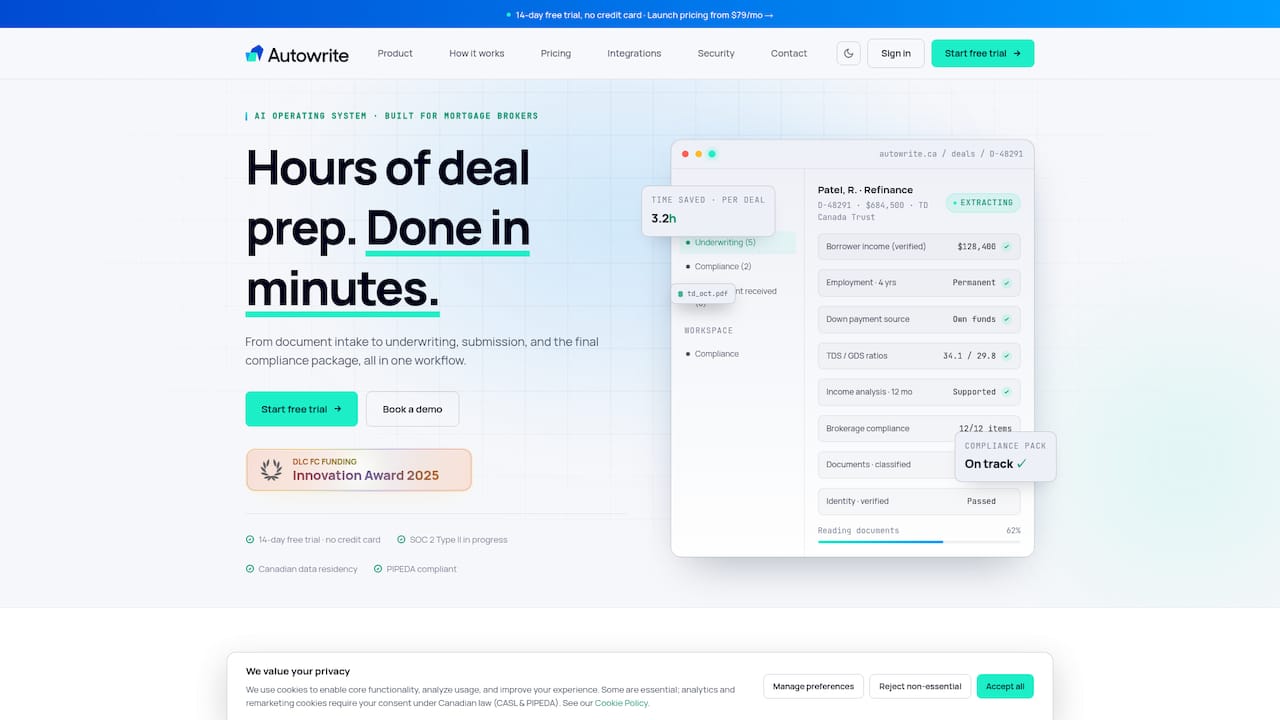
We built Autowrite for Canadian brokers with exactly this in mind. Our platform is designed to classify incoming documents, extract the data with line-level confidence, and fill underwriting forms, so a separation agreement, a stack of statements and a leave letter land in the right place without retyping. We believe a broker's hours belong with the client, not with a scanner.
Our view is simple: the more complex the income, the more a structured, Canadian-built workflow pays for itself. Compliance packages, Canadian data residency and team pipeline tools are part of the same system, so the care you take with one file is repeated on every file.
Anant Bawa
Faster files for brokers handling support and leave income
If you are a licensed broker or agent, Autowrite is an AI-powered operating system for Canadian mortgage work. It handles document intake, classification and data extraction, auto-fills underwriting forms, syncs with mortgage software, and assembles e-sign and compliance packages, with income and down payment analysis built in. Plans on our pricing page start at $99 per month for Starter, with Pro at $199 per month and Legend at $399 per month. Additional deals are $20 each, pay as you go is $35 per deal, and Enterprise is available on request. Paid plans come with a 14-day free trial.
If you are comparing tools first, our guide to the best mortgage document automation software in Canada sets out what to look for.
FAQ
Can I use alimony or spousal support to qualify for a mortgage in Canada?
Usually yes, if it is backed by a signed separation agreement, divorce agreement or court order and you can show it arriving regularly. Lenders decide how much deposit history they need, often between none (with a fresh agreement) and three to six months. Your broker can tell you which lenders fit your timeline.
Is spousal support taxable income in Canada?
Generally, spousal support is taxable to the person who receives it and deductible by the person who pays it, according to the Canada Revenue Agency. Child support follows different rules that depend on when the order or agreement began. Your accountant can confirm how your own agreement is treated.
Does maternity leave income count for a mortgage?
Often it does, through your expected return-to-work income. Some lenders allow up to 100% with an employer letter confirming your return date, position and salary. If you return more than about 12 months out, some reduce the figure to 60% of base salary, and others exclude it past the EI benefit period.
What documents prove maternity leave income?
The most common is a letter from your employer with your return date, position and salary. Some lenders also accept an EI statement plus one older pay stub. Which one works depends on the lender, so confirm before you request documents.
What happens if I pay spousal support?
Lenders deduct it from your income or count it as a debt, which raises your TDS ratio and lowers the amount you can borrow. Disclose the full amount and provide your agreement or order so your broker can calculate your ratios accurately.
Sources
- MoneySense: what to do about your mortgage when you get a divorce
- Financial Consumer Agency of Canada: getting preapproved for a mortgage
- Broker guidelines on support and leave income (September 2024)
- Lender income documentation requirements (August 1, 2024)
- Mortgage FAQ on support received and paid
- Broker explainer on maternity leave, child support and Canada Child Benefits
- Acceptable documents list for brokers
- Canada Revenue Agency: Income Tax Folio S1-F3-C3, Support Payments