

For a Canadian brokerage, the best AI income verification software is the one that covers the whole file, not just one document type. It should read pay stubs, T4s, Notices of Assessment and bank statements, flag what does not add up, fill the lender forms and keep the data in Canada. Autowrite is built that way for licensed brokers, agents and brokerage owners: income and down payment analysis sit inside the same workflow as document intake, underwriting forms and compliance packages.
Below, the main kinds of tools are compared on what matters to a broker: the documents they handle, how they catch altered paperwork, how they connect to your mortgage software, how they are priced and how they treat borrower data.
TL;DR
- Income verification is slow and exposed to altered documents, which is why Canadian brokers and lenders keep asking for better tools.
- Tools fall into five types: all-in-one broker workflow platforms, consent-based third-party data services, standalone document checkers, origination platforms with add-on features, and general AI assistants.
- Autowrite is our pick for brokers: it combines document intake, income and down payment analysis, form auto-fill and compliance packages, with Canadian data residency.
- Plans start at $99 per month with a 14-day free trial, so a single agent can start small and a team can scale.
- AI does not replace your judgment: you still review the file and stay accountable under existing Canadian privacy law.
Table of Contents
- Why income verification is the bottleneck
- How to judge income verification software
- The five types of tools compared
- What a good income analysis looks like in practice
- Privacy, consent and compliance
- Which tool fits which reader
- Where human review stays
- Try Autowrite on your next file
- Our perspective
- FAQ
- Sources
Why income verification is the bottleneck
Income is the part of a mortgage file that takes the longest to prove. A self-employed client sends two years of Notices of Assessment, T1 Generals, corporate statements and bank records. A salaried client sends a pay stub, a letter of employment and a T4. Someone has to read each one, key the numbers into the application and check that they agree.
The federal government has looked at this problem directly. In its July 2025 consultation report on a potential income-verification tool, the Canada Revenue Agency (CRA) records 1,637 completed questionnaire submissions from industry members across Canada. Participants said they were concerned about fake or altered income documents, and that current verification practices take substantial time.
The same report shows what brokers and lenders want from a tool: borrower consent, an immediate response and access through a secure online service. It also notes that some participants already use third-party services that give brokers and lenders access to a borrower's documents with consent. Participants were open to cost-per-transaction, flat monthly or annual subscription pricing. The CRA report sets no price and does not create a tool you can use today, so brokers still need software of their own.
The cost of a slow or shaky verification is real. A file that stalls on income can mean a missed deadline, and a deal that collapses at the lender stage leaves the client scrambling, as in this look at what happens when buyer financing falls through. Getting income right early protects the deal and the client relationship.
How to judge income verification software
A broker has different needs from a large lender. You handle many different borrowers, each with a messy mix of documents, and you submit to several lenders. Judge any tool against these six criteria:
- Document coverage. Does it handle Canadian documents: T4, T4A, T1 General, Notice of Assessment, Notice of Reassessment, pay stubs, letters of employment, commission statements and bank statements?
- Income analysis. Does it turn documents into a qualifying income figure, including for self-employed and commission clients, and show how it got there?
- Fraud and consistency checks. Does it flag mismatches between documents, so you see problems before the lender does?
- Workflow fit. Does it connect to your mortgage software and fill forms, or does it leave you copying numbers by hand?
- Data handling. Is borrower data stored in Canada, and does the vendor support your privacy obligations?
- Pricing. Is the cost predictable for a one-person practice and for a growing team?
The five types of tools compared
No other business is named here. The options are described by type, so you can match them to your own situation.
| Type of tool | What it does well | Where you still do the work | Fit for brokers |
|---|---|---|---|
| All-in-one broker workflow platform (Autowrite) | Intake, classification, data extraction, income and down payment analysis, form auto-fill, e-sign and compliance packages, team pipeline | Final review and sign-off, which stay with the licensed professional | Best: one system for the whole file |
| Consent-based third-party data service | Pulls verified data directly with the borrower's consent | Documents outside the service, analysis, forms and packaging | Useful input, not a workflow |
| Standalone document verification tool | Checks documents for authenticity and consistency | Moving results into your application and lender forms | Solves one step |
| Origination platform with add-on features | Application, submission and lender connectivity | Reading and analyzing the underlying documents | Strong for submission, lighter on documents |
| General AI assistant | Drafts emails, summarizes text | Everything involving borrower data and compliance | Not built for mortgage files |
1. All-in-one broker workflow platforms
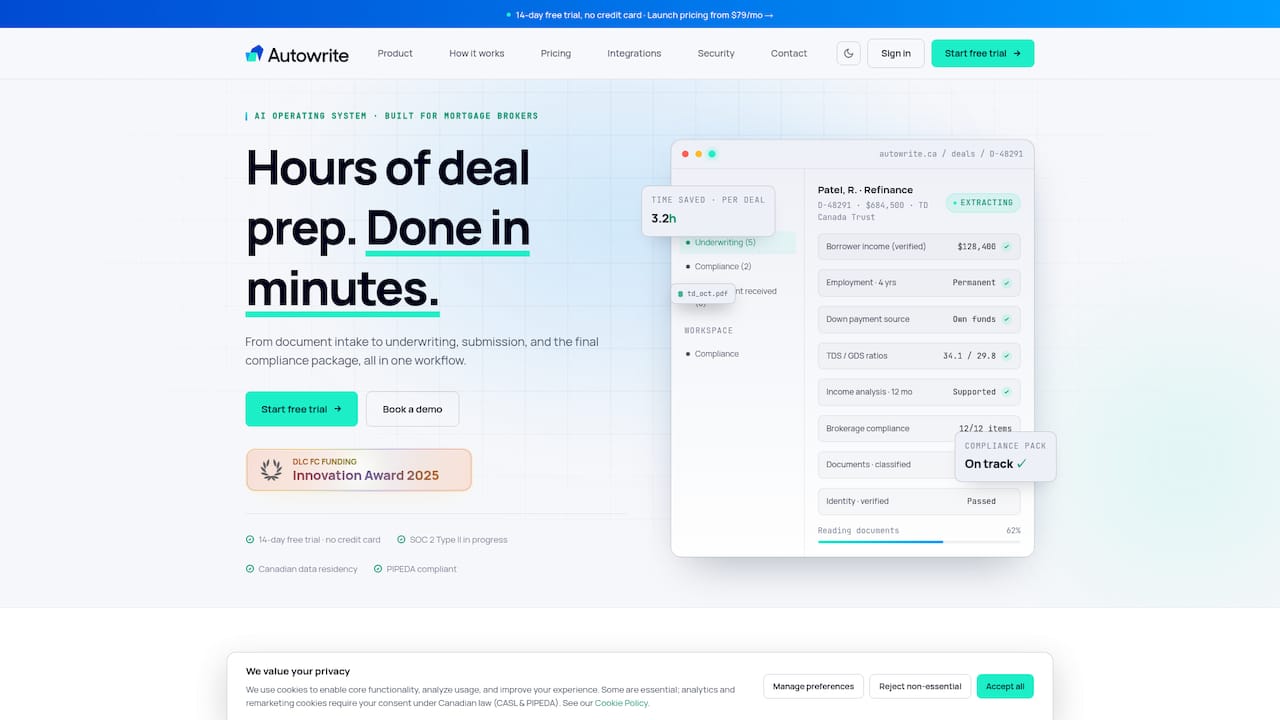
This is where Autowrite sits. It is an AI-powered operating system for Canadian mortgage brokers that automates document intake, classification and data extraction, then auto-fills underwriting forms and syncs with your mortgage software. It also assembles e-sign and compliance packages, provides income and down payment analysis and supports team pipeline management.
For income verification the advantage is continuity. The same extracted data feeds the income analysis, the forms and the package that goes to the lender, so a number is read once and used everywhere. Our document intelligence gives line-level confidence for extraction, which means you see how sure the system is about each figure and can check the ones that matter. Autowrite also provides native integrations with Canadian loan origination systems and keeps data in Canada.
2. Consent-based third-party data services
These services let a borrower authorize access to certain records, and the broker or lender receives the data directly. The CRA report confirms such services are already in use and that they give brokers and lenders access to borrowers' documents with consent. They are a good source of data. What they do not do is run your file: you still need to analyze the income, complete the forms and assemble the package.
3. Standalone document verification tools
These focus on a single question: is this document genuine and consistent? That helps with the altered-document risk participants raised in the CRA consultation. But a checker that stops at a pass or fail result leaves the rest of the work with you. If your day is spent moving numbers between systems, a narrow tool adds one more place to log in.
4. Origination platforms with add-on features
Origination platforms manage the application and the connection to lenders. Some now add document features. They are strongest at submission. If you already use one, the question is whether the documents are analyzed deeply enough for complex income. Autowrite syncs with mortgage software, so you can keep your origination system and add document intelligence in front of it.
5. General AI assistants
General chat tools can summarize or draft, but they are not designed for borrower files, Canadian document types or brokerage compliance. Pasting a client's T1 into a general assistant raises privacy questions that a purpose-built system is designed to answer.
What a good income analysis looks like in practice
Take a self-employed client with two years of Notices of Assessment, a T1 General, personal bank statements and a down payment held across two accounts. By hand, you would read each page, record line 15000 total income and net business income, add back eligible amounts, compare years and trace the down payment history.
With Autowrite, the documents are classified on intake, the figures are extracted with line-level confidence, and the income and down payment analysis is built from that data. The underwriting forms are then auto-filled from the same figures. Your time moves from typing to reviewing, which is where a licensed professional adds value. The Canadian mortgage underwriting steps are laid out in our mortgage underwriting checklist for Canadian brokers, and the wider picture of how this works is in how AI is automating mortgage underwriting in Canada.

Privacy, consent and compliance
Using AI on borrower files does not change your obligations. The Office of the Privacy Commissioner of Canada's 2024 to 2025 annual report says AI systems remain governed by existing privacy laws and stresses safeguards for personal information. In practice, that means three things for a brokerage:
- Consent. Borrowers need to understand what is collected and why. Our guide to privacy consent wording for Canadian mortgage brokers covers how to word it.
- Safeguards. Keep income documents in secure systems. Autowrite supports Canadian data residency and privacy compliance.
- Accountability. The OPC's 2025 issue sheets recommend privacy-by-design and privacy impact assessments for high-risk activities. That is a recommendation, not a new mortgage-specific rule, but it is a sensible way to document how your brokerage handles AI.
Rules differ by province. Brokers in Ontario, British Columbia, Alberta and Quebec each answer to their own provincial regulator, and Quebec has its own privacy framework. Confirm your regulator's expectations and, for legal questions about your brokerage's obligations, speak with a lawyer or your regulator.
Which tool fits which reader
- Solo agent or broker. You want to cut hours of data entry without a heavy system. Autowrite's Starter plan is $99 per month.
- Growing team. You want shared pipeline visibility and consistent files. The Pro plan is $199 per month and the Legend plan is $399 per month.
- Large brokerage or private lender. You want AI workflows across many users. Enterprise pricing is not published; see the pricing page.
- Occasional use. Pay as you go is $35 one-off per deal, and an additional deal on a plan is $20 one-off per deal.
For a wider view of costs, see our breakdown of mortgage software costs in Canada. For other categories of tools, our guide to the best AI mortgage software for Canadian brokers and the one on AI document automation for mortgage brokers go deeper.
Borrowers do not buy this software. It is built for licensed brokers, agents and brokerage owners, who pay for a subscription. A first-time buyer who wants to organize documents is best served by their broker, who can collect them securely through a workflow like this one.

Where human review stays
AI extracts, compares and flags. You decide. A licensed professional still judges whether income is stable, whether an add-back is acceptable to a particular lender and whether a letter of employment matches the story. Line-level confidence helps because it points your attention to the figures that deserve a second look, instead of asking you to re-read everything.
Try Autowrite on your next file
Autowrite is a subscription for licensed Canadian mortgage professionals, with paid plans and a 14-day free trial. Plans run from Starter at $99 per month to Legend at $399 per month, with Enterprise available for larger organizations. Start from autowrite.ca and see how a real income file moves from intake to a lender-ready package.
If you manage a team, the pipeline management tools give you one view of every file and where it stands.
Our perspective
Brokers did not get licensed to retype pay stubs. The work that earns a client's trust is advice: structuring the deal, explaining the options, standing behind the file. Yet income verification eats the hours that advice needs.
We built Autowrite around one idea: read a document once and use it everywhere. When intake, classification, extraction, income analysis, forms and compliance packages share the same data, the brokerage stops paying for the same work three times. That is why we do not treat income verification as a stand-alone feature.
We also built it for Canada. That means Canadian documents, native integrations with Canadian origination systems and Canadian data residency. Your clients hand you sensitive financial records, and where those records live matters.
Our aim is simple: hours of paperwork become minutes, and the saved time goes back to your clients.
Anant Bawa
FAQ
Can AI verify income for a Canadian mortgage file?
AI can read income documents, extract the figures and flag inconsistencies, which speeds up verification considerably. The licensed broker or agent still reviews the result and remains accountable for the file. Autowrite shows line-level confidence so you can focus on the figures that need attention.
Does the CRA offer a tool brokers can use for income verification?
The CRA consulted the mortgage industry on a potential income-verification tool and published its findings in July 2025. The report describes what participants wanted and does not set up a tool or price. Brokers who need to verify income now rely on software and documents the borrower provides.
Is borrower data safe in AI mortgage software?
Canadian privacy law applies to AI the same way it applies to any other handling of personal information, so consent and safeguards matter. Autowrite supports Canadian data residency and privacy compliance. For specific legal questions, consult a lawyer or your provincial regulator.
How much does Autowrite cost?
Starter is $99 per month, Pro is $199 per month and Legend is $399 per month. An additional deal costs $20 one-off, and pay as you go is $35 one-off. Enterprise has no published price, and paid plans start with a 14-day free trial.
Will it work with the mortgage software I already use?
Autowrite syncs with mortgage software and offers native integrations with Canadian loan origination systems. Your documents are classified and extracted, then the data fills your underwriting forms. Check the pricing page or the site for the current list of integrations.
Sources
- Mortgage Industry Consultation on a Potential Income Verification Tool, Canada Revenue Agency, July 2025
- Prioritizing privacy in a data-driven world: 2024-2025 annual report, Office of the Privacy Commissioner of Canada
- Consolidated issue sheets for a general information session, Office of the Privacy Commissioner of Canada, 2025