

AI is automating the repetitive front half of Canadian mortgage underwriting: sorting documents, pulling data out of them, calculating income, checking files against policy and preparing a summary for a person to review. It is not replacing the underwriter's judgment. Lenders such as TD are reporting large time savings on that preparation work, and brokers who feed them cleaner, better-organized files stand to benefit.
This guide explains what "AI underwriting" really means in Canada, which steps are automated today, what the numbers say, where humans stay in the loop, and what you can do in your own brokerage to prepare.
TL;DR
- AI underwriting in Canada mostly means automating document classification, data extraction, income calculation, policy checks and file summaries, then handing the result to an underwriter.
- TD reports that its agentic AI cut a document-review process from an average of 15 hours to under three minutes in early results.
- Files that break standard rules or show inconsistencies are still routed to a human underwriter, and lenders say experienced underwriters remain essential for complex deals.
- Regulators (OSFI and FCAC) flag privacy, bias and weak risk management as the main concerns, so documentation, consent and human oversight matter.
- Brokers can capture the same gains upstream by automating intake, extraction and form fill before the file reaches a lender.
Table of Contents
- What "AI underwriting" means in Canada
- The underwriting steps AI can automate
- What Canadian lenders report so far
- Where humans still review the file
- Risks and what regulators are watching
- What this means for brokers and brokerage owners
- Our perspective
- Automate your side of the file with Autowrite
- Where this is heading
- FAQ
- Sources
What "AI underwriting" means in Canada
Two terms get mixed up. Automated underwriting is the broader idea: software applies predefined decision logic to check an application against eligibility, credit and documentation rules. AI-powered underwriting is a type of automation that can also interpret unstructured documents, spot inconsistencies and generate recommendations or summaries. The two overlap, but "automated" does not by itself mean machine learning or generative AI.
The shift is real in this country. OSFI and FCAC report that federally regulated financial institutions are increasingly using AI for core functions, including underwriting and credit adjudication.
For a Canadian broker or mortgage agent, the practical meaning is simple. Much of what used to be manual reading, retyping and cross-checking of pay stubs, T4s, Notices of Assessment, bank statements and property documents can now be done by software. The decision to lend still belongs to the lender, and the advice and suitability duties still belong to you.

The underwriting steps AI can automate
Underwriting is not one task. It is a chain, and AI is strongest at the links that involve reading and reconciling paper.

Document intake and classification
A typical Canadian file arrives as a pile of PDFs, phone photos and scans: employment letters, T4s, Notices of Assessment, void cheques, bank statements, purchase and sale agreements, MLS listings, gift letters and ID. AI sorts each page into the right type, even when file names are useless, and flags what is missing.
Data extraction
Once a page is classified, the system reads it and pulls out structured fields: employer name, year-to-date earnings, line 15000 on a Notice of Assessment, account balances, legal description. Better tools show how confident they are about each extracted value, so a person can check the doubtful ones instead of rereading everything.
Income and down payment analysis
Extracted figures feed calculations: salaried, hourly, commission and self-employed income treated according to the rules of the lender you are targeting, and down payment sourcing traced through bank statements. This is the step that most often eats an afternoon.
Policy checks and discrepancy detection
AI can compare file data against selected policy requirements, check that consent is in place and surface discrepancies, for example a stated income that does not match the documents. TD describes its agentic-AI process as one that classifies documents, extracts information, calculates income, validates selected policy requirements, checks consent and discrepancies, then prepares underwriter memos.
Summaries and form completion
The last automated step is the write-up: a summary memo for the underwriter on the lender side, and on the broker side, an auto-filled application and a clean submission package. For more on this part, see our guide to making mortgage autofill compliant and underwriter ready.
What Canadian lenders report so far
The clearest numbers come from the big banks. TD says its agentic-AI model automates pre-adjudication by generating application summary memos for underwriters. In early results, it reduced the process from an average of 15 hours to an average of less than three minutes. The 15-hour figure includes queue time, so much of the saving comes from removing waiting as well as reading.
Scotiabank is moving in the same direction. Its Anique Asher said the bank is deploying AI in pre-funding operations to automate document checks and reduce manual intervention by approximately 25%, according to Canadian Mortgage Trends. The same report covers TD's expectation that these gains will reach brokers.
That last point matters for you. Faster lender-side processing only helps a broker whose submissions arrive complete and consistent. A file with missing pages or conflicting figures still bounces, however fast the lender's engine runs.
| Step | What AI does | Who still decides |
|---|---|---|
| Intake | Sorts and labels documents, flags gaps | Broker confirms the file is complete |
| Extraction | Reads fields, shows confidence | Broker or underwriter checks low-confidence values |
| Income and down payment | Calculates and traces sources | Underwriter applies policy and judgment |
| Policy checks | Compares file against selected rules | Underwriter handles exceptions |
| Summary and forms | Drafts memo, fills forms, builds package | Broker reviews and signs off |
Where humans still review the file
Canadian lenders are clear that this is assistance, not replacement. In April 2025, executives speaking to Canadian Mortgage Trends said that when a file doesn't meet standard rules or shows an inconsistency, it is kicked out to an underwriter. CMLS Financial's Andrew Gilmour described testing fully automated pre-approvals built on algorithms aligned with internal credit policy. One panelist said roughly 10% of CMLS loans were then fully committed using rules-based algorithms. The panel also said AI can shorten turnaround and help with fraud detection but is not yet ready to replace experienced underwriters.
The near-term value, in other words, is time reallocation. Underwriters spend less effort on repetitive document work and more on complex deal structuring. The same logic applies to your brokerage: the hours you save on retyping go back to advising clients, structuring self-employed and rental-income deals, and chasing the next referral.
Three kinds of file keep needing human eyes:
- Non-standard income. Self-employed borrowers, new Canadians with limited credit history, and variable-commission earners need interpretation, not just calculation.
- Inconsistent documents. A name spelled two ways, a deposit with no source, a letter that does not match the pay stub. These are routed to people by design. Our piece on procurement questions about document tampering covers what to ask of any tool in this area.
- Policy exceptions. Anything the rules do not cleanly cover.
Risks and what regulators are watching
Automation raises its own obligations. OSFI and FCAC's joint risk report finds that risk management is lagging behind AI adoption and that controls often do not consider every risk across the model lifecycle. The report lists controls such as human-in-the-loop review, performance monitoring, back-up systems, alerts and limits on the use of personal information. Respondents ranked data privacy, data governance and data quality as their top concern.
For brokers, this translates into questions worth asking of any AI workflow you rely on:
- Where is borrower data stored? Canadian data residency simplifies privacy conversations with clients and lenders.
- Is there a human checkpoint before anything is submitted? Extraction with visible confidence levels makes review quick.
- Can you explain what happened to a document? If a client or lender asks why a figure appears on a form, you need a traceable answer.
- Is client consent recorded? Consent to collect, use and share information should be part of the file, not an afterthought.
Provincial rules add a layer. OSFI's March 2026 FIFAI II report notes that AI regulatory uncertainty in Canada spans 14 jurisdictions, creating a matrix of guidelines, rules and legislation, which can mean operational overhead. The same report also notes that AI can deliver significant productivity gains across compliance, fraud detection and operational workflows. If you work in Quebec, Ontario, British Columbia or Alberta, confirm your obligations around automated processing and personal information with your brokerage's compliance officer and your regulator.
TD's description of its own approach shows the principle in action: its Trustworthy AI team assesses privacy, security, fairness, accountability and explainability before deployment and keeps monitoring afterwards, as set out in its announcement. Treat that sequence as a template for your own tool choices.
What this means for brokers and brokerage owners
You do not need to be a bank to capture these gains. Lenders automate after the file lands in their system. The broker's side of the pipeline, intake, extraction, form completion and package assembly, is where most of the hours in a brokerage go, and it is where a cleaner file changes everything downstream.
A practical way to think about it: the lender's AI reads your file. The better organized it is, the more likely it passes straight through standard checks rather than being kicked to a person.
A pre-submission checklist
- Classify everything on intake. Every page has a type, a borrower and a date range before anyone touches it.
- Extract once, reuse everywhere. Capture income and asset data a single time and let it populate the application, the lender forms and your own notes.
- Reconcile before you submit. Check that names, addresses, employers and amounts agree across documents, and resolve gaps with the client early.
- Trace the down payment. Identify the source of every large deposit and attach the supporting statement.
- Record consent. Keep it with the file.
- Review low-confidence fields. Spend your attention where the software is least sure, not on everything.
- Assemble the package once. Generate the e-sign and compliance package from the same data, so nothing is retyped.
If you want to go deeper on the mechanics, our guides on AI document automation for mortgage brokers and mortgage OCR walk through the intake and extraction layers in detail. For the compliance side, see mortgage compliance automation for Canadian brokers.
Our perspective
Underwriting automation is often described as a lender story. We see it as a brokerage story too, because the paperwork that slows a deal starts before the file ever reaches a lender.
When we built Autowrite, we focused on the broker's side of that chain: document intake, classification, data extraction, auto-filled underwriting forms, income and down payment analysis, and e-sign and compliance packages. Our approach is designed so that a file leaves your office organized, consistent and ready for review, with line-level confidence on extracted values so you know where to look.
We also think Canadian brokers should not have to trade speed for control. That is why we are built around Canadian data residency and privacy compliance, native syncing with mortgage software, and a workflow in which a licensed professional always reviews and approves what goes out. AI prepares the file. You advise the client and own the decision.
The brokerages that will do best are the ones that stop treating paperwork as a cost of doing business and start treating it as a process they can run in minutes. That is the shift we are working toward.
Anant Bawa
Automate your side of the file with Autowrite
Autowrite is an AI-powered operating system built for Canadian mortgage brokers, agents and brokerage owners. It automates document intake, classification and data extraction, auto-fills underwriting forms, syncs with your mortgage software, assembles e-sign and compliance packages, and supports team pipeline management.
Plans start at $99 per month for Starter, with Pro at $199 per month and Legend at $399 per month. Enterprise pricing is not published. Additional deals cost $20 each, and pay as you go is $35 per deal. Paid plans come with a 14-day free trial.
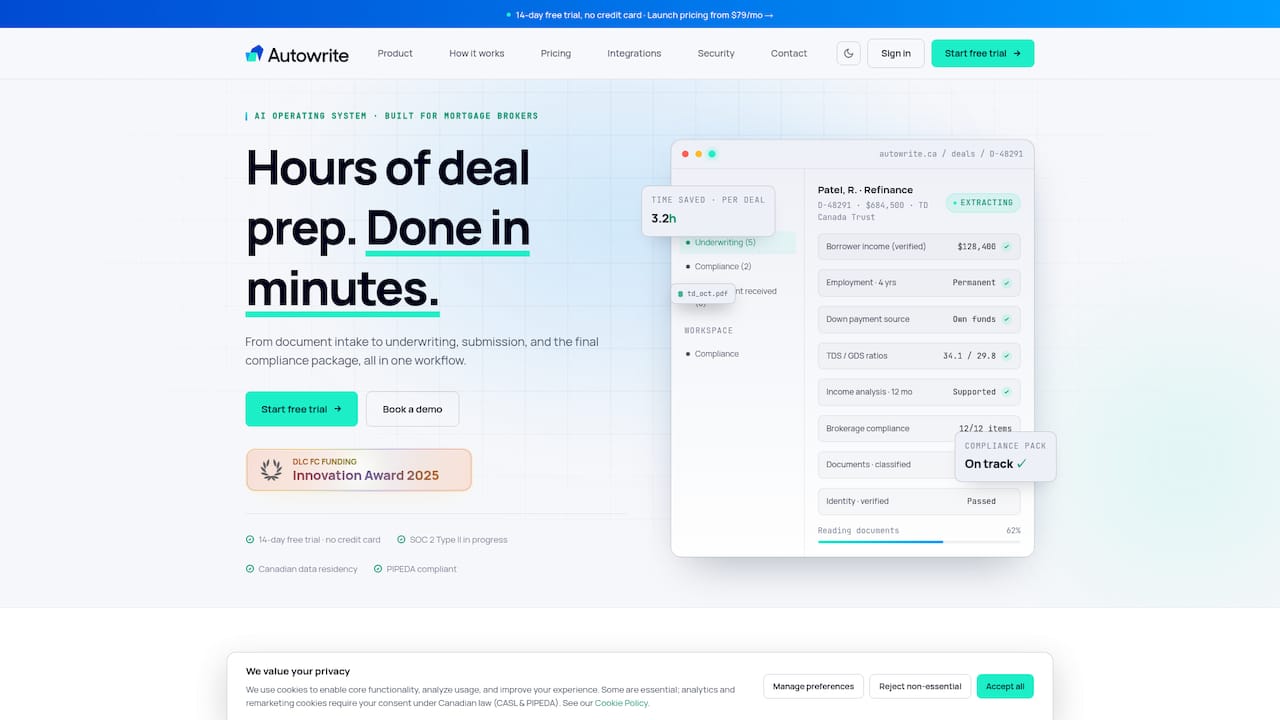
You can see the full plan details on the Autowrite pricing page, or start from the Autowrite home page. If you are comparing approaches first, our overview of the best AI mortgage software for Canadian brokers sets out the criteria that matter.
Where this is heading
Three trends look durable.
Lender-side automation will reach brokers. TD has said it expects its AI-driven processing gains to extend to the broker channel. Brokers whose files are structured and consistent will be best placed to benefit.
Oversight will tighten, not loosen. OSFI's reports point to risk governance catching up with adoption. Expect lenders to ask more questions about how brokerage tools handle data, consent and review.
Document integrity will matter more. As extraction gets faster, the value of catching inconsistencies early grows. For the broader picture, see our look at mortgage tech trends under OSFI scrutiny and the five workflow stages worth automating.
FAQ
Is AI approving mortgages on its own in Canada?
For standard files at some lenders, rules-based automation can commit a loan without manual underwriting. One CMLS panelist said approximately 10% of its loans were fully committed this way in 2025. Files that fail standard rules or contain inconsistencies are sent to a human underwriter.
Will AI replace mortgage underwriters?
Canadian lenders speaking to Canadian Mortgage Trends in 2025 said it is not ready to replace experienced underwriters. The more likely change is that underwriters spend less time on repetitive document work and more on complex deals.
What can a broker automate before the file reaches the lender?
Document intake and classification, data extraction, income and down payment analysis, form completion and the assembly of e-sign and compliance packages. These are the steps that consume most of a brokerage's administrative hours. Autowrite is designed to handle each of them in one workflow.
What are the main risks of AI in underwriting?
OSFI and FCAC point to privacy, data governance and data quality, along with weak controls across the model lifecycle. Practical safeguards include human review, performance monitoring, limits on personal information use, and clear records of consent.
Does AI underwriting differ by province?
Yes, the regulatory picture spans multiple jurisdictions, and OSFI notes it can create operational overhead. Brokers in Quebec, Ontario, British Columbia and Alberta should confirm their obligations with their brokerage's compliance officer and regulator.
Sources
- OSFI-FCAC Risk Report: AI Uses and Risks at Federally Regulated Financial Institutions
- OSFI, FIFAI II: AI Risks and Opportunities
- TD Launches Agentic AI to Transform Real Estate Secured Lending
- Canadian Mortgage Trends: AI is coming for mortgage underwriting, but underwriters aren't going anywhere
- Canadian Mortgage Trends: TD expects AI-driven mortgage processing gains to reach brokers
- AI Mortgage Software vs. Traditional LOS