
Generative and agentic AI are the defining technology shift for Canadian mortgage brokers in 2026, and regulators are watching closely. OSFI's technology risk bulletins now flag third-party and cyber exposure tied to these tools. For brokers, the priorities this year are document intelligence, vendor governance, and tighter integration with lender workflows.
TL;DR:
- Run a focused pilot on one document type within four weeks, tracking administrative hours saved per file, funding time, and package errors.
- Before adding underwriting assistants or autonomous agents, map every vendor handling client data, verify hosting and breach terms, and test a manual fallback.
- Although brokerages are not directly bound by OSFI guidance, lenders may expect documented oversight, while shared AI infrastructure can spread one outage across multiple workflows.
- Pair automated document screening with consent based income verification when available, and reserve biometric checks for higher risk remote applications without prior client relationships.
Table of Contents
- Snapshot: major mortgage tech trends shaping Canada in 2026
- What OSFI and federal signals mean for mortgage professionals
- Practical AI and automation use cases for Canadian mortgage brokerages in 2026
- Implementation checklist: vendors, integrations, timelines, and cost
- Risks, mitigations, and controls for cyber, model, and third-party exposure
- How Canadian document intelligence illustrates these trends in practice
- Emerging biometric and identity verification technologies enhancing mortgage security
- Role of blockchain and distributed ledger technology in mortgage processing
- Impact of 5G and edge computing on mortgage data processing speeds
- Customer experience innovations enabled by mortgage technology trends
- Future regulatory changes affecting mortgage technology adoption beyond OSFI guidance
- Competitive landscape: new fintech entrants and partnerships shaping mortgage tech
- What brokers should prioritize this quarter
- How Autowrite helps Canadian brokers put these trends to work
- FAQ
- Sources
Snapshot: major mortgage tech trends shaping Canada in 2026
Three forces are converging on Canadian brokerages this year: smarter automation, closer regulatory attention, and a renewal-driven market that rewards speed. Understanding how they overlap matters more than tracking any single tool.
Artificial intelligence now shows up in mortgage work in three distinct forms. Generative AI drafts text, summarizes documents, and answers client questions. Agentic AI goes further, taking multistep actions such as pulling data from a pay stub and populating a lender form without a person clicking through each field. Frontier AI, the most advanced and least predictable category, is the one OSFI's bulletins single out for added scrutiny because its behaviour is harder to forecast and audit. Brokers mostly encounter the first two categories today, usually packaged inside document intelligence or underwriting-assist software rather than as standalone AI products.
Document intelligence, the combination of optical character recognition (OCR) with classification and extraction logic, has matured specifically for Canadian paperwork. Where generic OCR tools choke on Notices of Assessment, T4 slips, and provincial land titles, document intelligence built for this market recognizes those formats and pulls the right fields into underwriting software automatically.
Two other pressures are reshaping the 2026 landscape:
- Income verification is moving toward digital rails. The Canada Revenue Agency has consulted the mortgage industry on a possible digital income verification tool, with industry feedback favouring an API-integrated, consent-based design.
- Renewal volume is driving the market. CMHC's residential mortgage industry reporting shows renewal cycles and borrower-condition indicators as central drivers of 2025 and 2026 mortgage activity, which means brokers handling high renewal volumes need faster file turnaround more than ever.
- Fraud pressure is rising alongside legitimate AI adoption. Industry commentary in Canadian Mortgage Professional notes that synthetic documents and AI-generated fraud are increasing in parallel with broker adoption of the same technology.
None of these trends sit in isolation. A broker who automates document intake without addressing fraud screening, or who adopts an AI underwriting assistant without a plan for vendor oversight, is solving half the problem.
What OSFI and federal signals mean for mortgage professionals
Brokerages are not federally regulated financial institutions, so OSFI's rules do not bind brokers directly. Lenders, however, answer to OSFI, and they increasingly expect transparency from the brokers who feed them files. That makes OSFI's 2026 guidance relevant to every brokerage, even indirectly.
OSFI's bulletin on generative and agentic AI states that these tools materially amplify cyber, technology, and third-party risk, and calls for stronger governance and operational resilience across the institutions it supervises. The Semi-Annual Risk Outlook and FIFAI II framework go a step further, introducing an AGILE approach to AI risk management and warning about concentration risk when too many institutions lean on the same handful of vendors.
OSFI frames responsible AI adoption as both a competitive advantage and a regulatory necessity, noting that firms combining governance with automation stand to improve resilience and productivity together.
That framing matters for brokers choosing software. If your document intelligence provider, your lead-scoring tool, and your e-signature platform all depend on the same underlying AI infrastructure, a single outage or breach ripples across your entire workflow. OSFI calls this third-party concentration risk, and its Annual Risk Outlook update flags it as a growing concern across the financial sector, alongside technology sovereignty questions about where vendor infrastructure and data actually sit.
Brokers do not need an OSFI compliance program, but a handful of governance habits make files easier to defend if a lender or insurer ever asks questions:
- Map which vendors touch client data at each stage of a file, from intake to funding.
- Assign a named person at your brokerage to own vendor accountability, not just IT troubleshooting.
- Test what happens when a vendor goes down: confirm you can still produce a lender-ready package without it.
- Ask vendors directly where data is hosted, how breaches are reported, and how long backups are retained.
- Review contracts for notification clauses that require a vendor to tell you promptly about a security incident.
None of this requires a dedicated compliance officer. It requires treating your software stack the way you'd treat a sub-broker: someone you trust, but whose work you can still verify.
Practical AI and automation use cases for Canadian mortgage brokerages in 2026
The most useful mortgage AI in 2026 is not flashy. It handles the repetitive parts of a file so brokers can spend more time on the parts that need judgment and a relationship.
- Document intake and classification. Automated sorting of pay stubs, Notices of Assessment, bank statements, and identification documents replaces manual filing, and extraction tools pull the right fields directly into underwriting software instead of requiring retyping.
- Autofill and underwriting assist. Software can populate lender forms from extracted data and flag inconsistencies, such as a stated income that doesn't match a pay stub, but final judgment on exceptions, conditions, and client communication stays with the broker.
- CRM mining and renewal automation. With renewal volume driving much of the 2026 market according to CMHC's reporting, tools that scan a client list and flag upcoming renewal dates or cross-sell opportunities turn a static database into a pipeline.
- Fraud detection and verification support. Automated screening for altered documents, combined with the kind of digital income verification the CRA has been consulting on, gives brokers a second check before a file reaches a lender.
Industry commentary from Canadian Mortgage Professional describes brokers using these tools for client mining and document-heavy workflows as seeing immediate returns, not a distant payoff. The same reporting notes that synthetic documents and AI-generated fraud are rising in step with legitimate adoption, which is why verification steps belong in the same workflow as automation, not bolted on afterward.
A practical guide to OCR for Canadian mortgage documents walks through how document intelligence tools handle Canadian-specific paperwork formats that generic tools often mishandle. For underwriting specifically, a breakdown of underwriting automation for Canadian brokers covers where machine assistance ends and human sign-off begins.
Pro Tip: Start automation with your highest-volume document type, usually pay stubs or Notices of Assessment, so you can measure time saved before expanding to the rest of the file.

Implementation checklist: vendors, integrations, timelines, and cost
Choosing mortgage technology is less about finding the flashiest tool and more about confirming it fits your existing workflow without creating new risk.
Before signing with any vendor, confirm these basics:
- Governance and audit trails. Ask whether the vendor logs who accessed or changed a file, and whether those logs are available to you on request.
- Breach notification terms. Confirm the contract specifies a notification window if the vendor experiences a security incident.
- Data residency. Verify where client data is physically stored and processed, particularly if the vendor's infrastructure spans multiple countries.
- Integration format. Decide whether you need API-level integration with your loan origination system (LOS) or whether file-transfer compatibility is sufficient for your volume.
- E-sign and lender package compatibility. Confirm the tool can assemble packages in the formats your lenders actually accept.
A four-week framework for building a Canadian mortgage tech stack lays out a realistic pilot timeline: most brokerages can run a focused pilot on one document type or one workflow stage within that window, with a single team lead overseeing the rollout rather than a full department.
Pilots that prove their worth share a measurable pattern of time saved on administrative work, according to a breakdown of task automation outcomes for Canadian brokers, which tracks admin-hour reduction as the clearest early signal before brokerages expand into underwriting assist or CRM mining.
Three metrics are worth tracking from day one of any pilot:
- Admin hours saved per file, measured before and after automation.
- Time-to-fund, from application intake to lender disbursement.
- Error rate on submitted packages, measured by how often a lender kicks a file back for missing or inconsistent data.
Partner analysis on AI agent adoption outside the mortgage sector found that founders using AI agents reported reduced task hours across comparable administrative workflows, a pattern consistent with what Canadian mortgage pilots tend to show in their first quarter.
Risks, mitigations, and controls for cyber, model, and third-party exposure
AI tools introduce attack surfaces that didn't exist in a paper-based workflow, and brokers need practical, not theoretical, ways to manage them.
Prompt injection, where a malicious actor embeds hidden instructions inside a document or email to manipulate an AI system's output, is one of the attack vectors OSFI's bulletin on generative and agentic AI flags as amplified by these tools. Automated exploits targeting agentic systems, where an AI takes autonomous multi-step actions, are another. Testing for these risks doesn't require a security team: ask your vendor directly whether they test for prompt injection and what happens when their system encounters an unexpected or malformed document.
Third-party risk controls that hold up under scrutiny include:
- Mapping every vendor that touches client data, not just your core document intelligence provider.
- Checking substitutability: if a vendor disappeared tomorrow, how quickly could you switch to another without losing client files.
- Building incident response steps into vendor contracts, including who notifies whom and within what timeframe.
- Keeping human-in-the-loop checkpoints on any step where an AI system makes a judgment call that affects a client's file.
- Managing identity and access permissions for AI agents the same way you would for a junior staff member, with defined limits on what they can touch.
Partner guidance on building AI governance frameworks for regulated industries suggests mapping internal processes against recognized standards as a starting point, which mirrors what OSFI expects from the institutions it supervises directly.
Audit readiness rounds out the picture. Keep a simple log of what changed in your tech stack and when, along with a short explanation of how your AI tools reach their outputs. A lender reviewing a file after the fact will ask fewer questions if you can show, in plain terms, how a figure was extracted or verified.
Pro Tip: Keep a one-page change log for every tool that touches client data, noting what it does, when it was added, and who approved it. It turns a vendor review from a scramble into a five-minute conversation.
For compliance teams specifically, a guide on passing FINTRAC audits with compliance automation covers how automated record-keeping supports the kind of documentation regulators expect during a review.
How Canadian document intelligence illustrates these trends in practice
Canadian-built document intelligence shows what the trends above look like when they're applied to an actual file rather than discussed in the abstract. The core idea is straightforward: classify incoming documents, extract the fields a lender needs, auto-fill the underwriting forms, and assemble a compliance package, all while keeping data inside Canadian infrastructure.
That workflow touches every stage described earlier in this piece:
- Document classification and extraction handle the intake stage described in the use-case section, pulling fields from Canadian-specific paperwork like Notices of Assessment and T4 slips.
- Compliance packaging connects directly to the audit-readiness controls discussed above, since a well-assembled package is easier to defend if a lender or regulator asks questions later.
- Connectors to loan origination systems (LOS) address the integration priorities covered in the implementation checklist, reducing the gap between extraction and submission.
A deeper look at compliance-first document classification for Canadian brokers covers how classification logic handles the specific document types that generic OCR tools tend to mishandle. For brokers who want to see how extracted data flows into an actual lender form, a walkthrough on making mortgage autofill compliant and underwriter-ready breaks down the handoff between extraction and submission.
The best way to validate any of this for your own brokerage is to measure the same KPIs outlined earlier, admin hours per file, time-to-fund, and error rate, before and after a pilot. The broader Autowrite blog carries further reading on each of these workflow stages for brokers evaluating their options.
Emerging biometric and identity verification technologies enhancing mortgage security
Identity verification is shifting away from a photocopy of a driver's licence toward layered digital checks. Facial matching against government-issued ID, liveness detection to confirm a real person is present during a video call, and device-level fingerprint or face unlock on client-facing apps are becoming more common across Canadian financial services, mortgage included.
For brokers, the practical value is fraud reduction at the point of intake rather than after a file has already moved through underwriting. A biometric check during initial client onboarding can catch a stolen or synthetic identity before it consumes hours of processing time. This pairs naturally with the fraud-detection use case described earlier: biometric verification confirms who someone is, while document screening confirms what they've submitted is genuine.
The caution here is proportionality. Not every file needs biometric verification, and brokers should reserve it for higher-risk scenarios, such as remote applications with no prior client relationship, rather than applying it uniformly. Any biometric data collected also falls under the same data residency and breach notification questions covered in the implementation checklist, so the same vendor due diligence applies.
Role of blockchain and distributed ledger technology in mortgage processing
Blockchain and distributed ledger technology come up often in mortgage technology discussions, usually in the context of land title registries, smart contracts for closing conditions, or tamper-evident document trails. The appeal is a shared, verifiable record that multiple parties, lender, broker, and land registry, could theoretically rely on without reconciling separate databases.
In practice, adoption in Canadian mortgage processing remains limited. Provincial land registries operate their own systems, and no national blockchain-based title or mortgage registry exists for brokers to plug into today. Where the technology shows up, it tends to be in narrower pilots around document integrity, using a ledger to timestamp and verify that a document hasn't been altered after signing, rather than full mortgage lifecycle management.
For most brokerages, the near-term relevance is limited. The document integrity problem blockchain aims to solve overlaps with what compliance packaging and audit logging already address through conventional means, as covered in the risk controls section above. Brokers are better served watching this space than building around it, since the infrastructure and regulatory framework for broad adoption in Canada hasn't materialized yet.
Impact of 5G and edge computing on mortgage data processing speeds
Faster mobile networks and local processing power matter most where a mortgage workflow depends on real-time interaction, such as a video-based identity verification call or an in-person signing appointment using a mobile device in an area with weak fixed broadband.
Edge computing, where data is processed close to where it's collected rather than sent to a distant server first, can shorten the lag between a client uploading a document on their phone and that document being classified and extracted. For brokers working with clients in rural or remote parts of Canada, where fixed broadband can be inconsistent, 5G coverage expansion matters more for reliability than for raw speed.
That said, most mortgage document processing today isn't bottlenecked by network speed. The slower parts of a file, document collection, manual review, and lender back-and-forth, are workflow problems, not bandwidth problems. Faster networks help marginally with mobile-first client interactions, but they don't substitute for the document intelligence and automation improvements covered earlier in this piece. Brokers evaluating technology investments get more return from fixing extraction and intake than from chasing network infrastructure upgrades.
Customer experience innovations enabled by mortgage technology trends
Clients increasingly expect a mortgage application to feel closer to a modern banking app than a stack of paper. That shift shows up in a few concrete ways: self-serve document upload portals that replace email attachments, status trackers that show a client where their file sits without needing to call their broker, and faster turnaround on approval conditions because automation has already handled the data entry.
The renewal-heavy market CMHC describes in its industry reporting makes this especially relevant. A client renewing a mortgage has been through the process before and notices when it's smoother or clumsier the second time around. Brokers who can offer a faster, more transparent renewal experience have a retention advantage that shows up directly in cross-sell and referral opportunities.
None of this requires replacing the broker relationship with a chatbot. The strongest customer experience gains come from removing friction around paperwork so the broker has more time for the conversations that actually need a human: explaining rate options, working through a client's specific financial situation, or negotiating conditions with a lender. Technology that speeds up the invisible parts of a file tends to improve the client's perception of the visible parts, even when the client never sees the automation directly.
Future regulatory changes affecting mortgage technology adoption beyond OSFI guidance
OSFI's guidance applies most directly to federally regulated lenders, but other regulatory threads are worth watching. The CRA's consultation on a potential digital income verification tool is the clearest example: if a consent-based, API-integrated verification tool moves from consultation to implementation, brokers who already have API-ready workflows will adapt faster than those still manually re-keying income data.
Provincial regulators who license mortgage brokers and agents haven't issued AI-specific rules at the scale OSFI has for federally regulated institutions, but that gap is unlikely to persist as AI-assisted files become more common industry-wide. Brokers who build documentation habits now, keeping a record of how a file was processed and what a vendor's tool actually did, will be better positioned if provincial licensing bodies eventually introduce their own technology or disclosure requirements.
Privacy regulation is the other thread to watch. As document intelligence and biometric verification collect more client data, existing federal and provincial privacy law already governs how that data must be stored, consented to, and disclosed. Brokers don't need to anticipate new rules here so much as confirm their current vendors already meet existing privacy obligations, since that's the baseline any future regulatory tightening would build on rather than replace.
Competitive landscape: new fintech entrants and partnerships shaping mortgage tech
The mortgage technology space in Canada has moved from a handful of legacy loan origination systems to a broader mix of specialized tools: document intelligence platforms, AI-assisted underwriting software, digital identity verification providers, and CRM tools built specifically for renewal tracking. Many of these tools now integrate with each other rather than competing head-on, which means a brokerage's tech stack increasingly looks like several connected point solutions rather than one all-in-one platform.
Partnerships between fintech providers and established lenders or loan origination system vendors are becoming more common too, since lenders benefit when the files arriving from brokers are already clean and well-formatted. A broker's choice of document intelligence provider can therefore affect how smoothly a file moves through a specific lender's systems, which is part of why integration compatibility, covered in the implementation checklist above, deserves as much attention as any single feature.
For brokers, the practical takeaway is to evaluate new entrants on fit with your existing lender relationships and LOS rather than on novelty alone. A tool that handles document intelligence beautifully but doesn't connect to the lenders you work with most often creates more manual work, not less.
What brokers should prioritize this quarter
If I had to compress everything above into one instruction, it would be this: fix document intake before you touch anything else. It's the highest-volume, lowest-risk place to prove automation works, and it builds the operational habits you'll need before layering on anything more ambitious.
Once intake is automated and producing lender-ready packages, lock down vendor governance before expanding into AI agents that take autonomous action on a file. Test what happens when a vendor goes down. Confirm your contracts cover breach notification. That groundwork is unglamorous, but it's what keeps a lender's trust in your files intact.
Only after those two steps should a brokerage measure admin-hour savings and scale into underwriting assist or CRM mining. Sequencing matters more than speed here.
— Anant Bawa
How Autowrite helps Canadian brokers put these trends to work
Our platform is built around key workflow gaps common in the industry: document classification, data extraction, underwriting autofill, and compliance packaging, all running on Canadian data infrastructure. For brokers trying to apply OSFI-aware vendor governance without hiring a compliance team, that combination matters, since fewer disconnected tools means fewer third-party dependencies to map and monitor.
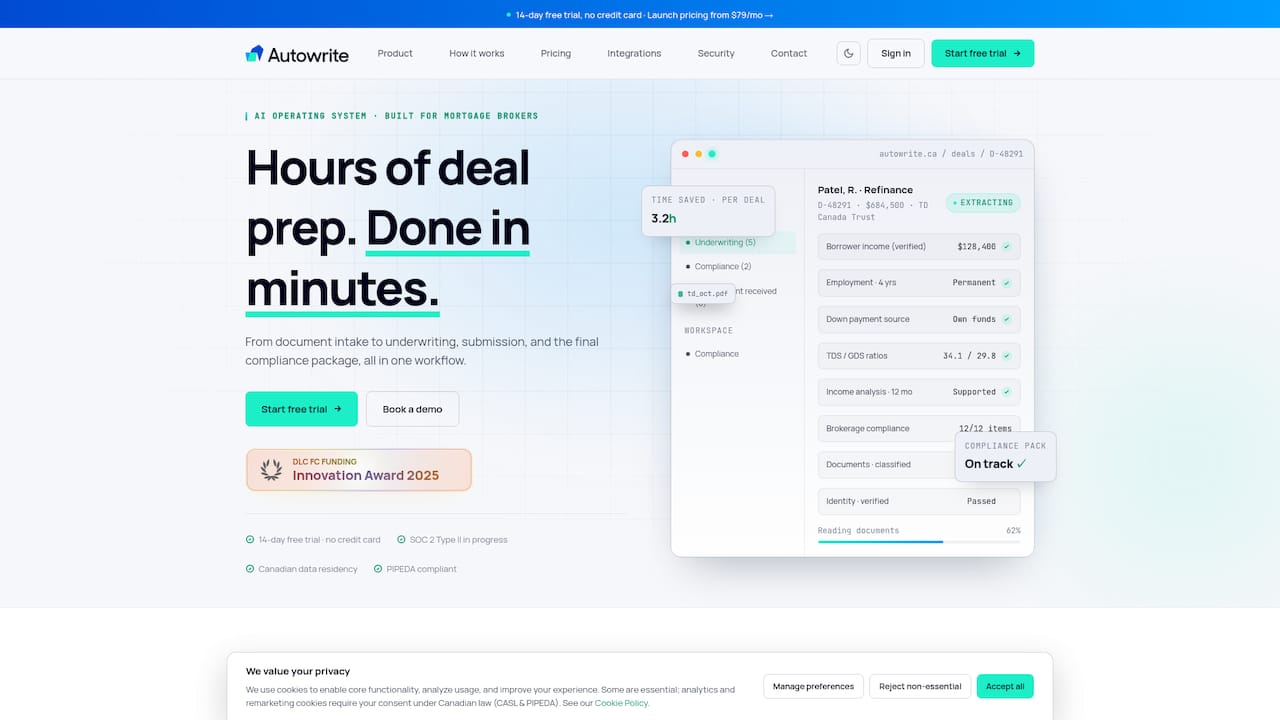
We offer four ways to get started, depending on brokerage size and volume:
- Starter, at $99 per month, for brokers testing automation on a single workflow.
- Pro, at $199 per month, for brokerages ready to scale document intelligence across a full pipeline.
- Legend, at $399 per month, for higher-volume teams managing multiple agents.
- Enterprise, with pricing available on request, for brokerages with custom integration needs.
Every plan starts with a 14-day free trial, which is the enough time to measure the admin-hour savings and error-rate improvements covered earlier in this piece on your own files. Check current plan details on our pricing page.
FAQ
Are mortgage rates expected to drop in Canada in 2026?
Rate direction depends on broader economic conditions that fall outside the scope of mortgage technology, and no figure in this piece addresses that forecast. Brokers are better served watching CMHC's residential mortgage industry reporting for renewal and borrower-condition trends than relying on a single rate prediction.
What income do you need for a $1,000,000 mortgage in Canada?
Required income depends on the lender's debt-service ratio calculations, including how they treat property taxes, condo fees, and other obligations, which CMHC's guidance on calculating GDS and TDS outlines in detail. There is no single income figure that applies across all lenders and borrower situations, so a broker needs to run the specific numbers against a client's full financial picture.
What will mortgages do in 2026?
Renewal volume continues to dominate the market, with CMHC's industry reporting pointing to borrower-condition indicators and renewal cycles as key drivers of 2026 activity. On the technology side, OSFI's guidance on generative and agentic AI signals that lenders will expect more documented oversight of AI-assisted files as adoption grows.
How much does a mortgage broker make on a $500,000 mortgage?
Broker compensation varies by lender, commission structure, and province, and no source in this piece states a specific commission figure for a mortgage. Brokers should check their own lender agreements for exact commission terms rather than relying on a generic industry estimate.
Do brokers need to worry about OSFI's AI guidance if they aren't a federally regulated institution?
Brokerages themselves are not federally regulated financial institutions, so OSFI's technology risk bulletins don't apply to them directly. Lenders that are regulated by OSFI increasingly expect transparency from brokers about how AI tools touch a file, so documenting vendor governance protects a broker's standing with lender partners even without a direct regulatory requirement.
Sources
- Generative and Agentic Artificial Intelligence: Implications for Technology, Cyber Security, and Operational Resilience - Office of the Superintendent of Financial Institutions
- Residential mortgage industry report - CMHC
- Canada
- AI is a gamechanger for mortgages – and brokers need to get on board | Canadian Mortgage Professional