

Prioritize three things before anything else: lender submission connectivity through Filogix or an equivalent, AI-driven document automation, and a mortgage-specific CRM to run your pipeline. Everything else, including marketing tools, comes later. Confirm every vendor meets PIPEDA data residency standards and aligns with FSRA expectations, roll out a minimal stack within weeks, and measure hours saved per file before you add a single additional tool.
TL;DR:
- A minimum viable mortgage tech stack should include Filogix-based submission, a simple pipeline CRM, secure document intake with e-sign, a basic rate reference, and automation features within four weeks.
- Vendors must demonstrate Filogix connectivity, Canadian data residency, FSRA compliance, and real-time API or native integrations to avoid manual re-entry and data mishandling.
- Building secure, automated document flows that classify and auto-fill submission forms can eliminate most re-typing and save hours per file, improving overall efficiency.
- A phased rollout focusing on core pipeline, lender matching, and document automation yields the greatest long-term time savings and reduces errors before expanding to marketing tools.
- Prioritizing connectivity and automation over marketing and lead generation ensures scaling success, with tools like Autowrite offering integrated solutions for Canadian broker workflows.
Table of Contents
- What Are the Five Categories a Canadian Mortgage Tech Stack Needs?
- What's the Minimum Viable Stack for a New Canadian Broker?
- How Do You Evaluate a Mortgage Tech Vendor Before Signing Up?
- Which Integrations Cut the Most Manual Work From a Broker's Day?
- What's a Realistic Rollout Timeline for a New Mortgage Tech Stack?
- Where Document Automation Fits in a Canadian Broker's Stack
- Why Most Broker Tech Advice Gets the Sequence Backward
- Try Autowrite: Document Automation Built for Canadian Brokerages
- Sources
What Are the Five Categories a Canadian Mortgage Tech Stack Needs?
Every functional Canadian mortgage tech stack breaks into five buckets, and brokers who scale past $20 to $30 million in annual funded volume typically run somewhere between 8 and 15 tools across them. That's not a target to chase on day one. It's a ceiling that tells you how much room you have to grow into.
Deal submission and underwriting is the backbone. This is where Filogix connectivity lives, along with document upload, condition tracking, and lender status updates. Without solid submission tooling, everything downstream slows down.
Lender matching and rate intelligence tools pull live rate feeds and match client profiles against lender criteria, cutting the manual research that used to eat an afternoon per file.
CRM and pipeline management replaces the spreadsheet-and-email approach with a visible pipeline, usually a kanban-style view showing every deal's stage.
Marketing and lead generation covers everything from email nurture sequences to social scheduling. It matters, but only once your pipeline and submission workflow already run clean.
Automation and workflow ties the other four together, handling tasks like auto-classifying a Notice of Assessment or a T4 the moment a client uploads it.
The core software layers, submission platform, CRM, e-signature, and document handling, form the spine of the stack, and most lost admin time happens in the gaps between them, not inside any single tool. A broker with a great CRM and a great submission platform that don't talk to each other is still re-keying data by hand.
Two Canadian constraints run through every category. First, Filogix (built by Finastra) has been the connectivity standard for submission and lender management for years, so any tool that claims lender integration needs to prove it actually talks to Filogix or the lenders directly. Second, data residency under PIPEDA and FSRA's regulatory posture toward the mortgage brokering sector mean you can't treat a US-hosted tool the same way you'd treat a Canadian one, regardless of how polished its interface looks.
What's the Minimum Viable Stack for a New Canadian Broker?
You don't need fifteen tools on day one. A minimum viable stack (MVS) covers five needs and can usually be running inside two to four weeks:
- Submission access through Filogix or a lender's direct portal, so deals actually move.
- A simple CRM or pipeline tracker that shows every deal's stage without you memorizing it.
- Secure document intake with e-sign so clients aren't emailing sensitive financials as unencrypted attachments.
- A basic rate reference or lender matrix, even a well-maintained spreadsheet works at this stage.
- Basic task automation, like reminder triggers for missing conditions or expiring rate holds.
Budget for the MVS runs modest, often a few hundred dollars a month in software costs for a solo broker, with most of the real cost being setup time rather than subscription fees. The upgrade trigger is volume, not calendar time: once you're closing more than roughly $2 to $3 million a month, or you've added a second or third agent, manual handoffs start costing more in errors and delay than the next tier of software costs in fees. That's your signal to add document automation and deeper lender integrations, not a fixed date on the calendar.
How Do You Evaluate a Mortgage Tech Vendor Before Signing Up?
Run every vendor through the same checklist, because the sales pitch will sound identical from every one of them.
- Lender connectivity: Does it plug into Filogix, and which lenders actually receive submissions cleanly versus requiring manual re-entry?
- Canadian data residency: Where is client data physically stored, and does the vendor state PIPEDA compliance in writing, not just in a sales call?
- FSRA alignment: Does the tool support the recordkeeping and disclosure practices FSRA expects from licensed brokers?
- Integration depth: Is there a real API or native connector, or does "integration" mean exporting a CSV and importing it somewhere else?
- Support and SLA: What's the actual response time when a submission fails at 4:45 p.m. on a Friday?
- Pricing structure: Per-seat, per-transaction, or flat brokerage rate, and does that scale sensibly as you add agents?
Red flags show up fast once you know to look for them: vendors that can't name which Canadian lenders they connect to, vague answers about where data lives, workflows that still require manual data re-entry at any step, and integrations that exist only as a marketing bullet point with no documentation behind them.
Pro Tip: Ask every vendor one blunt question during the demo: "Show me a document going from client upload to a completed Filogix submission, live." Vendors with real integrations do this without hesitation. Vendors without it stall, reschedule, or show you a slide instead.
Which Integrations Cut the Most Manual Work From a Broker's Day?
The highest-value integration pattern in any Canadian mortgage stack looks the same regardless of brokerage size: a client uploads a document, AI classifies it and extracts the relevant fields, those fields auto-fill the submission form, the package routes through e-sign, and the completed file lands in Filogix for lender review.
That single flow, done well, eliminates most of the re-typing that eats a broker's morning. The prioritization rule that matters here: build secure submission connectivity and document automation before you touch marketing integrations. A brokerage with beautiful lead-gen automation and a manual document pipeline is optimizing the wrong end of the funnel.
Three technical patterns handle the connective tissue:
- API integration for real-time data exchange between your CRM, document tool, and Filogix.
- Middleware or webhook orchestration when two tools don't talk directly but need to trigger actions in each other.
- Secure vaulting with scheduled sync for document storage that needs to stay compliant while still feeding downstream systems.
Getting this sequence right is the difference between a stack that saves hours and one that just adds more software to babysit.
What's a Realistic Rollout Timeline for a New Mortgage Tech Stack?
Roll out in phases, and resist the urge to buy everything in month one.
- Phase 0 (before launch): Audit your current workflow and clock how many hours per file go into document handling, data entry, and follow-up. You need this baseline or you'll never know if the new stack actually helped.
- Phase 1 (months 0 to 3): Deploy the minimum viable stack. Track hours saved per file against your baseline.
- Phase 2 (months 3 to 6): Add document automation and e-sign integration. This is usually where the biggest time reduction shows up, since document handling is the most repetitive part of the job.
- Phase 3 (months 6 to 12): Layer in rate intelligence and advanced workflow automation once your core pipeline runs clean.
Track three numbers throughout: manual hours per file, time from submission to approval, and frequency of lender condition requests tied to missing or misformatted documents. A brokerage that cuts document turnaround time meaningfully in Phase 2 will typically see fewer condition requests in Phase 3, since clean submissions generate fewer follow-up questions from underwriters. That compounding effect, less admin time feeding into faster approvals, is the real return on a well-sequenced rollout, more than any single tool's feature list. For a deeper framework on measuring this, see this guide to mortgage workflow automation ROI.
Where Document Automation Fits in a Canadian Broker's Stack
Document automation isn't about replacing a broker's judgment. It's about removing the part of the job that never required judgment in the first place: sorting a stack of PDFs, figuring out which one is the NOA and which is the bank statement, and typing numbers from a T4 into a submission form.
The realistic role of AI in a Canadian mortgage workflow is narrow and specific: classify documents, extract data accurately, and hand a clean file to the licensed advisor who makes the actual lending decision. The advisor's judgment stays exactly where it belongs.
Tasks that automate well in practice:
- Classifying uploaded documents by type (NOA, T4, bank statement, pay stub).
- Extracting income figures and down payment details for underwriting forms.
- Flagging missing or inconsistent documents before submission, not after a lender rejects the file.
Why Most Broker Tech Advice Gets the Sequence Backward
Most advice aimed at Canadian brokers leads with marketing and lead generation, because that's the flashy part. It's also the wrong place to start. A broker with a slick funnel and a manual document pipeline just generates more leads that get stuck in the same bottleneck.
The research on how top-performing brokerages actually scale backs a different order: deal flow and lender matching come first, marketing comes after the pipeline and underwriting workflow already run without friction. That sequencing isn't intuitive to a broker just starting out, because marketing tools are the ones every vendor pitches loudest.
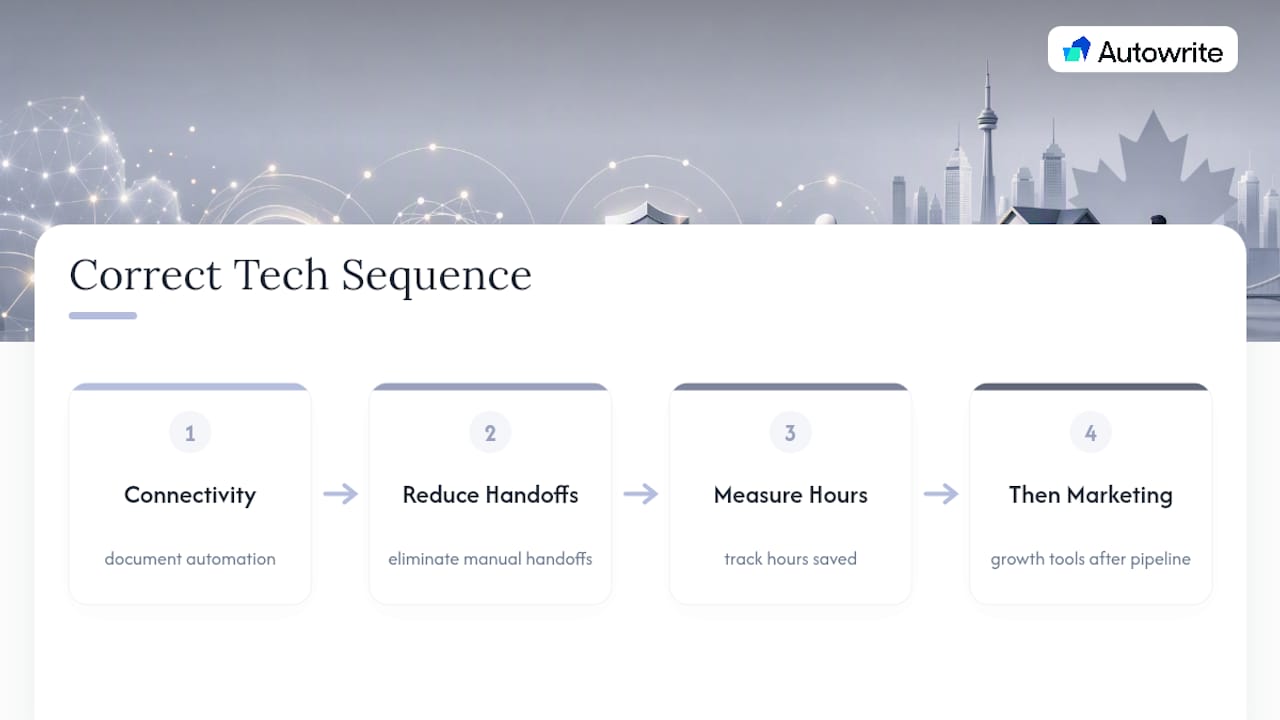
What I'd push back on directly is the idea that more tools equal more efficiency. A brokerage running eight well-integrated tools will outperform one running fifteen disconnected ones every time. The number that matters isn't tool count. It's how many manual handoffs disappear between document intake and Filogix submission. Get that number down first. Everything else, rate intelligence, advanced CRM segmentation, lead scoring, is optimization on top of a foundation that either works or doesn't.
Start with connectivity and document automation. Measure the hours saved. Then, and only then, spend on growth tools.
— Anant Bawa
Try Autowrite: Document Automation Built for Canadian Brokerages
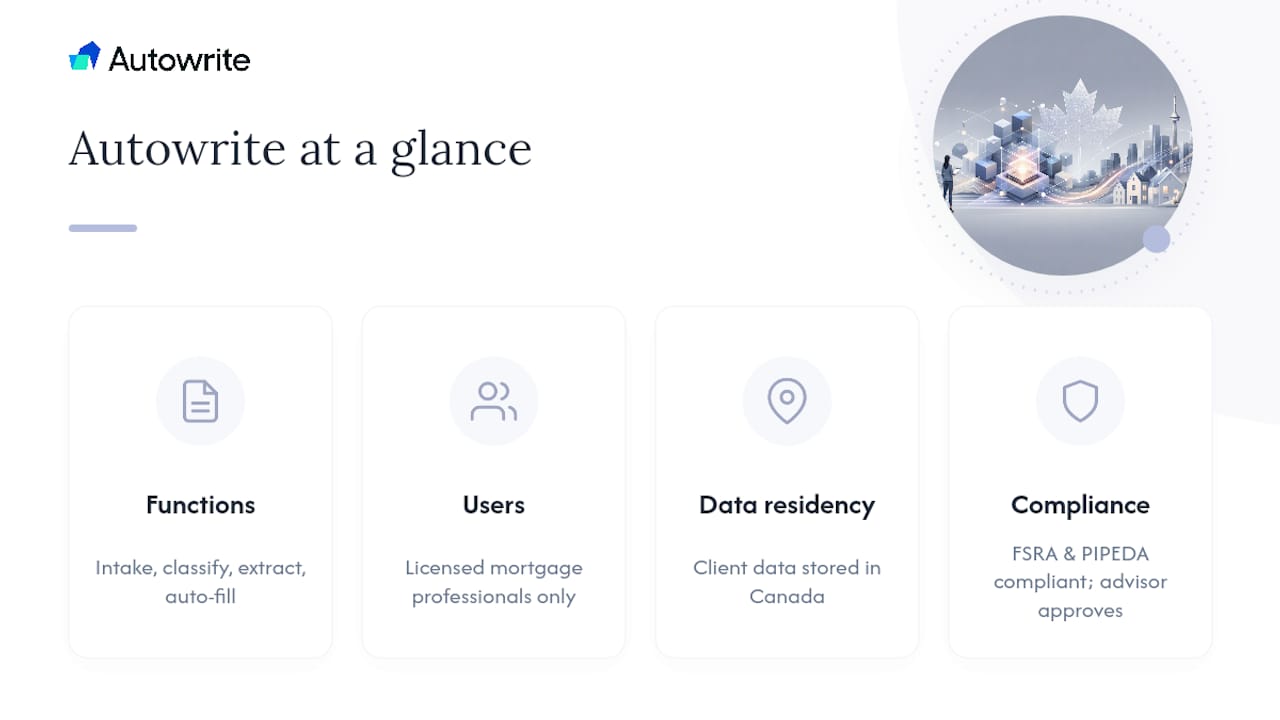
Autowrite is the direct answer to the document bottleneck this article just walked through: instead of stitching together a classification tool, a data-extraction tool, and a separate compliance checklist, Autowrite handles intake, classification, extraction, and underwriting form auto-fill as one connected system built specifically for the Canadian mortgage workflow.
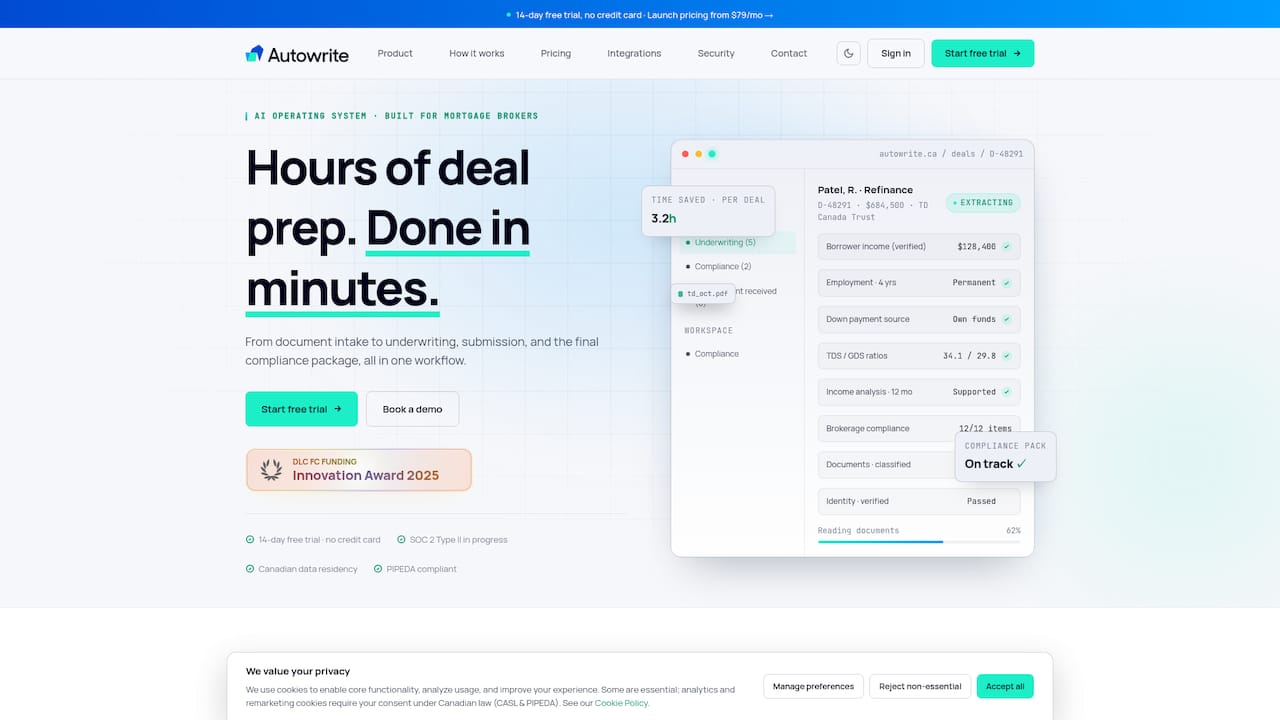
It's designed for licensed mortgage professionals who handle manual document sorting and data entry, not for borrowers managing their own paperwork. Client data stays resident in Canada, the compliance package assembly is built around FSRA and PIPEDA expectations, and the licensed advisor keeps final decision authority on every file, exactly the human-in-the-loop model that Canadian AI mortgage platforms are converging on.
If your current stack still has you manually sorting NOAs and bank statements, start a free trial at Autowrite and see how much of that work disappears in your first month. For more on where AI fits into a broker's daily workflow, read this breakdown of AI for mortgage brokers.
Sources
For deeper detail, see FSRA's mortgage brokering resources, this pipeline management automation guide, and this document intake checklist.
This article is general information, not a substitute for advice from a qualified financial advisor. Consult a qualified financial professional about your own circumstances before acting on anything here.
- The Complete Canadian Mortgage Broker Tech Stack (2026)
- The Canadian mortgage broker tech stack, explained.
- FSRA — Industry: mortgage brokering sector
- Technology — Canada's AI-Powered Mortgage Platform