

Market structure pushes mortgage technology toward standardized workflows and audit-ready documentation, not consumer-journey reinvention. Centralized lending, OSFI supervision of third-party AI risk and FSRA scrutiny of suitability files reward configurable lender rules, integrations and traceable records. We built Autowrite around that reality, automating document workflows for Canadian mortgage brokers.
TL;DR:
- Canadian lending is more centralized than US lending, so vendors should prioritize lender rules, broker portal integrations, and traceable records over consumer app redesign.
- FSRA found suitability documentation missing, incomplete, or inconsistent in about 65% of sampled private mortgage files; record recommendation rationale and preserve changes for later review.
- Mortgage approval typically takes 6 to 12 weeks; classification, data extraction, and condition tracking target document gathering and tax verification, while appraisal delays remain.
- Automate sorting, data entry, form filling, and status chasing; train staff to check extracted figures and handle exceptions, leaving negotiation and complex deal structuring to people.
Table of Contents
- How do market drivers differ from the US for mortgage technology?
- Which workflow stages standardize well, and why does it matter?
- What do regulators expect from documentation and workflow design?
- Where does automation shorten the underwriting workflow?
- What should vendors prioritize when building for this market?
- How should brokerages plan for efficiency and workforce change?
- Where does original Canadian mortgage workflow research need to go next?
- How does an AI document-intelligence system map to these priorities?
- FAQ
- Sources
How do market drivers differ from the US for mortgage technology?
Think of this as a quick map for judging whether a vendor's features fit the market you actually operate in.
- Canada: a smaller, more centralized market with fewer product variants and national supervisory expectations. That favours lender-configurable rules and deep integrations.
- United States: larger scale, state-by-state variation and heavier product complexity. That often favours consumer-journey reinvention and opaque consumer scoring.
- Lender relationships: mortgage finance companies occupy a meaningful part of Canadian origination, which keeps broker-to-lender submission flows central to how files move.
- Implication for vendors: lead with integration, configurability and audit outputs. A slick borrower app does little for an underwriter who must defend a decision on file.
The practical test is simple: if a product cannot adapt to a lender's own policy rules, it will struggle here regardless of how polished its interface looks.
Which workflow stages standardize well, and why does it matter?
Centralization means lenders publish clear policies and brokers submit to many of them through similar channels. That makes certain stages ideal candidates for automation first:
- Document intake: collecting and sorting files from clients, employers and agencies.
- Identity checks: confirming who the applicant is against required records.
- Income validation: reconciling pay stubs, T4s and notices of assessment.
- Policy-rule checks: testing the file against a lender's stated guidelines.
- Condition tracking: following each outstanding item through to clearance.
Lender-defined rule engines fit this environment better than opaque scoring models. An underwriter can see why a rule fired, and a principal broker can re-create the decision later. Opaque scores cannot offer that.
The payoff is practical: faster approvals, more consistent underwriting decisions and files that assemble themselves into an audit-ready package. Our guide to document classification for brokers shows how this plays out in daily operations.
Pro Tip: Automate the stages with the most repetition and the least judgement first, then measure condition-clearing time before expanding.
What do regulators expect from documentation and workflow design?
Regulatory pressure shapes what a file must contain long before technology enters the picture. FSRA's guidance on documenting suitability calls failure to record the rationale behind a recommendation a leading compliance pitfall, and principal brokers must be able to re-create a suitability decision from the file alone. On the federal side, reporting on AI and the broker back office notes that OSFI treats AI tools as third-party technology risk, so vendors must support fraud detection, data security and internal control.
What that means for file design:
- Record the rationale for each recommendation, not only the supporting documents.
- Keep an audit trail showing who changed what and when.
- Preserve records so a principal broker can reproduce the decision later.
- Document vendor controls for any AI tool that touches client data.
- Align retention with the practical proofs described in our piece on FSRA mortgage compliance.
FSRA's review of private mortgage files found that about 65% of sampled transactions had missing, incomplete or inconsistent documentation of the suitability assessment. That gap is a workflow problem as much as a training one, and it is exactly where structured capture helps. Our overview of audit-ready digital compliance records goes deeper on retention.
Where does automation shorten the underwriting workflow?
Underwriting is a sequence of handoffs, and each handoff is a chance for delay. A practitioner timeline puts the full journey from first contact to closing at about 6 to 12 weeks, with these typical stages:
- Document gathering: 1 to 3 days.
- Pre-approval: 1 to 5 business days.
- Conditional approval: 3 to 10 business days.
- Appraisal: 3 to 10 business days.
- Title search: 3 to 5 business days.
- Closing: coordinated once conditions clear.
The usual delays are missing documents, appraisal lag and tax-record verification. Automation attacks the first and the last. Classification routes each upload to the right slot, extraction pulls figures into fields, and condition tracking flags what is still outstanding before the lender asks.
Take an illustrative case: an underwriter receives a file where pay stubs, a notice of assessment and bank statements arrive in one unsorted bundle. Manually, someone names, sorts and keys every figure. With classification and auto-fill, the underwriter opens a pre-populated review screen and checks the numbers instead of typing them. Our underwriting submission package checklist lists the core documents involved.

What should vendors prioritize when building for this market?
Market structure translates directly into a product roadmap:
- Configurable rule engines: let lenders encode their own policies rather than forcing a generic model.
- Policy templates: ship starting points that lenders can tune.
- Integrations: connect to the origination systems and lender portals brokers already use. Monoline lenders, for example, typically offer broker portals with real-time deal status and document upload, and a vendor must fit that flow.
- Audit-ready exports: produce packages a principal broker can hand to a regulator.
- Third-party risk documentation: make it easy for a lender to complete its own vendor assessment. Guidance on sovereign AI deployment is a useful reference for the controls that reviewers look for.
Entry tactics matter too: support principal-broker review steps, work alongside mortgage insurers and build local integrations before chasing breadth. Our analysis of mortgage tech trends under OSFI scrutiny covers what regulators are watching.
Pro Tip: Write your third-party risk documentation before a prospect asks for it. It shortens every sales cycle that touches a regulated lender.
How should brokerages plan for efficiency and workforce change?
Automation exposure is highest where work is repetitive and rule-based. Judgement, negotiation and client trust stay human.
- High exposure: document sorting, data entry, form population and status chasing.
- Lower exposure: structuring complex deals, explaining trade-offs to clients and handling exceptions.
- Upskilling: train administrative staff to review machine output, catch extraction errors and manage exceptions rather than retype data. Reporting on AI in the broker back office suggests some firms will adapt and others will not.
- Preserve knowledge: have experienced staff define review checklists so institutional knowledge lives in the process.
- Expected outcomes: fewer days to clear conditions, clearer client communication and more hours for advisory work.
The aim is not fewer people. It is moving effort from keying to checking, where human attention actually reduces risk.
Where does original Canadian mortgage workflow research need to go next?
My view is that the industry measures outcomes it can see, such as rates and volumes, and ignores the operational metrics that decide whether a file closes cleanly. I would prioritize time-to-condition-clear, document completeness rates, pre-funding error rates and upskilling outcomes. Gender and regional differences in automation exposure also need longitudinal study. Anonymized operational data shared through industry bodies would finally let firms benchmark themselves.
— Anant Bawa
How does an AI document-intelligence system map to these priorities?
We designed Autowrite for the workflow described above, and it lines up with the sections you just read:
- Document classification and data extraction for intake and income validation.
- Auto-filled underwriting forms with line-level confidence for reviewers.
- Audit-ready compliance and e-sign packages.
- Canadian data residency.
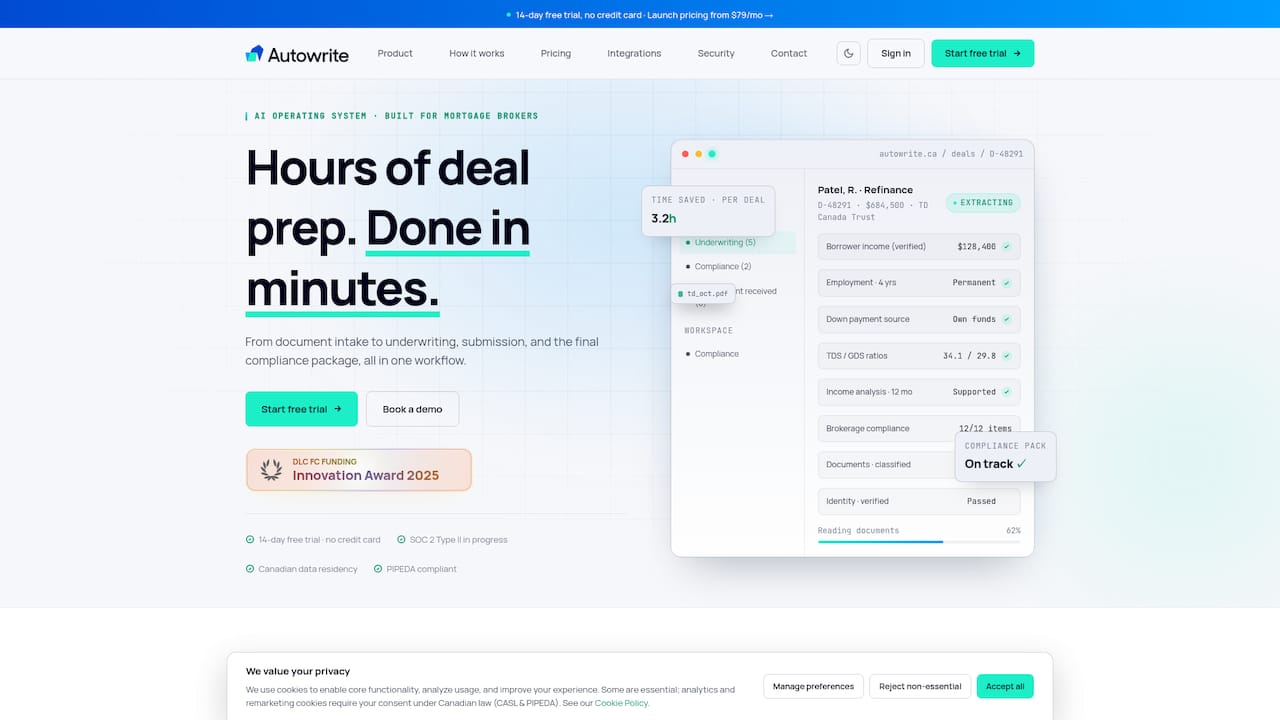
If you are a licensed broker or brokerage owner, review plans on our pricing page, where Starter is $99 per month, or start the free trial.
FAQ
How many Canadians own homes without a mortgage?
Statistics Canada reports that a share of households were homeowners without a mortgage in 2024.
How do mortgage workflows differ from the US?
Lending here is more centralized, with fewer product variants and national supervisory expectations. That favours configurable lender rules, integrations and audit outputs over consumer-journey redesign.
What are the recent federal mortgage rule changes?
The federal government's December 2024 reforms raised insured mortgage caps and expanded amortization eligibility for some first-time buyers. Confirm current parameters with the primary source before advising clients.
How long does mortgage approval take?
A practitioner timeline shows about 6 to 12 weeks from first contact to closing. Document gathering, appraisal and conditions are the stages where workflow automation helps most.
Sources
- The Rise of Mortgage Finance Companies in Canada: Benefits and Vulnerabilities
- AI is coming for brokers' back office. Some will adapt. Many will not | Canadian Mortgage Professional
- Show your work: documenting that a mortgage is suitable for your client | Financial Services Regulatory Authority of Ontario
- How Long Does Mortgage Approval Take in Canada? 2026 Timeline by Lender | WealthNorth