
Lender submission automation converts scattered borrower documents into a validated, lender-ready package without the usual chase of emails and text threads. It cuts the number of resubmissions caused by missing conditions or bad data, and it shortens the time between file completion and lender review. Platforms like Autowrite and insurer channels such as Sagen's Excel program show what this looks like in practice.
TL;DR:
- Automation reduces manual handling and minimizes resubmission rates by validating required conditions before submission, cutting days from the process.
- It ensures structured intake, confidence scoring, and timestamps for compliance, auditability, and faster adjudication times, often under a minute to 24 hours.
- Proper implementation requires phasing out old channels, configuring templates correctly, training staff, and updating privacy policies to meet security regulations.
- A successful rollout hinges on a single intake portal, clear data validation, and aligning workflow and technology changes simultaneously.
- Systems like Autowrite are designed to support Canadian brokers with built-in templates, data extraction, and compliance packages, simplifying deployment.
Table of Contents
- The business case for automating lender submissions
- How lender submission automation actually works
- Privacy, security, and regulatory obligations you can't skip
- A step-by-step rollout checklist for brokerages
- Timelines and the KPIs that prove it's working
- What good vendor and workflow design looks like
- What successful rollouts tend to have in common
- Where the biggest implementation problems show up
- Where the technology is headed next
- Build compliance in, don't bolt it on
- Try Autowrite for your own lender submissions
- Where these numbers and rules come from
- Sources
- FAQ
The business case for automating lender submissions
The pitch for automation is simple: processors spend less time chasing documents and more time closing files. When intake, validation, and packaging happen in one system instead of across email chains, a single processor can carry a heavier pipeline without extra hours.
The bigger payoff shows up in fewer resubmissions. Missing signatures, stale bank statements, and mismatched income figures are the most common reasons lenders bounce a file back, and each round trip adds days. Automated validation catches these gaps before submission instead of after a lender flags them.
Compliance also stops being a bottleneck once it is built into the workflow. A file that arrives with a documented audit trail and pre-checked conditions gives the lender less reason to pause for verification.
- Fewer manual touches per file, since documents are sorted and checked automatically.
- Lower resubmission rates because STIP conditions are validated before the file leaves the brokerage.
- Faster lender review because the package already matches what the adjudicator expects to see.
Insurer channels can adjudicate in under a minute or take up to 24 hours, depending on the complexity of the file and the verifications required, according to Sagen's Schedule A. Cleaner, better-validated submissions tend to land at the faster end of that range.
How lender submission automation actually works
Automation replaces the patchwork of email attachments and text photos with a structured pipeline that moves a document from upload to lender inbox with as little manual handling as possible.
- Intake: borrowers upload through a dedicated portal, mobile capture, or a guided form instead of emailing PDFs or texting photos.
- Document intelligence: optical character recognition and line-level extraction pull data from pay stubs, bank statements, and identification, each field carrying a confidence score.
- Validation: extracted data is checked against lender and insurer rules, flagging missing conditions or inconsistent figures before a human ever opens the file.
- Orchestration: a checklist-driven workflow tracks outstanding STIP conditions, branches based on loan type, and timestamps every step for the audit trail.
- Submission: the completed package moves out through a lender API, an insurer's electronic channel, or secure file transfer, depending on what the receiving institution supports.
Replacing email intake with a structured channel matters more than it sounds. Email and text threads create version control problems: nobody can be sure which attachment is current, and there is no reliable timestamp for when a condition was satisfied.
- Structured portals eliminate duplicate or outdated document versions.
- Confidence-scored extraction lets processors focus review time on the fields that need a second look.
- Auditable timestamps give lenders and regulators a clear record of when each step happened.
Insurer channels add their own requirements on top of this. Sagen's Excel electronic communication program is built as a two-way electronic channel for handling most residential mortgage insurance applications on a paperless basis, and it expects lenders to verify data accuracy before anything goes out. Automation that conforms to those templates from the start avoids a second layer of manual reformatting.
Privacy, security, and regulatory obligations you can't skip
Automation touches personal financial data, which means it inherits every privacy and security obligation a brokerage already carries. Federal privacy law under PIPEDA applies across the industry, alongside provincial counterparts that can impose additional requirements depending on where a brokerage operates.
Documented consent for credit checks is not optional. PIPEDA guidance and OPC audit findings recommend limiting data collection to what is necessary, keeping consent records for every credit pull, training staff regularly, and having a breach-response plan ready before it is needed.
Cybersecurity expectations add another layer. The Mortgage Broker Regulators' Council of Canada's cybersecurity preparedness principles call for controls that protect client information and procedures for notifying affected parties if something goes wrong.
- Encrypt data in transit and at rest, and restrict access by role.
- Log every access and edit to a borrower file for the audit trail.
- Train staff on consent requirements and breach procedures on a set schedule.
- Centralize responsibility for credit pulls rather than letting any team member initiate one.
These controls are not separate from the workflow improvements described earlier. The same validation rules and timestamped audit trail that speed up lender review are what regulators and auditors expect to see when they check how a brokerage handles sensitive data.
Pro Tip: Build consent capture into the intake portal itself, so a documented credit-check authorization exists before the file ever reaches a processor.
A step-by-step rollout checklist for brokerages
Deploying automation works best as a phased project rather than a single switch-over.
- Lock a single intake portal and communicate to borrowers and referral partners that email and text uploads are no longer accepted.
- Define lender and insurer templates so validation rules match what each receiving institution actually requires, including insurer formats like Sagen's Excel schedule.
- Configure STIP branching so conditional requirements (self-employed income, gifted down payments, non-resident status) trigger the right document requests automatically.
- Assign privacy and security ownership to a specific role, and update the brokerage's privacy policy and consent language to reflect the new intake process.
- Run a short pilot with a subset of files, tracking resubmission rate and time-to-submission against the old process before rolling it out brokerage-wide.
A document checklist built for intake workflows helps standardize what gets requested at each stage, and a complete lender submission checklist gives processors a per-document reference so nothing gets missed during the transition.
Timelines and the KPIs that prove it's working
Most brokerages can move from pilot to full production within a few weeks to a couple of months, depending on how many lender templates need configuring and how much staff retraining is involved. The variables that stretch this timeline are usually integration complexity and the number of legacy channels still in use.
Four KPIs tell you whether the rollout is working:
- Time-to-submission: how long from file completion to lender receipt.
- Resubmission rate: the share of files bounced back for missing or incorrect information.
- Processor throughput: files handled per processor per week.
- Time-to-decision: how long the lender or insurer takes to adjudicate once the file arrives.
Adjudication windows can range from very short to up to a full day, according to Sagen's submission schedule, and cleaner submissions tend to land toward the faster end because they need less manual verification on the lender's side.
What good vendor and workflow design looks like
Anant Bawa covers mortgage workflow automation from the operational side of the brokerage, focused on where paperwork actually slows deals down. Autowrite is built around that same problem: it classifies incoming documents, extracts data at the line level with confidence scoring, assembles compliance packages automatically, and keeps data within Canadian residency requirements.
When evaluating any vendor, ask how the system handles STIP branching, what its audit trail captures, and whether it integrates with the lender templates your brokerage submits to most often. A short pilot measuring resubmission rate and time-to-decision, as outlined above, is the fastest way to separate a real fit from a demo that looks good but doesn't hold up in production.
What successful rollouts tend to have in common
Brokerages that get the most out of automation share a pattern: they treat the rollout as an operational change first and a software purchase second. The brokerages that struggle usually try to run the new system alongside the old email-based process, which defeats the purpose since borrowers and referral partners keep defaulting to whatever channel is easiest.
The ones that succeed pick a single intake portal, retire every other channel at the same time, and give processors a short adjustment period with direct support. They configure lender and insurer templates before go-live rather than discovering gaps mid-file, and they assign one person to own privacy and consent updates so nothing falls through during the transition.

Pipeline visibility matters too. Brokerages that pair document automation with pipeline management practices catch bottlenecks earlier, since a stalled file shows up in the dashboard instead of sitting unnoticed in someone's inbox. The common thread across working implementations is that the technology change and the process change happen together, not in sequence.
Where the biggest implementation problems show up
The most common failure point is letting old channels survive alongside the new system. If borrowers can still text a photo of a pay stub or email a document directly to a processor, the audit trail has a hole in it and version control breaks down immediately.
Under-configured validation rules cause a different problem: a system that accepts documents without checking them against lender requirements just moves the resubmission problem downstream instead of solving it. Brokerages sometimes skip the step of mapping insurer-specific formats, like Sagen's Excel schedule, and end up reformatting files manually anyway.
Staff resistance is a quieter but common issue. Processors who have built workarounds for years can be slow to trust an automated validation step, especially if early configuration produces false flags. Running a short pilot with clear before-and-after metrics, rather than a brokerage-wide switch-over, gives staff time to see the system catch real errors before they're asked to rely on it fully.
Privacy gaps round out the list. A brokerage that automates intake without updating its consent language or retraining staff on the new data flow can end up out of step with PIPEDA obligations even if the technology itself is sound. Fixing this means treating the privacy policy update as part of the rollout, not an afterthought.

Where the technology is headed next
Document intelligence is improving quickly enough that line-level extraction accuracy keeps climbing, which means fewer fields need manual review before submission. The next layer being built on top of that is predictive flagging: systems that don't just extract data but also anticipate which conditions a specific lender is likely to require based on loan type and borrower profile.
Machine learning models trained on historical resubmission patterns are starting to catch the kinds of errors that used to require a processor's judgment, like an income calculation that technically checks out but doesn't match a lender's typical underwriting pattern. That shifts more of the quality-control work earlier in the process, before the file ever reaches a human reviewer.
Integration is also tightening. As more lenders and insurers open direct electronic channels, similar to Sagen's Excel program, the gap between "automated intake" and "automated submission" keeps narrowing, reducing the manual handoff that currently sits between a validated file and the lender's system. Brokerages that build clean, well-validated data pipelines now will be better positioned to plug into those direct channels as they roll out more broadly.
Build compliance in, don't bolt it on
The brokerages getting the most out of automation didn't treat compliance as a speed bump. They designed validation and audit trails into the intake process itself, which is exactly what made lenders move faster, not slower, on their files.
If there's one policy worth mandating brokerage-wide, it's this: pick a single structured intake portal and require every processor and referral partner to use it. Automation only works as an operations project, with training and enforced habits behind it. The software is the easy part.
— Anant Bawa
Try Autowrite for your own lender submissions
If the checklist above sounds like a lot to build in-house, that's exactly the gap Autowrite is built to close for Canadian mortgage brokers.
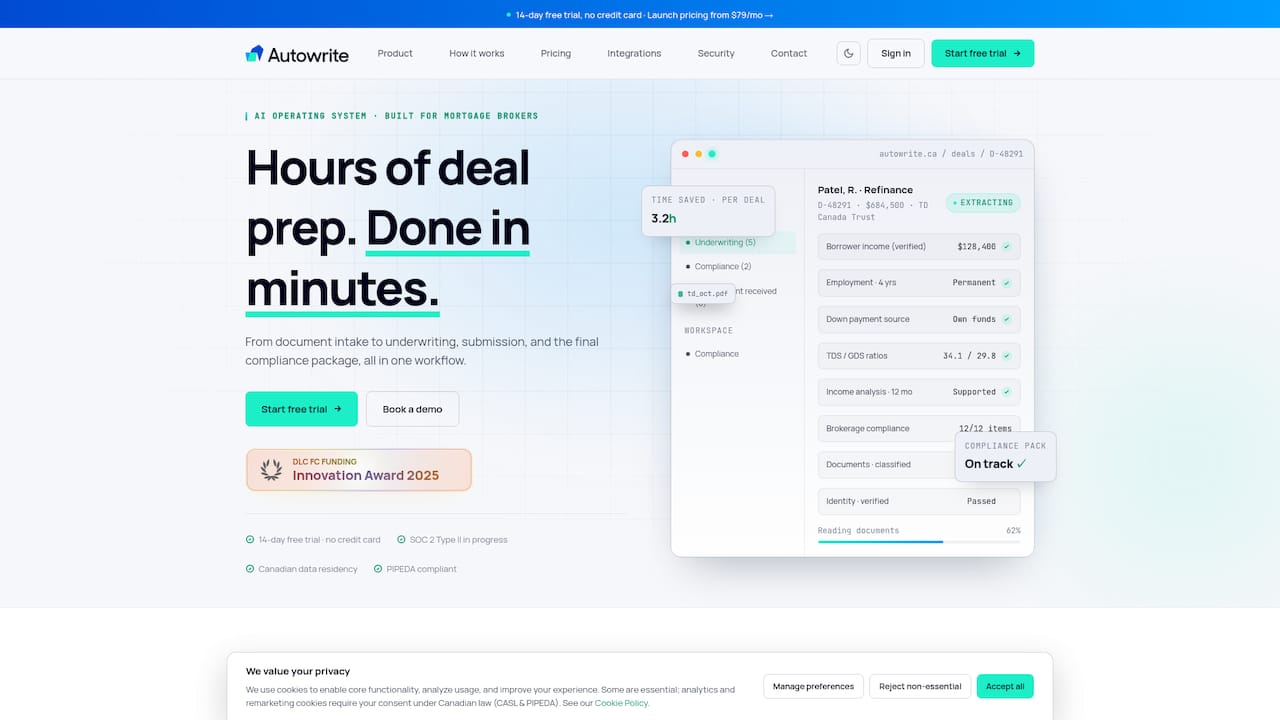
It classifies incoming documents, extracts data at the line level with confidence scoring, and assembles compliance packages automatically, keeping data within Canadian residency requirements throughout. Instead of configuring validation rules and STIP branching from scratch, brokers get that structure built in from the first upload.
Before committing, it's worth checking a few things against your own pipeline:
- Does it support the lender and insurer templates you submit to most often?
- How does the audit trail hold up against your brokerage's privacy policy?
- What does a short pilot look like, and what would you measure?
Plans start with Starter at $149 per month, with Pro and Legend tiers available for larger pipelines, plus a 14-day free trial to test fit before committing.
Where these numbers and rules come from
Claims here draw on government broker audits, FSRA cybersecurity guidance, Sagen's submission schedule, and Ontario's O. Reg. 188/08.
Sources
- Mortgage Broker Regulators' Council of Canada Principles for Cybersecurity Preparedness for the Mortgage Brokering Sector
- Schedule A to the Electronic Commerce Endorsement — Sagen Mortgage Insurance Company Canada
- O. Reg. 188/08 — Mortgage Brokerages: Standards of Practice
- Mortgage broker privacy best practices (PIPEDA guidance summary)
- Audit of Selected Mortgage Brokers — Government of Canada
FAQ
What are the 5 C's of lending?
The 5 C's typically refer to character, capacity, capital, collateral, and conditions, the factors lenders weigh when assessing a borrower's creditworthiness. Definitions vary slightly by institution, but these five categories cover the core of most underwriting frameworks.
What is mortgage automation?
Mortgage automation refers to software that handles repetitive parts of the loan process, such as document collection, data extraction, and compliance packaging, without manual entry at each step. It typically covers intake, validation, and submission, reducing the time between application and lender review.
What is the best loan management software for lenders?
The right choice depends on a brokerage's pipeline size, lender relationships, and compliance requirements, so there's no single best option for every situation. Platforms like Autowrite focus specifically on document intelligence and compliance packaging for Canadian mortgage brokers, which makes it worth evaluating against your own template and integration needs.
Can AI be used for loan underwriting?
AI is increasingly used to support underwriting tasks like data extraction, confidence scoring on submitted documents, and flagging missing conditions before a file reaches a human underwriter. It generally assists the process rather than replacing underwriter judgment on complex or borderline files.