

Most of the time lost on a Canadian mortgage file is not underwriting. It is the work around it: chasing documents, retyping the same data into forms, assembling compliance packages and fixing submissions that come back incomplete. The fastest way to shorten a file is to automate that work in one system built for Canadian brokers. That is why we built Autowrite: it handles document intake, classification, data extraction and form fill, so you spend your hours on the client and the lender.
TL;DR
- Delays come from incomplete intake, manual re-entry and rework at lender submission, so fix those first.
- Collect a complete document set up front and validate it before you submit.
- CMHC's Mortgage Data Standards report estimates that standardized data could cut loan processing time by 2.9 days across the industry.
- Keep FINTRAC and provincial records intact while you speed up: automation should produce them, not skip them.
- Measure time from first document to lender submission, and count resubmissions, before and after any change.
Table of Contents
- Where the time actually goes
- Step 1: Collect a complete document set once
- Step 2: Stop re-typing the same data
- Step 3: Validate before you submit
- Step 4: Keep compliance inside the workflow
- Step 5: Track status and keep follow-ups moving
- When to hire an assistant, and what to hand over
- How to measure whether it is working
- Our view: speed comes from one connected workflow
- Try it on your own files
- FAQ
- Sources
Where the time actually goes
CMHC describes the mortgage process as running from the first intake of application information through to loan closing, and it points to data handling across that span as a source of inefficiency (CMHC, Mortgage Data Standards). In a broker's day, that shows up in four places:
- Intake. Clients send pay stubs, a Notice of Assessment, T4s, bank statements and a purchase agreement in whatever format and order they like.
- Re-keying. The same income, address and liability figures are typed into the application, the lender portal and the compliance forms.
- Submission quality. A file missing one document or one required field comes back, and the clock restarts.
- Follow-up. Status checks with lenders, lawyers and clients fill the gaps between milestones.
Lender speeds vary widely. One lender states that it may provide an approval and commitment in as few as three hours and close in two to four days (Canadian Mortgages Inc submission guidelines). Another targets one business day for application receipt and review stages (DMS Broker Kit). These are each lender's own best-case targets, not national standards. What they show is that the lender's clock only runs well when your submission is complete and accurate. That part is yours to control.
Step 1: Collect a complete document set once
A lender-ready purchase file typically needs the application, credit report, proof of income, appraisal and MLS listing, lawyer information and the Notice of Assessment, plus a file summary with the client, property and financing details (Canadian Mortgages Inc). Another lender's broker kit adds gathering submission documents immediately and obtaining a property title search (DMS Broker Kit).
Where it goes wrong: the checklist lives in your head, the client sends documents in three emails over two weeks, and a missing page is found only at submission.
What helps: a single intake request that lists every document by name, with a clear reason for each. Our mortgage document checklist for Canadian brokers and file preparation checklist lay out the full list. In Autowrite, documents that arrive are classified automatically and extracted into structured data, so you are not sorting attachments by hand.
Step 2: Stop re-typing the same data
Every manual entry is time and a chance for error. CMHC reports that standardized, higher-quality data can reduce manual reconciliation and repeated data collection, with a potential 2.9-day reduction in loan processing time (CMHC). The report presents this as an industry-level potential, not a promise for any one brokerage, but the direction is clear: capture data once, reuse it everywhere.
Autowrite extracts data from documents with line-level confidence, so you can see which values are certain and which deserve a glance. It then auto-fills underwriting forms and syncs with your mortgage software, so the figure you confirmed once is the figure everywhere.
Where it goes wrong: extraction that is fast but opaque. You still need to know which numbers to verify. Line-level confidence is designed to point you straight to them.

Step 3: Validate before you submit
Lenders that run electronic submission systems often provide a validation function. One tells brokers to use it before submitting, to check that the necessary application details are entered properly (Canadian Mortgages Inc). Another recommends submitting through application software and including full loan notes and broker fees (DMS Broker Kit).
A short pre-submission routine:
- Every required field is complete and matches the supporting document.
- Income and down payment are explained, with the source of the down payment documented.
- The file summary tells the underwriter the story in a few lines.
- Compliance items (identification, signed forms) are in the package.
Our underwriting checklist goes deeper on what underwriters look for. Autowrite provides income and down payment analysis and assembles e-sign and compliance packages, so these checks come from the file rather than from memory.
Step 4: Keep compliance inside the workflow
Speed that creates audit risk is not speed. FINTRAC obligations that came into force on October 11, 2024 for mortgage originators, lenders and administrators include a compliance program, customer due diligence, identity verification, applicable beneficial-ownership checks, client identification records and specified transaction reporting. BCFSA notes these federal requirements are separate from British Columbia's Mortgage Brokers Act and Regulation (BCFSA advisory). The same advisory lists suspicious transaction reports, terrorist property reports and large cash transaction reports at $10,000 or more among the obligations.
Provincial rules also touch records. In Alberta, the 2023 RECA Mortgage Broker Industry Council record shows amendments approved to clarify electronic record storage under Real Estate Act Rules 82(1)(f) and 82(2)(f) (RECA council meeting record). Confirm your own province's current requirements with your regulator, whether that is FSRA in Ontario, BCFSA in British Columbia, RECA in Alberta or the AMF in Quebec.
The practical point: build identification and record-keeping into the same flow as intake, so the compliance file is a by-product of the deal, not a second job at the end. Our guides on FINTRAC client identification methods, the FINTRAC compliance package and document retention periods cover the details. Autowrite stores data in Canada and generates compliance packages automatically.

Step 5: Track status and keep follow-ups moving
Once a file is submitted, time is lost in silence. Some lenders send email status updates as the file moves (DMS Broker Kit), but you also need your own view across every lender and client. A shared pipeline with a clear stage for each file lets a team see what is waiting on whom. Autowrite supports team pipeline management, which matters most when an agent or assistant works files alongside you.
Keeping clients informed reduces inbound questions as well. Clear status messages and a predictable cadence do more than any single tool, as this piece on automation, clear communication and status updates in the mortgage process also suggests.
When to hire an assistant, and what to hand over
An assistant is worth it when you are the bottleneck on tasks that do not need a licence: chasing documents, sorting attachments, keying data. Bring the assistant into a system where those tasks are already structured, and they become faster to train and easier to review. If document handling is automated first, the assistant's time goes to client contact and lender follow-up instead of data entry.
How to measure whether it is working
Pick a few numbers and track them for a month before changing anything:
| Measure | What it shows |
|---|---|
| Days from first client contact to complete document set | Intake speed |
| Hours of your time per file before submission | Admin load |
| Share of files resubmitted or sent back | Submission quality |
| Days from submission to commitment | Lender response, to compare by lender |
| Compliance items missing at file review | Risk |
Compare the same measures after the change. If turnaround drops but resubmissions or missing compliance items rise, you have moved the problem, not solved it.
Our view: speed comes from one connected workflow
We built Autowrite because brokers told the same story: the deal is won on the relationship and lost in the paperwork. Document intake, extraction, underwriting forms and compliance packages are usually handled in separate tools, and every handoff costs time and invites errors.
Our approach is a single platform made for Canadian brokers. Documents are classified and read with line-level confidence, forms are filled from that data, the package is assembled for e-signature and compliance, and everything syncs with your mortgage software. Data stays in Canada.
The goal is simple: turn hours of file work into minutes, so you can take more files without taking more risk.
Anant Bawa
Try it on your own files
Autowrite plans start at $99 per month for Starter, $199 for Pro and $399 for Legend, with Enterprise available on request. Additional deals cost $20 each, and pay as you go is $35 per deal. Paid plans come with a 14-day free trial. See the details on the Autowrite pricing page.
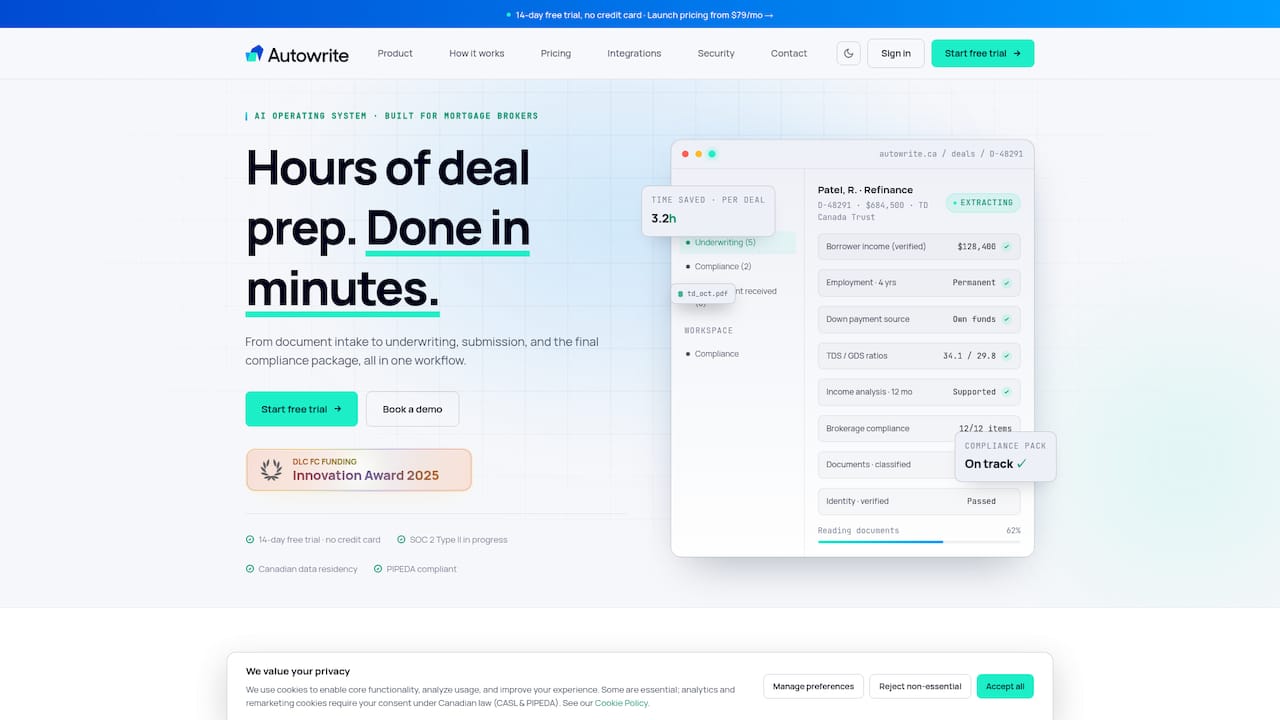
If you want to see how the workflow fits your brokerage, start from the Autowrite site.
FAQ
How long does mortgage approval take in Canada?
It depends on the lender and on how complete your file is. One lender states that it may issue an approval and commitment in as few as three hours, while another targets one business day for application receipt and review stages. Both are their own targets, so a clean, validated submission is the best way to stay near them.
What slows a mortgage file the most?
Incomplete documents and manual re-entry. Missing items trigger back-and-forth with the client, and retyped data creates errors that lenders send back. Collecting a full set up front and extracting data once addresses both.
Do I still need FINTRAC records if I automate?
Yes. Client identification records, compliance program elements and reporting obligations still apply. Automation should generate and store them as you work, so that your file is audit-ready when the deal closes.
When should a broker hire an assistant?
When unlicensed admin tasks such as sorting documents and keying data take more of your week than client conversations. Structuring those tasks in a workflow first makes the assistant productive sooner.
Sources
- CMHC, Mortgage Data Standards: Technology, business and policy
- Canadian Mortgages Inc, Mortgage Submission Guidelines
- DMS Broker Kit
- BCFSA advisory on FINTRAC obligations
- RECA Mortgage Broker Industry Council meeting record, 14 September 2023