
Compliance package automation works when three safeguards are built in from day one: every regulatory requirement is mapped to a template field, every extraction and approval leaves an immutable audit trail, and a licensed human signs off before a package leaves the building. Done that way, brokerages using automated tools like Autowrite can assemble disclosure sets, income documentation, and appraisal files that hold up under a Financial Services Regulatory Authority of Ontario (FSRA) audit or a provincial licensing review, provided Form 1/3.2 signatures and LOS integration are handled correctly.
TL;DR:
- Automation must ensure all regulatory disclosures, signatures, and retention requirements are captured with immutable audit trails and proper date logging.
- Human sign-offs and licensing controls remain essential, with clear SOPs, vendor governance, and regular audits to maintain accountability.
- Implementation should follow mapped requirements, thorough testing, and phased pilots, avoiding configuration before requirements are fully understood.
- Confidence scoring thresholds need to be tailored by document type, with cross-verification and error routing to prevent silent inaccuracies.
- Data security requires encryption, role-based access, and compliance with provincial storage laws, as breaches can escalate with automation.
Table of Contents
- What Compliance Package Automation Must Include
- Regulatory and Governance Controls Your Automation Must Show
- How Do You Implement Compliance Package Automation?
- Setting Extraction Confidence and LOS Field Mapping
- Who Owns What: Policies, Training, and Retention
- What Timeline, Cost, and ROI Should You Expect?
- How Autowrite Handles Compliance Package Automation
- Risk Management Strategies for Automated Compliance Packages
- Security and Data Privacy in Automated Compliance Packages
- Common Challenges When Automating Compliance Packages
- Where Most Brokerages Get Automation Wrong
- Evaluating Autowrite for Your Brokerage
- Sources
What Compliance Package Automation Must Include
Before you automate anything, know exactly what a complete file looks like on paper. Regulators require brokerages to provide certain disclosures in writing and collect signed acknowledgements, which means your automation has to track not just what document exists but who signed it and when.
A defensible package typically needs:
- Borrower and investor disclosures, including suitability assessments tied to the specific loan product recommended
- Conflict-of-interest and commission disclosures, delivered before the borrower commits to anything
- Form 1 or Form 3.2 style investor disclosures, which in many jurisdictions must carry a licensed Broker's signature, not an agent's
- Income and credit evidence (pay stubs, T4s, credit bureau pulls) cross-checked against loan application figures
- Appraisal reports and property valuation support tied to the specific file
- E-signature timestamps proving certain disclosures went out in a timely manner before the relevant event, where that timing rule applies
Retention matters as much as assembly. Most provincial rules point to a multi-year retention window consistent with common regulatory requirements for investor-related records, so your system needs to log who received each document, who signed it, and exactly when, not just store a PDF in a folder.
Regulatory and Governance Controls Your Automation Must Show
Automating the paperwork doesn't remove the Principal Broker's accountability. Provincial licensing rules make clear that the Principal Broker has to establish written policies and procedures, maintain a complaints process, and keep records current, including monthly reconciliations. Automation doesn't change who is on the hook when a regulator asks questions.
What examiners and auditors actually want to see:
- Immutable audit logs that record extraction events, which template version generated a document, who approved it, and when it was delivered
- Human-in-the-loop controls, including confidence thresholds that route uncertain extractions to a person rather than auto-approving them
- Documented standard operating procedures describing exactly how exceptions get handled and who has approval authority
- Vendor governance records, since regulators increasingly treat AI tools like any other third-party vendor requiring documented policies and scheduled audits
Pro Tip: Ask any automation vendor to export a full audit trail for a single file, start to finish, before you sign anything. If they can't produce it in under a minute, that's a governance gap you'll inherit.
How Do You Implement Compliance Package Automation?
Rolling this out in the wrong order is how brokerages end up automating a broken process faster. Follow this sequence instead.
- Map every regulatory requirement to a template field first. List every disclosure, signature, and retention rule your files need before you configure a single extraction rule. Skipping this step is the single most common cause of automation that amplifies existing mistakes rather than fixing them.
- Build extraction templates and validation rules. Set confidence thresholds for each document type and define exactly what happens when a field falls below that threshold.
- Configure LOS integration and field mapping in a sandbox. Test the full pipeline end to end, from intake to package delivery, before anything touches a live file.
- Run a parallel pilot on your highest-volume document type. Measure straight-through processing and exception rates side by side with your existing manual process, since phased pilots reduce risk and reveal the real exception rate before you commit.
- Formalize policies, train staff, and schedule vendor audits. Write the SOP that describes exception handling, assign sign-off authority, and put a recurring audit date on the calendar rather than treating this as a one-time setup.
Most brokerages underestimate step one and overestimate step three. The mapping work is tedious, but a well-mapped compliance framework makes the technical configuration almost mechanical. Skip it, and every downstream step inherits the gap.
Setting Extraction Confidence and LOS Field Mapping
Confidence scoring is the mechanism that decides whether a document gets auto-populated or sent to a person. A well-tuned system routes anything below its threshold to manual review rather than guessing, and that threshold should differ by document type based on how much variance is tolerable.
Key technical practices worth locking down early:
- Set higher confidence thresholds for income and credit documents than for lower-risk items like proof of address
- Build cross-document validation that compares a W-2 against pay stubs and bank statement deposits, flagging discrepancies to the underwriter rather than silently accepting the higher number
- Complete LOS field mapping in a sandbox environment and test with real historical files before go-live, since brokers consistently rank integration complexity among their top adoption barriers
- Log confidence score, source page, extraction timestamp, and the name of whoever verified the field for every extracted value, not just the final result
Error recovery deserves its own plan. When an extraction fails validation, the file should route back to a defined queue with a reason code attached, not sit in limbo waiting for someone to notice.
Who Owns What: Policies, Training, and Retention
Automation shifts tasks, not accountability. Documented policies need to explicitly reference the automated steps, the exception process, and who holds approval authority at each gate.
A few things brokerages consistently get wrong here:
- Treating automation as self-governing instead of assigning a named person to review exception queues weekly
- Skipping licensed Broker sign-off on documents that legally require it, even when the automation flags them correctly
- Under-training staff on how to pull an audit trail during a live regulator inquiry, not just how to run the software day to day
- Storing records for less than the retention window their province requires, often defaulting to whatever the software vendor's default setting happens to be
Retention schedules should match your provincial requirements for investor-related records, with secure storage and a clear chain-of-custody note showing who accessed a file and why.
What Timeline, Cost, and ROI Should You Expect?
Most brokerages move from pilot to full go-live in 8 to 16 weeks, depending heavily on how complex their LOS integration turns out to be. Custom integration work, template configuration, and exception-handling staffing are the biggest cost drivers, not the software license itself.
Document automation implementations commonly cut processing time substantially once intake, classification, and cross-document validation are running together, according to industry technology benchmarks.
Track four numbers to know whether it's working: straight-through processing rate, exception rate by document type, average time-to-package, and how long it takes to retrieve a full audit trail on demand. If audit retrieval still takes hours, the automation isn't finished, even if the packages look complete.
How Autowrite Handles Compliance Package Automation
Autowrite was built specifically for the paperwork side of Canadian mortgage brokering, not adapted from a general document tool. It classifies incoming files, extracts the data underwriting actually needs, and assembles e-sign and compliance packages without a broker retyping numbers from a pay stub into a form.
What that looks like in practice:
- Configurable confidence thresholds route uncertain extractions to a person instead of guessing, with exceptions landing in a queue rather than disappearing
- LOS integration and field mapping happen before go-live, so the sandbox testing step in your implementation roadmap has somewhere real to plug into
- Audit metadata, including who approved what and when, exports in a format ready for a regulator inquiry
- Data residency keeps client information secure within infrastructure compliant with applicable regulations
Brokerages evaluating a pilot can start with the document checklist and intake workflow guide to see how the mapping work translates into an actual configuration.
Risk Management Strategies for Automated Compliance Packages
The biggest risk in compliance package automation isn't the software failing outright. It's the software succeeding at producing a package that looks complete but is quietly wrong, because nobody built a control to catch that specific failure mode.
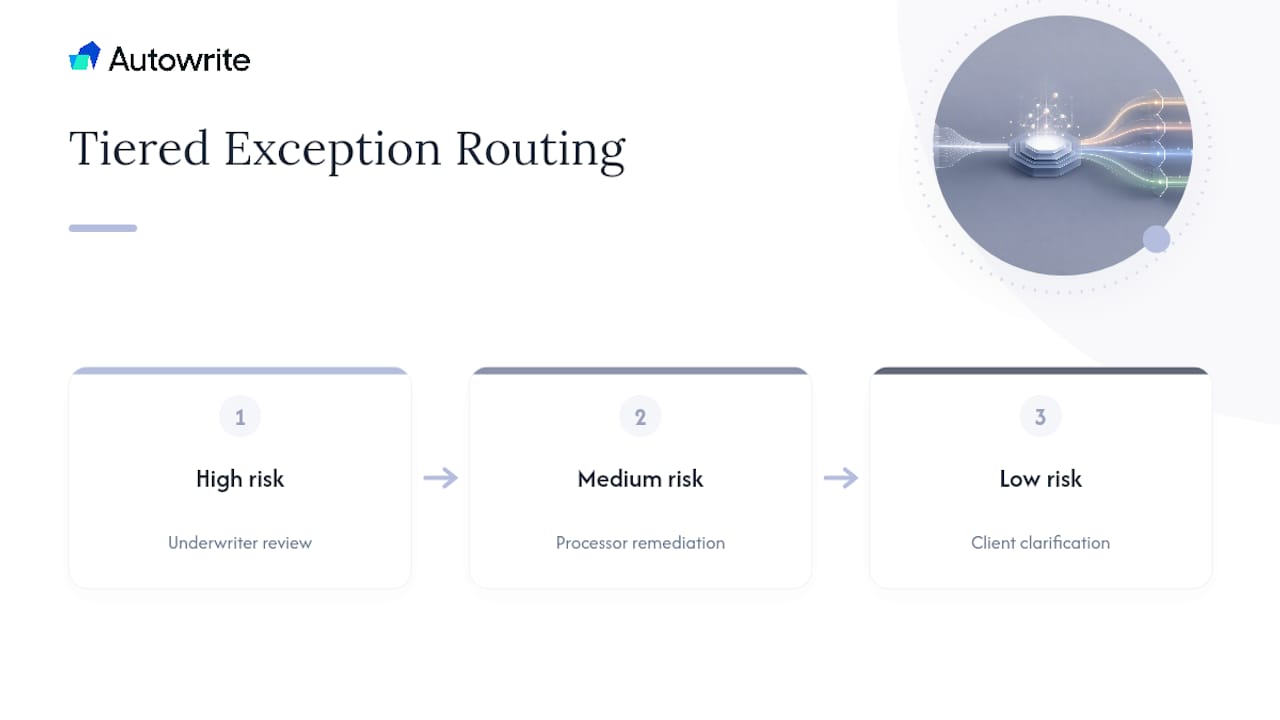
Start by tiering risk by document type rather than treating every file the same way. High-risk discrepancies, like income figures that don't reconcile across sources, should route immediately to underwriter review. Medium-risk items can go to a trained processor for quick remediation, and low-risk gaps, like a missing page number on a form, can go back to the client directly for clarification through a tiered exception queue.
Build in a kill switch. If exception rates spike above a defined threshold on a given day, the system should flag it for human review of the whole batch rather than continuing to process at the same confidence settings. That single control catches upstream problems, like a lender changing a form layout, before dozens of files inherit the same extraction error.
Vendor concentration is a risk most brokerages don't plan for. If one platform handles intake, extraction, and package assembly, you need a documented fallback process for the day that platform is unavailable during a closing deadline. Write that fallback into your policies before you need it, not while a file is stuck.
Finally, revisit your risk assumptions quarterly. Loan products change, lenders update their forms, and a validation rule that worked in January can silently stop catching the errors it was built for by summer.
Security and Data Privacy in Automated Compliance Packages
Mortgage files carry some of the most sensitive personal data a client will ever hand over, including social insurance numbers, bank statements, and credit history. Automating the handling of that data raises the stakes rather than lowering them, because a misconfigured system can expose or mishandle far more files, far faster, than a person ever could.
Encryption in transit and at rest is table stakes, but access control matters just as much. Every person and system component that touches a file should have logged, role-based access, so an audit trail shows not just what happened to a document but who could have touched it.
Data residency deserves specific attention for Canadian brokerages. Where client data is stored and processed carries real regulatory weight, and confirming a vendor's servers and processing location before signing a contract avoids a problem that's expensive to fix after the fact.
Industry survey data shows security and compliance concerns are the top adoption barrier cited by brokers evaluating mortgage technology, ahead of cost and integration complexity. That's a reasonable instinct. Ask any vendor for their data handling policy, breach notification process, and how long they retain data after a contract ends, in writing, before a pilot begins.
Common Challenges When Automating Compliance Packages
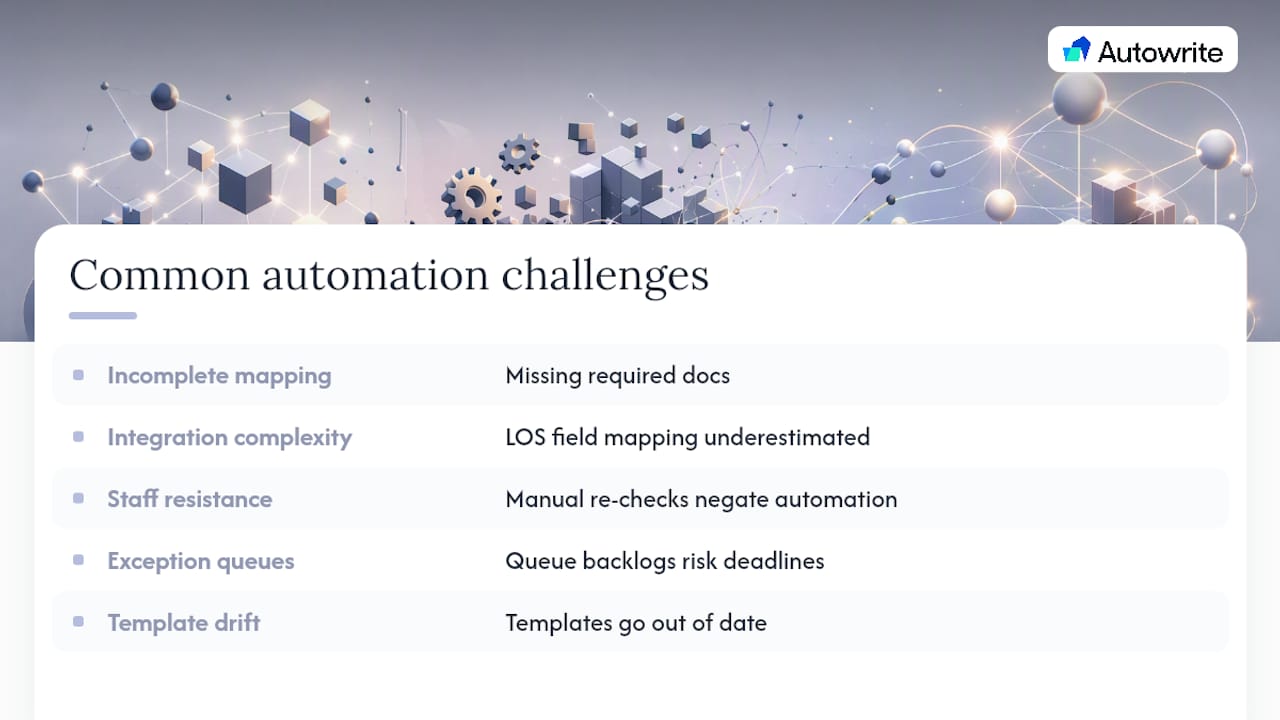
The most common failure isn't technical. It's mapping regulatory requirements to templates incompletely, then discovering the gap only when a regulator asks for a document the automation never knew to collect. That single background insight explains more failed rollouts than any software bug does.
Integration complexity is an important barrier for many brokerages. Many brokerages underestimate how much time LOS field mapping takes, especially when a lender's system uses inconsistent field names across product types. Budget more sandbox testing time than feels necessary, because catching a mapping error before go-live costs a fraction of what fixing it costs after fifty files have gone through wrong.
Staff resistance can occur quietly. People who've handled compliance packages manually for years sometimes distrust an automated confidence score, and that distrust either gets addressed through training or it gets solved by staff quietly re-checking everything by hand, which defeats the point of automating in the first place.
Exception queues can accumulate quickly if not properly managed. A queue that's supposed to get cleared daily but sits for a week isn't a minor lag. It's a compliance timing risk if any of those files carry disclosure deadlines.
Finally, template drift is easy to miss. Lenders update forms, provincial requirements shift, and a template that was compliant at launch can quietly fall out of date unless someone is assigned to review it against current FSRA compliance and fraud checklists on a regular schedule.
Where Most Brokerages Get Automation Wrong
The failure pattern is consistent: brokerages configure the software before they've mapped the regulatory requirements, then spend months retrofitting compliance logic into a system that was never built to hold it. Mapping first, configuring second, isn't a nice-to-have order of operations. It's the difference between automation that catches a missing disclosure and automation that quietly ships one.
My advice for anyone starting this process is narrow on purpose: run a short parallel pilot on your single highest-volume document type before touching anything else. Keep the audit trail exportable and the human approval gate visible, because that combination is what actually survives a regulator's questions.
— Anant Bawa
Evaluating Autowrite for Your Brokerage
If you're weighing automation against sticking with your current manual process, the real question isn't whether software can extract data. It's whether it can produce a package a regulator would accept without a broker rebuilding half of it by hand. Autowrite is built around that specific bar, using document intelligence tuned for Canadian mortgage files rather than generic OCR bolted onto a form builder.
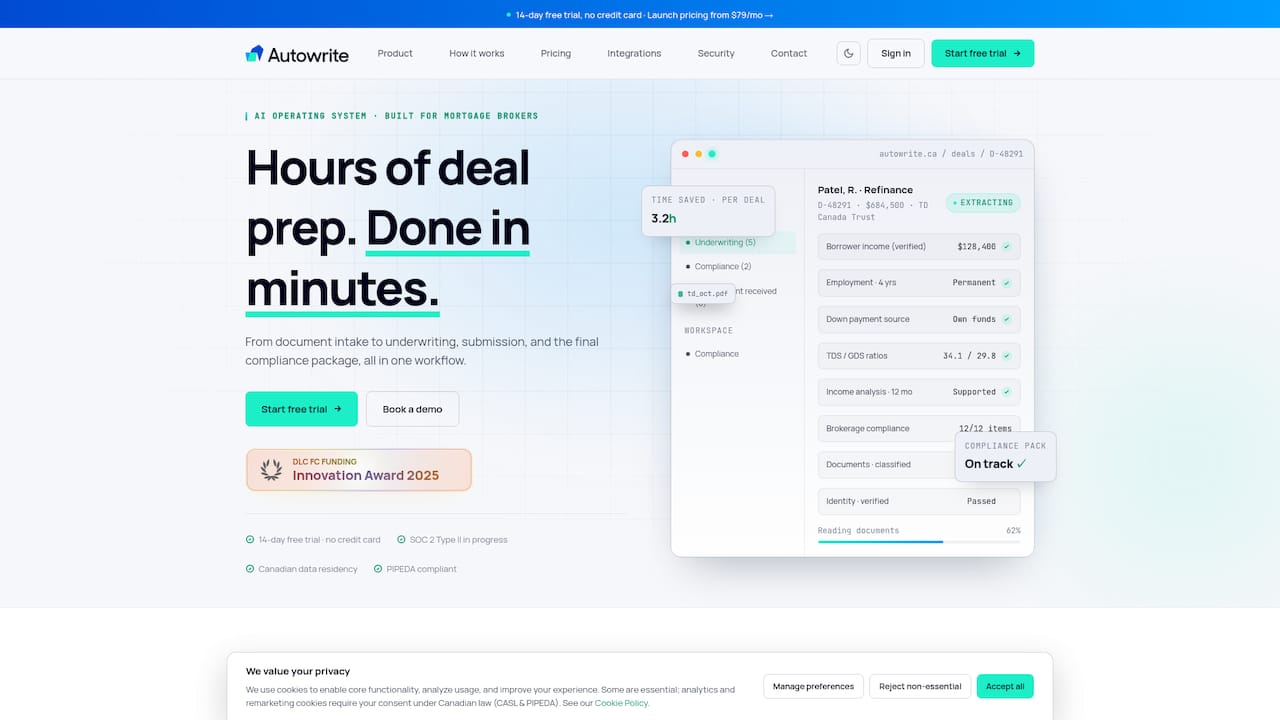
When you request a demo, ask specifically to see an audit-log export for a completed file, the template editor for building your own extraction rules, the LOS integration setup, and how the exception queue actually routes a flagged document. Those four things tell you more than any feature list. A sensible pilot scope runs four to six weeks in parallel with your current process, focused on your highest-volume file type, so you can compare exception rates side by side before switching anything over live.
Brokerages that want to see the workflow in practice can start with AI for mortgage brokers or head straight to the Autowrite landing page to start a trial and scope a pilot with your own file volume.
Sources
For deeper reading, start with FSRA's disclosure requirements and compliance checklists, provincial licensing rules like FCNB's MB-001, and vendor-architecture questions raised by AML Guard's CRM compliance analysis.
- Mortgage brokerage disclosure requirements | Financial Services Regulatory Authority of Ontario
- FINANCIAL AND CONSUMER SERVICES COMMISSION RULE MB-001 Mortgage Brokers Licensing and Ongoing Obligations
- Mortgage Document Automation: How Lenders Cut Loan Processing Time Without Cutting Corners
- AI governance in mortgage banking: moving from policy discussion to regulatory reality