
Canada's open banking framework, formally called consumer-driven banking, became law when the Consumer-Driven Banking Act received royal assent in March 2026. For mortgages, the immediate effect is faster, API-verified income and asset checks and more competitive rates as switching friction drops. The Department of Finance and Bank of Canada oversee rollout, and platforms like Autowrite are already helping brokers get ready for the paperwork shift underneath it.
TL;DR:
- Only the largest banks are mandated to implement open banking data sharing, with smaller lenders gradually adopting the framework over multiple underwriting cycles.
- Consumers can now share transaction data securely through accredited third-party providers, eliminating the need to share passwords or PDFs with third parties.
- API-driven verification reduces document fraud, speeds up mortgage approval processes, and benefits borrowers with irregular or non-traditional incomes.
- Brokers should begin integrating consent-based, API-driven workflows now to stay ahead of the full system rollout and capitalize on faster, more accurate data.
- Security and privacy protections require accredited providers to meet strict standards, with active, revocable consent from consumers, reducing scam risks during the transition.
Table of Contents
- What Open Banking Mortgages in Canada Actually Mean
- How Open Banking Reshapes the Mortgage Process
- Who Benefits Most from Open Banking Mortgages
- The Risks and Protections Built Into the Framework
- When Mortgages Will Actually Feel the Change
- How Mortgage Brokers Can Prepare Now
- Why the Winning Brokers Won't Be the Most Automated Ones
- Autowrite: Built for the Paperwork Open Banking Won't Fully Solve
- Where to Read the Primary Sources
- Sources
- FAQ
What Open Banking Mortgages in Canada Actually Mean
Consumer-driven banking gives Canadians the legal right to share their own financial data securely with accredited third parties, instead of handing over bank logins or PDFs. The Act sets governance, accreditation standards, and common rules for consent, liability, and security, with the Bank of Canada delegated to implement and supervise the system.
Right now, the framework covers read-only access. That means an accredited app or lender can view transaction histories, deposit accounts, and payment data with a customer's consent, but it cannot move money or write to an account. Budget 2025's framework description puts deposit accounts, payment accounts, investment accounts, and lending accounts inside scope, and it requires that sharing this data cost the consumer nothing.

Accreditation is not a rubber stamp. Third parties applying to participate, known as accredited third-party service providers or ATPSPs, must show they meet technical standards, incident management protocols, and personnel integrity controls before they get access. The Bank of Canada will publish a central registry of every accredited entity, so consumers and brokers can check legitimacy before sharing anything.
That registry matters because it replaces a practice that's been the industry's dirty secret for years: screen scraping. An estimated nine million Canadians currently hand over their online banking credentials to third-party apps so those apps can log in and scrape account data. The new rules prohibit this outright. Data moves through secure, standardized APIs instead, which means:
- No more sharing your actual banking password with a budgeting app or lender.
- Tamper-resistant data pulled directly from the institution, not screen-scraped and reformatted.
- A clear, revocable consent trail for every data-sharing relationship.
- Accountability that sits with named, registered entities rather than anonymous scrapers.
How Open Banking Reshapes the Mortgage Process
For anyone who has sat through a mortgage application, the paperwork is the part everyone dreads: bank statements, pay stubs, T4s, notices of assessment, and the endless back and forth when a lender's underwriter needs "just one more document." Open banking attacks that friction directly, and it does it in a specific sequence.
-
Income and asset verification moves from PDFs to APIs. Instead of uploading three months of bank statements as scanned documents, a borrower consents to share transaction data directly from their bank through an accredited provider. That data arrives structured and verified at the source, not typed into a form by a loan officer squinting at a screenshot.
-
Underwriting gets richer, more reliable inputs. Financial Post reporting notes lenders can use timely deposit patterns and even rental payment history to assess creditworthiness, which helps borrowers whose income doesn't fit neatly into a T4 box, like gig workers or small business owners.
-
Document chasing and fraud risk both drop. API-sourced data is tamper-resistant in a way a scanned bank statement never was. That cuts down on the manual verification calls brokers currently have to make, and it closes a door that's historically been open to falsified documents.
-
Forms pre-fill and systems talk to each other. Once data flows through a standardized API, it can populate loan origination systems and CRM platforms automatically rather than requiring a human to retype it. That shaves real time off turnaround, particularly for brokers juggling a full pipeline.
-
Switching gets easier, which changes renewal dynamics. When a borrower can authorize data sharing in a few clicks instead of assembling a new paperwork package from scratch, the cost of moving to a competing lender at renewal drops. Brokers who've relied on inertia to retain clients will feel this first at renewal time, not at origination.
None of this happens instantly. But the mechanics are already defined in regulation, and lenders that integrate early will process files faster than those still asking for scanned statements by email.
Who Benefits Most from Open Banking Mortgages
Three groups gain from this shift, each in a different way.
Borrowers get faster decisions because verification no longer depends on how quickly someone can find last month's bank statement. Borrowers with non-traditional income, freelancers, contractors, people with multiple part-time jobs, stand to benefit the most, since API-sourced transaction data can show income patterns that a standard employment letter misses entirely.
Lenders get better risk data with less friction. Verified, tamper-resistant transaction histories reduce the fraud exposure that comes with self-reported or scanned documents, and richer data supports more nuanced credit decisions than a simple credit score and debt ratio calculation.
Brokers get relief from the administrative load that eats their week. Less time spent chasing documents means more submissions per week and faster comparisons across lender offers for the same client.
At the system level, Financial Post's analysis points to a broader effect: lower switching costs intensify competition among lenders, which tends to push rates and terms in the borrower's favor over time.
- Faster approvals for borrowers with clean, verifiable transaction histories.
- Expanded access for self-employed and gig-economy borrowers whose income patterns are hard to document manually.
- Reduced fraud exposure for lenders relying on API-verified data instead of uploaded scans.
- More submissions per broker per week once intake and verification are automated.
Pro Tip: Don't wait for full rollout to start training your team on consent-based data workflows. The brokers who understand how to explain data sharing to clients today will close deals faster the moment lenders start accepting API-verified statements.
The Risks and Protections Built Into the Framework
Open banking isn't risk-free just because it's regulated. Sharing financial data more broadly, even through secure channels, creates new surfaces for something to go wrong, and the framework's rules exist specifically to manage that.
Privacy and breach exposure top the list. Every accredited entity has to meet baseline security requirements, including multi-factor authentication and formal incident management protocols, before it's allowed to touch consumer data. Liability allocation is also spelled out in the rules rather than left to a fight between the bank, the fintech, and the consumer after something breaks.
Consent mechanics matter just as much as the technology. A borrower has to actively authorize each data-sharing relationship, and that consent has to be revocable, not a one-time checkbox buried in a terms-of-service agreement. Budget 2025 is explicit that sharing in-scope data cannot come with a fee attached, which closes off a potential source of hidden costs.
The prohibition on screen scraping removes the biggest current risk, credential sharing, but it also creates a transition period where millions of Canadians using older tools need to migrate to accredited alternatives. That gap is where scams tend to appear.
- Be wary of any app or "advisor" asking for your actual online banking password rather than directing you through an accredited consent flow.
- Check the Bank of Canada's public registry before sharing data with an unfamiliar provider.
- Confirm that any mortgage-related data request explains exactly what's being accessed and for how long.
- Treat unsolicited requests to link your bank account, especially by text or email, as a red flag regardless of how official they look.
When Mortgages Will Actually Feel the Change
Rollout isn't a single switch flipping on. It's phased, and the phases determine when mortgage lenders and brokers can realistically start relying on open banking data.
-
Mandated large banks move first. The framework requires Canada's biggest banks to participate, since they hold the deposit relationships most consumers and lenders need visibility into.
-
Credit unions and smaller payment service providers can opt in. Participation isn't mandatory for every institution size, so coverage will expand gradually rather than all at once.
-
ATPSPs operate within strict limits. Accredited third parties can request and use data only for the purposes a consumer consented to, and the Bank of Canada's central registry keeps their status visible and checkable.
-
Phase one stays read-only. Budget 2025 confirms that write access, the ability for an app to actually move money or update account details, is a future policy question, not a current feature.
Based on the government's own rollout language and industry coverage from outlets like Canadian Mortgage Professional, expect the first wave of mortgage-specific applications, income and asset verification tools built on accredited APIs, to reach mainstream lender use within the next couple of underwriting cycles, not overnight.
How Mortgage Brokers Can Prepare Now
Waiting for the framework to fully mature is a losing strategy. The brokers who benefit most will be the ones who've already rebuilt their workflow around consent-based, API-sourced data before their competitors catch up.
Start with technical readiness. If your loan origination system or CRM can't accept structured data feeds, you'll still be manually retyping information long after your competitors have automated it. Mortgage document automation tools are worth evaluating now, before demand for API-integrated intake spikes.
Build consent-first workflows into your intake process today, not after a client asks about it. Retention policies should already align with the Act's requirements around data minimization and revocable consent, and your team should know how to explain both to a nervous first-time buyer.
Redesign the handoff between intake and underwriting so it doesn't rely on someone manually re-entering data that arrived digitally in the first place. That's where margin gets lost, and it's the exact problem AI-driven admin automation is built to solve.
Don't let automation replace the relationship work that keeps clients loyal once switching gets easier. Use the time freed by automated verification for proactive renewal outreach, not less client contact.
- Confirm your compliance program meets current anti-money laundering obligations alongside the new consent requirements.
- Verify any vendor's Canadian data residency claims before signing a contract.
- Check that fraud-prevention tools, like those reviewed in guides to account takeover detection tools, are part of your security stack, not an afterthought.
- Evaluate CRM integration options now so your systems are ready to accept API-sourced data the day lenders start offering it.
Pro Tip: Ask any vendor selling you "open banking readiness" to show you their actual accreditation status against the Bank of Canada's registry, not just marketing language. If they can't point to it, they're not ready either.
Why the Winning Brokers Won't Be the Most Automated Ones
Automation should buy you time, not replace judgment. The brokers who thrive won't be the ones who automate the most, they'll be the ones who use freed-up hours for renewal calls and honest advice competitors skip. Over-automate the client relationship itself, and you'll lose the trust that switching-cost erosion makes easier to walk away from.
— Anant Bawa
Autowrite: Built for the Paperwork Open Banking Won't Fully Solve
Open banking speeds up data collection, but someone still has to classify documents, extract the right fields, and assemble a compliance-ready package before a deal closes. That's the gap Autowrite fills for Canadian mortgage brokers today, without waiting for every lender to finish their API integration.
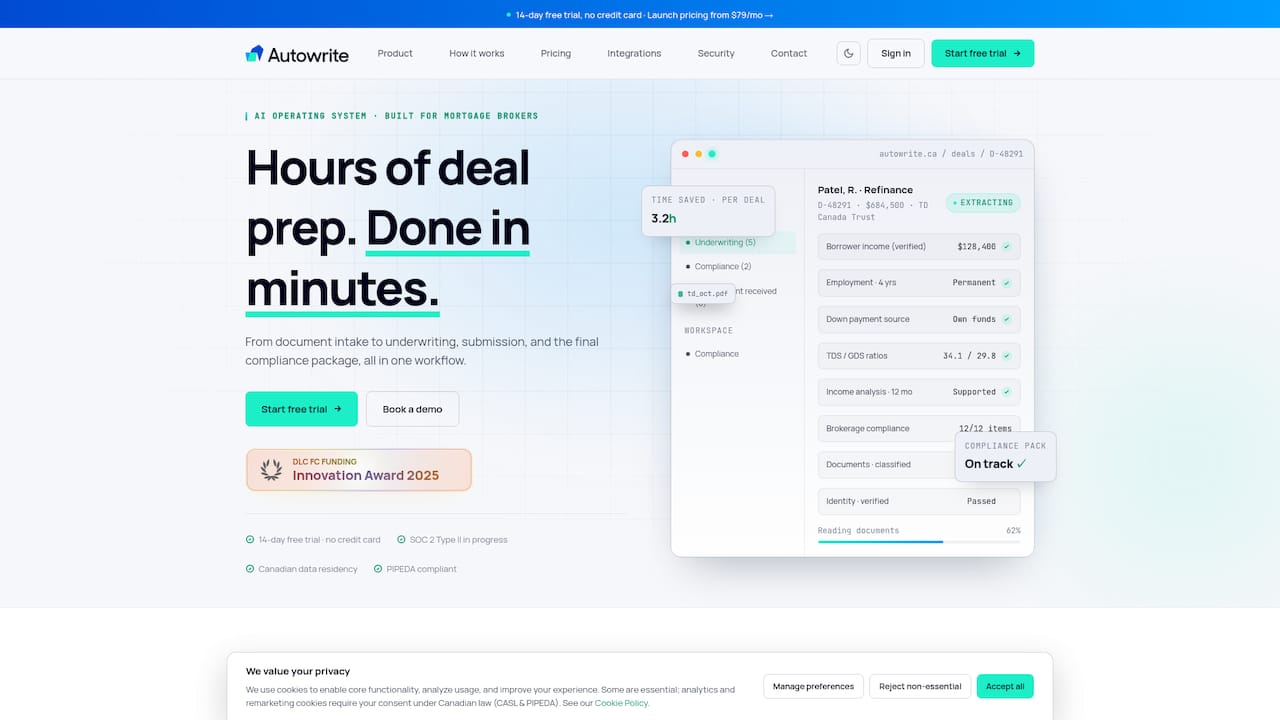
Some software automates document intake, classification, and data extraction, then auto-fills underwriting forms and syncs with mortgage software. As open banking data starts flowing into broker workflows, automation can handle the handoff: pulling verified figures into compliant, e-sign-ready packages with a full consent trail, instead of someone manually reconciling a spreadsheet against a PDF at midnight. The software is designed to consider Canadian data residency, which matters as data-sharing accreditation becomes standard practice.
If you're a licensed mortgage broker or brokerage owner trying to figure out where your workflow breaks down before open banking data starts arriving, start a trial and see what Autowrite can automate on your very next file.
Where to Read the Primary Sources
- Canada Gazette: Consumer-Driven Banking Regulations
- Department of Finance: Budget 2025 framework
- Payments Canada: Open banking for the common good
This article is general information, not a substitute for advice from a qualified financial advisor. Consult a qualified financial professional about your own circumstances before acting on anything here.
Sources
- Canada Gazette, Part 1: Consumer-Driven Banking Regulations
- Budget 2025: Canada's framework for consumer-driven banking (Department of Finance)
- How open banking could get you a better mortgage deal | Financial Post
- The brokers who will win the open-banking era are already doing what big banks can't | Canadian Mortgage Professional
FAQ
Is Open Banking Available in Canada?
Yes. The Consumer-Driven Banking Act received royal assent in March 2026, and the framework is currently in its read-only phase one, with accreditation and oversight run by the Bank of Canada.
Which Lenders Use Open Banking?
Canada's largest banks are mandated to participate, while credit unions and smaller payment service providers can opt in as the framework matures. Full lender-by-lender adoption for mortgage products will roll out over the coming underwriting cycles.
What Are the Downsides of Open Banking?
The main risks are privacy exposure, third-party accreditation gaps, and a transition period where millions of Canadians still using screen scraping need to migrate to accredited alternatives. The framework mitigates this through mandatory security standards, consent rules, and a public registry of accredited providers.
What Is the $10,000 Bank Rule in Canada?
That rule refers to a separate anti-money laundering requirement: financial institutions must report large cash transactions to FINTRAC. It's unrelated to open banking's data-sharing framework, though brokers should track both sets of compliance obligations together.