

Mortgage exception tracking means logging every deal that falls outside a lender's standard policy, recording why, who approved it and on what evidence, and keeping that record retrievable for years. For a Canadian broker, the practical version is one exception record per issue, attached to the file, with a named decision owner, a timestamp and a written rationale. This guide shows how to build that, what an exception letter should contain, and which Canadian record-keeping rules sit behind it.
TL;DR
- An exception is any element of a file that sits outside the lender's or insurer's written criteria and needs a documented approval to proceed.
- Track each one as its own record: issue, evidence, impact, proposed resolution, decision owner, deadline, outcome.
- OSFI expects federally regulated lenders to identify, escalate, limit and report exceptions, so lenders will ask you for a clear rationale.
- Record retention differs by regulator: FINTRAC requires at least five years, and Ontario brokerages must keep transaction records for at least six years after the term or transaction ends.
- A consistent, searchable system turns exceptions from a scramble into a routine step.
Table of Contents
- What counts as a mortgage exception
- Why tracking matters more than it used to
- What an exception record should contain
- Tracking an exception from flag to final decision
- What is a mortgage exception letter?
- Who reviews and approves, and how to record it
- Record-keeping rules that apply to exception files
- Organizing exception records so audits are painless
- Perspective: why exceptions belong inside the workflow
- Where Autowrite fits
- Common mistakes to avoid
- FAQ
- Sources
What counts as a mortgage exception
An exception is a departure from a written underwriting rule that someone with authority has agreed to accept. The rule might be a debt service ratio ceiling, a loan-to-value limit, a minimum credit score, an income documentation requirement or a property type restriction. The file is not necessarily weak. It may have strong compensating factors, such as a large down payment, a long job history or significant liquid assets. But the deal cannot proceed on the standard path without a decision.
Exceptions appear at predictable moments:
- At intake, when documents do not match the application: a stated income that differs from the notice of assessment, or a down payment source that is not yet seasoned.
- At submission, when the file is checked against a specific lender's policy and a threshold is missed.
- At underwriting, when the underwriter asks for clarification, a letter of explanation or a policy override.
- After approval, when conditions are not met on time and the lender must agree to an extension or a substitute document.
For the lender side, the regulatory frame is clear. OSFI's Guideline B-20 says federally regulated financial institutions should set underwriting standards and limits for individual loans, identify and escalate exceptions, set limits on them, and maintain approval and exception-reporting processes. Brokers are not federally regulated lenders, but the lenders you submit to are working under that expectation, which is why they ask for tidy, reasoned exception requests.
Why tracking matters more than it used to
The pressure runs in two directions. Lenders are expected to watch exceptions closely. OSFI's 2024 paper, Reinforcing residential mortgage risk management practices, expects robust monitoring systems for early detection of underwriting policy exceptions, looking across dimensions such as the borrower, the property, the product and the origination channel. That last dimension is you. A broker who sends clean, well-documented exceptions is easier to work with than one who sends vague requests.
At the same time, provincial regulators expect brokerages to be able to show their work. FSRA in Ontario stresses that record keeping is a core part of showing a mortgage is suitable, and that without solid documentation you cannot recreate how a recommendation was reached, as set out in its guidance Show your work: documenting that a mortgage is suitable for your client. An exception is exactly the kind of decision someone may ask you to explain later.
There is also a plain business reason. Every unresolved exception is a deal sitting in limbo. Brokers who track them can see at a glance which files are waiting on the lender, which are waiting on the client, and which have gone quiet.
What an exception record should contain
Start from what a complete mortgage file looks like. Under B-20, approval documentation generally covers the loan's purpose, income verification, debt service ratio calculations, LTV ratios and property appraisals, credit bureau reports, down payment verification, and explanations of mitigating criteria or soft information for higher-risk loans. B-20 also says complete approval documentation should include a clearly stated rationale for the decision, including exceptions. You can find that in the guideline text.
Building on that, a practical exception record has seven fields:
| Field | What to write | Example |
|---|---|---|
| Issue summary | One sentence naming the policy point missed | Total debt service ratio is above the lender's stated maximum |
| Policy reference | The lender guideline or insurer criterion in question | Lender's income and debt service policy |
| Evidence | Document names and page or line references | Notice of assessment, two recent pay stubs, employment letter |
| Mitigating factors | Compensating strengths, stated plainly | Larger down payment, stable tenure, low credit utilization |
| Impact if unresolved | What happens to the deal | Cannot proceed to commitment; closing date at risk |
| Proposed resolution | What you are asking for | Approval with a documented override, or a revised structure |
| Decision owner and deadline | A named person and a date | Lender underwriter; needed three business days before conditions are due |
Add two fields as the file moves: decision (approved, declined, approved with conditions) and decision timestamp, with the name of who decided. If the exception is approved subject to a condition, link the condition to the document that satisfies it.
Keep the language factual. Soft information, such as a client's circumstances, belongs in the record, but label it as such and keep it separate from verified figures.
Tracking an exception from flag to final decision
A reliable workflow is short. Each step leaves a trace.
- Flag it at intake. When a document or figure falls outside the target lender's criteria, create the exception record immediately, not after the underwriter calls. Categorize it: income, credit, down payment, property, or documentation gap.
- Attach the evidence. Link the specific documents. A reference such as "employment letter, page 1, salary line" saves the underwriter a round of questions.
- Assign a decision owner. For a lender exception that is the underwriter or a named approver. For an internal one, it may be the brokerage's compliance lead or principal broker.
- Set a deadline tied to the file. Work backwards from the financing condition date, not from when you hope to hear back.
- Send one complete packet. The goal is a single submission with the issue, evidence, impact, proposed action and deadline, rather than a trickle of emails.
- Log the decision and the reasoning. Record who approved, when, on what basis and with what conditions.
- Close the loop in the file. Confirm the final submission package reflects the approved terms, and that every condition has its supporting document.
Brokers who staff their offices with assistants often write this out as a checklist and give each step an owner. The point is that nobody has to remember where an exception stands. It is in the record.
Use categories to spot patterns
Once you have a few months of records, tag each exception by type and by lender. You will see patterns: one lender that repeatedly queries self-employed income documentation, or a recurring gap in down payment verification from a particular client segment. OSFI expects lenders to run exception reporting that identifies patterns, trends or systemic issues in the residential mortgage portfolio. A brokerage can apply the same idea on a small scale to fix its own intake process, so that fewer files arrive with the same avoidable problem.
What is a mortgage exception letter?
A mortgage exception letter is a written request, usually from the broker or agent to the lender's underwriter or to a mortgage insurer, asking for an approval outside standard policy and explaining why it is reasonable. It is the narrative companion to your exception record. Some underwriters also ask for a separate letter of explanation from the borrower to cover a specific item, such as a gap in employment or a large deposit. Do not confuse the two: the broker's letter argues the case for the deal, and the borrower's letter explains a fact.
A strong exception letter is short, usually a page, and contains:
- The request in the first sentence. State what you are asking for and on which file.
- The policy point involved. Name the limit or criterion that is exceeded and by how much.
- The compensating factors, with evidence. Reference documents rather than describing them in general terms.
- The risk considered. Show you looked at the downside: payment shock, income stability, property marketability.
- The proposed structure. If you are offering a mitigating change, such as a larger down payment or a co-borrower, say so.
- The decision needed and the date. Tie it to the conditions timeline.
Where a mortgage insurer is involved, the rules matter. OSFI's Residential Mortgage Insurance Underwriting Practices and Procedures Guideline requires insurers to establish conditions for exceptions to insurable mortgage criteria. It also requires that the rationale and approval be documented and maintained, and that lenders receive a record or policy certificate for approved exceptions. In practice, file that certificate or record with the exception record, so the approval and its reasoning are never separated.
The letter should never be a template pasted with new names. Underwriters read many of them, and generic wording signals that nobody looked at the file. A standard structure with file-specific content is the right balance.
Who reviews and approves, and how to record it
There are usually three layers of approval in a brokered deal:
- The lender's underwriter or credit team, who can approve within their authority or escalate to a senior approver.
- The mortgage insurer, where the loan is insured and the exception touches insurable criteria.
- Your own brokerage, where internal policy requires a principal broker or compliance lead to review certain files before submission.
For each, record the person or role, the date and time, the decision and the stated reason. If the approval arrives by email, save the email into the file in a format you can retrieve later, and copy the key terms into the exception record. Do not rely on an inbox as your system of record. Approvals buried in a personal mailbox are the first thing to go missing when someone leaves the brokerage.
Record-keeping rules that apply to exception files
Exception files are part of the mortgage file, so the same retention rules apply. Two federal and provincial regimes matter most, and they do not match.
Federal (FINTRAC). Under the Proceeds of Crime (Money Laundering) and Terrorist Financing Act, mortgage administrators, brokers and lenders must keep specified information records and mortgage loan records for at least five years, as FINTRAC explains in its record keeping requirements for mortgage administrators, brokers and lenders. FINTRAC also expects a record of the purpose and intended nature of the business relationship once it is established, ideally described well enough to help you notice unusual activity later. See its business relationship requirements.
Ontario (FSRA). Ontario brokerages must keep complete and accurate records of mortgage activities, including applications, instruments, renewal agreements and all documents and communications obtained from or given to clients, under the Mortgage Brokerages, Lenders and Administrators Act, 2006. FSRA's records management guidance says transaction records must be kept at least six years after the mortgage term expires or the transaction is completed or expires. It also says electronic records must be stored so they can be promptly retrieved in a legible format, and need not be at the brokerage's principal place of business if they are readily accessible.
FSRA's advice on organization applies directly to exceptions. Its guidance on keeping good records says records should form a document-based narrative of what was done and why, so that another agent or broker could explain the recommendation without extra help. Test your exception records against that standard: could a colleague, six years from now, read the file and understand why the exception was sought and approved?
The regulator does act on gaps. FSRA's announcement on revoking the licence of Mortgage Smart Inc. cites failures that include documenting suitability, keeping adequate records and maintaining record retention policies.
For the practical side of the two retention periods, our walkthrough on FINTRAC five-year versus FSRA six-year retention shows how to set a single rule that covers both. If you work in Ontario, the three proofs FSRA expects on file pair naturally with exception records. In British Columbia, see our notes on BCFSA compliance under the MSA. Check your own provincial regulator for the retention period that applies to you, since the Ontario figure is not universal.

Organizing exception records so audits are painless
A few habits make the difference between a file that survives scrutiny and one that does not.
- One naming convention. Use the same pattern for every document, such as client surname, file number, document type and date.
- One home for each file. Keep the exception record, the letter, the approval and the supporting documents together, not in four systems.
- Standard templates. An escalation packet with the same sections every time makes review faster for the underwriter and for you.
- Retention flags. Record the date each file becomes eligible for destruction under the longer applicable period, and check it before deleting anything.
- Access control. Limit who can edit approved records, and keep a history of changes.
- Data residency and privacy. Exception files contain income, credit and identity information. Know where your tools store it and whether that fits your obligations.
If you are moving off paper, our guide to piloting 15 to 20 files for a paperless brokerage is a low-risk way to test a new process. For the wider picture, see audit-ready digital compliance records and the seven core documents for an underwriting submission. Exceptions are much easier to manage when the base package is already clean.
Perspective: why exceptions belong inside the workflow
We built Autowrite around a simple observation: most exceptions start as a document problem, not a credit problem. A figure does not match, a page is missing, a letter is out of date. When intake, classification and data extraction are done carefully, you catch these items on day one instead of the night before conditions are due.
That is why we do not treat exception tracking as a separate spreadsheet. Our document intelligence reads each file and shows line-level confidence for what it extracted, so a broker can see which numbers are solid and which deserve a second look. From there, the underwriting forms are auto-filled, the compliance package is assembled, and the same record that supports the submission supports the exception.
Our view is that a brokerage should be able to answer three questions about any file in seconds: what was flagged, who decided, and what proof backs it up. Brokers who can do that spend their time with clients, not hunting through folders. We designed Autowrite for Canadian brokers, with Canadian data residency, so that this discipline does not cost extra hours.
Anant Bawa
Where Autowrite fits
Autowrite is an AI-powered operating system for Canadian mortgage brokers. It automates document intake, classification and data extraction, auto-fills underwriting forms, syncs with mortgage software, and assembles e-sign and compliance packages. It also provides income and down payment analysis and supports team pipeline management, with Canadian data residency. Those are the pieces that surface exceptions early and keep the supporting evidence attached to the file.
Plans are published on the pricing page: Starter is $99 per month, Pro is $199 per month and Legend is $399 per month. Enterprise has no published price. Additional deals are $20 each, and pay as you go is $35 per deal. Paid plans come with a 14-day free trial, so you can run a few live files and see how exceptions are handled before committing.
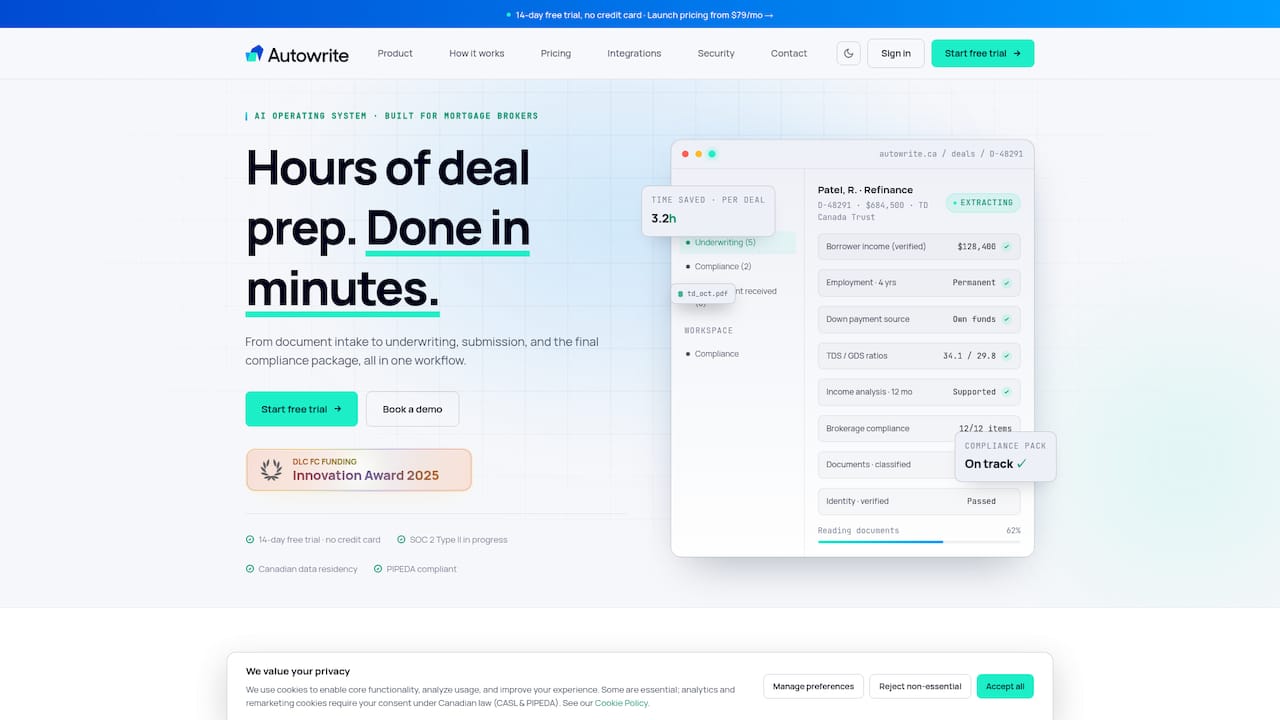
If you are a licensed broker, agent or brokerage owner, start your 14-day trial at Autowrite and run your next difficult file through it.
Common mistakes to avoid
- Raising the exception late. The later the underwriter sees it, the less room there is to restructure.
- Arguing in general terms. "Strong client" is not evidence. Cite the document.
- Mixing verified facts and impressions. Keep soft information labelled.
- Losing the approval. If the decision lives only in an email thread, it is not in your file.
- Forgetting the final package. After an exception is approved, make sure the submission and the conditions list reflect the approved terms.
- Using documents or terms from outside Canada. Use Canadian forms, such as the notice of assessment, and the terminology your lender and regulator use.
For related compliance routines, our pieces on anti-money laundering for mortgage brokers and the FINTRAC compliance package checklist cover the adjacent paperwork, and our resource hub collects the rest.
FAQ
What is the difference between an exception and a condition?
A condition is something the lender requires before funding, such as a final pay stub or proof of insurance. An exception is a departure from the lender's written policy that needs approval. A file can have both, and an approved exception often generates new conditions, so track them together.
How long should I keep exception records?
Treat them as part of the mortgage file. FINTRAC requires at least five years for specified mortgage records, and Ontario brokerages must keep transaction records at least six years after the term or transaction ends. Apply the longer period that covers you, and check your own provincial regulator's rule if you are outside Ontario.
Does an exception letter guarantee approval?
No. It is a request with a reasoned case behind it, and the lender or insurer decides. A clear structure, referenced evidence and realistic compensating factors improve your chances of a quick and informed answer, but nothing in the letter binds the underwriter.
Do I need software to track exceptions?
Not strictly, but a spreadsheet struggles once you have many live files. Whatever you use should link each exception to its evidence, name a decision owner, timestamp the outcome and let you retrieve the record quickly, since regulators expect electronic records to be promptly retrievable.
Sources
- OSFI Guideline B-20: Residential mortgage underwriting practices and procedures
- OSFI: Reinforcing residential mortgage risk management practices
- OSFI: Residential Mortgage Insurance Underwriting Practices and Procedures Guideline
- FINTRAC: Record keeping requirements for mortgage administrators, brokers and lenders
- FINTRAC: Business relationship requirements
- FSRA: Show your work, documenting that a mortgage is suitable for your client
- FSRA: Mortgage brokerage and administrator records management and front fees
- FSRA: Keep good records to protect your reputation
- FSRA: Revocation of the licence of Mortgage Smart Inc.