

Who closes your client's purchase depends on the province. In Quebec, a notary is the required professional for a mortgage, because the law makes notarial form mandatory for that act. In British Columbia, the buyer hires either a lawyer or a notary. In Ontario and Alberta, the closing is handled by a lawyer. In every province the job is the same: check title, move the money, register the deal. For the broker, the real work is getting a clean, complete file to whichever professional is acting. That is the part Autowrite is built to take off your desk.
TL;DR
- Quebec: a notary is mandatory for a mortgage, since notarial form is required for real estate mortgages.
- British Columbia: hiring a lawyer or a notary is normal practice to prepare the documents that transfer ownership.
- Ontario and Alberta: the closing professional is a lawyer, working under the lender's instructions.
- Both professionals do the same core tasks: title search, contract review, receiving funds, paying the seller and registering the property.
- Your part as broker is the same everywhere: a complete, consistent file delivered early. Autowrite organizes it and assembles the package.
Table of Contents
- What a closing lawyer or notary actually does
- Province by province
- Can the same professional act for buyer and lender?
- What the choice means for the client
- Why files stall before closing
- A hand-off routine that works in every province
- Perspective: the closing starts on the broker's desk
- Autowrite for the paperwork around the closing
- FAQ
- Sources
What a closing lawyer or notary actually does
A closing is the day ownership passes from seller to buyer and the lender's money is advanced. The legal professional is the person who makes that safe.
CMHC's Homebuying Step by Step guide says the buyer's lawyer, or notary in Quebec, checks for liens, charges, and work or cleanup orders, and reviews contracts, especially the offer to purchase. On closing, the lender sends the mortgage funds to the lawyer or notary. The buyer supplies the rest of the down payment and the closing costs. The legal professional then pays the seller and registers the home in the buyer's name.

The lender also gives instructions. RBC's general instructions to lawyers and notaries for provinces other than Quebec and New Brunswick direct the retained professional to verify the borrower's identity, search title, prepare and register the mortgage, and provide a title opinion or obtain title insurance as applicable. Other lenders issue their own instruction packages, so the checklist your closing professional follows is partly set by the lender on your file.
That matters to you because every one of those tasks runs on documents you collected: identification, the accepted offer, proof of down payment, insurance details and the commitment. A gap on your side becomes a delay on theirs.
Province by province
| Province | Who closes | What the sources say |
|---|---|---|
| Quebec | Notary | Notaries are public officers whose acts are authentic, and notarial form is mandatory for real estate mortgages |
| British Columbia | Lawyer or notary | Hiring either is normal practice to prepare the ownership transfer documents |
| Alberta | Lawyer | Mortgage work follows the Western Law Societies Conveyancing Protocol |
| Ontario | Lawyer | Buyer guidance from the Ontario Bar Association is written around the buyer's lawyer |
Quebec: the notary is a public officer
A Quebec notary is not a lawyer under another name. The Chambre des notaires du Québec describes notaries as public officers whose acts are authentic, meaning they carry a special legal weight. When executing those acts, the notary must act in the interests of the persons involved, make sure the parties understand the clauses and obtain informed consent.
For a Quebec broker, this changes the rhythm of a file. The notary is the one who receives the signatures on the mortgage, so the borrower's documents and the lender's conditions have to reach the notary in a state that allows a single clean signing.
British Columbia: lawyer or notary, same job
BCFSA, the provincial regulator, says it is normal practice for a buyer to hire a lawyer or notary to prepare the documents transferring legal ownership. It adds that the closing professional searches the Land Title and Survey Authority system for third-party rights, easements and restrictive covenants, and obtains prescribed strata documents where relevant.
BC has a convention to know. Lenders' instructions in British Columbia, Alberta, Manitoba and Saskatchewan reference the Western Law Societies Conveyancing Protocol, and RBC's instructions also refer to BC notary-society guidelines for certain opinions and survey certificates. In practice, whether your client picks a lawyer or a notary in BC, the lender's requirements travel with the file.
Alberta and Ontario: the lawyer's closing
In Alberta, the Western protocol shapes how lender and lawyer interact. Registration happens through Alberta Land Titles, and the province's Land Titles Online page states that registration fees for certain documents increased effective October 1, 2026, for documents received on or after that date. Closing cost estimates you gave clients earlier in the year may need a refresh.
In Ontario, the Ontario Bar Association's brochure Working with a Lawyer When You Buy a Home describes the buyer's lawyer as the person who guides the purchase through to closing. Its advice to buyers is practical and worth passing on: tell the lawyer about unusual property characteristics and the intended use, arrange insurance with the lender's interest noted, and sign lender commitment documents promptly after the offer is accepted.
Can the same professional act for buyer and lender?
Often, yes, for lawyers. The Law Society of Ontario's Rules of Professional Conduct allow a lawyer to act for both lender and borrower in a mortgage transaction in listed situations, for example where the lender is a lending client or a type of institutional lender the rule names, and only if the rule's other conditions are met. That is why many closings have one lawyer working for both sides of the mortgage.
When the situation falls outside those conditions, the lender needs its own lawyer. This is more likely with private or non-institutional lenders, and it affects timing and cost. Tell your client early who is acting for whom, and ask the lender's instructions which approach they require. The rules differ by province, so confirm with the law society or the notary chamber that governs your client's closing professional.

What the choice means for the client
Your client's question is usually "which one do I pick?" Here is a sound way to answer it.
- In Quebec, the question does not arise. The notary is required for the mortgage.
- In BC, either works. The decision usually comes down to who the lender accepts, who can meet the timeline, and the fee quote. Ask the lender's conditions first.
- In Ontario and Alberta, find a real estate lawyer early. Early means before the conditions come off, so the lawyer can review the offer to purchase while there is still room to change it.
- Check for fit with the lender. Some lenders keep approved lists or issue specific instruction packages. Fit with the lender saves rework.
A first-time buyer may ask whether a notary is cheaper or a lawyer is safer. The best answer is that fees are quoted by each professional and vary, and that both are doing regulated work for the same purpose. Do not promise a number you cannot source.
Why files stall before closing
Most closing delays are paperwork delays, not legal ones. The timing pressure is real. The Law Society of BC's residential conveyance checklist, current to September 4, 2025, notes that mortgage funds may need to be requested a specified number of days before closing, depending on lender requirements. It also says a strata Form F certificate of payment, when required, must be dated within 60 days of closing. Miss either window and the closing date is at risk.
The Ontario Bar Association adds that buyers should be available before and on closing day to sign documents and give instructions, and should line up utilities and moving arrangements around when the keys become available.
The common failure points on the broker side are predictable:
- Identification on the file that does not match the name on the offer or the commitment
- Down payment sources that the lender needs explained, such as gifts, which require a proper gift letter
- Missing or outdated conditions, because the version of a document the closing professional holds is not the version you hold
- Signed documents that are hard to prove later, which is why defensible e-signing matters
- Identity and beneficial ownership details that were captured once and never reconciled, covered in our KYC guide for brokers and the beneficial ownership guide
A hand-off routine that works in every province
Whether the file is going to a notary in Montreal or a lawyer in Calgary, the same routine reduces back-and-forth.
- Confirm the professional and the lender's instructions the day the commitment is issued. Do not wait for the firm to ask.
- Send one complete package. Commitment, accepted offer, identification, proof of down payment and insurance details, in one place and in a consistent order. Our file preparation checklist and document checklist lay out what to include.
- Flag the time-sensitive items. Funds request deadlines, strata certificates, insurance proof.
- Keep one version of each document. When something is updated, replace it everywhere.
- Tell the client what happens next. They need to be reachable to sign, and to understand that the closing professional, not you, receives and releases the funds.
- Plan for the discharge side on refinances and switches. The Financial Consumer Agency of Canada notes that discharge procedures vary by province or territory. In most cases an owner works with a lawyer, notary or commissioner of oaths, though some jurisdictions let owners do it personally. The provincial or territorial land-title registry receives the discharge documents and updates title once it is completed.
Step 2 is where most of the hours go. Collecting, renaming, sorting and cross-checking documents by hand is the slow part of the routine, and it is where Autowrite works: it handles document intake, classification and data extraction, and assembles e-sign and compliance packages. With the package assembled, step 3 and step 4 are easier because the file is already in one organized place. If you are building your underwriting side as well, our underwriting checklist shows what the lender will look at before it issues instructions.
Perspective: the closing starts on the broker's desk
We built Autowrite for Canadian brokers because the legal step at the end of a deal is rarely where the time is lost. It is lost earlier, in the intake, sorting and re-keying of documents that the notary or lawyer will eventually rely on.
Our platform is designed to classify documents as they arrive, extract the data with line-level confidence, auto-fill underwriting forms and sync with your mortgage software. When the file reaches a closing professional in Quebec, BC, Alberta or Ontario, it should already be consistent and complete.
We also think compliance should not be a separate project. Autowrite assembles e-sign and compliance packages and keeps data in Canada, so the work you do for the lender is the same work you can show if anyone asks later.
The notary or lawyer owns the legal closing. You own the file. We want that file to be the best part of the transaction.
Anant Bawa
Autowrite for the paperwork around the closing
Autowrite is an AI-powered operating system for Canadian mortgage brokers. It automates document intake, classification and data extraction, auto-fills underwriting forms, syncs with mortgage software, assembles e-sign and compliance packages, and provides income and down payment analysis. It also supports team pipeline management, which helps brokerages where several agents hand files to the same closing firms.
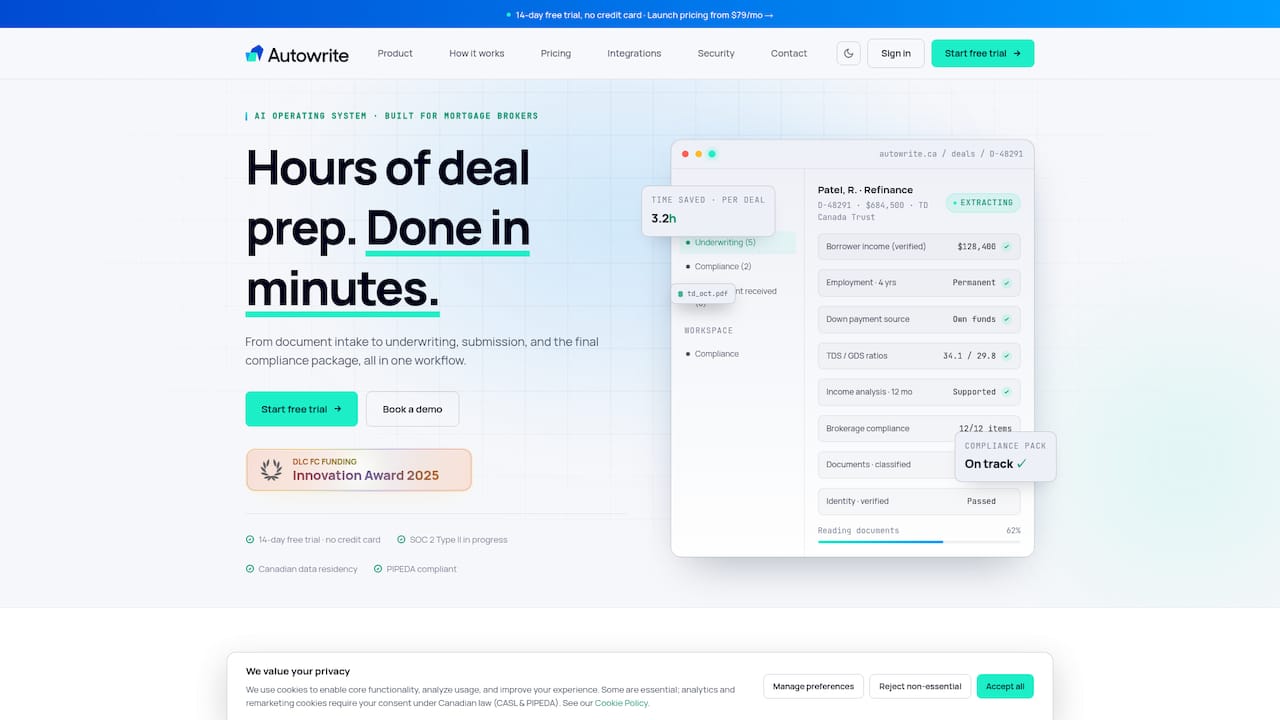
Plans are published on the Autowrite pricing page: Starter at $99 per month, Pro at $199 per month and Legend at $399 per month. Enterprise has no published price. An additional deal costs $20 one-off, and pay as you go is $35 one-off. Paid plans come with a 14-day free trial. You can see how it fits your brokerage at autowrite.ca. If you are comparing tools first, our guides to document automation software and mortgage software costs cover the field, and our resource hub collects the rest.
FAQ
Do I need a lawyer or a notary to close a mortgage in Canada?
You need a legal professional, and which one depends on the province. In Quebec, it must be a notary for a mortgage. In British Columbia, either a lawyer or a notary is normal practice. In Ontario and Alberta, the closing is handled by a lawyer.
Can a lawyer act as a notary in Quebec?
Not for the notarial acts that Quebec requires. Notaries there are public officers whose acts are authentic, and notarial form is mandatory for real estate mortgages. For a Quebec file, plan on a notary.
Can one professional act for both the buyer and the lender?
Sometimes. The Law Society of Ontario's rules allow a lawyer to act for both in listed situations, with conditions. Where those conditions are not met, the lender needs separate representation, so confirm early with the lender's instructions.
What does the closing professional do with the mortgage money?
The lender sends the mortgage funds to the lawyer or notary. The buyer adds the remaining down payment and closing costs. The professional pays the seller and registers the property in the buyer's name.
What should a broker send to the closing professional?
Send the commitment, the accepted offer, identification, down payment proof and insurance details in one consistent package, and flag any funding deadlines. Start from our file preparation checklist to make sure nothing is missing.
Sources
- CMHC, Homebuying Step by Step
- Chambre des notaires du Québec, The notary's role
- BCFSA, Completing Your Purchase
- RBC, General instructions to lawyer/notary
- Alberta Land Titles Online
- Ontario Bar Association, Working with a Lawyer When You Buy a Home
- Law Society of Ontario, Rules of Professional Conduct
- Law Society of British Columbia, Residential conveyance checklist
- Financial Consumer Agency of Canada, Discharging a mortgage